


As an Amazon Associate, We earn from qualifying purchases.
Choosing the right kitchen light bulb isn’t just about watts anymore; it’s about lumens for brightness and color temperature for ambiance. Modern LED technology offers energy efficiency and longevity, making it crucial to select bulbs that provide adequate illumination for various kitchen zones while complementing your space. Focus on achieving sufficient light for tasks, a comfortable overall glow, and the flexibility of dimmers.
Stepping into the kitchen, you might often find yourself squinting at a recipe, struggling to see the subtle browning on your cookies, or simply wishing for a brighter, more inviting space. If this sounds familiar, you’re not alone! Kitchen lighting is one of the most critical, yet often overlooked, aspects of home design. It’s where culinary magic happens, families gather, and countless daily tasks unfold. The right lighting can transform your kitchen from merely functional to truly extraordinary.
But here’s the million-dollar question that often stumps homeowners: “What watt light bulb for kitchen?” It’s a query that seems straightforward but actually hides a world of considerations beyond just a simple number. Gone are the days when a 60-watt bulb universally meant “bright enough.” With the advent of energy-efficient lighting like LEDs, the conversation has shifted dramatically. Now, we’re talking about lumens, color temperature, and how different types of light impact everything from food preparation to the overall mood of your space.
This comprehensive guide is designed to demystify kitchen lighting. We’ll walk you through the essential factors to consider, helping you understand how to choose the perfect light bulbs that illuminate your kitchen beautifully, enhance its functionality, and even save you money on your energy bills. So, let’s shed some light on the subject and discover exactly what watt light bulb for kitchen will best serve your culinary haven!
Key Takeaways
- Lumens Rule Over Watts: Forget old wattage numbers for brightness. Modern bulbs, especially LEDs, deliver brightness based on lumens. Aim for 2,000-4,000 lumens for ambient kitchen lighting and higher for task areas.
- Kitchens Need Layered Lighting: Implement ambient (general), task (under-cabinet, pendants), and accent (decorative) lighting to create a functional and inviting kitchen space. Each layer requires different lumen outputs.
- LEDs are Your Best Bet: Energy-efficient, long-lasting, and versatile, LED bulbs are ideal for the kitchen. They come in various shapes, sizes, and color temperatures, offering significant savings and reduced maintenance.
- Color Temperature Matters: Measured in Kelvin (K), color temperature influences mood. Neutral white (3000K-4000K) or cool white (4000K-5000K) is generally recommended for kitchens to ensure clarity and accurate food preparation.
- Dimmer Switches Are a Game-Changer: Install dimmer switches to adjust light levels for different activities and times of day, providing flexibility and enhancing the atmosphere in your kitchen.
- Consider Kitchen Size and Style: Larger kitchens or those with dark finishes require more lumens. Your kitchen’s aesthetic also influences fixture choice and bulb appearance.
- Don’t Be Afraid to Mix and Match: Combine different types of fixtures and bulbs to create a dynamic and highly functional lighting scheme that perfectly suits your kitchen’s unique needs.
Quick Answers to Common Questions
How many lumens do I need for a kitchen?
For general ambient lighting in a kitchen, aim for approximately 30-40 lumens per square foot. So, a 100 sq ft kitchen would need 3,000-4,000 total ambient lumens.
What is a good color temperature for kitchen lights?
Most experts recommend a neutral to cool white color temperature, typically between 3500K and 4500K, for kitchens. This provides bright, clear light ideal for tasks without being overly harsh.
Are LED lights good for kitchens?
Yes, LED lights are excellent for kitchens due to their energy efficiency, long lifespan, instant-on brightness, versatility in design, and availability in various color temperatures.
Should kitchen lights be dimmable?
Yes, dimmable kitchen lights are highly recommended. They offer flexibility to adjust brightness for different activities, from intense task work to creating a relaxed ambiance.
How often should I change my kitchen light bulbs?
With modern LED bulbs, you won’t need to change them frequently. LEDs can last 25,000 to 50,000 hours, meaning they could last 10-25 years or more with typical household use.
📑 Table of Contents
- Understanding Lumens vs. Watts: The Modern Approach to Brightness
- Lighting Zones in Your Kitchen: A Multi-Layered Approach
- Choosing the Right Color Temperature for Your Kitchen
- The Power of LEDs: Why They’re Best for Kitchens
- Practical Wattage (Lumen) Equivalents for Different Kitchen Tasks
- Beyond Bulbs: Dimmers, Fixtures, and Smart Lighting
- Conclusion: Illuminating Your Kitchen with Confidence
Understanding Lumens vs. Watts: The Modern Approach to Brightness
For decades, we’ve instinctively associated brightness with watts. A 100-watt bulb was brighter than a 60-watt bulb, simple as that. However, with modern lighting technology, especially LEDs, this equation no longer holds true. Watts now primarily tell you about energy consumption, not brightness. To choose what watt light bulb for kitchen, you need to think in lumens.
The Shift from Watts to Lumens
Watts measure the amount of electricity a bulb consumes. An old incandescent 60-watt bulb consumed 60 watts of power. An equivalent LED bulb might only consume 9-12 watts, yet produce the same or even more light. This is why focusing solely on watts when asking what watt light bulb for kitchen can lead you astray.
Lumens, on the other hand, measure the total amount of visible light produced by a bulb – its true brightness. The higher the lumen number, the brighter the light output. This is the crucial metric you should be looking for when selecting your kitchen light bulbs.
As a general guideline for kitchen ambient (general) lighting, you’ll want to aim for approximately 30-40 lumens per square foot. For a typical 10×10 foot (100 sq ft) kitchen, this means a total of 3,000-4,000 lumens for overall illumination. Task areas like countertops might need even more concentrated brightness.
Converting Old Watts to New Lumens (LED Equivalents)
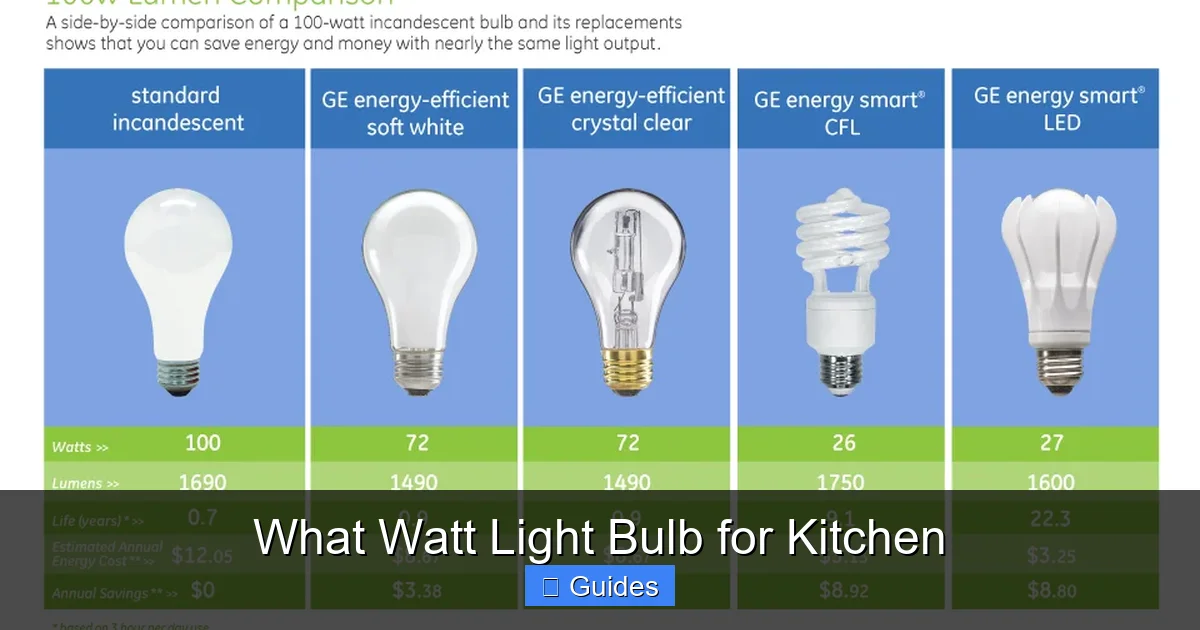
To give you a rough idea of what lumen output corresponds to traditional wattages, here’s a handy conversion table:
- 25-watt incandescent equivalent: ~200-300 lumens (LED: 3-5 watts)
- 40-watt incandescent equivalent: ~450 lumens (LED: 6-8 watts)
- 60-watt incandescent equivalent: ~800 lumens (LED: 9-12 watts)
- 75-watt incandescent equivalent: ~1100 lumens (LED: 13-15 watts)
- 100-watt incandescent equivalent: ~1600 lumens (LED: 16-20 watts)
So, when you’re asking what watt light bulb for kitchen, remember you’re usually asking for the *equivalent* brightness, which is best measured in lumens.
Lighting Zones in Your Kitchen: A Multi-Layered Approach
A truly functional and inviting kitchen isn’t lit by a single overhead fixture. Instead, it uses a thoughtful combination of different light sources, creating “layers” of illumination. This layered approach ensures that every activity, from chopping vegetables to enjoying a late-night snack, is perfectly lit.
Ambient Lighting: The Foundation
Ambient lighting provides the general illumination for your entire kitchen. It’s the overall glow that allows you to safely move around the space. For what watt light bulb for kitchen in this category, think about recessed lights, ceiling-mounted fixtures, or track lighting. As discussed, aim for 30-40 lumens per square foot. For example, if your kitchen is 150 square feet, you’d want between 4,500 and 6,000 total ambient lumens. This could be achieved with six 800-lumen (60W equivalent) LED recessed lights, or fewer higher-lumen fixtures.
Visual guide about What Watt Light Bulb for Kitchen
Image source: i.pinimg.com
Task Lighting: For Precision and Safety
Task lighting is crucial for specific work areas where you need focused, bright light to perform tasks safely and accurately. This includes countertops, sinks, and stove areas. Without proper task lighting, you risk eye strain and even accidents while using sharp knives or cooking on the stovetop. For these areas, what watt light bulb for kitchen would translate to higher lumen output, often more concentrated. Examples include:
- Under-cabinet lighting: LED strip lights or puck lights mounted beneath upper cabinets provide excellent illumination directly onto countertops.
- Pendant lights: Suspended over islands or peninsulas, these provide focused light for prep work or casual dining.
- Directional track lighting: Adjustable heads can be aimed precisely at work surfaces.
For task lighting, you generally want brighter, more focused light. A single under-cabinet LED strip might deliver 300-500 lumens per foot, effectively illuminating a specific area. Pendants often use 450-800 lumen bulbs (40-60W equivalent) depending on their proximity to the task.
Accent Lighting: Adding Style and Depth
Accent lighting is about highlighting architectural features, artwork, or decorative elements in your kitchen, adding visual interest and depth. This layer isn’t about brightness for tasks but about creating mood and aesthetic appeal. For what watt light bulb for kitchen in this category, lower lumen outputs are typical. Examples include:
- In-cabinet lighting: To showcase glassware or collectibles.
- Toe-kick lighting: Creates a soft glow along the floor, especially at night.
- Small spotlights: Directed at a backsplash feature or a piece of art.
Accent lights might only require 100-200 lumens (15-25W equivalent) per fixture, providing a subtle glow rather than intense illumination.
Choosing the Right Color Temperature for Your Kitchen
Beyond how bright a bulb is (lumens), its color temperature profoundly impacts the atmosphere and functionality of your kitchen. Measured in Kelvin (K), color temperature describes the “warmth” or “coolness” of the light.
Understanding the Kelvin Scale
- Warm White (2700K-3000K): Emits a soft, yellowish light, similar to traditional incandescent bulbs or candlelight. It creates a cozy, inviting atmosphere, ideal for dining areas or kitchens used more for entertaining.
- Neutral/Cool White (3500K-4500K): Provides a balanced, crisp white light that’s excellent for tasks. It’s bright and clear without being overly harsh, making it a popular choice for active kitchens where food preparation is key. This range ensures colors appear true to life, which is essential when assessing ingredients.
- Daylight (5000K-6500K): Mimics natural daylight, offering a very bright, bluish-white light. While excellent for focused work and detail, it can sometimes feel sterile or overly clinical in a home kitchen if not balanced with warmer tones.
Recommended Color Temperature for Kitchens
For most kitchens, a color temperature in the 3500K to 4500K range (neutral to cool white) is highly recommended. This range offers the perfect balance:
- It provides sufficient clarity for food preparation, making it easier to distinguish colors and spot imperfections.
- It’s energizing without being overly harsh, promoting alertness during cooking tasks.
- It allows for accurate color rendering, which is important when you’re looking at ingredients or the finished dish.
If your kitchen doubles as a dining or entertaining space, you might consider incorporating some warmer tones (3000K) with accent lighting or using dimmable bulbs that can shift from cool to warm. When deciding what watt light bulb for kitchen, always check the Kelvin rating to ensure the color temperature meets your needs.
The Power of LEDs: Why They’re Best for Kitchens
When you’re asking “what watt light bulb for kitchen?” the answer increasingly points to LEDs. Light Emitting Diodes (LEDs) have revolutionized lighting, offering a host of benefits that make them the superior choice for any kitchen.
Unmatched Energy Efficiency
LEDs consume significantly less electricity than traditional incandescent or even CFL bulbs. They convert most of their energy into light, with very little wasted as heat. This means substantial savings on your energy bills over time. For example, replacing a 60-watt incandescent bulb with a 9-watt LED can save you around $50 per year per bulb, depending on electricity costs and usage.
Incredible Longevity
LED bulbs have an exceptionally long lifespan, often lasting 25,000 to 50,000 hours or more. Compare this to incandescent bulbs that typically last 1,000-2,000 hours. In a busy kitchen, this means fewer bulb changes, less hassle, and greater convenience, especially for hard-to-reach fixtures.
Instant On and Full Brightness
Unlike some CFLs, LEDs provide instant, full brightness the moment you flip the switch. There’s no warm-up period, which is incredibly useful in a kitchen where you often need immediate light for quick tasks.
Versatility in Design and Functionality
LEDs come in an astonishing array of shapes, sizes, and styles to fit virtually any fixture. From standard A-shape bulbs to recessed downlights, strip lights, puck lights, and even decorative filaments, there’s an LED solution for every kitchen lighting need. Many LEDs are also fully dimmable, allowing you to control the ambiance, a crucial feature when choosing what watt light bulb for kitchen versatility.
Environmental Benefits
Because they last longer and use less energy, LEDs reduce your carbon footprint. They also don’t contain mercury, unlike CFLs, making them safer and easier to dispose of responsibly.
Practical Wattage (Lumen) Equivalents for Different Kitchen Tasks
Now that we’ve covered lumens and color temperature, let’s get down to the practicalities of what watt light bulb for kitchen for various scenarios. Remember, these “wattages” refer to the *incandescent equivalent* that you’ll see on LED packaging.
General Ambient Lighting
For overall kitchen illumination, you need enough light to see comfortably. A good starting point is to target 3,000 to 6,000 total lumens, distributed evenly across the space. This usually means multiple fixtures, each housing bulbs in the 800-1100 lumen range (60W-75W incandescent equivalent). For larger kitchens (over 150 sq ft), you might need to lean towards the higher end of the lumen scale or add more fixtures.
- Example: A 12×10 ft (120 sq ft) kitchen might use four to six recessed LED lights, each providing 800 lumens (approx. 9-12 actual watts per bulb) for a total of 3,200-4,800 lumens.
Countertop Task Lighting
This is where precision matters. Under-cabinet lighting is paramount here. For what watt light bulb for kitchen on countertops, you’ll want bright, focused light. LED strip lights are ideal, often delivering 300-500 lumens per linear foot. If using puck lights, each one might be 150-250 lumens (20-30W equivalent), placed every 12-18 inches.
- Example: An 8-foot stretch of counter could be lit by an LED strip providing 2,400-4,000 lumens across its length, or 6-8 LED puck lights (each 200 lumens) totaling 1,200-1,600 lumens focused on the workspace.
Island/Peninsula Lighting (Pendants)
Pendants typically serve both task and ambient roles. Depending on the size of your island and how many pendants you have, each pendant might hold a bulb in the 450-800 lumen range (40W-60W incandescent equivalent). If they’re the primary source of task lighting for prep work on the island, lean towards the higher lumen output.
- Example: Two pendants over a kitchen island, each with an 800-lumen LED bulb, provide 1,600 lumens focused on the island surface.
Sink Area Lighting
Often, a dedicated fixture above the sink provides essential task lighting. A single bulb in the 800-1100 lumen range (60W-75W incandescent equivalent) is usually sufficient here, ensuring good visibility for washing dishes or preparing food at the sink.
Accent Lighting
For highlighting specific features or adding mood, bulbs in the 100-200 lumen range (15W-25W incandescent equivalent) are typically sufficient. These are usually smaller bulbs in puck lights, tape lights, or decorative fixtures.
Beyond Bulbs: Dimmers, Fixtures, and Smart Lighting
Choosing what watt light bulb for kitchen is just one piece of the puzzle. How you control and house those bulbs plays an equally significant role in the functionality and ambiance of your kitchen.
The Magic of Dimmer Switches
A dimmer switch is perhaps the single most impactful upgrade you can make to your kitchen lighting. It allows you to adjust the light intensity to suit any mood or activity. Bright lights for chopping vegetables, a softer glow for a relaxed dinner, or a subtle night light when you grab a midnight snack. Ensure that the LED bulbs you purchase are specified as “dimmable” and that you use an LED-compatible dimmer switch for optimal performance and to prevent flickering.
Choosing the Right Fixtures
The fixture itself directs the light and contributes to your kitchen’s aesthetic. When considering what watt light bulb for kitchen, also think about how the bulb will sit within the fixture:
- Recessed Lighting (Pot Lights): Excellent for ambient and general task lighting. They offer a clean, unobtrusive look. Ensure you choose bulbs or integrated LED fixtures with appropriate beam angles (wider for ambient, narrower for more focused task light).
- Pendant Lights: Perfect for islands, peninsulas, or over the sink. They provide focused task lighting and can be a significant decorative element.
- Under-Cabinet Lighting: Essential for task lighting on countertops. Options include LED strips, puck lights, or linear fluorescent (though LEDs are now preferred).
- Track Lighting: Versatile for directing light to specific areas, good for both task and accent lighting.
- Flush Mounts/Semi-Flush Mounts: Good for general ambient light in smaller kitchens or areas with low ceilings where recessed lighting isn’t feasible.
Embracing Smart Lighting
Smart lighting systems take kitchen illumination to the next level. With smart bulbs or switches, you can control your lights with a smartphone app, voice commands (via smart assistants like Alexa or Google Home), or even schedule them to turn on/off at specific times. Many smart bulbs also offer features like tunable white light (changing color temperature) and full-color spectrum options, allowing for unparalleled customization of your kitchen’s ambiance.
Conclusion: Illuminating Your Kitchen with Confidence
Choosing what watt light bulb for kitchen is no longer a simple decision, but with the insights gained here, you’re well-equipped to make informed choices. Remember, the journey begins by prioritizing lumens over watts to understand true brightness. Layer your lighting with ambient, task, and accent sources to create a versatile and functional space. Embrace the energy efficiency and longevity of LEDs, and don’t underestimate the impact of color temperature on your kitchen’s mood and utility.
Experiment with different options, use dimmers to fine-tune your environment, and consider smart lighting for ultimate control and flexibility. A well-lit kitchen isn’t just about visibility; it’s about comfort, safety, and creating a space where you love to cook, gather, and live. So go ahead, illuminate your kitchen with confidence, and let your culinary haven shine!
Frequently Asked Questions
What’s the difference between lumens and watts for kitchen bulbs?
Watts measure the energy a bulb consumes, while lumens measure its brightness. For modern LED bulbs, focusing on lumens tells you how bright the light will be, while watts indicate its energy efficiency. When choosing what watt light bulb for kitchen, prioritize the lumen output for desired brightness.
Why is layered lighting important in the kitchen?
Layered lighting, combining ambient, task, and accent lighting, is crucial for a kitchen because it provides flexibility and functionality. It ensures you have sufficient general light, focused bright light for tasks like chopping, and atmospheric lighting for dining or entertaining, making the space adaptable to various needs.
Can I mix different color temperatures in my kitchen?
While a consistent color temperature across your main ambient and task lighting is generally recommended for visual harmony, you can subtly mix in warmer tones for accent lighting. For instance, main lights might be 4000K, while decorative cabinet lighting could be 3000K to create a cozy contrast.
What kind of bulbs are best for under-cabinet lighting?
For under-cabinet lighting, thin LED strip lights or LED puck lights are typically the best choice. They provide bright, even illumination across countertops for task work, are very energy-efficient, and offer a low-profile design that blends seamlessly.
Should my kitchen have smart lighting?
Smart lighting can be a fantastic addition to a kitchen, offering convenience through app or voice control, scheduling capabilities, and often tunable white or color-changing options. If you enjoy smart home technology and desire greater flexibility in controlling your kitchen’s ambiance, it’s definitely worth considering.
How do I know what watt light bulb for kitchen is safe for my fixture?
Always check the maximum wattage rating on your light fixture. Even if you’re using an LED bulb that consumes fewer actual watts, you still refer to this rating. If your fixture says “Max 60W,” you can safely use an LED equivalent to a 100W incandescent as long as its *actual* power consumption (e.g., 15W) is below the fixture’s maximum rating.
