


As an Amazon Associate, We earn from qualifying purchases.
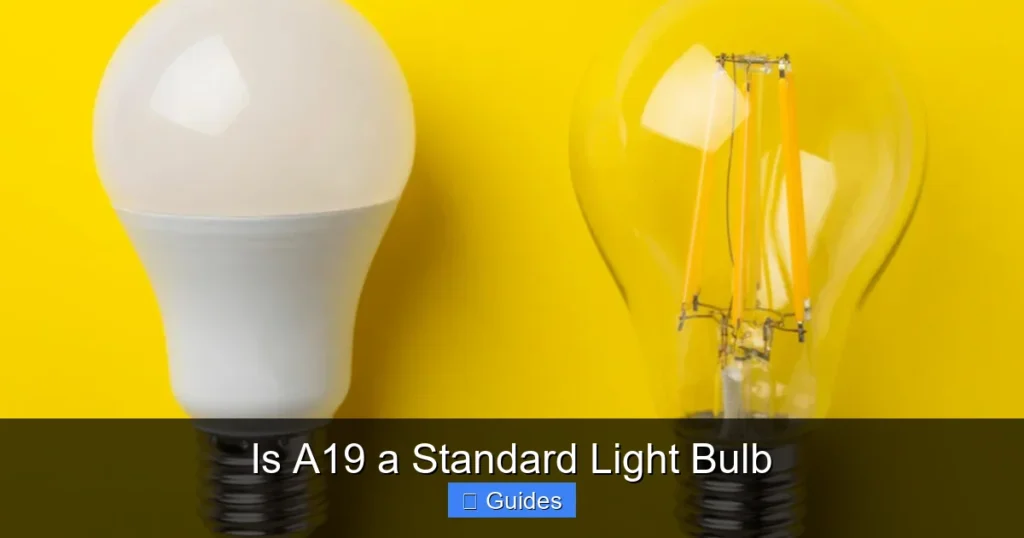
The A19 light bulb is indeed the most common and widely recognized standard light bulb shape for general household use. Its distinctive pear-like shape and medium screw base (E26 in North America) make it compatible with the vast majority of lamps and fixtures, regardless of whether it’s an incandescent, CFL, or modern LED bulb. Understanding the A19 standard helps ensure you pick the perfect bulb for any room, guaranteeing broad compatibility and ease of replacement.
Ever walked into a hardware store, faced a dizzying array of light bulbs, and just picked the one that looked right? Chances are, the one that “looked right” was an A19 light bulb. It’s the quintessential light bulb shape, the icon you probably draw when someone says “light bulb.” But what exactly makes an A19 light bulb so standard, and why is it found in nearly every home?
It’s a question many people ponder, often without even realizing it. “Is A19 a standard light bulb?” is a common query that gets right to the heart of everyday lighting. The short answer is a resounding yes! The A19 light bulb is, without a doubt, the most common and widely recognized standard light bulb shape for general household use, particularly in North America. But delving deeper into what makes it standard can illuminate your understanding of home lighting and empower you to make smarter choices for your space.
In this comprehensive guide, we’ll peel back the layers of this familiar lighting staple. We’ll explore what the “A” and “19” actually mean, why its medium screw base is so important, and how this iconic shape has adapted across different lighting technologies, from the classic incandescent to the modern LED. Get ready to shine a light on the humble yet powerful A19 light bulb!
Key Takeaways
- A19 is the universally recognized standard: It’s the most common light bulb shape for general household use across North America, defining a specific pear-like form factor.
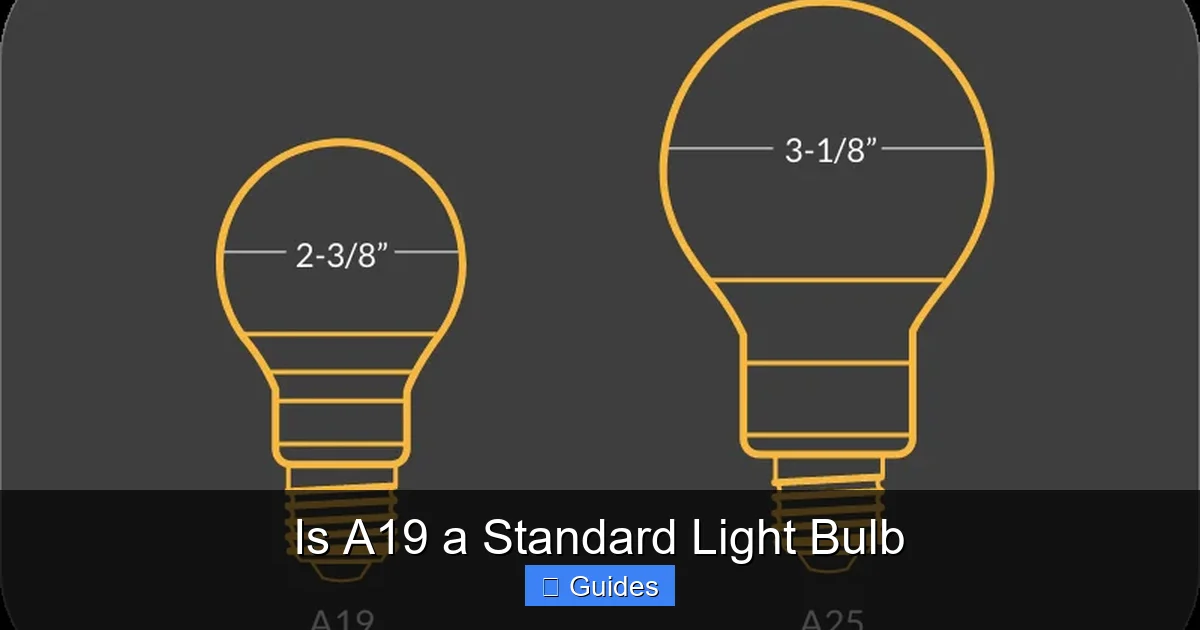
- “A” denotes the shape, “19” indicates diameter: The “A” refers to its arbitrary or classic pear shape, while “19” signifies its maximum diameter is 19/8ths of an inch (or 2.375 inches).
- Features a standard E26 medium screw base: Almost all A19 light bulbs in North America come with an E26 base, ensuring compatibility with the vast majority of household lamps and fixtures.
- Compatible with all lighting technologies: Whether it’s the old incandescent, energy-saving CFL, or modern LED, the A19 form factor has been adapted to house various lighting technologies.
- Ubiquitous in homes and easily replaceable: Its widespread adoption means you’ll find an A19 light bulb in nearly every room, making replacement simple and straightforward.
- Beyond shape, consider lumens, color temperature, and dimmability: While A19 defines the physical bulb, remember to check brightness (lumens), color of light (Kelvin), and dimming capabilities for optimal lighting.
- Your go-to choice for general-purpose lighting: When in doubt for general room illumination, an A19 light bulb is almost always the correct and most versatile choice.
Quick Answers to Common Questions
What does A19 mean in a light bulb?
The “A” refers to the classic pear or arbitrary shape of the bulb, and the “19” indicates its maximum diameter is 19/8ths of an inch (or 2.375 inches).
Is an A19 light bulb always an LED?
No, an A19 refers to the bulb’s shape and size. It can be incandescent, CFL, or LED, though LED A19 light bulbs are the most common type sold today due to their efficiency.
Can I use an A19 bulb in any fixture?
An A19 bulb will fit in most standard household fixtures that use a medium screw base (E26 in North America) and have enough space for the bulb’s dimensions. Always check the fixture’s wattage rating and physical clearance.
What’s the difference between A19 and A21?
Both are “A” shaped bulbs. The difference is in their diameter: an A19 is 19/8ths of an inch (2.375″), while an A21 is 21/8ths of an inch (2.625″). A21s are slightly larger and typically produce more lumens.
Is the E26 base standard for A19 bulbs?
Yes, in North America, virtually all A19 light bulbs use an E26 medium screw base, making it the standard base type for this bulb shape in the region.
📑 Table of Contents
What Exactly Is an A19 Light Bulb?
Before we crown the A19 light bulb as the king of standard bulbs, let’s break down its name. Like many things in the world of light bulbs, the name “A19” isn’t just a random alphanumeric code; it’s a precise descriptor that tells you a lot about the bulb’s physical characteristics.
Decoding the “A” and “19”
The “A” in A19 refers to the bulb’s shape. It stands for “arbitrary” or, more commonly, “standard” or “traditional.” Think of the classic pear or teardrop shape – that’s the “A” shape. It’s the design that has been around for over a century, offering a broad, even distribution of light, which is ideal for general room illumination.
The “19” refers to the maximum diameter of the bulb, measured in eighths of an inch. So, if you divide 19 by 8, you get 2.375 inches. This means an A19 light bulb has a maximum diameter of approximately 2 and 3/8 inches at its widest point. This specific size and shape are incredibly common, contributing significantly to why an A19 light bulb is considered a standard.
The Universal E26 Medium Screw Base
While the shape and size are crucial, what really seals the deal for the A19 light bulb’s standard status is its base type. In North America, almost all A19 light bulbs come equipped with an E26 medium screw base. The “E” stands for Edison, recognizing Thomas Edison’s screw-in design, and “26” indicates the base’s diameter in millimeters (26mm). This E26 base is incredibly prevalent, found in countless lamps, ceiling fixtures, and recessed lights throughout homes and businesses. It’s the most common screw-in base, ensuring that when you pick up an A19 light bulb, it will fit into the vast majority of your household fixtures.
Why the A19 Reigns as the “Standard” Light Bulb
The ubiquity of the A19 light bulb isn’t just a coincidence; it’s a result of historical factors, practical design, and widespread adoption. It has become the default choice for general lighting needs, making an A19 a standard light bulb that consumers instinctively reach for.
Visual guide about Is A19 a Standard Light Bulb
Image source: electronicshub.org
A Legacy of Ubiquity
The A-shape light bulb has a long and storied history, dating back to the early days of incandescent lighting. Its design was optimized for the filament technology of the time, efficiently radiating light and heat. Over generations, this shape became synonymous with “light bulb” itself. This deep-rooted familiarity has cemented its place in our collective consciousness, making the A19 light bulb a cultural icon as much as a practical object. This historical dominance laid the groundwork for its continued reign as a standard.
Unmatched Versatility and Compatibility
One of the primary reasons an A19 light bulb is considered standard is its incredible versatility. Its medium size and classic shape make it suitable for a vast array of applications: table lamps, floor lamps, ceiling fixtures, pendant lights, and even some enclosed outdoor fixtures (provided the bulb is rated for such use). Its design provides a broad, omnidirectional light output, which is perfect for general ambient lighting in almost any room. This “fits everywhere” quality is a hallmark of a truly standard product.
Industry Standards and Consumer Familiarity
Beyond its practical advantages, the A19 light bulb benefits from widely accepted industry standards. Organizations like ANSI (American National Standards Institute) help define bulb shapes, sizes, and base types to ensure interoperability and consumer safety. The A19 shape and E26 base combination are key components of these standards, meaning manufacturers produce them consistently, and consumers can trust that an A19 light bulb from one brand will generally work the same as one from another. This standardization simplifies the purchasing process and reduces confusion, further solidifying the A19’s position as a standard light bulb.
The A19 Form Factor Across Different Lighting Technologies
What’s truly remarkable about the A19 light bulb is its adaptability. As lighting technology evolved dramatically over the past century, the A19 shape remained, proving its enduring utility. This consistent form factor, regardless of the underlying technology, is another strong indicator of why an A19 light bulb is a standard.
The Original Incandescent A19
For decades, the incandescent A19 light bulb was the only game in town. These bulbs produced light by heating a filament until it glowed. They were known for their warm, inviting glow but also for their inefficiency and relatively short lifespan. Despite their energy shortcomings, the incandescent A19 set the benchmark for brightness (wattage) and color temperature for household lighting, establishing the familiar benchmarks that modern bulbs now emulate and surpass.
Energy-Saving CFL A19s
When energy conservation became a significant concern, Compact Fluorescent Lamps (CFLs) emerged as a more efficient alternative. Early CFLs often had a distinct spiral or folded tube design, which could look out of place in many fixtures. To address this, manufacturers began enclosing the CFL tubes within an A19-shaped glass envelope. This innovation allowed consumers to enjoy the energy savings of CFLs without sacrificing the aesthetic and compatibility of the standard A19 light bulb. While less common today, these A19-shaped CFLs were a crucial stepping stone in the evolution of energy-efficient lighting.
The Modern LED A19 Revolution
Today, the LED (Light Emitting Diode) A19 light bulb dominates the market. LEDs represent the pinnacle of energy efficiency, offering incredibly long lifespans, significant energy savings, and a wide range of light qualities. Modern LED A19 bulbs are designed to mimic the appearance and light distribution of traditional incandescents, making the transition seamless for consumers. They fit perfectly into existing A19 fixtures, provide instant full brightness, are often dimmable, and can even offer smart features like color changing and remote control. The LED A19 light bulb has truly inherited the crown, becoming the go-to standard for contemporary homes.
Beyond Shape: What Else Matters When Choosing an A19 Bulb?
Knowing that an A19 light bulb is a standard and will likely fit your fixture is a great start. However, the physical fit is just one piece of the puzzle. To truly illuminate your space effectively and efficiently, you need to consider several other specifications. These factors are crucial whether you’re buying an incandescent, CFL, or LED A19 light bulb.
Brightness (Lumens, Not Watts!)
This is perhaps the biggest shift in light bulb shopping. For generations, we associated “brightness” with “watts.” A 60-watt bulb was brighter than a 40-watt bulb. However, watts measure energy consumption, not light output. With the advent of energy-efficient LEDs, a 10-watt LED can produce the same amount of light as a 60-watt incandescent. So, when choosing an A19 light bulb, always look for lumens. Lumens directly measure how much light the bulb produces. For general room lighting, an A19 light bulb typically offers between 450-800 lumens (equivalent to 40-60W incandescent), but you can find higher lumen options for brighter spaces.
Color Temperature (Kelvin for Ambiance)
Color temperature, measured in Kelvin (K), describes the hue of the light emitted. This dramatically affects the mood and feel of a room. Lower Kelvin numbers (e.g., 2700K-3000K) produce a warm, yellowish light, similar to traditional incandescents, ideal for cozy living areas and bedrooms. Mid-range Kelvin (3500K-4100K) offers a neutral or “cool white” light, good for kitchens, offices, or bathrooms where task lighting is important. Higher Kelvin numbers (5000K-6500K) mimic daylight, often used in workshops or commercial settings. When selecting your A19 light bulb, consider the desired ambiance for the space.
Color Rendering Index (CRI for True Colors)
The Color Rendering Index (CRI) measures how accurately a light source reveals the true colors of objects compared to natural sunlight. CRI is rated on a scale from 0 to 100, with 100 being perfect color rendering. For most household applications, a CRI of 80 or higher is considered good. For areas where color accuracy is important, such as art studios, kitchens, or bathrooms where you apply makeup, look for an A19 light bulb with a CRI of 90+. A high CRI ensures that your decor, food, and skin tones appear vibrant and true to life.
Dimmability and Smart Features
Not all A19 light bulbs are dimmable. If you plan to use a dimmer switch, make sure your A19 LED light bulb explicitly states “dimmable” on the packaging. Using a non-dimmable bulb with a dimmer can lead to flickering, buzzing, or premature bulb failure. Beyond basic dimming, many modern A19 LED bulbs now incorporate smart features, allowing you to control them via apps, voice assistants, or schedules. These smart A19 light bulbs can offer adjustable color temperature, color-changing capabilities, and integration into your smart home ecosystem, adding a layer of convenience and customization to your lighting.
Practical Tips for Selecting the Perfect A19 Light Bulb
Now that you know an A19 light bulb is a standard, and you understand its various specifications, how do you pick the best one for your specific needs? Here are some practical tips to guide your next light bulb purchase, ensuring your A19 light bulb provides the perfect illumination.
Match the Lumens to Your Needs
Don’t just replace your old 60W bulb with a new “60W equivalent” LED A19 light bulb without thinking. Consider the actual light output you need. For a small reading lamp, 450 lumens might be perfect. For a large living room ceiling fixture, you might need 800-1000 lumens per bulb, or multiple bulbs. Manufacturers often provide guidance on lumens needed per square foot. Too many lumens can make a room feel sterile or harsh, while too few leave it dim and unwelcoming. For task lighting, aim for higher lumens, and for ambient lighting, lower lumens with a warmer color temperature.
Consider the Room’s Function and Mood
Think about what you do in each room. For a kitchen or home office, a brighter, cooler A19 light bulb (3500K-4100K) with a high CRI can enhance focus and visibility. In a bedroom or living room, a warmer (2700K-3000K) and perhaps dimmable A19 light bulb creates a relaxing, inviting atmosphere. The right color temperature from your A19 light bulb can dramatically impact the psychological comfort and utility of a space. Don’t be afraid to mix and match color temperatures in different rooms to suit their specific functions.
Don’t Forget Energy Efficiency and Lifespan
One of the biggest advantages of LED A19 light bulbs is their efficiency and longevity. While they might have a higher upfront cost than incandescents, they consume significantly less energy and can last for 15,000 to 25,000 hours or more – often over 10-20 years with typical household use. This translates to substantial savings on your electricity bill and far fewer bulb replacements. Always check the estimated lifespan and energy consumption (in kWh/year) on the packaging of your A19 light bulb to make an informed, cost-effective decision.
Check for Special Features Like Dimmability or Smart Home Integration
If your fixture is on a dimmer switch, always double-check that your chosen A19 LED light bulb is explicitly labeled as “dimmable.” Not all LEDs are, and using the wrong type can cause issues. Similarly, if you’re building a smart home system, look for smart A19 light bulbs that are compatible with your preferred platform (e.g., Philips Hue, Lutron Caseta, Google Home, Amazon Alexa). These features, while not essential, can greatly enhance your lighting experience, allowing for personalized control and automated routines for your standard A19 light bulb.
Conclusion
So, is A19 a standard light bulb? Absolutely. It’s more than just a shape; it’s a testament to enduring design, practical utility, and universal compatibility. From the dim glow of early incandescents to the sophisticated brilliance of modern LEDs, the A19 form factor has adapted and persisted, proving its status as the default choice for millions of homes.
Understanding what “A19” means empowers you as a consumer. You now know that when you’re looking for a general-purpose bulb that fits most of your household fixtures, an A19 light bulb with an E26 base is almost certainly the one you need. But beyond mere fit, remembering to consider lumens, color temperature, CRI, and dimmability will ensure you’re not just buying a light bulb, but the right light bulb for every corner of your life.
The next time you’re in the lighting aisle, you won’t just see a sea of bulbs. You’ll recognize the familiar A19 light bulb as the reliable standard it is, ready to provide efficient, beautiful illumination for your home. Shine on!
Frequently Asked Questions
Is A19 a standard size worldwide?
While the A19 shape is widely recognized, the “standard” base size can vary. In North America, the E26 medium screw base is standard for A19 bulbs, but in Europe and other regions, the E27 base (which is very similar but slightly different thread pitch) is more common.
Do all A19 bulbs dim?
No, not all A19 light bulbs are dimmable. While incandescent A19s were inherently dimmable, many LED A19 bulbs require specific “dimmable” circuitry. Always check the packaging of an LED A19 light bulb if you intend to use it with a dimmer switch.
Can I replace an incandescent A19 with an LED A19?
Yes, in most cases, you can directly replace an incandescent A19 light bulb with an LED A19 bulb, provided the LED is suitable for the fixture (e.g., if it’s an enclosed fixture, ensure the LED is rated for it) and you check for dimmability if applicable.
What’s the best color temperature for an A19 bulb?
The “best” color temperature for an A19 light bulb depends on the room’s function and desired mood. Warm white (2700K-3000K) is great for living rooms and bedrooms, while cooler white (3500K-4100K) is often preferred for kitchens or offices.
Why are A19 bulbs so common?
A19 light bulbs are common due to their traditional pear shape which provides good omnidirectional light, their universally compatible E26 medium screw base in North America, and their historical ubiquity across different lighting technologies.
How do I know if my fixture takes an A19?
Look at the existing bulb; if it’s the classic pear shape and measures about 2.375 inches across, it’s an A19. Most general household lamps and open fixtures are designed for A19 light bulbs, but you can also check the fixture’s specifications or previous bulb for confirmation.
