


As an Amazon Associate, We earn from qualifying purchases.
Finding the correct light bulb size is simpler than you think when armed with the right knowledge. This comprehensive guide will walk you through deciphering alphanumeric codes, measuring key dimensions like diameter and base type, and understanding crucial factors like wattage and color temperature. Say goodbye to mismatched bulbs and illuminate your space perfectly with our easy-to-follow tips!
Ever found yourself staring at a wall of light bulbs at the store, completely overwhelmed by the dizzying array of shapes, sizes, and numbers? You’re not alone! Picking the right light bulb can feel like solving a complex puzzle, especially when you just want to replace a simple burned-out one.
The frustration is real: you bring home a new bulb, eager to restore light to your favorite lamp, only to discover the base doesn’t fit, or the bulb itself is too large for the fixture. It’s a common scenario that wastes time, money, and trips back to the store. But what if there was a simple way to crack the code and confidently choose the perfect replacement every single time?
This comprehensive guide is your personal roadmap to understanding everything about light bulb sizes. We’ll demystify those cryptic alphanumeric codes, show you how to measure like a pro, and help you identify the various base types. By the end of this article, you’ll be an expert in how to find light bulb size, making your next bulb shopping trip a breeze and ensuring your home is always perfectly lit.
Key Takeaways
- Check the Old Bulb First: The most reliable method to find light bulb size is to inspect the existing bulb for printed codes and specifications.
- Understand Alphanumeric Codes: Bulb sizes like “A19” or “BR30” denote shape and diameter. The letter indicates the shape (e.g., ‘A’ for traditional, ‘BR’ for bulged reflector), and the number represents the diameter in eighths of an inch.
- Measure When Markings are Absent: If the old bulb’s markings are gone, measure its widest diameter, overall length, and especially the base to determine the correct light bulb size and type.
- Identify Base Type: The base is crucial for compatibility. Common types include screw-in (Edison, e.g., E26, E12), pin (e.g., GU10, G9), and bayonet.
- Consider More Than Just Size: Beyond physical dimensions, remember to match wattage/lumens, color temperature (Kelvin), and dimmability for optimal performance and safety.
- Take a Photo: When in doubt, snap a picture of the old bulb and its base. This visual aid can be invaluable when shopping for a replacement.
Quick Answers to Common Questions
What does the number in a bulb size (e.g., A19) mean?
The number indicates the maximum diameter of the bulb across its widest point, measured in eighths of an inch. So, “19” in A19 means the bulb is 19/8 inches (or 2 3/8 inches) in diameter.
How do I know if my bulb is dimmable?
A dimmable bulb will be explicitly labeled “dimmable” on its packaging or directly on the bulb itself. If it doesn’t say “dimmable,” assume it is not, as using a non-dimmable bulb with a dimmer can cause issues.
Can I use an LED bulb if my fixture originally used incandescent?
Yes, in most cases, you can replace an incandescent bulb with an LED as long as the base type, voltage, and physical size (diameter/length) are compatible. Just ensure the LED bulb’s wattage equivalent provides the brightness you desire.
What’s the difference between E26 and E27?
E26 and E27 are both medium screw-in (Edison) bases, with diameters of 26mm and 27mm, respectively. E26 is standard in North America, while E27 is common in Europe. They are often considered interchangeable due to their similar size, but it’s best to match the exact type if possible for optimal fit and safety.
How do I measure a screw-in base?
To measure a screw-in base, use a ruler or caliper to find the diameter of the threaded part of the base. For instance, a diameter of approximately 26mm indicates an E26 base, while 12mm points to an E12 candelabra base.
📑 Table of Contents
- Understanding the Basics: What Do Light Bulb Sizes Mean?
- The Most Important First Step: Check the Old Bulb
- When the Old Bulb is Missing or Unreadable: Measuring Your Way
- Navigating Different Base Types: The Key to Compatibility
- Beyond Size: Other Crucial Factors to Consider
- Expert Tips for a Seamless Bulb Replacement
- Conclusion
Understanding the Basics: What Do Light Bulb Sizes Mean?
Before we dive into the nitty-gritty of measuring and identifying, let’s get a foundational understanding of what those letters and numbers on light bulbs actually signify. When you’re trying to find light bulb size, this alphanumeric code is your best friend.
Decoding the Alphanumeric Code
Most standard light bulbs have a code printed on them, like “A19,” “BR30,” or “G25.” This code provides crucial information about the bulb’s shape and its diameter. It’s the primary way manufacturers communicate the light bulb size.
- The Letter: This usually refers to the shape or type of the bulb. For instance:
- A: This is the classic, most common “arbitrary” or standard pear-shaped bulb we’ve all grown up with. An A-type bulb is what you typically think of when you hear “light bulb.”
- B or C: These denote candelabra or torpedo-shaped bulbs, often found in decorative fixtures.
- G: Indicates a globe-shaped bulb, common in vanity lights or open fixtures where the bulb itself is part of the aesthetic.
- MR: Stands for “multifaceted reflector,” often small, directional bulbs used in track lighting or recessed fixtures.
- BR: Means “bulged reflector,” designed to spread light over a wider area, commonly used in recessed lighting.
- PAR: Stands for “parabolic aluminized reflector,” offering more precise beam control, also for recessed or outdoor floodlights.
- T: Denotes a tubular shape, often long and thin, used in certain decorative fixtures or appliances.
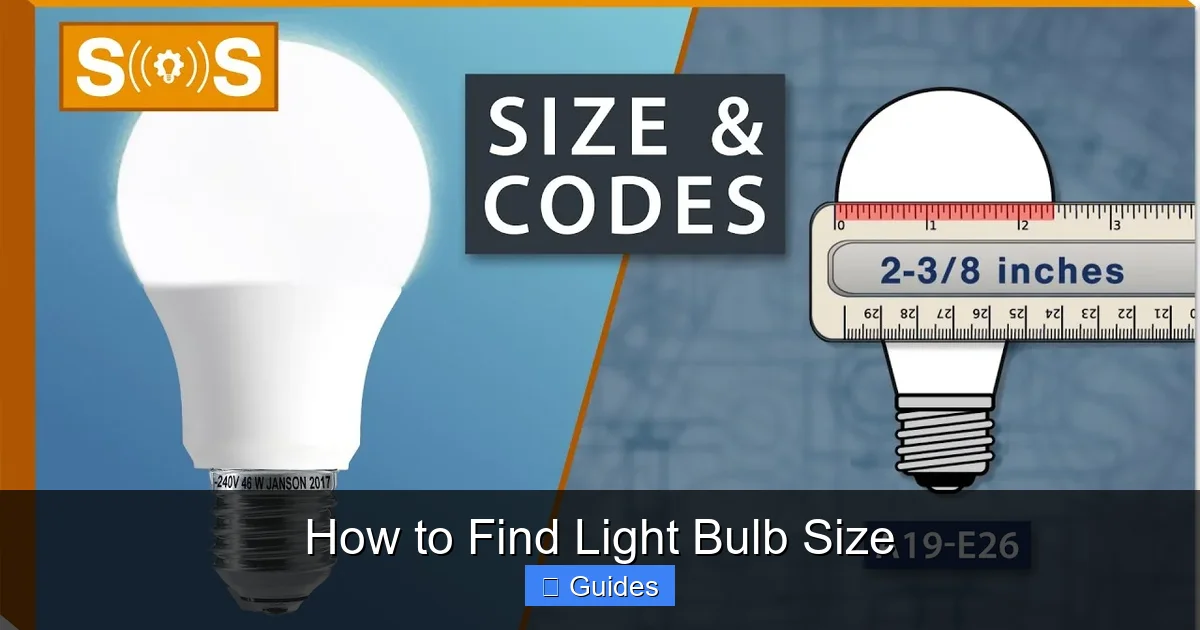
- The Number: This part of the code tells you the maximum diameter of the bulb across its widest point. But here’s the trick: the number is almost always in eighths of an inch.
- So, an “A19” bulb has a maximum diameter of 19/8 inches, which is 2 3/8 inches.
- A “BR30” bulb has a maximum diameter of 30/8 inches, or 3 3/4 inches.
- A “G25” bulb has a maximum diameter of 25/8 inches, or 3 1/8 inches.
Understanding this simple system makes it much easier to find light bulb size just by reading the packaging.
Common Bulb Shapes and Their Meanings
Let’s look at some examples to solidify this understanding of light bulb size and shape:
- A-Shape (A15, A19, A21): The classic household bulb. A19 is the most common size for general lighting. A15 is slightly smaller, A21 slightly larger.
- B/C-Shape (B10, C7, C9): Often called candelabra or torpedo bulbs, these are decorative and smaller, commonly found in chandeliers or night lights.
- G-Shape (G16.5, G25, G30, G40): Spherical “globe” bulbs, popular in bathrooms, vanities, and pendant lights. The number indicates increasing diameter.
- BR-Shape (BR20, BR30, BR40): Bulged reflector bulbs, designed for recessed fixtures where they sit flush with the ceiling and spread light widely. BR30 is a very common recessed can light bulb size.
- PAR-Shape (PAR16, PAR20, PAR30, PAR38): Parabolic reflector bulbs, also for recessed or track lighting, offering more focused beams than BR bulbs. PAR38 is a large floodlight bulb.
- MR-Shape (MR11, MR16): Miniature reflector bulbs, often low voltage, used in track lighting, display lighting, or landscaping.
- T-Shape (T6, T8, T10): Tubular bulbs, used in specific fixtures, sometimes for their aesthetic or compact design.
When you need to find light bulb size, identifying the shape is the first visual clue, and the number confirms the diameter.
The Most Important First Step: Check the Old Bulb
The easiest and most reliable way to find light bulb size is to simply look at the bulb you’re replacing. Manufacturers print a wealth of information directly on the bulb itself.
Visual guide about How to Find Light Bulb Size
Image source: i.ytimg.com
Where to Look for Markings
Most of the crucial information is printed on the base (the part that screws or plugs into the fixture) or on the glass part of the bulb near the base. You might need to rotate the bulb to find all the details. Sometimes, especially with older bulbs or very small specialty bulbs, the markings can be faint or have rubbed off, but it’s always the best place to start.
What Information You’ll Find
When you inspect the old bulb, look for these key pieces of information:
- Light Bulb Size (Shape and Diameter): As discussed, this will be the alphanumeric code like “A19,” “BR30,” “G25,” or “MR16.” This is your primary indicator for how to find light bulb size.
- Base Type: This is critical for compatibility with your fixture’s socket. Common markings include:
- E26: Standard household screw-in base (Edison base) in North America.
- E12: Candelabra screw-in base (smaller than E26).
- GU10: Bi-pin twist-and-lock base, common for spotlights.
- G9: Bi-pin push-in base, often for decorative fixtures.
- MR16: Often found with a GU5.3 bi-pin base.
We’ll delve deeper into base types shortly.
- Wattage (W): This indicates the power consumption of the bulb. For traditional incandescent bulbs, it also roughly correlates with brightness.
- Lumens (lm): For modern LED and CFL bulbs, lumens are the best measure of brightness, indicating how much light the bulb produces.
- Color Temperature (K): Expressed in Kelvin, this tells you the “warmth” or “coolness” of the light (e.g., 2700K for warm white, 5000K for cool daylight).
- Dimmable: Look for “dimmable” or a dimmer symbol if you need the bulb to work with a dimmer switch.
- Voltage (V): Most household bulbs are 120V, but some specialty bulbs (like MR16s) might be 12V.
Armed with this information, you can confidently go to the store and find an exact match for your old bulb.
When the Old Bulb is Missing or Unreadable: Measuring Your Way
What if the old bulb is long gone, or the markings have worn away completely? Don’t despair! You can still accurately determine the light bulb size by taking a few simple measurements. All you’ll need is a ruler or a tape measure.
Measuring the Base (Socket Type)
The base is the most crucial measurement because it dictates whether the bulb will physically connect to your fixture. If you have the old bulb, measure its base. If not, measure the opening of the socket itself.
- For Screw-In Bases (Edison): Measure the diameter of the threaded part of the base.
- Roughly 26mm (1 inch) = E26 (Standard household)
- Roughly 12mm (1/2 inch) = E12 (Candelabra)
- Roughly 14mm (9/16 inch) = E14 (European candelabra, less common in North America)
- Roughly 39mm (1 1/2 inch) = E39 (Mogul base, for large industrial/commercial fixtures)
- For Pin Bases: Measure the distance between the center of the two pins.
- 10mm = GU10 (twist-and-lock, with two thick prongs)
- 5.3mm = GU5.3 (two thinner pins, often for MR16 bulbs)
- 9mm = G9 (two looped pins)
- 4mm = G4 (two very small pins)
- For Bayonet Bases: Measure the diameter of the base itself. These have two small pins on the sides that twist into slots.
- Roughly 22mm = BA22d (common in some European fixtures)
- Roughly 15mm = BA15d (smaller bayonet)
This measurement is critical for knowing how to find light bulb size for the base.
Measuring the Bulb Diameter
If you don’t have the alphanumeric code, you can measure the maximum diameter of the old bulb across its widest point. Then, multiply this measurement by 8 to get the “number” part of the bulb size code (e.g., if it’s 2 3/8 inches, or 2.375 inches, then 2.375 * 8 = 19, so it’s an A19 or similar 19-diameter bulb). This helps you determine the correct light bulb size in terms of width.
- For example, if your bulb is a traditional pear shape and measures approximately 2.375 inches (2 and 3/8 inches) across, you’re looking for an A19.
- If it’s a globe shape and measures about 3.125 inches (3 and 1/8 inches), you need a G25.
Measuring the Bulb Length/Overall Height
Sometimes, especially in enclosed fixtures, the length of the bulb matters. Measure from the very tip of the bulb to the bottom of the base (excluding the screw threads or pins that go into the socket). This ensures the new bulb won’t hit the fixture’s globe or housing. This isn’t usually part of the standard light bulb size code but is an important practical consideration.
Navigating Different Base Types: The Key to Compatibility
The base of a light bulb is its connection point to the fixture’s socket. Getting this right is non-negotiable. Even if the light bulb size (shape and diameter) is perfect, the wrong base means it won’t work. Here’s a rundown of common base types:
Screw-In Bases (Edison Bases)
These are the most common in household lighting. They are identified by “E” followed by a number indicating the diameter in millimeters. When learning how to find light bulb size for screw-in bases, direct measurement is best.
- E26 (Medium/Standard Edison): The standard household screw-in base in North America. If you don’t see any other marking on a regular bulb socket, it’s most likely E26.
- E12 (Candelabra Edison): A smaller screw-in base, commonly used for decorative bulbs in chandeliers, night lights, and accent lighting.
- E14 (European Candelabra): Similar in size to E12 but with a slightly different threading. Found in fixtures designed for European markets.
- E17 (Intermediate Edison): Less common, falls between E12 and E26 in size.
- E39 (Mogul Edison): A very large screw-in base, usually for high-wattage industrial or commercial lighting.
Pin Bases (Bi-Pin, GU, GZ)
These bases use two or more pins that push into or twist into the socket. The number after the “G” typically indicates the distance between the pins in millimeters, an essential aspect when you find light bulb size for these types.
- GU10: Features two short, thick pins with flattened ends, requiring a twist to lock into place. Common for track lighting and recessed spotlights.
- GU5.3 (or GZ5.3): Has two thinner pins spaced 5.3mm apart. Often found on MR16 halogen or LED spotlight bulbs, typically low voltage.
- G4 / G6.35 / G9: These are often smaller capsules or mini-reflector bulbs. G4 has two small pins, G6.35 slightly larger, and G9 features two looped pins that push into the socket. Used in under-cabinet lighting, task lighting, or decorative fixtures.
Bayonet Bases
Bayonet bases have two small pins on the sides that slide into L-shaped slots in the socket, then twist to secure. They are common in some specialty applications, automotive lighting, and occasionally older or imported household fixtures. They are denoted by “BA” followed by the diameter, e.g., BA15d.
Wedge Bases
These bulbs have a flat base that simply pushes into a corresponding slot. They are very common in automotive lighting, landscape lighting, and some low-voltage accent lights. Examples include T5 or T10 wedge bases.
Specialty Bases
Some fixtures use highly specialized bases, such as those for fluorescent tubes (G13 for T8/T12, G5 for T5), or single-pin bases. If you encounter one of these, it’s best to take the old bulb to a specialty lighting store or consult the fixture’s manual to accurately find light bulb size.
Beyond Size: Other Crucial Factors to Consider
Once you’ve mastered how to find light bulb size, there are still a few more important specifications to consider to ensure you get the perfect bulb for your needs and avoid compatibility issues.
Wattage, Lumens, and Brightness
For traditional incandescent bulbs, wattage (W) directly correlated with brightness. A 60W bulb was brighter than a 40W bulb. However, with the advent of energy-efficient LEDs and CFLs, wattage now primarily indicates energy consumption, not brightness. To find light bulb size for brightness, focus on lumens.
- Lumens (lm): This is the true measure of a bulb’s brightness. The higher the lumen count, the brighter the light. For example, a 60W incandescent bulb produces about 800 lumens. An LED bulb might produce 800 lumens while only using 9-10 watts. Always match lumens to your desired brightness, not just wattage.
- Wattage Equivalence: Many LED bulbs will still indicate a “wattage equivalent” (e.g., “9W LED = 60W Incandescent”) to help consumers transition. This is a helpful guide when trying to find light bulb size based on brightness.
Tip: Never exceed the maximum wattage listed on your fixture. Overwattage can lead to overheating and fire hazards.
Color Temperature (Kelvin)
Color temperature (measured in Kelvin, K) describes the “warmth” or “coolness” of the light emitted by the bulb. This doesn’t affect the light bulb size, but it significantly impacts the ambiance of a room.
- Warm White (2700K – 3000K): Emits a soft, yellowish light, similar to traditional incandescent bulbs. Ideal for living rooms, bedrooms, and dining areas where a cozy atmosphere is desired.
- Cool White / Bright White (3500K – 4100K): Offers a more neutral, whiter light. Good for kitchens, bathrooms, and offices where task lighting and clarity are important.
- Daylight (5000K – 6500K): Produces a very bright, bluish-white light, mimicking natural daylight. Best for workshops, garages, reading lamps, or anywhere high visibility is crucial.
Dimmability
Not all light bulbs are dimmable. If you plan to use a bulb with a dimmer switch, you must ensure the bulb is specifically labeled “dimmable.” Using a non-dimmable bulb on a dimmer switch can lead to flickering, buzzing, reduced bulb lifespan, or even damage to the dimmer or bulb itself. This is a functionality, not a light bulb size, but crucial for user experience.
Energy Efficiency (LED, CFL)
Modern lighting offers significant energy savings. While traditional incandescents are still available, LEDs (Light Emitting Diodes) and CFLs (Compact Fluorescent Lamps) are far more efficient and long-lasting.
- LEDs: Most energy-efficient, longest lifespan, instant on, come in a wide range of colors and light bulb sizes. While generally more expensive upfront, they save a lot on electricity and replacement costs.
- CFLs: More efficient than incandescents but less than LEDs. They take a moment to warm up to full brightness and contain a small amount of mercury, requiring special disposal.
Expert Tips for a Seamless Bulb Replacement
Here are some additional tips to make your light bulb shopping even easier, helping you quickly find light bulb size and other specifications.
Take a Photo
If you’re unsure about any details, or if the markings are hard to read, simply snap a picture of the old bulb! Take photos of the bulb itself, its base, and any text printed on it. This visual aid is incredibly helpful when you’re at the store, allowing you to compare directly and ensure you find light bulb size and type correctly.
Consult the Fixture Itself
Sometimes, the maximum wattage or even the recommended light bulb size might be printed on the light fixture’s socket, canopy, or inside the glass globe. Always check for this information, especially if the old bulb is completely missing or unidentifiable. It’s a critical safety precaution.
When in Doubt, Ask for Help
Don’t hesitate to ask a store associate at your local hardware or lighting store. Bring your old bulb, a photo, or your measurements. They are trained to help you identify the correct light bulb size and type.
Buy a Few Extra
Once you’ve successfully identified and purchased the correct light bulb, consider buying a few extras. This way, you’ll have replacements readily available for next time, saving you another trip to the store and the hassle of needing to re-identify the light bulb size.
Conclusion
Finding the correct light bulb size doesn’t have to be a daunting task. By understanding the alphanumeric codes, knowing how to measure effectively, and recognizing the different base types, you can confidently navigate the world of light bulbs.
Remember to always start by checking the old bulb for its printed specifications. If that’s not possible, a simple ruler can help you determine the bulb’s diameter, length, and most importantly, its base type. And don’t forget those crucial secondary factors like lumens for brightness, Kelvin for color, and dimmability for functionality.
With the knowledge gained from this guide, you’re now equipped to make informed choices, ensure perfect compatibility, and keep your home beautifully lit. No more guessing, no more wasted trips, just clear, consistent light! Happy illuminating!
Frequently Asked Questions
Why is it important to find the correct light bulb size?
Finding the correct light bulb size is crucial for compatibility with your fixture’s socket, ensuring the bulb physically fits without hitting shades or enclosures, and for safety. Using the wrong size can lead to improper electrical connection, overheating, or simply prevent the bulb from working at all.
What if the old bulb has no markings?
If the old bulb has no discernible markings, you’ll need to measure it yourself. Focus on measuring the base type (diameter of screw-in bases or distance between pins for pin bases), the widest diameter of the bulb, and its overall length to find a suitable replacement.
Can I use a bulb with a different wattage?
When replacing old incandescent bulbs, it’s generally safe to use an LED bulb with a lower actual wattage that produces a similar lumen output (brightness). However, you should never exceed the maximum wattage rating specified on your light fixture, regardless of the bulb type, to prevent fire hazards.
What does “color temperature” mean for light bulbs?
Color temperature, measured in Kelvin (K), describes the visual appearance of the light emitted by a bulb. Lower Kelvin values (e.g., 2700K) produce a warm, yellowish light, while higher values (e.g., 5000K-6500K) create a cool, bluish-white light, impacting the ambiance of a room.
How do I dispose of old light bulbs?
The disposal method depends on the bulb type. Incandescent bulbs can usually be thrown in household trash. CFLs (compact fluorescents) contain small amounts of mercury and should be recycled at designated collection points. LED bulbs are generally safe for regular trash but can also be recycled at electronics recycling centers.
Are there universal light bulb sizes?
No, there are no truly universal light bulb sizes. While some sizes, like the E26 A19, are very common for general household use in specific regions, the vast array of fixtures and lighting needs requires many different shapes, diameters, and base types. Always check your specific bulb or fixture for compatibility.
