


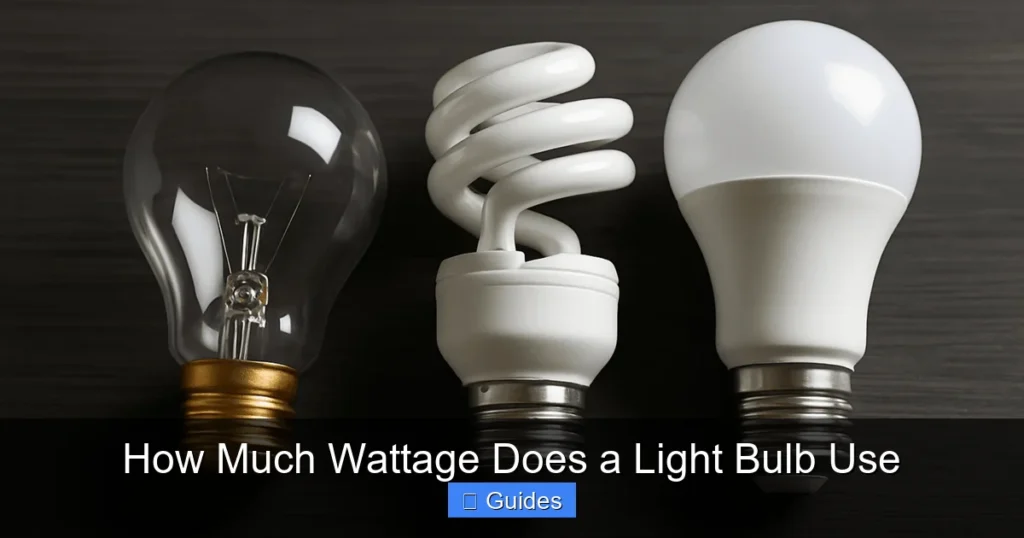
As an Amazon Associate, We earn from qualifying purchases.
When asking how much wattage does a light bulb use, it’s important to understand that wattage measures *power consumption*, not brightness. While older incandescent bulbs used high wattage for light, modern LEDs deliver the same or more brightness (measured in lumens) with significantly less wattage, making them far more energy-efficient and cost-effective. Focus on lumens for brightness and low wattage for savings!
Have you ever stood in the lighting aisle, squinting at light bulb packages, and felt a little lost? You’re not alone! For decades, picking a light bulb was simple: you just looked for the wattage. A 60-watt bulb was “standard,” a 100-watt bulb was “bright,” and that was pretty much it. But nowadays, you see numbers like “8W,” “60W equivalent,” “800 lumens,” and even “2700K.” It can be a bewildering array of information.
The good news is that understanding how much wattage a light bulb uses is actually simpler than it seems once you grasp a few key concepts. More importantly, getting a handle on it can lead to significant savings on your energy bill and a better lighting experience in your home. Let’s shine a light on this topic and demystify the world of light bulb wattage together.
Key Takeaways
- Wattage Measures Power, Not Brightness: Wattage indicates how much electricity a light bulb consumes, not how bright it is.
- Lumens are the True Measure of Brightness: For modern bulbs, always look at lumens to understand how much light a bulb produces. More lumens mean more light.
- LEDs Offer Superior Efficiency: Light-Emitting Diodes (LEDs) use dramatically less wattage to produce the same amount of lumens compared to older incandescent or CFL bulbs, leading to significant energy savings.
- Older Bulb Types are Energy Hogs: Incandescent and halogen bulbs require much higher wattage to produce light and convert most of their energy into heat, making them inefficient.
- Calculating Energy Costs is Simple: You can estimate your electricity bill savings by multiplying a bulb’s wattage by its usage hours and your electricity rate, highlighting the long-term benefits of low-wattage bulbs.
- Choose Wisely for Savings and Quality: When selecting a bulb, consider lumens for brightness, Kelvin for color temperature, beam angle, and dimming capabilities, in addition to low wattage.
- Practical Tips Reduce Consumption: Simple habits like upgrading to LEDs, using dimmers, maximizing natural light, and turning off lights when not needed can significantly lower your overall light bulb wattage and energy consumption.
Quick Answers to Common Questions
How do I know how bright an LED bulb is?
You should always look for the lumen (lm) rating on the packaging. Lumens measure brightness, not wattage.
Can I replace a 60W incandescent bulb with an 8W LED?
Yes, absolutely! An 8-10W LED bulb typically produces the same amount of light (around 800 lumens) as a traditional 60W incandescent bulb, but uses much less electricity.
Do smart bulbs use more wattage than regular LEDs?
No, smart bulbs are essentially LEDs with added connectivity features. Their base wattage for light production is similar to standard LEDs, and the smart features consume very little additional power.
What is “equivalent wattage” on a light bulb package?
“Equivalent wattage” tells you which traditional incandescent bulb’s brightness (lumens) a modern LED or CFL bulb matches. For example, “60W equivalent” means it’s as bright as a 60-watt incandescent, but consumes much less actual wattage.
Does dimming a light bulb reduce its wattage consumption?
Yes, dimming an LED bulb reduces the amount of electricity it draws, thereby lowering its wattage consumption and saving energy. It also extends the bulb’s lifespan.
📑 Table of Contents
- Understanding Wattage: The Basics
- The Shift to Lumens: Why Brightness Matters More Than Power
- Different Light Bulb Technologies and Their Wattage Consumption
- Calculating Energy Costs and Savings
- Choosing the Right Bulb for Your Needs (Beyond Just Wattage)
- Practical Tips for Reducing Your Light Bulb Wattage and Energy Bill
Understanding Wattage: The Basics
Let’s start with the fundamental question: what *is* wattage when we talk about a light bulb? Simply put, wattage is a measure of the amount of electrical power a device consumes. In the context of a light bulb, it tells you how much electricity the bulb needs to operate. It does *not*, however, directly tell you how bright the bulb will be, especially with modern lighting technology.
What Wattage Really Means
Imagine your home’s electrical system as a river. Wattage is like the amount of water flowing through a specific point – it’s the rate of energy consumption. The higher the wattage, the more electricity the bulb draws from your home’s power supply, and consequently, the more it costs to run. So, when you ask “how much wattage does a light bulb use?”, you’re essentially asking “how much electricity does this light bulb consume?”
The Old Way: Incandescent Wattage
For a long time, wattage *was* a reliable indicator of brightness because incandescent light bulbs were the primary technology available. These bulbs work by heating a tiny filament wire until it glows, producing light. Unfortunately, they also produce a lot of heat – in fact, about 90% of the energy consumed by an incandescent bulb is released as heat, with only about 10% converted into visible light.
Because all incandescent bulbs used the same basic technology, a higher wattage *always* meant a brighter bulb. A 60-watt incandescent bulb produced a predictable amount of light, and a 100-watt incandescent bulb produced more. This made the wattage a convenient proxy for brightness. However, with the advent of more efficient lighting, this direct relationship between wattage and brightness no longer holds true.
The Shift to Lumens: Why Brightness Matters More Than Power
Visual guide about How Much Wattage Does a Light Bulb Use
Image source: consumerenergycenter.org
With new lighting technologies, focusing solely on wattage when buying a light bulb is like buying a car based only on its fuel tank size – it doesn’t tell you how far it will go or how efficiently it will use that fuel. Today, the most important number to look for on a light bulb package is “lumens.”
What Are Lumens?
Lumens are the true measure of a light bulb’s brightness. A lumen quantifies the total amount of visible light produced by a bulb. The more lumens a bulb has, the brighter it will appear. This is the crucial measurement if you’re trying to figure out if a bulb will provide enough light for a room.
Think of it this way:
- Wattage: How much electricity the bulb *uses* (cost).
- Lumens: How much light the bulb *produces* (brightness).
This distinction is vital for understanding how much wattage does a light bulb use *efficiently*.
Wattage vs. Lumens: A Modern Perspective
The reason we’ve shifted from wattage to lumens is efficiency. Modern light bulbs, especially LEDs, are incredibly good at converting electricity into light without wasting much energy as heat. This means they can produce the same amount of light (the same number of lumens) as an old incandescent bulb, but with significantly less wattage.
For example:
- A traditional 60-watt incandescent bulb produces about 800 lumens.
- A modern LED bulb can produce 800 lumens while only using 8-10 watts!
See the difference? Both bulbs give you the same brightness, but the LED uses nearly 90% less electricity to do it. This is why when you see “60W equivalent” on an LED package, it means it produces a similar amount of light (around 800 lumens) to a 60-watt incandescent, not that it *consumes* 60 watts.
How Many Lumens Do You Need? (Practical Guide)
To help you choose the right brightness, here’s a general guide for common room types:
- Ambient/General Lighting:
- Living Room: 1500-3000 lumens (total, for a medium-sized room)
- Bedroom: 1000-2000 lumens
- Kitchen: 3000-6000 lumens (total, often with task lighting)
- Dining Room: 1000-2000 lumens (often with a dimmer)
- Task Lighting (e.g., reading lamp, under-cabinet lighting): 300-500 lumens per fixture
- Accent Lighting (e.g., highlighting artwork): 100-300 lumens per fixture
Remember, these are guidelines. Personal preference, room size, ceiling height, and wall colors can all influence how many lumens feel right.
Different Light Bulb Technologies and Their Wattage Consumption
The amount of wattage a light bulb uses varies wildly depending on its technology. Let’s break down the main types you might encounter.
Incandescent Bulbs: The Energy Hogs
These are the traditional bulbs with a glowing filament.
- Wattage Range: Typically 40W to 150W (for common household use).
- Efficiency: Very low. Around 10-15 lumens per watt.
- Lifespan: Short (around 750-1,000 hours).
- Why they’re being phased out: Due to their inefficiency, many countries have restricted their sale. They consume a lot of wattage to produce very little light relative to modern alternatives.
Example: A 60W incandescent bulb produces about 800 lumens.
Halogen Bulbs: A Step Towards Efficiency
Halogen bulbs are a type of incandescent bulb that uses a halogen gas to improve efficiency and lifespan slightly.
- Wattage Range: Generally 25W to 75W (for common household use).
- Efficiency: Better than standard incandescents, but still low. Around 15-25 lumens per watt.
- Lifespan: Longer than incandescents (around 1,500-2,000 hours).
- Usage: Often found in spotlights, floodlights, and some decorative fixtures.
Example: A 43W halogen bulb can produce around 800 lumens, acting as a “60W equivalent.” While better than a 60W incandescent, it still uses significantly more wattage than an LED for the same brightness.
CFLs (Compact Fluorescent Lamps): The Early Savers
CFLs were one of the first widely adopted energy-efficient alternatives to incandescents. They work by passing an electric current through a tube containing argon and a small amount of mercury vapor.
- Wattage Range: Typically 7W to 25W (for common household use).
- Efficiency: Much better than incandescent/halogen. Around 50-70 lumens per watt.
- Lifespan: Significantly longer (8,000-10,000 hours).
- Considerations: Contain mercury (requiring special disposal), take a moment to warm up to full brightness, and some people dislike their light quality or flicker.
Example: A 13W CFL bulb produces about 800 lumens, replacing a 60W incandescent. Here, how much wattage does a light bulb use drastically decreases while maintaining brightness.
LEDs (Light-Emitting Diodes): The Reigning Champions of Efficiency
LEDs are the current gold standard for lighting efficiency. They produce light when an electric current passes through a semiconductor material.
- Wattage Range: Extremely low, typically 4W to 15W for common household use.
- Efficiency: Outstanding. 75-100+ lumens per watt, and continually improving.
- Lifespan: Very long (25,000 to 50,000+ hours).
- Benefits: Instant on, excellent color quality, durable, dimmable (if specified), no mercury, and available in a wide range of color temperatures and styles.
Example: An 8W LED bulb produces about 800 lumens. This clearly demonstrates how much wattage does a light bulb use has been revolutionized by LED technology.
Smart Bulbs: More Than Just Light
Smart bulbs are essentially LEDs with added connectivity (Wi-Fi, Bluetooth). They offer features like color changing, dimming via an app, scheduling, and integration with smart home systems.
- Wattage Range: Similar to standard LEDs, typically 5W to 15W. The “smart” features themselves consume minimal additional power.
- Efficiency: Excellent, as they are LED-based.
- Cost: Higher upfront cost due to the technology.
For smart bulbs, understanding how much wattage does a light bulb use remains key, but you also gain unparalleled control over your lighting environment.
Calculating Energy Costs and Savings
Now that you understand the different types of bulbs and the difference between wattage and lumens, let’s talk about the real-world impact on your wallet. Knowing how much wattage a light bulb uses directly translates to your electricity bill.
Your Electric Bill and Light Bulbs
Your electricity provider charges you based on kilowatt-hours (kWh) of electricity consumed. One kilowatt-hour is equal to 1,000 watts used for one hour.
So, if you have a 100-watt bulb on for 10 hours, it uses 1,000 watt-hours, or 1 kWh.
The Simple Cost Calculation
To calculate the cost of running a light bulb, you need three pieces of information:
- The bulb’s wattage (W).
- How many hours per day/month you use it (H).
- Your electricity rate (C), usually in dollars per kWh.
The formula is:
(Wattage × Hours Used ÷ 1000) × Cost per kWh = Daily/Monthly Cost
Let’s do an example:
* An old 60W incandescent bulb.
* Used 4 hours per day.
* Electricity rate: $0.15 per kWh.
(60 W × 4 H ÷ 1000) × $0.15 = 0.24 kWh × $0.15 = $0.036 per day.
Per month (30 days): $0.036 × 30 = $1.08 per month.
Per year: $1.08 × 12 = $12.96 per year for *one* 60W incandescent bulb.
Now, let’s compare that to an 8W LED bulb providing the same amount of light:
(8 W × 4 H ÷ 1000) × $0.15 = 0.032 kWh × $0.15 = $0.0048 per day.
Per month (30 days): $0.0048 × 30 = $0.144 per month.
Per year: $0.144 × 12 = $1.73 per year for *one* 8W LED bulb.
Long-Term Savings with Efficient Bulbs
As you can see from the example, the difference in how much wattage a light bulb uses directly impacts your wallet. Replacing just one 60W incandescent with an 8W LED saves you over $11 per year, per bulb! Multiply that by all the bulbs in your house, and the savings can be substantial. Plus, LEDs last much longer, meaning you save even more by not having to buy replacement bulbs as frequently. This long-term cost benefit is a huge reason to switch to low-wattage, high-lumen lighting.
Choosing the Right Bulb for Your Needs (Beyond Just Wattage)
While understanding how much wattage a light bulb uses is crucial for energy efficiency, there’s more to choosing the perfect bulb than just power consumption and brightness.
Considering Brightness (Lumens)
As discussed, lumens are your primary guide for brightness. Don’t be fooled by high wattage; focus on the lumen count to get the light level you desire. Match the lumen output to the size and purpose of your room.
Color Temperature (Kelvin)
This refers to the “warmth” or “coolness” of the light, measured in Kelvin (K).
- Warm White (2700K – 3000K): Similar to traditional incandescents, creating a cozy, inviting atmosphere. Ideal for bedrooms, living rooms, and dining areas.
- Cool White / Neutral White (3500K – 4500K): Brighter, more energetic light, good for kitchens, bathrooms, and home offices where task visibility is important.
- Daylight (5000K – 6500K): Very bright, bluish-white light, mimicking natural daylight. Often used in workshops, garages, or for display lighting.
Choosing the right color temperature significantly impacts the mood and functionality of a space.
Beam Angle and Directionality
Some bulbs cast light in all directions (omnidirectional), like traditional A-shape bulbs. Others, like floodlights or spotlights, have a narrower beam angle, directing light in a specific direction. Consider where you need the light to go.
- Omnidirectional: General room lighting.
- Directional: Task lighting, accent lighting, outdoor security lights.
Dimming Capabilities
Not all LEDs are dimmable. If you plan to use a dimmer switch, make sure the bulb packaging specifically states “dimmable LED.” Using a non-dimmable LED on a dimmer can cause flickering, buzzing, or damage to the bulb.
Smart Features
If you’re building a smart home, consider smart bulbs that offer remote control, scheduling, color changing, and integration with voice assistants. While they use similar wattage to standard LEDs, their added functionality makes them very versatile.
Practical Tips for Reducing Your Light Bulb Wattage and Energy Bill
Making smart choices about your light bulbs and how you use them can lead to substantial energy savings. Here are some actionable tips:
Upgrade to LEDs
This is the single most impactful step you can take. Replace all your old incandescent and halogen bulbs with energy-efficient LEDs. Even CFLs are less efficient than modern LEDs and contain mercury, so consider upgrading those too. The initial cost might be slightly higher, but the long-term savings on electricity and replacement bulbs are well worth it. When considering how much wattage does a light bulb use, LEDs are by far the best option for minimizing consumption.
Use Dimmers Wisely
If you have dimmable lights, use them! Dimming a light not only sets the mood but also reduces the amount of electricity (wattage) the bulb consumes, extending its lifespan even further. Make sure your dimmer switch is compatible with LED bulbs.
Maximize Natural Light
During the day, open curtains and blinds to let in as much natural light as possible. Position furniture to take advantage of sunlight, and use lighter paint colors on walls to reflect light. This reduces the need to turn on artificial lights, lowering your overall light bulb wattage usage.
Turn Off Lights
It sounds obvious, but many people forget. Get into the habit of turning off lights when you leave a room, even for a short period. The old myth that it takes more energy to turn a light on and off than to leave it on is largely untrue, especially for LEDs.
Consider Motion Sensors and Timers
For areas like hallways, bathrooms, closets, or outdoor security lighting, consider installing motion-sensor lights or timers. These ensure lights are only on when needed, drastically reducing the time they consume wattage. Smart bulbs can also be programmed with schedules and routines to automate this process.
Keep Fixtures Clean
Dust and grime can reduce a bulb’s light output by up to 30%. Regularly clean your light fixtures and bulbs to ensure you’re getting the maximum light output from your wattage, preventing you from needing brighter (and higher wattage) bulbs.
By implementing these tips, you’ll not only save money but also create a more sustainable and comfortable lighting environment in your home. Understanding how much wattage does a light bulb use is the first step towards smarter energy consumption.
In conclusion, the world of light bulbs has evolved, moving from a simple focus on wattage to a more nuanced understanding of lumens, efficiency, and light quality. While “how much wattage does a light bulb use” remains a critical question for energy consumption, remembering that lumens dictate brightness is key. By embracing modern LED technology and adopting smart lighting habits, you can significantly reduce your electricity bill, contribute to a greener planet, and enjoy superior lighting in every corner of your home. Make the switch, see the light, and save some green!
Frequently Asked Questions
What is the difference between watts and lumens?
Watts measure the amount of electrical power a light bulb consumes, indicating its energy usage. Lumens, on the other hand, measure the total amount of visible light produced by a bulb, indicating its brightness. For modern, energy-efficient bulbs like LEDs, focus on lumens for brightness and low wattage for energy savings.
Why are older incandescent bulbs less efficient?
Incandescent bulbs generate light by heating a filament until it glows. A significant portion of the energy they consume, about 90%, is wasted as heat rather than converted into visible light. This makes them highly inefficient compared to newer technologies like LEDs.
How much money can I save by switching to LED bulbs?
The savings can be substantial! By replacing a 60-watt incandescent bulb with an 8-watt LED, you can save over $10 per bulb per year on electricity costs, based on average usage and electricity rates. Multiply this by all the bulbs in your home, and the total annual savings can be hundreds of dollars, plus you save on frequent bulb replacements due to LEDs’ much longer lifespan.
Are all LED bulbs dimmable?
No, not all LED bulbs are dimmable. If you intend to use an LED bulb with a dimmer switch, it is crucial to check the packaging to ensure it is specifically labeled as “dimmable.” Using a non-dimmable LED with a dimmer can lead to flickering, buzzing, or damage to the bulb and the dimmer switch.
What does color temperature (Kelvin) mean, and why does it matter?
Color temperature, measured in Kelvin (K), describes the perceived “warmth” or “coolness” of the light emitted by a bulb. Lower Kelvin values (e.g., 2700K-3000K) produce a warm, yellowish light, similar to traditional incandescents. Higher Kelvin values (e.g., 5000K-6500K) produce a cool, bluish-white light resembling daylight. It matters because it significantly influences the mood and functionality of a room, affecting comfort and productivity.
How long do LED bulbs typically last compared to other types?
LED bulbs have a remarkably longer lifespan than older technologies. While incandescent bulbs typically last around 750-1,000 hours and CFLs around 8,000-10,000 hours, LED bulbs can last anywhere from 25,000 to 50,000 hours or even more. This means you replace them far less frequently, adding to their cost-effectiveness and convenience.
