


As an Amazon Associate, We earn from qualifying purchases.
It’s a common misconception, but the answer to “is tail light and brake light the same bulb?” isn’t always a simple yes or no. In many modern vehicles, a single dual-filament bulb serves both functions, providing a dim light for the tail light and a brighter light for the brake light. However, other cars use separate bulbs or LED clusters for each purpose. Understanding this difference is vital for vehicle safety, legal compliance, and proper maintenance.
Is Tail Light and Brake Light the Same Bulb?
Have you ever found yourself squinting at the back of a car, wondering why one light seems to get brighter when the driver hits the brakes, while the other stays consistently dim? Or perhaps you’ve faced the frustrating task of replacing a faulty rear light and questioned if you need one bulb or two for the same spot. It’s a common point of confusion for many drivers: are the tail light and brake light the same bulb?
This question pops up a lot, and for good reason! The answer isn’t a simple “yes” or “no” because vehicle lighting technology has evolved. What might be true for your grandma’s classic sedan might be completely different for a brand-new SUV. Understanding the intricacies of your car’s rear lighting system isn’t just about satisfying curiosity; it’s crucial for road safety, legal compliance, and even your wallet when it comes to maintenance. Let’s shed some light on this often-misunderstood aspect of your car.
In this comprehensive guide, we’ll dive deep into how tail lights and brake lights work, explore the different types of bulbs and systems used in modern vehicles, and explain why knowing the difference is so important. By the end, you’ll have a clear understanding of whether your tail light and brake light are the same bulb, how to identify what your car uses, and what to do if one isn’t working correctly.
Key Takeaways
- Dual-Filament Bulbs are Common: Many cars use a single bulb with two filaments – one for the dim tail light and one for the bright brake light – to perform both functions from the same housing.
- Separate Bulbs or LEDs Exist: Some vehicles, especially newer ones, utilize entirely separate bulbs for tail lights and brake lights, or employ LED clusters where distinct diodes illuminate for each purpose.
- Functionality is Key: Regardless of the physical setup, the fundamental difference lies in their function: tail lights are for visibility at night, while brake lights signal deceleration to drivers behind you.
- Safety and Legality are Paramount: Ensuring both your tail lights and brake lights are working correctly is critical for road safety, preventing accidents, and complying with traffic laws.
- Check Your Vehicle’s Manual: The best way to determine your specific car’s configuration (single bulb, separate bulbs, or LEDs) is to consult your owner’s manual or visually inspect the rear light assembly.
- Troubleshooting Requires Understanding: If one light isn’t working, knowing if it’s a shared bulb or separate components helps in diagnosing the problem correctly, whether it’s a burnt filament or an electrical issue.
Quick Answers to Common Questions
Can I use a single-filament bulb where a dual-filament bulb is required?
No, you should never substitute a single-filament bulb for a dual-filament one. A single-filament bulb will only provide one level of illumination, meaning you’ll either have a constant bright light (no tail light) or a constant dim light (no brake light warning), compromising safety and legality.
How often should I check my tail lights and brake lights?
It’s a good practice to check your exterior lights, including tail lights and brake lights, at least once a month. A quick walk around your vehicle before driving, especially at night, can also help you spot issues early.
Why are LED tail lights so much brighter than incandescent ones?
LEDs are generally more efficient at converting electrical energy into light, resulting in higher perceived brightness with less power consumption. They also have a faster illumination time, which further enhances their warning effectiveness.
What if my brake lights stay on all the time?
If your brake lights stay on even when you’re not pressing the pedal, it’s usually a sign of a faulty brake light switch. This switch, typically located near the brake pedal, might be stuck in the “on” position and needs to be replaced.
Does a burnt-out tail light affect my front headlights?
Typically, no. Your tail lights and front headlights (and their respective filaments) are usually on separate circuits, though they are often activated by the same switch. A problem with one light usually doesn’t affect the other unless it’s a major electrical system failure or a blown main fuse affecting multiple systems.
📑 Table of Contents
The Core Difference: Function and Purpose
Before we get into the hardware, let’s clarify the fundamental roles of these two important lights. Even if your tail light and brake light are the same bulb physically, their *functions* are distinct and critical for safe driving.
The Tail Light: Your Car’s Nighttime Signature
The tail light (sometimes called a “running light”) is designed to illuminate your vehicle’s rear during nighttime driving or in low-visibility conditions like rain or fog. It comes on automatically when you turn on your headlights. Its primary purpose is passive visibility: it allows other drivers to see your car from behind, giving them an indication of your presence and position on the road. Tail lights are generally a constant, relatively dim red light. Think of them as your car’s “on” indicator for other drivers behind you. They’re always there when your headlights are on, providing a consistent visual cue.
The Brake Light: A Crucial Warning Signal
The brake light (often called a “stop light”) has a much more active and urgent role. These lights illuminate brightly *only* when you press the brake pedal. Their purpose is to signal to drivers behind you that your vehicle is slowing down or coming to a stop. This immediate, bright red flash is a critical safety feature, giving following drivers precious milliseconds to react and apply their own brakes, preventing potential rear-end collisions. Many vehicles also have a third, higher-mounted brake light, commonly known as the Center High Mount Stop Lamp (CHMSL), which serves the same warning function, often at eye level for drivers of following vehicles.
The Bulb Types: Dual-Filament vs. Single-Filament vs. LEDs
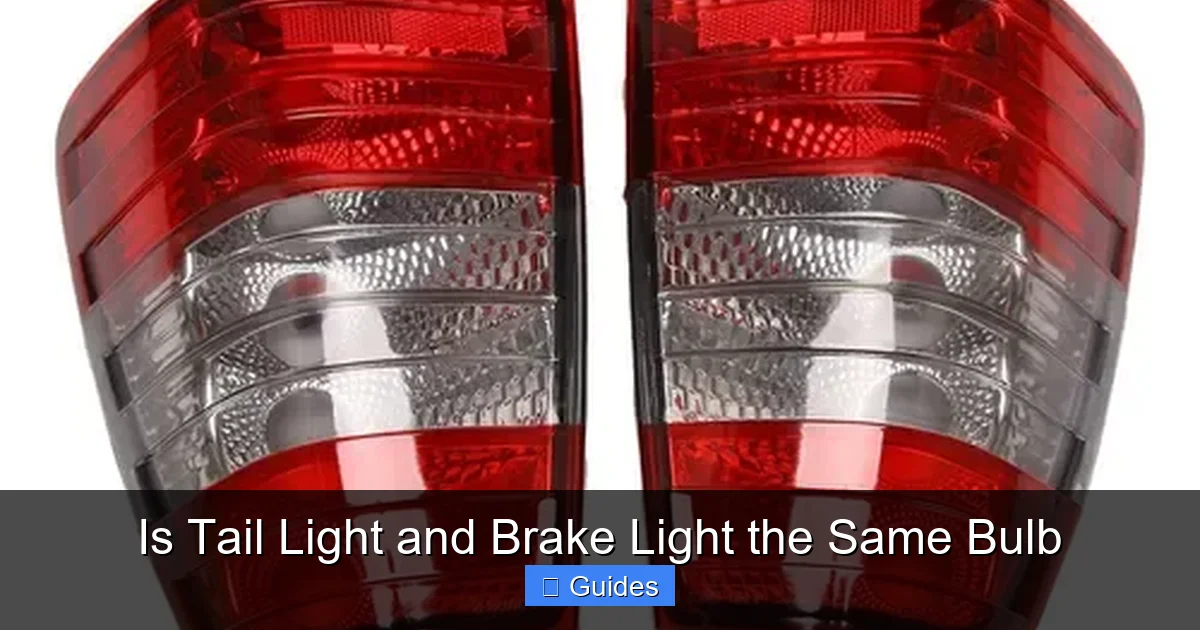
Visual guide about Is Tail Light and Brake Light the Same Bulb
Image source: http2.mlstatic.com
Now that we understand the distinct functions, let’s explore how vehicles achieve these different lighting behaviors. This is where the answer to “is tail light and brake light the same bulb?” really gets interesting.
Dual-Filament Bulbs: The Two-in-One Solution
For many years, and still common in countless vehicles today, the answer to whether your tail light and brake light are the same bulb is a resounding “yes, but it’s a special kind of bulb!” These are known as dual-filament bulbs. Imagine a regular incandescent light bulb, but instead of one tiny wire (filament) inside, it has two.
* How they work: One filament is smaller and designed to glow dimly, powered when your tail lights are on. The other filament is larger and much brighter, wired to illuminate only when you press the brake pedal. Both filaments are housed within the same glass envelope and share the same electrical base, fitting into a single socket in the tail light assembly. When you turn on your headlights, the dim filament lights up. When you press the brake, the brighter filament also lights up (or, if the tail light is already on, the brighter filament simply overrides or adds to the existing light, making the overall light much more intense).
* Common types: You’ll often see these labeled with numbers like 1157 or 3157 (for older cars) or sometimes 7443 (for newer cars that use a different base type). The “D” in some bulb codes often signifies a dual-filament design.
* Advantages: This setup is cost-effective, space-saving (one bulb, one socket), and simplifies the wiring somewhat by combining functions.
Single-Filament Bulbs: Separate Functions, Separate Bulbs
In contrast, some vehicles use entirely separate bulbs for each function. In these cases, the answer to “is tail light and brake light the same bulb?” is definitively “no.”
* How they work: Here, you’d have one single-filament bulb dedicated solely to the tail light function, and another separate single-filament bulb dedicated solely to the brake light function. Each bulb would have its own socket within the tail light housing. When your headlights are on, the tail light bulb illuminates. When you press the brake, the brake light bulb illuminates.
* Common types: Examples of single-filament bulbs often include 1156 or 3156.
* Advantages: This setup can sometimes simplify troubleshooting, as a failure in one function doesn’t necessarily impact the other (though it rarely does with dual-filament bulbs either, as usually only one filament burns out at a time). It also allows for more design flexibility in some cases.
The Role of LED Technology: A New Era of Lighting
More and more modern vehicles are moving away from traditional incandescent bulbs altogether and embracing Light Emitting Diodes (LEDs). When it comes to LEDs, asking “is tail light and brake light the same bulb?” becomes a bit outdated.
* How they work: Instead of a single bulb, LED tail light and brake light systems typically consist of a cluster of individual LEDs. These LEDs are arranged on a circuit board and are often integrated directly into the tail light housing, meaning you can’t just “unscrew” an LED bulb. For combined functions, the same cluster of LEDs can be illuminated at a lower intensity for the tail light and then at full intensity for the brake light. Alternatively, some designs use completely separate sets of LEDs within the same housing for each function, giving designers more freedom with light patterns and shapes.
* Advantages: LEDs offer numerous benefits: they’re much more energy-efficient, last significantly longer than incandescent bulbs, illuminate instantly (which can shave off crucial milliseconds in braking distance for following drivers), and allow for sleek, modern vehicle designs.
* Disadvantages: If an LED cluster fails, replacing it is often more complex and expensive, typically requiring the replacement of the entire tail light assembly rather than just a bulb.
Wiring and Circuitry: How They Work Together (or Separately)
The magic behind how these lights function, whether combined or separate, lies in the car’s electrical system. Understanding the basic wiring helps demystify the “is tail light and brake light the same bulb” question further.
Independent Circuits
Even when a dual-filament bulb is used, the two filaments operate on largely independent circuits.
* Tail light circuit: This circuit is activated when you turn on your vehicle’s parking lights or headlights. It provides a constant, lower voltage to the dim filament of a dual-filament bulb or to a dedicated tail light bulb.
* Brake light circuit: This circuit is activated by a pressure switch located near your brake pedal. When you press the pedal, the switch closes, completing the circuit and sending a higher voltage to the bright filament of a dual-filament bulb, or to a dedicated brake light bulb.
This separation means that a problem in one circuit (e.g., a blown fuse for the tail lights) might not affect the other (the brake lights could still work).
Shared Housing, Separate Control
Regardless of whether you have a dual-filament bulb or separate bulbs, the key takeaway is that the electrical control for each function is distinct. The tail light function is controlled by your headlight switch, and the brake light function is controlled by your brake pedal switch. This ensures that even if your tail light and brake light are the same bulb, they serve their unique purposes exactly when needed.
Why It Matters: Safety, Legality, and Troubleshooting
So, why go into all this detail? Beyond just knowing the answer to “is tail light and brake light the same bulb?” there are some very practical and important reasons to understand your vehicle’s lighting system.
Enhancing Road Safety
This is the most critical reason. Functional tail lights and brake lights are paramount for safety.
* Preventing rear-end collisions: Properly working brake lights provide crucial warning signals to drivers behind you. A delay in their illumination, or if they’re not bright enough, can lead to serious accidents.
* Nighttime visibility: Functional tail lights ensure your vehicle is visible to others from dusk till dawn, in bad weather, and whenever your headlights are on. Driving with a burnt-out tail light makes your car significantly harder to see, especially in traffic.
Legal Requirements and Inspections
In virtually every jurisdiction, it is a legal requirement for your vehicle to have properly functioning tail lights and brake lights.
* Traffic stops and fines: Driving with a non-functional tail light or brake light can lead to a traffic stop, a warning, or even a fine. Some areas might even impound your vehicle if it’s deemed unsafe.
* Vehicle inspections: Most states or countries require regular vehicle inspections, and functioning lights are a standard part of these checks. A failed light will result in a failed inspection, preventing you from legally operating your vehicle until it’s fixed.
* Insurance claims: In the unfortunate event of an accident, if your lights were found to be faulty, it could potentially complicate insurance claims or even assign partial fault to you.
Common Troubleshooting Scenarios
Knowing whether your tail light and brake light are the same bulb simplifies troubleshooting:
* “My tail light is out, but my brake light works!” If you have a dual-filament bulb, this often means the dimmer tail light filament has burned out, while the brighter brake light filament is still intact. You’ll need to replace the entire dual-filament bulb.
* “My brake light is out, but my tail light works!” Similarly, with a dual-filament bulb, this would indicate the brighter filament has failed. The solution is the same: replace the whole bulb. If you have separate bulbs, it means the dedicated brake light bulb has failed.
* “Both my tail light and brake light are out in one assembly!” This could indicate that both filaments of a dual-filament bulb have failed, or that both separate bulbs have failed. More commonly, it could point to an issue with the wiring, the socket itself, or a fuse related to that specific side of the vehicle.
* “Neither my brake lights nor my tail lights are working, even the third brake light!” This is a more serious issue that usually points to a blown brake light fuse, a faulty brake light switch (often located near the brake pedal), or a more widespread electrical problem.
Identifying and Replacing the Right Bulb
Now that you’re an expert on the theory, let’s get practical. How do you find out what kind of system your car uses and what to do if a light goes out?
Checking Your Car’s Manual
This is always your first and best resource! Your vehicle’s owner’s manual contains a wealth of information, including detailed diagrams of your lighting system, the specific bulb types (e.g., 1157, 3157, 7443) required for each function, and step-by-step instructions for replacement. Don’t skip this step!
Visual Inspection
If your manual isn’t handy or you want to confirm, a visual inspection can often tell you a lot.
* Incandescent bulbs: Carefully remove the tail light assembly (usually involves unscrewing a few fasteners from inside the trunk or cargo area) and then twist the bulb socket to remove it. If you see a single glass bulb with two visible wires (filaments) inside, you have a dual-filament bulb where the tail light and brake light are the same bulb. If you see two separate bulbs in two separate sockets in the same housing, then they are separate.
* LED systems: If you don’t see any traditional bulbs to remove, or if the light source looks like a panel of small glowing dots, you likely have an LED system. In this case, individual “bulbs” are not replaceable.
The Replacement Process (Brief Overview)
Replacing a bulb is generally a straightforward DIY task, but steps vary by vehicle:
1. Consult your manual: It will guide you on how to access the tail light assembly (usually from inside the trunk).
2. Remove the assembly/socket: Once inside, you’ll typically twist the bulb socket counter-clockwise to remove it from the housing.
3. Remove the old bulb: For wedge-style bulbs, just pull them straight out. For bayonet-style (push and twist) bulbs, push in slightly and twist counter-clockwise.
4. Insert the new bulb: Ensure you handle the new bulb by its base (especially if it’s halogen) to avoid getting oils from your skin on the glass, which can shorten its life. Insert and twist/push into place.
5. Test: Before reassembling everything, have a friend verify that both the tail light and brake light functions work with the new bulb.
6. Reassemble: Put everything back together in reverse order.
Remember, if you’re unsure or uncomfortable, a mechanic can perform this task quickly and affordably.
Conclusion
So, is tail light and brake light the same bulb? The answer is nuanced: often yes, if your car uses a dual-filament incandescent bulb designed to perform both tasks from a single socket. However, many vehicles, especially newer ones, use separate bulbs or integrated LED clusters that achieve the same two distinct functions with different hardware.
The key takeaway isn’t just about the physical bulb, but about the critical safety functions these lights perform. Your tail lights ensure you’re seen in the dark, and your brake lights unequivocally warn others when you’re slowing down. Regularly checking that both are working correctly is a simple yet profoundly important habit for every driver. It keeps you safe, keeps others safe, and keeps you compliant with the law. Next time you see a faulty rear light, you’ll know exactly what’s going on and what to do!
Frequently Asked Questions
What is the difference between a tail light and a brake light?
A tail light provides a dim, constant red light at the rear of your vehicle for nighttime visibility, showing other drivers your presence. A brake light, however, illuminates brightly only when you press the brake pedal, serving as an urgent warning that you are slowing down or stopping.
Do all cars use the same bulb for both tail and brake lights?
No, not all cars use the same bulb. Many older and some newer vehicles use a single dual-filament incandescent bulb, but others utilize separate single-filament bulbs for each function, or more commonly now, integrated LED clusters where individual diodes perform the different tasks.
How can I tell if my car has a dual-filament bulb for the tail and brake light?
The easiest way is to check your owner’s manual for the bulb specifications for your rear lights. Alternatively, you can visually inspect the bulb after removing it; a dual-filament bulb will clearly show two separate coiled wires (filaments) inside the glass casing.
What does it mean if my tail light works but my brake light doesn’t (or vice versa)?
If your car uses a dual-filament bulb, this typically means one of the two filaments inside that single bulb has burned out while the other is still functional. You would need to replace the entire dual-filament bulb to restore both functions.
Is it legal to drive with a broken tail light or brake light?
No, it is generally illegal to drive with a broken or non-functional tail light or brake light in most jurisdictions. It poses a significant safety risk as it impairs your vehicle’s visibility and ability to signal intentions, potentially leading to fines or even an accident.
Are LED tail lights and brake lights replaceable like traditional bulbs?
For most vehicles with LED lighting, the individual LEDs themselves are not designed to be user-replaceable. If an LED segment or cluster fails, you typically need to replace the entire tail light assembly, which can be more expensive than just replacing an incandescent bulb.
