


As an Amazon Associate, We earn from qualifying purchases.
The incandescent light bulb is a classic lighting device that produces light by heating a thin filament to incandescence, meaning it glows intensely hot. This simple yet revolutionary technology, popularized by inventors like Thomas Edison, transformed societies by providing widespread, affordable electric illumination. Despite its warm, familiar glow and instant operation, the incandescent light bulb is largely phased out today due to its significant energy inefficiency and shorter lifespan compared to modern alternatives like LEDs.
Have you ever stopped to think about the humble light bulb? Not the sleek, modern LED lamps we see everywhere today, but its grandparent – the classic incandescent light bulb. For over a century, this simple invention was more than just a source of light; it was a symbol of progress, innovation, and a world transformed from gaslight to electric brilliance. It allowed us to work, read, and socialize long after the sun went down, fundamentally reshaping daily life and human society.
From dimly lit homes to brightly lit city streets, the incandescent light bulb cast its warm glow across generations. It’s an iconic piece of technology, instantly recognizable with its pear-shaped glass and glowing wire inside. But what exactly *is* the incandescent light bulb? How did it work, and what made it such a game-changer? Join us on a journey to explore the inner workings, fascinating history, and enduring legacy of this brilliant invention that, even in its declining use, remains a testament to human ingenuity.
This article will dive deep into the world of the incandescent light bulb, explaining its core principles, anatomy, historical development, and the reasons behind its eventual phase-out. We’ll uncover why it was so beloved and why, despite its charm, it ultimately paved the way for more energy-efficient lighting solutions. Get ready to illuminate your understanding of this truly revolutionary device.
Key Takeaways
- Core Function: An incandescent light bulb produces light when electricity heats a thin, coiled wire filament, typically made of tungsten, to extremely high temperatures until it glows intensely (incandescence).
- Key Components: Its basic structure includes a glass bulb (envelope), a tungsten filament, lead-in wires, a stem, and a screw base, often filled with an inert gas like argon or nitrogen to extend filament life.
- Historical Significance: While many contributed, Thomas Edison is widely credited with developing a commercially practical and long-lasting incandescent light bulb in the late 19th century, revolutionizing home and street lighting.
- Energy Inefficiency: A major drawback of the incandescent bulb is its inefficiency; about 90% of the energy it consumes is converted into heat rather than visible light, making it a significant energy consumer.
- Warm Light Quality: Incandescent bulbs are known for their warm, yellowish light (low color temperature) and excellent color rendering index (CRI), making colors appear natural and vibrant, a quality often sought in modern lighting.
- Global Phase-Out: Due to their low energy efficiency, many countries have implemented regulations to phase out the sale of traditional incandescent light bulbs, encouraging the adoption of more energy-efficient alternatives like CFLs and LEDs.
- Legacy and Specialty Uses: Despite widespread replacement, the incandescent light bulb left an indelible mark on culture and design, and still finds niche applications in specialty lighting, ovens, and specific aesthetic contexts.
Quick Answers to Common Questions
What is the main principle behind an incandescent light bulb?
An incandescent light bulb works by passing an electric current through a thin filament, heating it to such a high temperature that it glows and emits visible light.
Who is largely credited with developing the first practical incandescent light bulb?
Thomas Edison and his team are widely credited with developing the first commercially practical and long-lasting incandescent light bulb in 1879.
Why are incandescent light bulbs considered energy inefficient?
Incandescent bulbs are inefficient because approximately 90% of the energy they consume is converted into heat rather than light, making them significant energy waste producers.
What primary technologies have replaced incandescent light bulbs?
Compact Fluorescent Lamps (CFLs) and, more predominantly, Light-Emitting Diodes (LEDs) have largely replaced incandescent light bulbs due to their superior energy efficiency and longer lifespans.
Can you still buy incandescent light bulbs today?
General-purpose incandescent light bulbs have been phased out in many regions, but specialty incandescent bulbs for appliances, heat lamps, or decorative purposes may still be available.
📑 Table of Contents
- The Core Concept: How the Incandescent Light Bulb Works
- A Glimpse into History: The Incandescent Light Bulb’s Journey
- Why We Loved Them: The Benefits of Incandescent Lighting
- The Downsides: Why the Incandescent Light Bulb Had to Evolve
- The Transition Away: Incandescent Light Bulbs in the Modern Era
- Conclusion
The Core Concept: How the Incandescent Light Bulb Works
At its heart, the incandescent light bulb is surprisingly simple. It takes electricity and turns it into light by making something extremely hot. The magic happens through a process called incandescence.
The Principle of Incandescence
“Incandescence” might sound like a fancy scientific term, but it just means “emitting light as a result of being heated.” Think about a piece of metal in a blacksmith’s forge: as it gets hotter and hotter, it first glows a dull red, then orange, then yellow, and eventually a bright white. The incandescent light bulb works on this very same principle. When an electric current passes through a thin, resistant wire, it causes the wire to heat up dramatically. If it gets hot enough – usually thousands of degrees Celsius – it begins to emit visible light.
Anatomy of the Incandescent Light Bulb
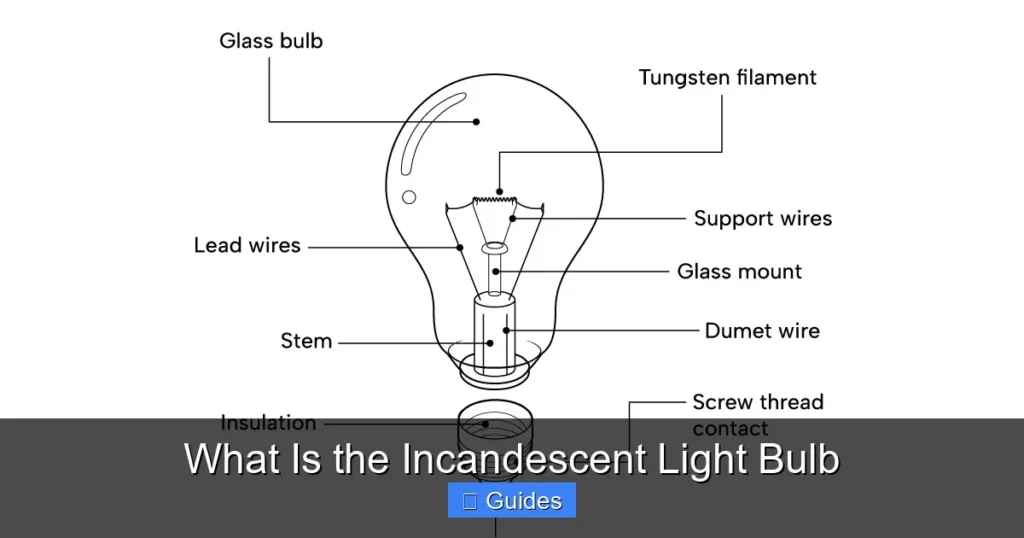
To understand what is the incandescent light bulb, it helps to break it down into its key components. Each part plays a crucial role in making the bulb work safely and effectively.
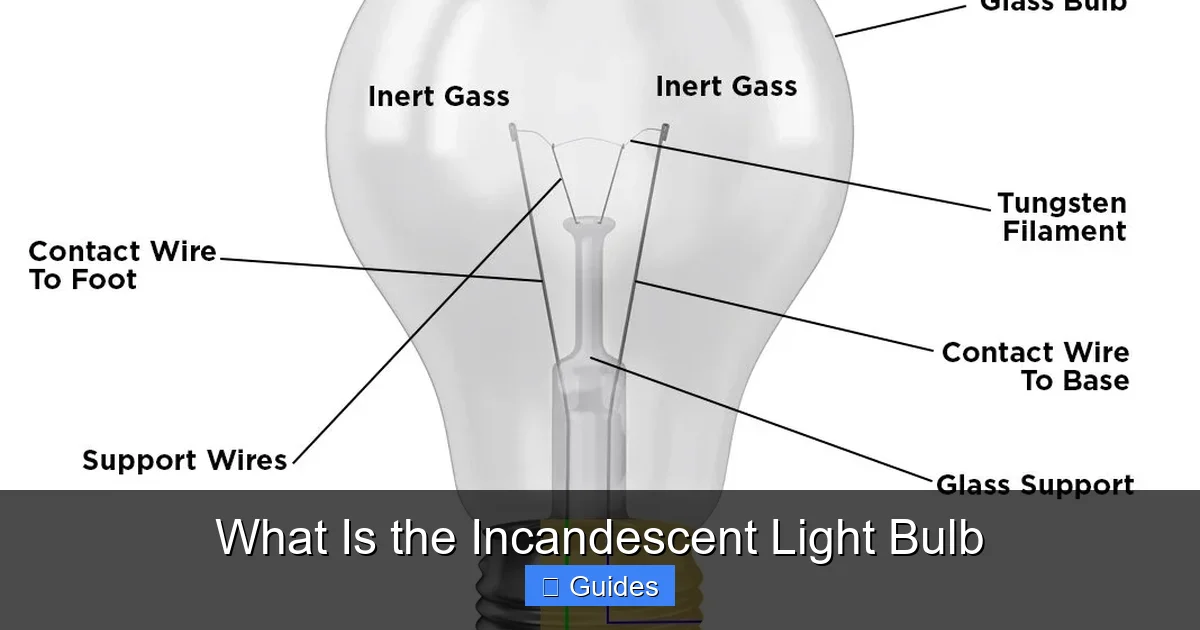
- The Filament: This is the heart of the incandescent light bulb, typically a very thin, coiled wire made of tungsten. Tungsten is chosen because it has an incredibly high melting point (over 3,400°C), allowing it to get intensely hot without melting. The coil design increases the wire’s length within a small space, maximizing light output.
- The Glass Bulb (Envelope): This is the familiar outer glass shell that protects the filament. It’s usually evacuated (a vacuum) or filled with an inert gas like argon or nitrogen. This is crucial because oxygen would cause the superheated tungsten filament to rapidly oxidize and burn out almost instantly. The inert gas also slows down the evaporation of the tungsten, extending the filament’s life.
- Lead-in Wires: These wires connect the filament to the electrical contacts in the base of the bulb. They are usually made of nickel-iron alloys or copper, designed to conduct electricity efficiently and withstand the heat generated by the filament.
- The Stem (or Mount): This glass support structure holds the filament and lead-in wires in place, maintaining their position within the bulb. It also forms a hermetic seal where the lead-in wires pass through the glass, preventing air from entering.
- The Base: This is the metal part at the bottom of the bulb that screws into a light fixture. It serves two purposes: providing mechanical support to hold the bulb in place and offering electrical contacts for the power supply. Most common are the Edison screw bases, but bayonet bases are also used.
- Exhaust Tube: During manufacturing, the bulb’s interior is evacuated or filled with inert gas through a small tube in the stem. Once complete, this tube is sealed, often leaving a tiny “tip” or “pip” at the bottom of the stem inside the bulb.
The Journey of Light: From Electricity to Glow
When you flip a switch, electricity flows from the power outlet, through the light fixture, and into the base of the incandescent light bulb. From the base, it travels up the lead-in wires to the tiny tungsten filament. Because the filament is so thin and has a relatively high electrical resistance, it opposes the flow of electrons. This resistance causes the electrical energy to be converted into heat.
As the filament rapidly heats up – reaching temperatures often between 2,200°C and 2,700°C (4,000°F to 4,900°F) – it begins to glow brightly, emitting visible light. This light then passes through the clear or frosted glass bulb, illuminating your room. It’s a beautifully simple and effective process that harnessed a fundamental physical phenomenon to create something entirely new and powerful: widespread artificial light.
A Glimpse into History: The Incandescent Light Bulb’s Journey
Visual guide about What Is the Incandescent Light Bulb
Image source: images.squarespace-cdn.com
The story of the incandescent light bulb isn’t just about a single inventor; it’s a saga of incremental improvements, fierce competition, and a relentless pursuit of practical, affordable light.
Early Experiments and Inventors
Long before Thomas Edison, many brilliant minds experimented with electric light. As early as 1800, Humphry Davy demonstrated the “electric arc lamp.” In 1840, British scientist Warren de la Rue enclosed a coiled platinum filament in a vacuum tube and passed an electric current through it, creating light. However, platinum was too expensive for practical use.
Over the next few decades, inventors like Joseph Swan in England and Henry Woodward and Matthew Evans in Canada made significant strides. Swan, in particular, created long-lasting bulbs with carbonized paper filaments in the 1860s and 70s, even demonstrating them publicly and lighting homes. These early versions, however, still faced challenges with filament longevity and vacuum technology.
Edison’s Breakthrough and Commercialization
Thomas Edison and his team in Menlo Park, New Jersey, are often credited with inventing the incandescent light bulb. While they didn’t invent the concept of electric light, Edison’s crucial contribution in 1879 was developing a *commercially practical* and *long-lasting* incandescent light bulb. His team experimented with thousands of materials for the filament, eventually discovering that a carbonized cotton thread filament, enclosed in a nearly perfect vacuum, could burn for an astonishing 13.5 hours. He later improved this to a carbonized bamboo filament, which lasted over 1,200 hours.
Edison’s genius wasn’t just in the bulb itself, but in creating an entire system for electric light – including generators, wiring, switches, and meters. This “system approach” made electric lighting safe, reliable, and accessible, leading to its rapid adoption. The first commercial power station, Edison’s Pearl Street Station in New York City, began operating in 1882, literally electrifying the world.
Evolution and Mass Adoption
After Edison’s initial success, improvements continued. In the early 20th century, the tungsten filament was introduced, vastly increasing efficiency and lifespan. Irving Langmuir, at General Electric, further improved the incandescent light bulb by filling it with inert gas in 1913, which reduced tungsten evaporation and allowed higher filament temperatures, resulting in brighter, longer-lasting bulbs.
By the mid-20th century, the incandescent light bulb was ubiquitous. It became a staple in homes, businesses, and public spaces, defining the era of electric illumination. Its widespread availability and affordability made it the dominant lighting technology for decades, shaping architecture, interior design, and our very routines.
Why We Loved Them: The Benefits of Incandescent Lighting
Despite their eventual shortcomings, incandescent light bulbs offered several compelling advantages that contributed to their widespread popularity and enduring appeal for so long.
Warm, Familiar Light
Perhaps the most cherished quality of the incandescent light bulb is the quality of light it produces. Incandescent bulbs emit a warm, inviting glow, typically around 2700 Kelvin (K), which is on the yellowish-red end of the color temperature spectrum. This light is often described as comforting, cozy, and natural, reminiscent of candlelight or a campfire. It’s the light most people grew up with, making it feel inherently familiar and pleasant in homes and hospitality settings.
Excellent Color Rendition (CRI)
Incandescent bulbs boast an almost perfect Color Rendering Index (CRI) of 100. CRI measures how accurately a light source reveals the true colors of objects compared to natural daylight. Because incandescent light bulbs produce a continuous spectrum of light, they render colors faithfully and vibrantly. This was particularly important in applications like art galleries, retail displays, and photography, where accurate color representation is crucial. No color appears washed out or distorted under an incandescent light bulb.
Instant On and Dimmability
Unlike some earlier and even modern lighting alternatives, incandescent light bulbs provide instant illumination. There’s no warm-up delay; you flip the switch, and the light is immediately at full brightness. This responsiveness was a significant convenience. Furthermore, incandescent bulbs are incredibly easy to dim. Simple, inexpensive dimmer switches can control their brightness smoothly from 0% to 100%, making them ideal for creating ambiance and adjustable lighting levels in any space. This ease of dimming is still a benchmark for other lighting technologies.
Low Manufacturing Cost
For many decades, the manufacturing process for incandescent light bulbs was highly refined and inexpensive. The materials were relatively common, and the assembly lines were efficient, making incandescent bulbs incredibly affordable for consumers to purchase. This low initial cost was a significant factor in their widespread adoption, making electric light accessible to nearly everyone.
The Downsides: Why the Incandescent Light Bulb Had to Evolve
While cherished for its warm glow, the incandescent light bulb carried significant drawbacks that ultimately led to its decline and replacement by more modern technologies.
Energy Inefficiency: The Heat Problem
The biggest Achilles’ heel of the incandescent light bulb is its abysmal energy efficiency. Remember how it works by heating a filament to incandescence? Well, most of that energy, about 90%, is released as heat, not visible light. Only a meager 10% (or less) of the electricity consumed actually contributes to illumination. This means that a 100-watt incandescent light bulb is essentially a 90-watt heater with a 10-watt light source attached. This massive energy waste contributes to higher electricity bills and a larger carbon footprint.
Short Lifespan
Compared to modern alternatives, the typical incandescent light bulb has a relatively short operational life. A standard incandescent bulb lasts around 750 to 1,000 hours. This means frequent replacements, which can be inconvenient and add to maintenance costs, especially in large installations. The high temperature of the filament causes tungsten atoms to slowly evaporate over time, thinning the filament until it eventually breaks, signaling the end of the bulb’s life.
Fragility
The glass envelope and delicate tungsten filament make the incandescent light bulb quite fragile. They can easily shatter if dropped or bumped, posing a safety hazard from broken glass and requiring careful handling. This fragility limits their use in certain environments where impact or vibration is common.
Environmental Concerns
The combination of low energy efficiency and short lifespan led to significant environmental concerns. The high electricity consumption translated to increased demand on power grids, often supplied by fossil fuel-burning power plants, contributing to greenhouse gas emissions. Furthermore, the sheer volume of discarded incandescent light bulbs added to landfill waste. While they don’t contain harmful chemicals like mercury (found in some CFLs), their rapid consumption of resources and energy still made them less sustainable than newer options.
The Transition Away: Incandescent Light Bulbs in the Modern Era
Recognizing the limitations and environmental impact of the incandescent light bulb, the world embarked on a journey to find and adopt better lighting solutions.
The Rise of Alternatives (CFLs, LEDs)
The quest for more efficient lighting began with the development of the Compact Fluorescent Lamp (CFL) in the 1980s. CFLs used a different mechanism, passing electricity through gas to produce UV light, which then excited a phosphor coating to emit visible light. They were significantly more efficient than incandescents and had a much longer lifespan, though they often had a warm-up period and contained small amounts of mercury.
However, the real game-changer came with the widespread adoption and improvement of Light-Emitting Diodes (LEDs) in the 21st century. LEDs work by passing current through a semiconductor material, directly converting electricity into light without generating much heat. Modern LED bulbs are incredibly energy-efficient (up to 90% more efficient than incandescents), boast incredibly long lifespans (25,000 to 50,000 hours or more), and are highly durable. They can also mimic the warm glow of an incandescent light bulb, offering various color temperatures and excellent dimmability. Today, the LED is the dominant lighting technology, and it represents a huge leap forward in efficiency and performance.
Global Phase-Outs and Regulations
Due to their inefficiency, many governments worldwide implemented regulations to phase out the sale of traditional incandescent light bulbs. Countries like Australia, Canada, the European Union, and the United States introduced legislation to ban the manufacture and import of inefficient general-purpose incandescent bulbs, starting in the late 2000s and continuing through the 2010s and beyond. These regulations aimed to reduce energy consumption, lower carbon emissions, and encourage the adoption of more energy-efficient alternatives. This meant that while you might still find specialty incandescent bulbs, the everyday bulbs that once lit our homes became increasingly scarce on store shelves.
Where You Might Still Find Them (Specialty Uses)
Even with the widespread phase-out, the incandescent light bulb hasn’t entirely disappeared. You might still encounter them in specific niche applications where their unique characteristics are either essential or preferred. For instance:
- Appliances: Many ovens, refrigerators, and range hoods still use incandescent bulbs because they are designed to withstand high temperatures or specific vibrations, and their compact size might be suitable for tight spaces.
- Specialty Lighting: Certain decorative or aesthetic applications, like lava lamps, party lights, or specific vintage-style fixtures, might still utilize incandescent technology for its unique look or heat generation.
- Heat Lamps: Because they produce so much heat, incandescents are still used in heat lamps for warming food, keeping animals warm, or in some therapeutic applications.
- Indicator Lights: Some older equipment or simple indicator lights might still use small incandescent bulbs due to their simplicity and low cost for very low power applications.
These specialty uses, however, represent a tiny fraction of the lighting market compared to the general-purpose lighting that incandescent bulbs once dominated.
Conclusion
What is the incandescent light bulb? It is more than just a historical artifact; it is the cornerstone of modern illumination, a testament to human ingenuity that literally brought light into the darkness. For over a century, it served as the primary means of electric lighting, fostering social and economic development on an unprecedented scale. Its warm, familiar glow and perfect color rendition endeared it to generations, making it a beloved fixture in homes and businesses worldwide.
While the incandescent light bulb ultimately yielded to more energy-efficient technologies like LEDs due to its inherent inefficiency and shorter lifespan, its legacy is undeniable. It sparked a revolution, paved the way for continuous innovation in lighting, and left an indelible mark on how we live, work, and interact with the world around us. Even as we embrace the brilliant future of sustainable lighting, we can still appreciate the simple yet profound genius of the incandescent light bulb, the invention that illuminated our past and set the stage for our bright present.
Frequently Asked Questions
What is the fundamental difference between an incandescent light bulb and an LED bulb?
The fundamental difference lies in how they produce light. An incandescent bulb creates light by heating a filament until it glows, wasting most energy as heat. An LED bulb generates light through semiconductors, converting electricity directly into light much more efficiently and with minimal heat.
Are incandescent light bulbs bad for the environment?
Yes, compared to modern alternatives, incandescent bulbs are considered environmentally less friendly. Their low energy efficiency leads to higher electricity consumption and associated carbon emissions from power generation, and their short lifespan contributes more frequently to landfill waste.
What does “incandescence” specifically mean in the context of light?
“Incandescence” refers to the emission of light by a body as a result of being heated to a high temperature. In an incandescent light bulb, the tungsten filament becomes incandescent when electricity heats it to thousands of degrees Celsius, causing it to glow brightly.
Why did incandescent light bulbs have such a warm, yellowish light?
The warm, yellowish light of an incandescent bulb is due to the temperature at which its tungsten filament operates. At around 2700 Kelvin, the filament emits more light in the red and yellow parts of the spectrum, producing a light quality that mimics natural firelight and feels cozy.
Are there any specific situations where incandescent bulbs are still preferred or necessary?
While largely phased out for general lighting, incandescent bulbs are still preferred in specific niche applications. These include heat lamps (due to their high heat output), some older appliance bulbs (like those in ovens that tolerate high temperatures), and certain decorative or specialized industrial settings where their unique spectral output or heat generation is desired.
How should I dispose of old incandescent light bulbs?
Old incandescent light bulbs can generally be disposed of with regular household waste, as they do not contain harmful chemicals like mercury. However, it’s always a good idea to check local recycling guidelines, as some communities may have specific recommendations or facilities for glass waste.
