


As an Amazon Associate, We earn from qualifying purchases.
Understanding what determines the brightness of a light bulb goes beyond just watts. While watts measure energy consumption, lumens are the real indicator of how bright a light bulb is, representing the total visible light emitted. Factors like bulb technology (LED, incandescent), voltage, efficacy (lumens per watt), and even beam angle also play significant roles in the perceived brightness, helping you choose the perfect lighting for any space.
What Determines the Brightness of a Light Bulb
Have you ever stood in the lighting aisle, scratching your head, wondering exactly what determines the brightness of a light bulb? For decades, we were taught to look at watts. A 60-watt bulb felt pretty standard, a 100-watt bulb was definitely brighter, and anything less was for mood lighting. It was a simple, albeit misleading, system. But with the advent of energy-efficient lighting like LEDs and CFLs, that old rule of thumb has gone completely out the window. Now, a 10-watt LED can easily outshine a traditional 60-watt incandescent!
So, if watts aren’t the answer anymore, what does determine the brightness of a light bulb? The truth is, it’s a fascinating mix of physics, electrical engineering, and even a bit of perception. Understanding these factors isn’t just for science enthusiasts; it’s incredibly practical. Knowing the real science behind light bulb brightness can help you choose the right bulbs for your home, save money on your electricity bill, and create the perfect ambiance for any space.
In this comprehensive guide, we’re going to demystify light bulb brightness. We’ll dive deep into the key measurements, explore how different bulb technologies work their magic, look at the crucial role electricity plays, and even consider how external factors can influence what you perceive as bright. By the end, you’ll be a light bulb connoisseur, ready to make informed decisions and truly understand what determines the brightness of a light bulb.
Key Takeaways
- Lumens are Key: Lumens, not watts, are the direct measure of a light bulb’s visible brightness. A higher lumen rating means more light is emitted.
- Watts are for Power: Watts indicate the energy consumption of a light bulb, showing how much electricity it uses, not how bright it inherently is.
- Technology Matters: Different bulb types (incandescent, LED, CFL) produce light with varying efficiencies. LEDs are the most efficient, generating more lumens per watt.
- Voltage and Current: The electrical power supplied to a bulb (determined by voltage and current) directly impacts its energy consumption and, consequently, its light output and brightness.
- Efficacy is Efficiency: A bulb’s efficacy (measured in lumens per watt) tells you how efficiently it converts electricity into visible light. Higher efficacy means more light for less power.
- Design and Environment: Factors like a bulb’s beam angle, color temperature, and even the reflectivity of a room can significantly influence the perceived brightness of a light bulb.
- Dimming Controls Power: Dimmers work by reducing the electrical power supplied to a bulb, thereby lowering its energy consumption and, as a result, its light output and brightness.
Quick Answers to Common Questions
What is the primary factor for measuring a light bulb’s brightness?
The primary factor for measuring a light bulb’s brightness is lumens. Lumens indicate the total amount of visible light emitted by the bulb.
Do more watts always mean a brighter light bulb?
No, more watts do not always mean a brighter light bulb. Watts measure energy consumption, while lumens measure brightness. An energy-efficient LED bulb can produce the same or more lumens than a high-wattage incandescent bulb.
What is “efficacy” in relation to light bulbs?
Efficacy refers to how efficiently a light bulb converts electrical energy into light, measured in lumens per watt (lm/W). Higher efficacy means more light for less power.
How does voltage affect light bulb brightness?
Voltage is the electrical pressure supplied to the bulb. If the voltage is too low, the bulb will not receive enough power and will appear dimmer. If too high, it will be brighter but burn out quickly.
Can the color of a room affect how bright a light bulb seems?
Yes, the color of a room significantly affects perceived brightness. Lighter colored walls and ceilings reflect light, making a room feel brighter, while darker colors absorb light, making it feel dimmer.
📑 Table of Contents
The Core Factors: Watts, Lumens, and Efficacy
Let’s kick things off by tackling the most common misconceptions and introducing the true heroes of light measurement. Understanding these terms is fundamental to grasping what determines the brightness of a light bulb.
Understanding Watts: Power Consumption, Not Brightness
For generations, people bought light bulbs based on watts. “I need a 60-watt bulb for my living room,” they’d say. This made sense when almost all bulbs were incandescent, because for a given incandescent technology, higher watts *did* generally mean more light. But here’s the crucial point: a watt is a unit of power, specifically, the rate at which electrical energy is consumed. It tells you how much electricity the bulb uses, not how much light it produces. Think of it like a car’s fuel consumption: a car that uses more fuel isn’t necessarily faster, it just uses more energy. Similarly, a bulb with more watts isn’t necessarily brighter; it just draws more power from the electrical outlet. This is a critical distinction when considering what determines the brightness of a light bulb in today’s market.
Lumens: The True Measure of Brightness
If watts are about consumption, then lumens are all about production. A lumen (lm) is the international standard unit for measuring the total amount of visible light emitted by a source. When you see a bulb advertised with 800 lumens, that means it’s emitting 800 units of light that your eyes can detect. The higher the lumen number, the brighter the light bulb will appear. This is the single most important number to look for when you want to know what determines the brightness of a light bulb.
For example, a traditional 60-watt incandescent bulb typically produces around 800 lumens. An energy-efficient LED bulb can produce the same 800 lumens while only consuming about 9-10 watts of power. This stark difference clearly illustrates why lumens have replaced watts as the go-to metric for brightness. Always check the lumen rating to truly understand how much light you’re getting.
Efficacy: How Efficiently Light is Produced (Lumens per Watt)
Beyond just watts and lumens, there’s a third term that helps us understand the efficiency of a light bulb: efficacy. Efficacy is simply the ratio of lumens produced to watts consumed (lumens/watt or lm/W). It tells you how efficiently a light bulb converts electrical energy into visible light. A bulb with high efficacy is very efficient, producing a lot of light (high lumens) for very little power (low watts).
For example:
- A 60-watt incandescent bulb producing 800 lumens has an efficacy of about 13.3 lm/W (800 lm / 60 W).
- A 9-watt LED bulb producing 800 lumens has an efficacy of about 88.9 lm/W (800 lm / 9 W).
This huge difference in efficacy highlights why LEDs are so popular for energy savings. When you’re trying to figure out what determines the brightness of a light bulb in terms of energy consumption, efficacy is your best friend.
Bulb Technology: How Different Types Create Light
Visual guide about What Determines the Brightness of a Light Bulb
Image source: i2.wp.com
The way a bulb actually produces light plays a massive role in its efficiency and, by extension, what determines the brightness of a light bulb for a given amount of energy. Different technologies convert electricity into light in fundamentally different ways.
Incandescent Bulbs: Heating a Filament
Incandescent bulbs are the classic light source, invented by Thomas Edison. They work by passing an electric current through a thin wire filament, usually made of tungsten. This filament heats up to extreme temperatures (around 4,500°F or 2,500°C), causing it to glow brightly, a process called incandescence. The problem is that most of the energy is wasted as heat, not light. They are very inefficient, converting only about 5-10% of the energy into visible light. This inefficiency means that to get a lot of brightness, they need a lot of watts, making them expensive to run.
Halogen Bulbs: Improved Incandescent
Halogen bulbs are a type of incandescent bulb, but with a clever twist. They use a halogen gas (like iodine or bromine) inside the bulb, which helps regenerate the tungsten filament. This allows the filament to burn hotter, producing a brighter, whiter light and slightly improving efficiency compared to standard incandescents. They last a bit longer too. While better, they still operate on the incandescent principle and are far from the most efficient lighting option when considering what determines the brightness of a light bulb.
Fluorescent Bulbs (CFLs): Gas and UV Light
Compact Fluorescent Lamps (CFLs) and their larger tubular cousins work in a completely different way. They contain a gas (typically argon and a small amount of mercury vapor) within a glass tube. When electricity flows through this gas, it excites the mercury atoms, causing them to emit ultraviolet (UV) light. This invisible UV light then strikes a phosphor coating on the inside of the bulb, which glows brightly in visible light. This two-step process is much more efficient than incandescence, converting a higher percentage of electricity into light. CFLs offer a good balance of brightness and energy efficiency, though they contain mercury, which requires careful disposal.
LED Bulbs: Semiconductors and Efficiency Kings
Light Emitting Diodes (LEDs) are the superstars of modern lighting technology, fundamentally reshaping what determines the brightness of a light bulb. LEDs are semiconductors that produce light through electroluminescence. When an electric current passes through them, electrons and holes recombine, releasing energy in the form of photons (light). This process is incredibly efficient because it generates very little heat compared to incandescent bulbs.
LEDs can produce a vast amount of lumens with very little wattage, offering superior efficacy. They also boast incredibly long lifespans, are durable, and can be designed for various beam angles and color temperatures. Their ability to deliver high brightness with minimal power consumption makes them the most advanced and widely adopted lighting solution today, giving consumers unprecedented control over their lighting choices.
Electrical Considerations: Voltage and Current
Beyond the bulb itself, the electrical supply powering it is absolutely crucial. The exact amount of electrical energy delivered to the bulb directly impacts its performance and, by extension, what determines the brightness of a light bulb.
Voltage: The Electrical Push
Voltage is often described as the “electrical pressure” or the “force” that pushes electric current through a circuit. In most homes, the standard voltage is around 120 volts (V) in North America or 230-240V in many other parts of the world. Bulbs are designed to operate optimally at a specific voltage. If a bulb receives a lower voltage than it’s designed for (undervoltage), it won’t get enough power to heat its filament sufficiently (for incandescents) or excite its semiconductors fully (for LEDs), resulting in significantly reduced brightness. Conversely, if it receives a much higher voltage (overvoltage), it will burn brighter than intended but its lifespan will be drastically shortened, often leading to immediate burnout.
Current: The Flow of Electrons
While voltage is the push, current (measured in amperes or amps, A) is the actual “flow” of electrons through the circuit. It’s the quantity of charge moving past a point per unit of time. For a light bulb to illuminate, current must flow through it. The amount of current a bulb draws is determined by its design (resistance) and the voltage applied. More current means more electrons are flowing, which contributes to more power being delivered to the bulb.
Ohm’s Law and Power (P=VI): The Relationship
The relationship between voltage, current, and power is fundamental to understanding how electricity affects bulb brightness. Ohm’s Law states that Voltage (V) = Current (I) x Resistance (R). Furthermore, Power (P) = Voltage (V) x Current (I). This equation, P=VI, is key. It tells us that the total power consumed by a bulb (in watts) is directly proportional to both the voltage and the current supplied to it.
Since we know that power consumption (watts) is linked to lumen output (efficacy), it logically follows that fluctuations in voltage or current will directly impact the power drawn by the bulb, and thus its lumen output and visible brightness. For example, a “brownout” where the voltage temporarily drops will make your lights dim because the bulb isn’t receiving enough power (less P due to less V). This intricate dance of electricity is central to what determines the brightness of a light bulb.
Dimming Systems: Controlling Power and Brightness
Dimmers are a perfect real-world example of how controlling electrical input directly affects brightness. Traditional dimmers for incandescent bulbs work by rapidly turning the power on and off many times per second (a technique called phase-cutting). By varying the percentage of time the power is “on,” the dimmer effectively reduces the average voltage and current supplied to the bulb. Less power means the filament doesn’t get as hot, producing less light and thus reducing brightness.
For LEDs and CFLs, dimming is more complex and requires specially designed dimmable bulbs and compatible dimmers. These dimmers might still use phase-cutting, but the bulb’s internal electronics (driver) must be able to interpret these signals correctly to adjust the light output without flickering or damage. This direct control over electrical power is precisely what determines the brightness of a light bulb when using a dimmer.
Environmental and Design Factors
While lumens and electrical input are the objective measures of light output, how bright a bulb *appears* can also be influenced by a variety of design and environmental factors. These often tweak our perception of what determines the brightness of a light bulb in a given space.
Bulb Shape and Beam Angle: Directing the Light
The physical design of the bulb and its intended light distribution can dramatically affect perceived brightness.
- Omnidirectional bulbs: These (like standard A-shape bulbs) cast light in all directions, spreading it widely.
- Directional bulbs: Bulbs like PAR (parabolic aluminized reflector) or BR (bulged reflector) types, often used in recessed lighting or spotlights, are designed with built-in reflectors to focus light into a narrower beam (measured in beam angle). A bulb with a tight beam angle can make a specific spot appear very bright, even if its total lumen output is no higher than an omnidirectional bulb with a wider spread. This is because the same amount of light is concentrated into a smaller area.
So, while the total lumens tell you how much light is produced, the beam angle tells you where that light goes, directly influencing where and how bright things appear.
Color Temperature (Kelvin): Perceived Brightness and Mood
Color temperature, measured in Kelvin (K), describes the hue of the light a bulb emits. Lower Kelvin numbers (e.g., 2700K-3000K) produce “warm” light, appearing yellowish-white, similar to traditional incandescents. Higher Kelvin numbers (e.g., 4000K-5000K and above) produce “cool” light, appearing bluish-white.
Interestingly, cooler light often *feels* brighter and more intense to the human eye, even if its actual lumen output is identical to a warmer light. This is a psychological effect; cooler light is associated with daylight and alertness. So, while color temperature doesn’t change what determines the brightness of a light bulb in terms of total lumens, it certainly impacts the perceived brightness and overall ambiance of a room.
Light Distribution: Spreading the Glow
Closely related to beam angle, light distribution refers to how the light from a fixture is spread across a surface or throughout a room. Some fixtures are designed to provide direct light (e.g., task lighting), while others offer indirect or diffused light (e.g., general ambient lighting). A light source that directly illuminates a surface will make that surface appear brighter than one that casts light indirectly or diffuses it broadly, even if the total lumen output is the same. The way light is distributed is a key factor in achieving desired brightness levels in different areas.
Surrounding Environment: Room Color, Reflectivity
Finally, the room itself plays a huge role in how bright a light bulb appears.
- Wall and Ceiling Colors: Lighter colors (whites, pastels) reflect light, bouncing it around the room and making the space feel brighter and more expansive. Darker colors absorb light, making the room feel dimmer and cozier, even with the same lumen output.
- Reflective Surfaces: Mirrors, glossy finishes, and certain metallic decorations can reflect light, increasing the overall perceived brightness.
- Windows and Natural Light: The presence and amount of natural daylight can significantly supplement artificial lighting, affecting how much “extra” brightness your bulbs need to provide.
These environmental factors don’t change what determines the brightness of a light bulb itself, but they absolutely influence the overall illumination and perceived brightness of the entire space.
Practical Tips for Choosing and Controlling Brightness
Now that you’re well-versed in the science of light, let’s translate that knowledge into practical advice for your home and lifestyle. Understanding what determines the brightness of a light bulb allows for smarter choices.
Matching Lumens to Your Needs
Forget watts for brightness; focus on lumens! Here’s a rough guide to help you choose:
- Accent/Mood Lighting (e.g., nightlights, decorative): 100-300 lumens
- Task Lighting (e.g., reading lamps, under-cabinet): 400-800 lumens
- General Room Lighting (e.g., living rooms, bedrooms):
- Small room (under 100 sq ft): 800-1200 lumens
- Medium room (100-200 sq ft): 1200-2500 lumens
- Large room (over 200 sq ft): 2500-5000+ lumens (often multiple bulbs)
- Kitchens/Bathrooms/Workspaces (need more focused brightness): 2000-4000+ lumens (again, usually multiple bulbs or brighter individual ones).
Remember these are guidelines. Personal preference, room color, and the number of light fixtures also play a part.
The Role of Dimmers
Dimmers are fantastic for flexibility, allowing you to adjust the actual light output to suit different activities and moods. However, not all bulbs are dimmable.
- Incandescent/Halogen: Most are dimmable with standard dimmers.
- CFLs: Only “dimmable CFLs” should be used with compatible dimmers. Non-dimmable CFLs will flicker or fail.
- LEDs: Always look for “dimmable LED” on the packaging. You’ll also need an LED-compatible dimmer switch, as traditional dimmers may cause flickering or buzzing.
Using dimmers correctly enhances your control over what determines the brightness of a light bulb in any situation.
Smart Lighting Options
For ultimate control over brightness, consider smart light bulbs. These bulbs connect to your home Wi-Fi and can be controlled via an app or voice assistant. Many smart bulbs offer:
- Precise Brightness Control: Adjust lumens from 1% to 100%.
- Tunable White: Change color temperature from warm to cool.
- Full Color: Choose from millions of colors.
- Scheduling and Scenes: Automate brightness changes throughout the day.
Smart lighting puts the power of adjusting what determines the brightness of a light bulb literally at your fingertips.
Considering Energy Efficiency
Always check the efficacy (lumens per watt) when buying bulbs. LEDs offer the best efficacy, leading to significant energy savings over the bulb’s lifespan. While they might have a higher upfront cost, the long-term savings on your electricity bill and the reduced need for replacements make them a worthwhile investment. Choosing an efficient bulb helps you get the brightness you need without draining your wallet or wasting energy.
Conclusion
The journey to understanding what determines the brightness of a light bulb is far more intricate than simply looking at watts. It’s a rich tapestry woven from fundamental physics and practical design. We’ve seen that lumens are the true heroes for measuring light output, while watts tell us about energy consumption. We’ve explored how different bulb technologies, from the warmth of incandescent to the efficiency of LEDs, convert electricity into light in unique ways.
Furthermore, we delved into the critical electrical factors like voltage and current, understanding how they supply the very energy that fuels a bulb’s glow. And finally, we uncovered how environmental and design elements—like beam angle, color temperature, and even the paint on your walls—can profoundly influence our perception of brightness.
Armed with this knowledge, you are no longer at the mercy of outdated assumptions. You can confidently navigate the world of lighting, choose bulbs that perfectly match your needs, optimize for energy efficiency, and create the ideal ambiance in every corner of your home. So go forth, embrace the lumens, and brighten your world intelligently!
🎥 Related Video: Bulb Concept || Which bulb will glow brighter || series and parallel
📺 Electrical Technology
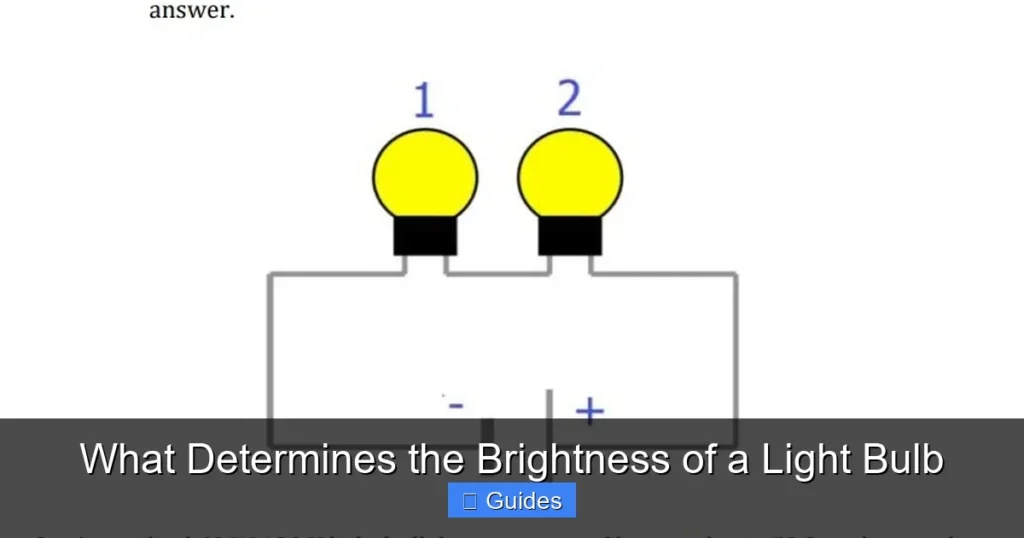
if two Bulb have different voltage rating if Bulb 1 is ….100 V and 50 W if Bulb 2 is …..120 V and 60 W then : R1 = 200 ohm R2= 240 …
Frequently Asked Questions
What is the difference between watts and lumens?
Watts measure the amount of electrical power a light bulb consumes, indicating its energy use. Lumens, on the other hand, measure the total amount of visible light emitted by the bulb, which is the direct indicator of its brightness.
Why do LED bulbs use fewer watts for the same brightness?
LED bulbs use fewer watts for the same brightness because they are significantly more energy-efficient than traditional bulbs. They convert a much higher percentage of electrical energy into light and generate very little heat, unlike incandescents that waste most energy as heat.
Can I use any dimmer switch with any dimmable LED bulb?
While many LED bulbs are dimmable, it’s crucial to use an LED-compatible dimmer switch. Traditional dimmers designed for incandescent bulbs may cause flickering, buzzing, or improper dimming with LEDs because of their different electrical characteristics.
How does color temperature affect perceived brightness?
Color temperature, measured in Kelvin (K), affects the hue of the light. While it doesn’t change the actual lumen output, cooler light (higher Kelvin, bluish-white) often feels brighter and more intense to the human eye than warmer light (lower Kelvin, yellowish-white), even if their lumen outputs are identical.
Does the shape of a light bulb influence its brightness?
The shape of a light bulb, particularly if it includes reflectors or diffusers, influences how light is distributed and perceived. For example, a bulb designed to focus light into a narrow beam will make a specific area appear brighter than an omnidirectional bulb with the same total lumen output.
What is the typical lumen output for a standard room?
For general room lighting in a medium-sized room (100-200 sq ft), a typical lumen output requirement ranges from 1200 to 2500 lumens. This is often achieved with multiple light bulbs or a single brighter fixture, depending on the desired ambiance and room function.
