



As an Amazon Associate, We earn from qualifying purchases.
The very first practical light bulb, perfected by Thomas Edison in 1879, looked quite different from modern bulbs but shared key elements. It was a glass sphere or pear-shaped bulb with a crucial vacuum inside, containing a delicate, U-shaped carbonized cotton filament that glowed with a soft, warm light when electricity passed through it. This simple yet revolutionary design laid the groundwork for the modern lighting we know today.
What Did the First Light Bulb Look Like?
Have you ever stopped to think about the humble light bulb? It’s a device we all take for granted, illuminating our homes, offices, and streets with a flick of a switch. But have you ever truly wondered about its origins? Specifically, what did the first light bulb look like? Was it a sleek, modern design, or something more rudimentary?
The answer is both fascinating and a little surprising. When most people think of the “first light bulb,” they picture Thomas Edison and his famous invention. While Edison certainly played a pivotal role, the story of the light bulb’s birth is much richer and involves a cast of brilliant minds from across the globe. Edison’s genius wasn’t in inventing the light bulb itself, but in perfecting it and making it practical, affordable, and durable for everyday use. He transformed a laboratory curiosity into a revolutionary technology that changed the world forever.
So, let’s peel back the layers of history and engineering to understand not just what the first light bulb looked like, but also the journey of its creation and the brilliant minds behind its evolution. Get ready to illuminate your understanding of this iconic invention!
Key Takeaways
- Not a Single Inventor: Thomas Edison did not invent the light bulb from scratch, but rather perfected earlier designs, making it practical and commercially viable. Many inventors contributed to its development.
- The 1879 Breakthrough: Edison’s most famous early bulb, unveiled in October 1879, featured a high-resistance, carbonized cotton filament and a significantly improved vacuum, allowing it to burn for hundreds of hours.
- Distinct Appearance: The first practical light bulb was a clear, often pear-shaped glass bulb, noticeably larger and less refined than modern bulbs. Inside, a thin, U-shaped filament glowed with a warm, reddish-orange light.
- Crucial Components: Key features included the fragile carbonized filament, platinum lead-in wires, an evacuated glass enclosure (vacuum), and often an early screw-type base for connection to power.
- Evolution of Filaments: Early filaments evolved from carbonized paper and cotton to bamboo fibers, which provided even longer lifespans, before eventually transitioning to tungsten.
- More Than Just a Bulb: Edison’s genius lay in developing an entire system of lighting, including generators, wiring, switches, and meters, alongside a durable, inexpensive bulb.
- Foundation for Modern Lighting: The fundamental principles of Edison’s incandescent lamp – a filament heated to incandescence in a vacuum – remained the basis for conventional light bulbs for over a century.
Quick Answers to Common Questions
What material was the filament in Edison’s first practical light bulb made from?
The filament in Edison’s most famous practical light bulb from 1879 was made from carbonized cotton thread. Later, he improved upon this by using carbonized bamboo fibers.
Did Thomas Edison invent the light bulb?
No, Thomas Edison did not invent the light bulb from scratch. He significantly improved upon existing designs and developed the first commercially practical, long-lasting, and affordable incandescent light bulb, along with a complete electrical distribution system.
How long could Edison’s 1879 light bulb typically last?
Edison’s 1879 light bulb with the carbonized cotton filament could last for hundreds of hours. With the later refinement using carbonized bamboo filaments, the lifespan extended to over 1,200 hours.
Why was a vacuum important in the first light bulbs?
A vacuum inside the glass bulb was crucial to prevent the filament from oxidizing and burning out rapidly. Without a vacuum, the oxygen in the air would quickly react with the heated filament, causing it to disintegrate.
What was unique about the base of Edison’s light bulb?
Edison introduced the revolutionary screw-in base, commonly known as the Edison screw, which provided a standardized, safe, and easy way to install and replace light bulbs, making electric lighting accessible for the general public.
📑 Table of Contents
The Myth vs. The Reality: Edison’s Role
Let’s clear up a common misconception right away: Thomas Edison did not invent the light bulb. This might sound like a shocking statement, given how often his name is associated with it. However, the truth is that many inventors tinkered with electric illumination long before Edison entered the scene. The concept of using electricity to create light had been explored for decades.
Think of it like this: someone invents the concept of a car, but another person invents the specific model that becomes popular and widely adopted. Edison was that second person for the light bulb. He took existing ideas, identified their flaws, and systematically worked to overcome them, creating a version that was robust enough for widespread use.
Early Pioneers and Their Contributions
The journey toward the practical light bulb began much earlier than Edison’s time.
* Humphry Davy (1802): The British chemist created the first electric light by passing current through a thin strip of platinum. It was more of an arc lamp, but it demonstrated the principle of incandescent light – light produced by heating a material until it glows. It burned out quickly and produced immense heat, making it highly impractical for general lighting.
* Warren de la Rue (1840): This British astronomer enclosed a coiled platinum filament in a vacuum tube. His design was efficient, but platinum was far too expensive for commercial use. He understood the importance of a vacuum to prevent the filament from oxidizing and burning out.
* Joseph Swan (1860s-1870s): The British physicist made significant strides by experimenting with carbonized paper filaments in an evacuated glass bulb. By 1860, he patented a “long-lasting” light bulb using carbonized paper. However, the vacuum pumps of the era weren’t powerful enough to create a truly effective vacuum, and his filaments still burned out relatively quickly. He continued his work, demonstrating an improved carbon filament lamp in 1878.
These early bulbs, while innovative, all shared common problems: short lifespan, high cost, and inefficient light production. They were fascinating demonstrations, but not yet ready to replace gas lamps or candles in homes.
Edison’s Genius: System, Not Just Bulb
What set Edison apart was his relentless pursuit of a *practical* and *economical* solution. He wasn’t just trying to make a light; he was trying to build an entire electrical lighting system. This meant developing not only a long-lasting, affordable bulb but also the generators, wiring, fuses, meters, and lamp sockets necessary to distribute electricity and make the system work for homes and businesses. This holistic approach was revolutionary. His goal was “cheap light.”
Edison’s First “Practical” Incandescent Lamp
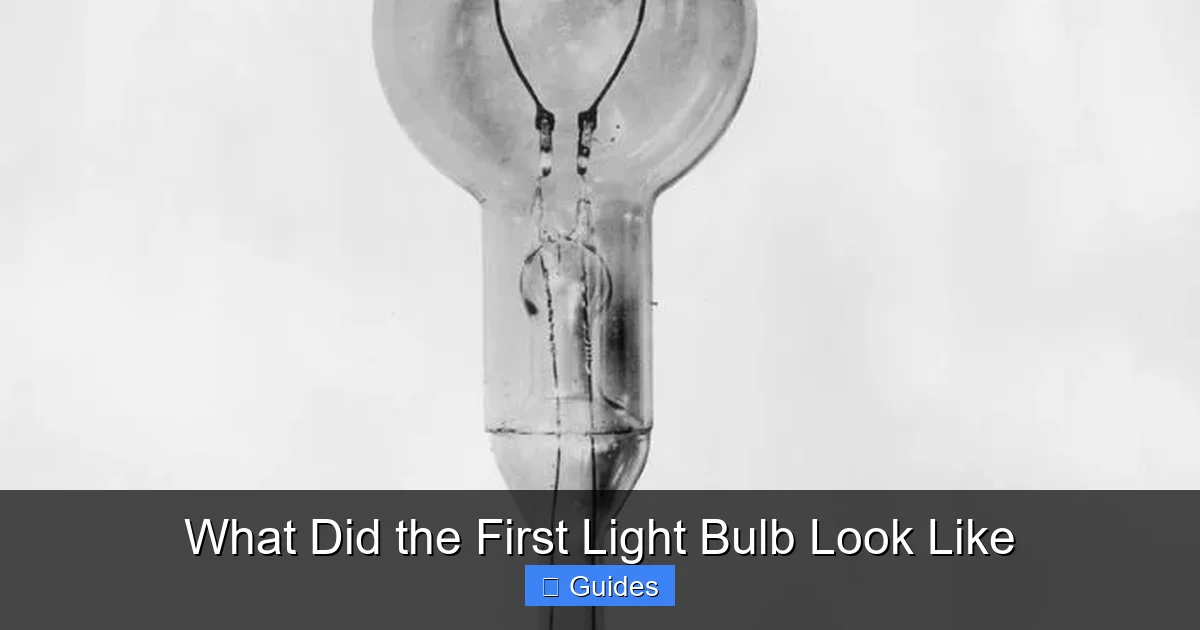
Visual guide about What Did the First Light Bulb Look Like
Image source: images.fineartamerica.com
The breakthrough that truly defined what did the first light bulb look like for commercial use came in October 1879. After countless experiments (“I have not failed 10,000 times, I’ve just found 10,000 ways that won’t work,” he famously quipped), Edison and his team at Menlo Park finally achieved a significant milestone. They created an incandescent lamp with a high-resistance filament that could burn for hundreds of hours.
The Carbonized Cotton Thread Filament
The heart of Edison’s 1879 bulb was its filament. After testing thousands of materials – from various metals to plant fibers – they stumbled upon carbonized cotton thread. This wasn’t just any cotton thread; it was carefully treated. They took a simple sewing cotton thread, shaped it into a U-shape, and then baked it at high temperatures in an oxygen-free environment. This process turned the cotton into pure carbon, making it conductive and surprisingly durable.
When electricity passed through this thin, hair-like carbon filament, it heated up to incandescence, emitting a warm, yellowish-orange glow. It wasn’t as bright as modern bulbs, but it was a steady, reliable light, a vast improvement over flickering gas lamps.
The Vacuum Chamber and Its Importance
Another critical component, refined by Edison, was the evacuated glass bulb. Earlier inventors, like de la Rue and Swan, understood the necessity of a vacuum. Oxygen causes the filament to quickly oxidize and burn out. However, Edison had access to improved vacuum pumps, allowing him to create a much better vacuum inside the bulb. This drastically reduced the presence of oxygen, extending the filament’s lifespan from minutes or hours to hundreds of hours.
So, when you consider what did the first light bulb look like, picture a glass vessel that was painstakingly evacuated of air, creating a tiny, oxygen-free environment for its delicate heart.
The Screw Base: A Revolutionary Idea
Beyond the filament and the vacuum, Edison introduced another brilliant innovation that made his light bulb truly practical: the screw-in base. Before this, connecting a light bulb to an electrical source was often a clumsy and unreliable affair, involving clamping or twisting wires. Edison’s screw base (which later became known as the Edison screw, or E-series, sizes like E26 or E27) provided a standardized, safe, and easy way to install and replace bulbs.
This seemingly small detail was a huge step forward in making electric lighting user-friendly for the general public. It meant that anyone could screw a bulb into a socket, rather than needing an electrician for every lamp change.
Beyond 1879: Evolution and Improvement
While the 1879 carbonized cotton filament bulb was a triumph, Edison and his team didn’t stop there. They continued to refine and improve their design, always searching for longer life and better efficiency.
From Cotton to Bamboo
Just a few months after the carbonized cotton thread success, Edison’s team discovered an even better material for filaments: bamboo fibers. They found that carbonized bamboo, particularly a species of bamboo from Japan, could last over 1,200 hours. This was a monumental improvement and quickly became the standard for Edison’s commercial bulbs. Imagine the effort involved in finding the perfect natural fiber for such a critical component!
This change impacted what did the first light bulb look like in terms of its glowing element. The bamboo filament would have still been a thin, dark, glowing U-shape, but perhaps with slightly different structural integrity or glow characteristics.
The Role of Materials Science
The story of the early light bulb is a testament to the power of materials science. From platinum to various plant fibers, the search for the perfect filament was an intensive, trial-and-error process. Each material offered different properties – resistance, melting point, durability, and cost. This era truly highlighted how understanding and manipulating materials could lead to world-changing inventions.
Standardizing the Bulb
As electric lighting began to spread, the need for standardization became apparent. Edison’s screw base was a significant step, but the entire industry eventually converged on common voltage levels, bulb shapes, and wattages. This ensured compatibility and made electric lighting a truly accessible technology for everyone.
What Did the First Light Bulb *Actually* Look Like? A Detailed Description
Let’s consolidate our understanding and really visualize what did the first light bulb look like, specifically Edison’s practical 1879-1880 carbon filament lamp.
Shape and Size
Imagine a clear glass bulb, often pear-shaped or somewhat rounded. It wasn’t the sleek, perfectly spherical or flame-tip design we see in decorative bulbs today. It had a more hand-blown, slightly irregular appearance, reflecting the manufacturing processes of the late 19th century. The glass would have been clear, allowing the glowing filament to be fully visible. Its size would have been comparable to many household bulbs today, perhaps a bit larger in some instances, but definitely something you could hold comfortably in your hand.
The Glowing Filament
Inside this glass enclosure, you would see the star of the show: the carbonized filament. For the 1879 version, it was a delicate, very thin strand of carbonized cotton thread, bent into a horseshoe or U-shape. This filament was typically attached to two thicker platinum lead-in wires. When powered, this filament would glow with a soft, warm, somewhat reddish-orange light. It wasn’t the stark white or bright yellow light of modern bulbs. It was a gentle illumination, sufficient for reading or lighting a room but far less intense than what we are used to. The filament itself would appear as a fragile, dark loop suspended within the vacuum.
The Base and Connections
At the bottom of the glass bulb was the base. Edison’s initial practical bulbs often featured an early version of the screw base, made of brass or a similar conductive metal. This base had threads that allowed it to be screwed into a corresponding socket. The platinum lead-in wires from the filament would connect to terminals within this base, allowing electricity to flow from the socket, through the filament, and back out. The space between the electrical contacts and the glass was typically filled with an insulating material like plaster of Paris. This entire assembly – the glass bulb, the filament, and the base – formed the complete unit that was the world’s first widely practical electric light bulb.
So, when we answer “what did the first light bulb look like?” think of a clear, pear-shaped glass orb, often slightly imperfect, housing a wispy, U-shaped carbon filament that glowed with a comforting, warm orange light, all attached to a revolutionary screw-in brass base. It was a marvel of its time, a blend of scientific principle and meticulous craftsmanship.
The Impact of Edison’s Bulb
The advent of Edison’s practical light bulb and his entire electrical distribution system was nothing short of revolutionary. It didn’t just provide a new way to light a room; it fundamentally changed society.
Bringing Light to the Masses
Before electric light, most people relied on candles, oil lamps, or gaslight. These were often dim, fire hazards, produced soot, and required constant maintenance. Edison’s bulb offered a safer, cleaner, brighter, and more convenient alternative. Imagine the transformation: homes could be lit uniformly, without the smell of gas or the risk of open flames. Nighttime activities were no longer limited by the flickering glow of a lamp.
This innovation rapidly led to the electrification of cities. Public spaces, factories, and homes could stay lit for longer, extending work hours, leisure time, and overall productivity.
Industrial and Social Transformation
The ability to light factories safely and efficiently meant that production could continue around the clock, revolutionizing industry. The concept of an “electric grid” took shape, creating vast networks of power generation and distribution that underpin modern infrastructure. Socially, brighter, safer streets contributed to increased public safety and enabled a more vibrant nightlife in urban centers. It even influenced architecture, as buildings no longer needed to be designed solely around natural light or gas pipes.
A Precursor to Modern Lighting
While modern LED and fluorescent lights bear little resemblance to Edison’s incandescent lamp, the fundamental principle of bringing electric light to the masses started with him. The widespread adoption of his system paved the way for all future innovations in lighting technology. Every time you flip a light switch, you are connecting to a legacy that began with that simple, glowing carbonized cotton filament in a glass bulb.
Conclusion
So, what did the first light bulb look like? It was a deceptively simple device: a clear, often pear-shaped glass bulb with a meticulously crafted carbonized cotton (or later, bamboo) filament glowing softly within a vacuum, all connected to a pragmatic screw-in base. It wasn’t just a bulb; it was a symbol of innovation, perseverance, and the power of systemic thinking.
Thomas Edison, through his tireless experimentation and vision, transformed a scientific curiosity into a practical, affordable, and durable invention that quite literally brought light to the world. His bulb, while seemingly primitive by today’s standards, was the essential stepping stone, a bright beacon in the dark that heralded the dawn of modern electrical illumination. It reminds us that even the most complex technologies often have humble, yet brilliant, beginnings.
Frequently Asked Questions
Who else contributed to the invention of the light bulb before Edison?
Many inventors contributed to the early development of electric lighting. Notable figures include Humphry Davy, who created the first electric arc lamp, and Joseph Swan, who experimented extensively with carbonized paper filaments in vacuum bulbs before Edison’s breakthrough.
What did the light from Edison’s first bulb look like compared to modern bulbs?
The light from Edison’s first bulb was a soft, warm, reddish-orange glow. It was not as bright or white as modern LED or fluorescent lights, but it provided a steady and clean illumination, a significant improvement over candles or gas lamps of the era.
How did Edison’s light bulb make electric lighting practical for homes?
Edison’s light bulb made electric lighting practical for homes because it was long-lasting, relatively inexpensive to produce, and featured a user-friendly screw-in base. Crucially, he also developed an entire system of power generation and distribution, allowing electricity to reach homes safely and reliably.
Were early light bulbs expensive?
Initially, early electric light bulbs were quite expensive to produce and operate. However, Edison’s genius lay in his commitment to creating an affordable and commercially viable product. His improvements and the development of his entire system gradually brought down costs, making electric light accessible to the masses.
What was the next major filament material after bamboo in light bulbs?
After carbonized bamboo, the next major breakthrough in filament materials was the introduction of tungsten. Tungsten filaments, developed in the early 20th century, allowed for brighter and more efficient light production, eventually becoming the standard for incandescent bulbs.
Did the first light bulbs use AC or DC electricity?
Edison’s early electrical system and his first light bulbs primarily used Direct Current (DC) electricity. This led to the famous “War of the Currents” as George Westinghouse and Nikola Tesla championed Alternating Current (AC) as a more efficient way to transmit power over long distances.
