


As an Amazon Associate, We earn from qualifying purchases.
When asking what is a normal light bulb base, you’re likely referring to the Edison screw-in types, primarily the E26 in North America and E27 globally. These are the most common bases found in household lamps and overhead fixtures. However, “normal” can also depend on the fixture or region, with bayonet and various pin bases being common for specific lighting needs.
What Is a Normal Light Bulb Base?
Have you ever stood in the lighting aisle, staring at a dizzying array of light bulbs, each with a slightly different bottom? You just want to replace a bulb, but suddenly you’re faced with E26, E12, GU10, B22d, and a bunch of numbers and letters that look like a secret code. It’s enough to make anyone wonder, “What *is* a normal light bulb base, anyway?”
Don’t worry, you’re not alone in this confusion. While the world of light bulb bases might seem complex at first glance, understanding the basics is actually quite straightforward. In most homes, there’s indeed a “normal” or standard light bulb base that you’ll encounter far more often than others. Let’s shine a light on this common question and help you navigate the world of bulb bases with confidence.
Why Do Light Bulb Bases Even Matter?
Before we dive into the specifics, it’s helpful to understand *why* different bases exist. A light bulb base serves two crucial functions: it provides a secure physical connection to the light fixture, holding the bulb in place, and it ensures an electrical connection, allowing power to flow to the filament or LED components. Different fixture designs, power requirements, and regional standards have led to the proliferation of various base types over time. Knowing what is a normal light bulb base for your particular needs is key to successful lighting.
Key Takeaways
- E26 is the North American Standard: For most household lamps and fixtures in the U.S. and Canada, the E26 Edison screw base is considered the “normal” light bulb base.
- E27 is the Global Equivalent: In many parts of Europe, Asia, and other regions, the E27 Edison screw base (which is very similar in size to E26) is the predominant standard.
- Base Codes Explain Size and Type: Light bulb base codes like E26, B22d, or GU10 tell you the base type (Edison, Bayonet, GU) and its size or pin spacing in millimeters.
- “Normal” Depends on the Fixture: While E26/E27 are universally common, specific fixtures like track lighting, recessed cans, or decorative lights often use other “normal” bases such as GU10, G9, or E12.
- Always Check Your Fixture: The most reliable way to know which bulb base you need is to check the existing bulb or the label on the fixture itself.
- Adapters Exist, But Use with Caution: While adapters can convert one base type to another, it’s generally best to use the bulb base designed for the fixture to ensure safety and proper operation.
Quick Answers to Common Questions
What is the most common light bulb base in the U.S.?
The most common light bulb base in the U.S. and Canada is the E26 Edison screw base. It’s widely used in lamps, ceiling fixtures, and other general household lighting.
Can an E26 bulb fit into an E27 socket?
Physically, an E26 bulb can usually fit into an E27 socket, as their diameters are very similar (26mm vs. 27mm). However, it’s crucial to match the bulb’s voltage rating to your electrical system (E26 for 120V, E27 for 220-240V) to avoid damage or safety risks.
What does “GU10” mean for a light bulb base?
GU10 refers to a bi-pin base where “G” indicates a multi-pin arrangement, “U” denotes a specific U-shaped ceramic base with a twist-and-lock mechanism, and “10” signifies that the centers of the two pins are 10 millimeters apart. It’s common for spotlights and recessed lighting.
Are bayonet bases common in the United States?
While not as common as E26 screw bases for general lighting in the U.S., bayonet bases like the B22d are very common in the UK, Ireland, Australia, and other regions. In the U.S., you might see specialized bayonet types in certain niche applications or imported fixtures.
How do I identify the correct light bulb base I need?
The best way is to check the base of the old light bulb itself, where the base type (e.g., E26, GU10) is usually printed. If you don’t have the old bulb, examine the fixture’s socket for a label or physically compare the socket to common base types.
📑 Table of Contents
- Understanding the Basics: What Defines a Light Bulb Base?
- The Reigning Champion: The E26/E27 Edison Screw Base
- Beyond the “Norm”: Other Common Screw-In Bases
- The Twist-and-Lock Family: Bayonet Bases
- Pin-Perfect: Bi-Pin and Other Pin Bases
- Navigating the Numbers: How Base Codes Work
- Choosing the Right Base: Tips for Your Home
- Conclusion
Understanding the Basics: What Defines a Light Bulb Base?
A light bulb base is essentially the part of the bulb that screws into, pushes into, or twists into a light fixture. The “normal” light bulb base often refers to the most common screw-in type you’ll find in general household use. But beyond that, bases are categorized by their connection method and size.
The Two Main Connection Types
There are two primary ways a bulb connects to a fixture:
- Screw-in Bases: These are probably what you picture when you think of a traditional light bulb. They have a threaded metal base that twists clockwise into a socket.
- Pin Bases: These bulbs have two or more metal pins that either push straight into a socket or twist and lock into place.
Each type has its own set of standards and variations, and we’ll explore the most common ones that might be considered a normal light bulb base within their specific categories.
The Reigning Champion: The E26/E27 Edison Screw Base

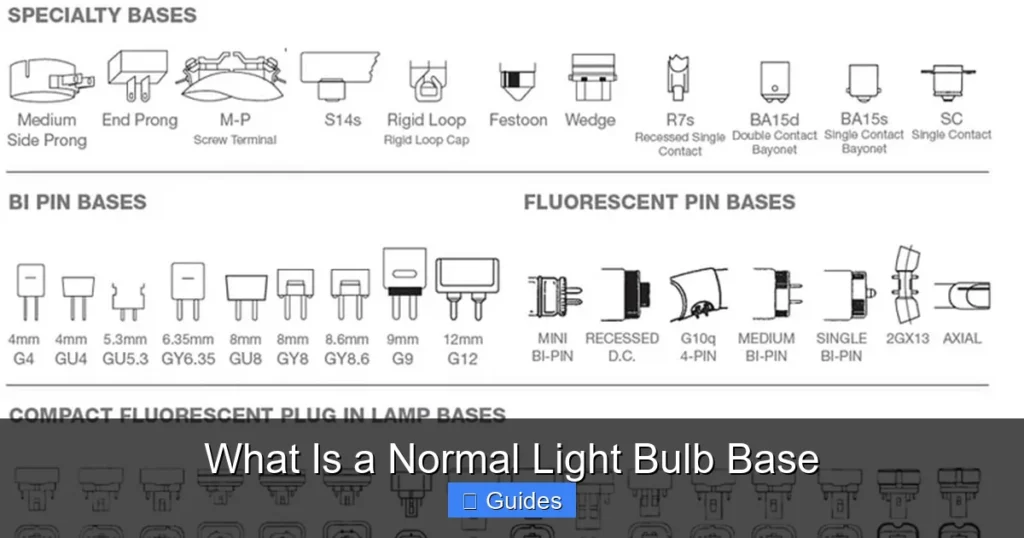
Visual guide about What Is a Normal Light Bulb Base
Image source: cdn-icons-png.flaticon.com
If there’s one base that truly fits the description of “what is a normal light bulb base” for general home lighting, it’s the Edison screw-in base.
E26: The North American Standard
In the United States, Canada, and other regions operating on 120-volt electricity, the E26 base is the undisputed king. The “E” stands for Edison, after Thomas Edison, who pioneered the screw-in design. The “26” indicates the diameter of the base in millimeters (approximately 1 inch). You’ll find E26 bulbs in everything from table lamps and floor lamps to ceiling fixtures, pendant lights, and many outdoor lights. If you’re replacing a general-purpose bulb in a North American home, chances are you need an E26. This is *the* normal light bulb base for most everyday applications here.
E27: The Global Equivalent
Move across the pond to Europe, Asia, Australia, or other parts of the world using 220-240-volt electricity, and you’ll find the E27 base is the dominant standard. Like the E26, the “E” means Edison, and the “27” refers to its 27mm diameter. While there’s a 1mm difference in diameter between E26 and E27, they are so similar that they are often considered interchangeable *physically*. However, it’s crucial to match the voltage rating of the bulb to your electrical system. An E26 bulb is designed for 120V systems, while an E27 is for 220-240V. Using the wrong voltage bulb can be dangerous or simply won’t work. For many international users, the E27 is what is a normal light bulb base.
Practical Tip: Identifying E26/E27
To identify an E26 or E27 base, simply look at the threaded metal part of your old bulb. If it’s roughly an inch wide and screws in, it’s almost certainly one of these two. Most new bulbs will clearly state the base type on the packaging.
Beyond the “Norm”: Other Common Screw-In Bases
While E26/E27 are the most common, there are other screw-in bases that are quite normal for specific types of fixtures or smaller bulbs.
E12: The Candelabra Base
The E12 base is often referred to as a “candelabra” base because it’s frequently used in decorative light fixtures designed to resemble candles. Think chandeliers, wall sconces, nightlights, and some smaller decorative lamps. The “12” indicates its 12mm diameter, making it significantly smaller than an E26. It’s a common, or “normal,” base for these specific aesthetic applications.
E14: The European Candelabra
Similar to the E12, the E14 base is the European equivalent for candelabra-style bulbs, with a 14mm diameter. Just like E26 and E27, E12 and E14 are physically distinct but serve the same purpose in their respective electrical regions.
E39/E40: Mogul Bases for Heavy-Duty Use
At the other end of the spectrum, you have the much larger E39 (North America) and E40 (Europe) bases, known as “Mogul” bases. These are high-wattage, heavy-duty bases typically found in industrial lighting, street lights, large floodlights, or very old, large fixtures. They are certainly not what is a normal light bulb base for household use, but they are normal within their specialized applications.
The Twist-and-Lock Family: Bayonet Bases
While screw-in bases are predominant in many regions, bayonet bases are equally common and often considered “normal” in other parts of the world, particularly the UK, Ireland, Australia, and New Zealand.
B22d: The Standard Bayonet Cap
The B22d base is the most common bayonet fitting for general household lighting in countries that traditionally use this system. The “B” stands for Bayonet, and “22” refers to its 22mm diameter. The “d” indicates a double contact, meaning it has two electrical contact points at the bottom. Instead of screwing in, bayonet bulbs have two pins that slide into slots in the fixture and then twist to lock into place. It’s a quick and secure connection.
GU10: The Modern Twist-and-Lock Spotlight Base
The GU10 base is a very common type for modern spotlighting and recessed downlights, regardless of region. The “G” indicates a bi-pin base, and “U” refers to its specific shape (often a small ceramic base with a slight U-shape where the pins connect), while “10” signifies that the centers of the two pins are 10mm apart. GU10 bulbs have two short, stubby pins that you push into the socket and then twist clockwise to lock. They are a normal light bulb base for track lighting, kitchen spotlights, and bathroom lighting.
Other Bayonet Variations
You might also encounter smaller bayonet bases like the BA15d (double contact, 15mm diameter) or single-contact versions like BA15s, often used in specialized applications like automotive lighting or older decorative fixtures. While not a general “normal light bulb base” for most rooms, they are normal for their intended uses.
Pin-Perfect: Bi-Pin and Other Pin Bases
Beyond screw-in and twist-and-lock, many modern and specialized light fixtures use pin bases. These are quite normal in their specific contexts.
G9: The Compact Halogen/LED
The G9 base is a compact bi-pin base often found in smaller, more decorative fixtures, particularly in pendants, wall lights, and some desk lamps. It features two loop-shaped pins spaced 9mm apart. G9 bulbs are known for their small size and bright output, making them a normal choice for accent lighting or when space is limited.
G4/G6.35/G8: Low Voltage Mini-Pins
These are even smaller bi-pin bases, with “G” indicating the pin type and the number representing the pin spacing in millimeters (e.g., 4mm for G4). They are typically used for low-voltage (12V or 24V) lighting systems, often found in under-cabinet lighting, display cases, landscape lighting, or small desk lamps. While not a general-purpose “normal light bulb base,” they are very common for these specialized low-voltage applications.
GX5.3/MR16: Recessed Lighting Standard
The GX5.3 base is commonly associated with MR16 halogen or LED bulbs, often used in recessed lighting, track lighting, and landscape lighting. It features two pins spaced 5.3mm apart. This is a very normal base for focused, directional lighting applications.
Navigating the Numbers: How Base Codes Work
Understanding the codes isn’t just for experts; it helps you decipher what is a normal light bulb base for a specific fixture.
Decoding the Letters
- E: Edison Screw (threaded)
- B: Bayonet (push and twist)
- G: Bi-pin or Multi-pin (push-in, often with a specific shape like a ‘U’)
- FA: Single Pin (less common in homes)
Decoding the Numbers
The number usually indicates a measurement in millimeters:
- For “E” bases: The diameter of the screw base (e.g., E26 is 26mm).
- For “B” bases: The diameter of the bayonet cap (e.g., B22d is 22mm).
- For “G” bases: The distance between the center of the two pins (e.g., GU10 means 10mm between pin centers, G9 means 9mm).
Sometimes, there’s an additional letter or two:
- s: Single contact (for bayonet bases)
- d: Double contact (for bayonet bases)
- Q: Quad contact (very rare in homes)
- U: Often indicates a specific shape or mechanism, like the twist-and-lock feature of GU10.
By knowing these simple rules, you can quickly understand what type of base you’re looking at and why it’s labeled that way. This makes identifying what is a normal light bulb base for your fixture much easier.
Choosing the Right Base: Tips for Your Home
So, how do you make sure you’re always picking the right bulb base? Here are some practical tips:
1. Check the Old Bulb First
The easiest and most reliable method is to look at the base of the bulb you’re replacing. The base type is almost always printed directly on the metal or plastic part of the base (e.g., “E26,” “B22d,” “GU10”). If the print is worn, compare its size and connection method to examples you find online or in-store.
2. Examine the Fixture Socket
If you don’t have the old bulb, carefully look inside the socket of the fixture.
- Does it have threads for screwing in? Measure the diameter.
- Does it have two slots for pins to slide into and twist?
- Does it have two small holes for pins to push straight into?
Often, the fixture itself will have a sticker or label indicating the required bulb type and maximum wattage. This label is your best friend when trying to figure out what is a normal light bulb base for that specific fixture.
3. When in Doubt, Take a Picture or Bring the Bulb
If you’re still unsure, snap a clear photo of the old bulb’s base (or the fixture’s socket) with your phone. Better yet, carefully remove the old bulb and take it with you to the store. A lighting specialist will be able to identify it instantly.
4. Be Wary of Adapters
Yes, adapters exist that can convert one base type to another (e.g., an E26 to GU10 adapter). While they might seem like a convenient solution, use them with caution. Adapters can add length to a bulb, potentially causing it to protrude too far or even touch the fixture’s housing, creating a fire hazard. They can also affect the aesthetic appeal. It’s almost always best to use the bulb base type that the fixture was originally designed for.
5. Consider the Environment (Damp vs. Dry)
Sometimes, the *environment* a bulb is used in will influence what’s considered a normal light bulb base. For instance, in damp locations like bathrooms or outdoors, certain sealed pin bases or specific screw bases might be more commonly used in waterproof fixtures, making them “normal” for those conditions.
Conclusion
Ultimately, when you ask “what is a normal light bulb base,” the answer largely depends on your geographical location and the specific type of light fixture you’re dealing with. For the majority of household lighting in North America, the E26 Edison screw base is your go-to. For much of the rest of the world, it’s the E27. However, for specialized lighting like spotlights, chandeliers, or display lighting, bases like GU10, E12, or G9 are perfectly “normal” and widely used.
Don’t let the alphabet soup of base codes intimidate you. By understanding the common types, knowing how to decipher the labels, and remembering to always check your existing bulb or fixture, you’ll never again be left in the dark about which light bulb base is the right fit. Happy lighting!
Frequently Asked Questions
What is the difference between an E26 and E27 light bulb base?
The main difference lies in their intended voltage and precise diameter. E26 (26mm diameter) is standard for 120-volt systems (North America), while E27 (27mm diameter) is for 220-240-volt systems (Europe, Asia). While physically very similar, using the correct voltage bulb for your region is critical for safety and performance.
Why are there so many different types of light bulb bases?
The variety of light bulb bases stems from historical developments, different regional electrical standards, and the diverse needs of various light fixtures. Different bases are designed to provide appropriate physical and electrical connections for everything from small decorative lamps to large industrial lights.
Can I use an adapter to change my light bulb base type?
While adapters exist to convert between different base types (e.g., E26 to GU10), it’s generally recommended to use the bulb base designed for your fixture. Adapters can add length, potentially creating aesthetic issues or safety hazards, and may not always provide the most secure connection.
What does “candelabra base” mean, and where is it used?
A “candelabra base” refers to a smaller screw-in base, most commonly the E12 in North America or E14 in Europe. It’s typically used in decorative light fixtures like chandeliers, wall sconces, and nightlights, where a more slender and less obtrusive bulb is desired.
Are pin-type bases like G9 or GU10 considered “normal”?
Yes, pin-type bases like G9 and GU10 are very normal and common, but typically within specific applications rather than for general household lighting. GU10s are standard for modern spotlights and recessed lighting, while G9s are frequently found in smaller, decorative fixtures and some appliances.
What should I do if I can’t find the base type on my old light bulb?
If the base type isn’t legible on your old bulb, inspect the socket of the light fixture for a label or etching that indicates the required bulb type and wattage. As a last resort, carefully take the old bulb to a hardware or lighting store, and a staff member can help you identify it.
