


As an Amazon Associate, We earn from qualifying purchases.
A halogen light bulb is an incandescent lamp that uses a halogen gas mixture to improve filament life and efficiency compared to traditional incandescent bulbs. It produces a very bright, white light with excellent color rendering, making it popular for spotlights and task lighting. While largely superseded by LEDs, understanding the halogen light bulb’s innovative design and characteristics provides insight into lighting technology’s evolution.
Have you ever wondered what makes certain light bulbs shine so brightly and clearly? Or perhaps you’ve heard the term “halogen” when discussing lighting but weren’t entirely sure what it meant beyond “a really bright bulb.” You’re not alone! For decades, the halogen light bulb was a go-to choice for everything from car headlights to kitchen task lighting, admired for its intense, crisp light.
Even though newer technologies like LEDs have taken center stage, the halogen light bulb still holds a significant place in lighting history and understanding it helps us appreciate the journey of illumination. It represents a clever evolution of the humble incandescent bulb, pushing the boundaries of what was possible with filament-based lighting. Let’s peel back the layers and discover the fascinating science and practical applications behind this bright idea.
What Is a Halogen Light Bulb? The Incandescent’s Smarter Cousin
To really understand what a halogen light bulb is, it helps to start with its ancestor: the traditional incandescent light bulb. Remember those classic bulbs with the glowing wire inside? Incandescents work by running electricity through a thin tungsten filament, heating it to such a high temperature that it glows and emits light. Simple, right? But they had a couple of drawbacks: a relatively short lifespan and a tendency to blacken over time as tungsten evaporated from the filament and coated the inside of the glass.
Enter the halogen light bulb, a brilliant upgrade that tackled these very issues. At its core, a halogen light bulb is still an incandescent bulb, meaning it still uses a tungsten filament heated by electricity. However, the crucial difference lies in its design and the special gas mixture it contains. Instead of a vacuum or an inert gas like argon (as in traditional incandescents), the compact glass envelope of a halogen bulb is filled with a small amount of halogen gas, such as iodine or bromine. This seemingly small addition makes a world of difference.
This special gas enables what scientists call the “halogen cycle,” a chemical reaction that constantly regenerates the tungsten filament. This cycle allows the bulb to operate at higher temperatures, producing a brighter, whiter light while significantly extending its life and preventing the bulb from darkening. Think of it like a self-cleaning oven for your light bulb!
The Magic Inside: How Halogen Technology Works
The true genius of the halogen light bulb lies in its sophisticated internal workings, particularly the “halogen cycle.” This innovative process is what sets it apart and allows it to perform so much better than its older incandescent relatives.
The Tungsten Filament and Quartz Envelope
Just like traditional incandescents, the heart of a halogen light bulb is a tungsten filament. Tungsten is chosen because it has an incredibly high melting point, allowing it to get intensely hot without vaporizing instantly. However, even tungsten will evaporate over time, especially at the high temperatures needed to produce bright light.
To facilitate the halogen cycle, the filament is encased in a much smaller, sealed envelope than a standard bulb. This envelope is typically made of quartz glass, not regular glass. Why quartz? Because the halogen cycle requires extremely high operating temperatures – so high that regular glass would melt! Quartz, with its much higher melting point, can withstand these intense conditions. The small size of the envelope also helps to keep the halogen gas concentrated near the filament, making the regenerative cycle more efficient.
The Role of Halogen Gas
Here’s where the “halogen” part comes in. The quartz envelope is filled with a precise amount of halogen gas (usually iodine or bromine, sometimes chlorine or fluorine). When the bulb is switched on, the tungsten filament heats up and emits light. As it heats, tiny atoms of tungsten evaporate from the filament’s surface, just as they would in a traditional incandescent bulb.
Instead of simply depositing onto the cooler inner surface of the glass (causing blackening), the evaporated tungsten atoms chemically react with the halogen gas in the high-temperature environment. This reaction forms a gaseous tungsten halide compound. Because the inside of the bulb is very hot, this tungsten halide compound remains in a gaseous state and circulates within the bulb.
The Halogen Cycle in Action
As the gaseous tungsten halide circulates, it eventually comes into contact with the extremely hot surface of the tungsten filament. At this super-heated point, the tungsten halide compound breaks down. The tungsten atoms are redeposited back onto the filament, and the halogen gas is released again, free to pick up more evaporated tungsten atoms and repeat the cycle.
This continuous process, known as the halogen regenerative cycle, has several key benefits:
- Extended Lifespan: By returning tungsten to the filament, the halogen light bulb can operate for a longer period before the filament becomes too thin and breaks.
- Consistent Brightness: The prevention of bulb blackening means that light output remains strong and consistent throughout the bulb’s life.
- Higher Efficiency: Because the filament can operate at higher temperatures without rapid degradation, it produces light more efficiently, resulting in brighter light for the same wattage compared to standard incandescents.
- Whiter Light: The higher operating temperature also shifts the color temperature of the emitted light, making it appear whiter and crisper.
It’s a marvel of chemistry and physics packed into a small, powerful package!
Types and Applications: Where You’ll Find Halogen Bulbs
For a long time, the halogen light bulb was incredibly versatile, finding its way into countless applications thanks to its bright light, excellent color rendering, and compact size. While many of these applications are now seeing a shift towards LED, understanding their traditional uses helps illustrate their strengths.
Common Halogen Bulb Shapes and Bases
Halogen bulbs come in various shapes and sizes to suit different fixtures and purposes:
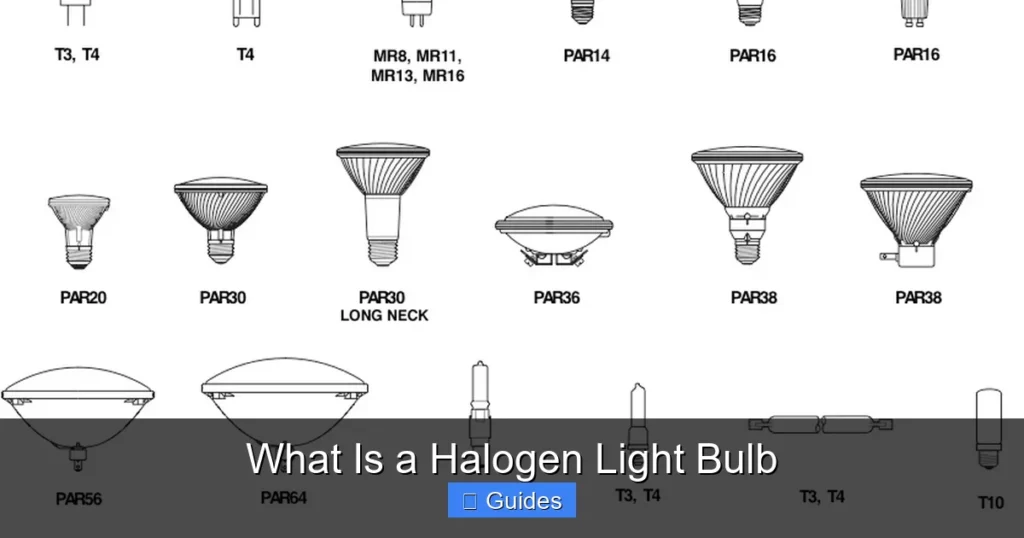
- MR16 and GU10: These are very common directional halogen light bulbs, often used in recessed lighting, track lighting, and display lighting. MR16s typically have two pins (GZ4 or GX5.3 bases), while GU10s have two thicker, twist-and-lock pins. They are excellent for creating focused beams of light.
- PAR Bulbs (e.g., PAR20, PAR30, PAR38): “Parabolic Aluminized Reflector” bulbs are larger, more robust directional bulbs, often used for floodlighting, spotlights, and outdoor security lighting. They have a screw-in base, similar to traditional incandescents.
- Linear Halogen Bulbs: These are tube-shaped bulbs, often with an R7s base (a double-ended base). You’d typically find these in floodlights, work lights, and some older outdoor security fixtures.
- Low-Voltage Halogen (e.g., G4, G9): These small capsule or bi-pin bulbs are often used in decorative fixtures, under-cabinet lighting, desk lamps, and older pendant lights where a compact, bright light source is needed. G9 bulbs are a common mains voltage (240V) version of this small type.
- Automotive Halogen Bulbs: Halogen headlights are a classic example of this technology, providing powerful, focused light for safe driving.
Practical Examples of Halogen Use
Imagine walking into a jewelry store where all the diamonds sparkle intensely – chances are, halogen spotlights were once illuminating those displays. Or think about a brightly lit art gallery, where paintings glow with accurate colors; halogen’s high Color Rendering Index (CRI) made it a prime choice.
* Task Lighting: Under-cabinet lights, desk lamps, and workshop lamps often used halogen light bulbs because their focused, bright output was perfect for concentrated work.
* Accent Lighting: For highlighting architectural features, artwork, or specific areas, MR16 or GU10 halogen bulbs provided precise beams of light.
* Outdoor and Security Lighting: Linear halogen floodlights or PAR bulbs were frequently chosen for illuminating patios, driveways, or providing security lighting due to their powerful output.
* Retail and Display Lighting: The excellent CRI of halogen bulbs ensured that merchandise, especially clothing and food, appeared vibrant and true-to-color.
While many of these roles are now filled by highly efficient LED alternatives, the legacy of the halogen light bulb in these applications is undeniable.
The Bright Side: Advantages of Halogen Bulbs
Despite the rise of LEDs, halogen light bulbs offered several compelling advantages that made them a popular choice for many years. These benefits are precisely why they were considered such an improvement over standard incandescents.
Superior Light Quality
One of the biggest draws of a halogen light bulb is the quality of light it produces.
- Bright, Crisp, White Light: Halogens operate at higher temperatures, which results in a whiter, more intense light compared to the warmer, yellower glow of traditional incandescents. This crispness often makes spaces feel more alert and vibrant.
- Excellent Color Rendering Index (CRI): Halogen bulbs typically boast a CRI of 100, which is the maximum possible score. This means they render colors almost perfectly, just as they would appear under natural sunlight. For applications where color accuracy is crucial – like retail displays, art studios, or photography – this was a massive advantage.
Instant Illumination and Dimmability
Unlike some early fluorescent bulbs, a halogen light bulb provides light immediately upon flicking the switch. There’s no warm-up time or flickering; it’s instant, full brightness. This is incredibly convenient for everyday use. Furthermore, halogens are fully dimmable with standard incandescent dimmer switches, allowing users to easily adjust the light level to suit their mood or task without any compatibility issues. This smooth, continuous dimming capability was a significant factor in their popularity.
Compact Size and Versatility
The ability to pack a lot of light into a small package was another key advantage. The quartz envelope for the filament is very compact, leading to smaller overall bulb designs. This made them ideal for:
- Small Fixtures: Such as under-cabinet lights, small spotlights, or decorative fixtures where space was limited.
- Directional Lighting: Their small, intense light source made them perfect for pairing with reflectors to create focused beams, like in spotlights or track lighting.
While LEDs now excel in many of these areas, it’s important to remember that these were pioneering features for halogen technology in its prime.
The Other Side of the Coin: Disadvantages and Considerations
No technology is without its drawbacks, and the halogen light bulb is no exception. While they offered significant improvements over traditional incandescents, they also came with their own set of challenges, some of which ultimately led to their decline.
High Heat Output and Safety Concerns
Perhaps the most significant disadvantage of a halogen light bulb is the immense heat it generates. Because the filament operates at such high temperatures, the bulb itself gets incredibly hot – much hotter than a standard incandescent.
- Fire Hazard: This high heat means they can pose a fire risk if placed too close to flammable materials like curtains, upholstery, or even paper. Adequate clearance is always necessary.
- Burns: Touching a halogen bulb that has been on, even for a short time, can cause severe burns.
- Fixture Design: Fixtures designed for halogen bulbs must be able to dissipate this heat safely. Using a halogen bulb in an enclosed fixture not designed for it can lead to overheating and potential failure or fire.
Handling Precautions
You might have heard the advice: “Don’t touch a halogen bulb with bare hands.” This isn’t just a myth; it’s a crucial handling instruction. The oils from your skin, even tiny amounts, can create hot spots on the quartz envelope when the bulb heats up. These hot spots can lead to localized weakening of the quartz, causing the bulb to shatter prematurely or dramatically. Always handle a halogen light bulb with a clean cloth or gloves.
Energy Inefficiency (Compared to LEDs)
While more efficient than traditional incandescents, halogen light bulbs are still relatively inefficient when it comes to converting electricity into light. A significant portion of the energy they consume is given off as heat, not light. This translates to higher electricity bills compared to modern alternatives. For example, an LED bulb can produce the same amount of light as a halogen bulb using 80-90% less energy. This stark difference in energy consumption has been a primary driver behind the move away from halogen technology.
Shorter Lifespan (Compared to LEDs)
While the halogen cycle extended the life of these bulbs compared to traditional incandescents, their lifespan is still considerably shorter than LEDs. A typical halogen bulb might last 1,000 to 3,000 hours, whereas many LED bulbs are rated for 15,000 to 50,000 hours or even more. This means more frequent bulb replacements, which can be inconvenient and costly.
UV Radiation
Halogen bulbs, particularly those without a specific UV filter, can emit small amounts of ultraviolet (UV) radiation. While usually not a significant health concern for casual use, prolonged exposure to unfiltered halogen light (especially from older or specialty bulbs) can potentially contribute to fading of fabrics or artwork. Many modern halogen bulbs incorporate a UV filter, often by using a secondary glass cover, to mitigate this.
Halogen vs. LED: Making the Modern Choice
In today’s lighting landscape, the conversation invariably turns to LED technology. While halogen light bulbs once represented the pinnacle of incandescent lighting, Light Emitting Diodes (LEDs) have largely surpassed them in almost every measurable aspect, prompting a significant shift in lighting choices globally.
Efficiency and Energy Savings
This is arguably the most significant differentiator. LEDs are vastly more energy-efficient than halogen bulbs. Where a 50-watt halogen might be needed for a certain brightness, an LED of just 5-7 watts can achieve the same lumen output. This translates directly into substantial savings on electricity bills and a reduced environmental footprint.
Lifespan and Durability
As mentioned earlier, LEDs boast significantly longer lifespans. It’s not uncommon for an LED bulb to last 15 to 25 times longer than a halogen equivalent. This means fewer replacements, less maintenance, and reduced waste. Furthermore, LEDs are solid-state devices with no fragile filaments, making them much more durable and resistant to vibrations and impacts.
Heat Output
While LEDs do produce some heat, they do so much more efficiently and direct it away from the light source itself, meaning the visible parts of the bulb often remain cool to the touch. This drastically reduces the safety concerns associated with the intense heat of halogen light bulbs.
Light Quality and Features
Early LEDs sometimes struggled with color rendering, but modern LEDs now offer excellent CRI values, often comparable to halogen, and are available in a vast range of color temperatures, from very warm white to cool daylight. They also offer features like smart control, color changing, and highly directional light without the need for complex reflectors. While halogen light bulbs are easily dimmable with traditional dimmers, some older LED dimmers can be finicky, though dedicated LED dimmers have largely solved this issue.
Cost Considerations
Initially, LED bulbs were considerably more expensive than halogens. However, as technology has advanced and manufacturing scales have increased, the price of LED bulbs has dropped dramatically, making them an incredibly cost-effective choice over their lifespan, especially when considering energy savings.
Conclusion: The Legacy of the Halogen Light Bulb
So, what is a halogen light bulb? It’s a clever, high-performing member of the incandescent family, bridging the gap between basic filament bulbs and today’s advanced LED technology. For decades, it illuminated our homes, offices, and cars with its distinct bright, crisp light and excellent color rendering. It allowed for compact designs and precise directional lighting that traditional bulbs simply couldn’t offer.
While its reign as the go-to high-performance bulb has largely ended, thanks to the undeniable advantages of LEDs in terms of energy efficiency, lifespan, and safety, the halogen light bulb leaves behind an important legacy. It showcased how innovative chemistry and engineering could significantly improve an existing technology, paving the way for future advancements. Understanding its principles helps us appreciate the ongoing evolution of lighting and the constant quest for brighter, better, and more sustainable ways to light our world. So, the next time you see a halogen bulb, you’ll know there’s a fascinating bit of science shining brightly within its compact quartz shell.
Key Takeaways
- Enhanced Incandescent Technology: A halogen light bulb is essentially an improved incandescent bulb, using a tungsten filament enclosed in a compact quartz envelope filled with halogen gas (like iodine or bromine).
- The Halogen Cycle: This chemical reaction redeposits evaporated tungsten back onto the filament, extending bulb life and maintaining light output by preventing the bulb from blackening.
- Bright, Crisp Light: Halogen bulbs are known for producing a very bright, white light with excellent Color Rendering Index (CRI), making colors appear more vibrant and natural.
- High Heat Output: A significant characteristic is the high heat they generate, requiring specialized handling (avoid touching with bare hands) and fixture design.
- Dimmable and Instant-On: Halogen bulbs offer full dimmability and instant illumination, without any warm-up time, which are desirable features for many applications.
- Phasing Out for Efficiency: While once a popular choice, halogen light bulbs are being phased out in many regions due to their lower energy efficiency compared to modern LED technology.
Quick Answers to Common Questions
What is the main difference between a halogen light bulb and a traditional incandescent bulb?
The main difference is that a halogen light bulb contains a halogen gas inside its small quartz envelope. This gas participates in a “halogen cycle” that redeposits evaporated tungsten back onto the filament, extending bulb life and preventing blackening, allowing it to burn hotter and brighter than a traditional incandescent.
Why should you not touch a halogen bulb with bare hands?
Touching a halogen bulb with bare hands can transfer oils and salts from your skin onto the quartz glass envelope. When the bulb heats up to its extremely high operating temperature, these contaminants create hot spots that can cause the glass to weaken, shatter prematurely, or dramatically shorten the bulb’s lifespan.
Are halogen light bulbs energy efficient?
Compared to traditional incandescent bulbs, halogen light bulbs are slightly more energy efficient. However, they are significantly less energy efficient than modern LED bulbs, converting a much larger percentage of consumed electricity into heat rather than light.
Do halogen bulbs produce a white or yellow light?
Halogen light bulbs typically produce a very bright, crisp white light. This is due to their higher operating temperature compared to traditional incandescents, which tend to emit a warmer, more yellowish light.
Can halogen bulbs be dimmed?
Yes, halogen light bulbs are fully dimmable with standard incandescent dimmer switches, allowing for smooth and continuous adjustment of light intensity without any special compatibility requirements.
Frequently Asked Questions
What is the “halogen cycle”?
The halogen cycle is a chemical process within a halogen bulb where evaporated tungsten atoms from the filament react with halogen gas (like iodine or bromine) to form a gaseous compound. This compound then circulates and redeposits tungsten back onto the filament, extending the bulb’s life and maintaining brightness.
Are halogen bulbs being phased out?
Yes, in many regions (like the European Union and parts of the U.S.), halogen light bulbs are being phased out or banned from sale due to their relatively low energy efficiency compared to modern LED alternatives. This move is part of broader efforts to promote energy conservation and reduce carbon emissions.
Why do halogen bulbs get so hot?
Halogen bulbs get extremely hot because they operate at very high filament temperatures to produce bright, white light. A significant portion of the electrical energy they consume is converted into heat rather than visible light, making them much hotter than other bulb types like LEDs.
What are the benefits of using halogen light bulbs?
Key benefits of halogen light bulbs include their ability to produce a very bright, crisp white light with excellent color rendering (CRI 100), instant-on illumination, and full dimmability with standard dimmers. They also tend to have a more compact design compared to traditional incandescents.
Can I replace a halogen bulb with an LED bulb?
In most cases, yes, you can replace a halogen bulb with an LED equivalent. You’ll need to match the base type (e.g., GU10, MR16, E27) and ensure the LED bulb’s lumen output is similar to the halogen’s brightness. Some LED replacements may require compatible dimmer switches if you plan to dim them.
Are halogen bulbs dangerous?
While generally safe when used correctly, halogen bulbs do pose some safety considerations due to the extremely high heat they generate. They can cause severe burns if touched when hot and may pose a fire risk if placed too close to flammable materials or used in unventilated fixtures not designed for them. It’s also crucial to handle them with a cloth to avoid skin oils on the bulb.
