


As an Amazon Associate, We earn from qualifying purchases.
For decades, the standard light bulb was the familiar incandescent, but technology has dramatically redefined this term. Today, a standard light bulb typically refers to an energy-efficient LED, designed to fit common screw-in sockets like the E26/E27. These modern bulbs offer exceptional longevity, significant energy savings, and customizable light options, making them the default choice for most homes. Understanding this evolution helps you choose the best and most efficient illumination for your space.
Ah, the humble light bulb! It’s one of those everyday items we often take for granted, screwing it into a lamp and expecting instant illumination. But have you ever stopped to think about what exactly makes a “standard light bulb” standard? The answer might be more complex and fascinating than you’d imagine, especially in today’s rapidly advancing world of lighting technology.
For decades, the image that popped into everyone’s head when they heard “light bulb” was almost universally the same: a clear or frosted pear-shaped glass bulb with a visible coiled wire inside, glowing warmly when switched on. This incandescent marvel was the undisputed standard for over a century, a symbol of modern convenience. However, like many technologies, the light bulb has undergone a profound transformation. What was once standard has given way to new innovations, driven by a global push for energy efficiency and sustainability. So, let’s embark on a journey to explore the evolution of this essential device and truly understand what is a standard light bulb in our modern era.
In this guide, we’ll peel back the layers of history and technology, from the glowing filaments of Edison’s day to the sophisticated semiconductor chips of today’s LEDs. We’ll delve into the characteristics that once defined a standard light bulb, examine the transitional technologies, and finally arrive at a comprehensive understanding of what constitutes a standard light bulb in your home today. Get ready to illuminate your knowledge!
Key Takeaways
- Evolving Definition: The concept of a “standard light bulb” has evolved from the traditional incandescent to modern, energy-efficient LED technology, driven by innovation and environmental concerns.
- Incandescent Legacy: Historically, a standard light bulb was an incandescent, defined by its wattage (brightness), common E26/E27 screw base, and A-shape, operating by heating a filament.
- LEDs are the New Standard: Today, the standard light bulb is predominantly an LED, recognized for its superior energy efficiency, longer lifespan, and lower heat output compared to older technologies.
- Key LED Metrics: When choosing a modern standard light bulb, focus on lumens (brightness), Kelvin (color temperature), CRI (color rendering index), and dimmability, rather than just wattage.
- Common Compatibility: A modern standard light bulb still largely maintains compatibility with existing fixtures, using familiar screw bases (like E26 in North America, E27 in Europe) and common shapes (e.g., A19).
- Environmental and Economic Benefits: Switching to or choosing LED standard light bulbs offers significant reductions in electricity consumption and waste, leading to substantial long-term cost savings.
- Smart Home Integration: Many contemporary standard light bulbs now include smart features, allowing for remote control, scheduling, and integration with smart home systems, adding convenience and advanced functionality.
Quick Answers to Common Questions
What was the original standard light bulb?
The original standard light bulb was the incandescent bulb, which used a heated filament to produce light and was prevalent for over a century due to its simple operation and warm glow.
What makes an LED the modern standard light bulb?
LEDs are the modern standard light bulb due to their exceptional energy efficiency (up to 90% less energy than incandescents), significantly longer lifespan (tens of thousands of hours), and versatility in brightness and color temperature.
What does “lumens” mean when buying a standard light bulb?
Lumens (lm) measure the total amount of visible light emitted by a bulb, indicating its brightness. When buying a standard light bulb today, you should look at lumens instead of watts to determine how bright the bulb will be.
Are all standard light bulbs dimmable?
No, not all standard light bulbs (especially LEDs) are dimmable. It’s crucial to check the packaging for a “dimmable” label and ensure you use an LED-compatible dimmer switch if you require this feature.
What is the most common base type for a standard light bulb in North America?
The most common base type for a standard light bulb in North America is the E26 (Edison Screw, 26mm diameter). This screw-in base allows modern LEDs to fit seamlessly into existing fixtures.
📑 Table of Contents
The Incandescent Era: Defining “Standard” for Decades
For well over a hundred years, when you talked about a standard light bulb, you were almost certainly referring to an incandescent bulb. This was the undisputed king of illumination, the technology that brought light into homes and businesses worldwide. It was simple, reliable, and produced a comforting warm glow that became synonymous with indoor lighting.
How an Incandescent Bulb Works
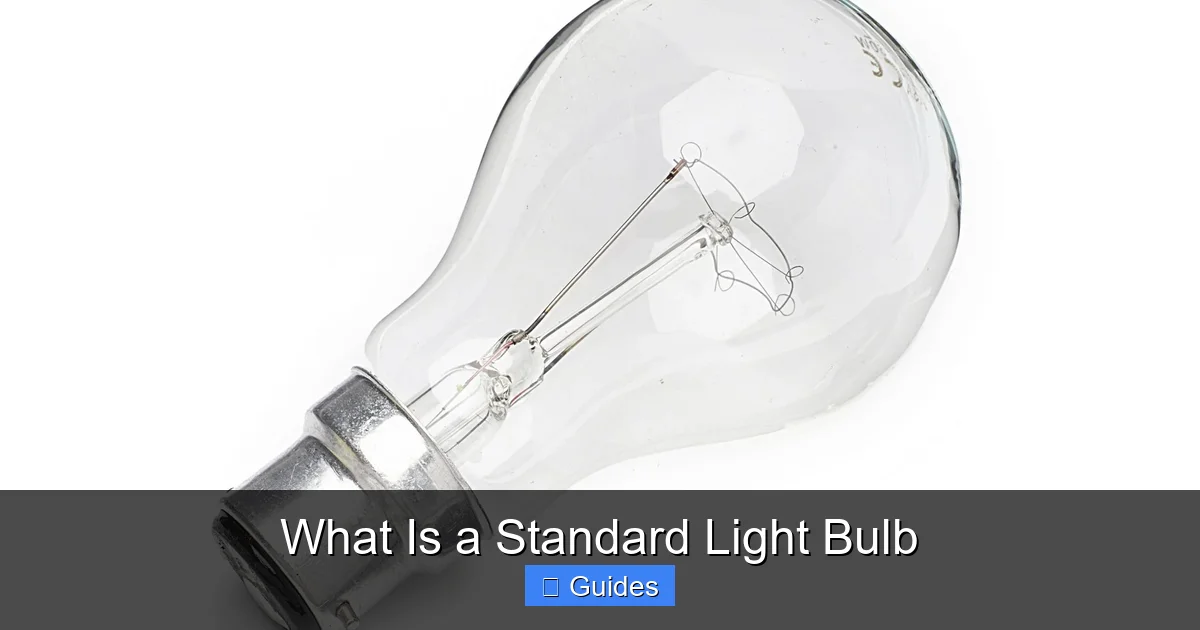
The magic of an incandescent bulb lies in its elegantly simple design. Inside the glass bulb, which is typically evacuated or filled with an inert gas like argon or nitrogen, sits a thin filament – usually made of tungsten. When electricity flows through this filament, it encounters resistance, causing it to heat up to an incredibly high temperature (around 4,500°F or 2,500°C). This extreme heat makes the tungsten glow, producing what we perceive as light. It’s essentially a controlled fire in a bottle, designed to create visible light rather than just heat.
Key Characteristics of Incandescent Bulbs
When the incandescent reigned supreme, several characteristics defined a standard light bulb:
- Wattage (Brightness): Brightness was directly associated with wattage. A “60-watt bulb” was a common phrase, telling you both its power consumption and its approximate light output. Higher wattage meant brighter light, but also more heat and higher energy bills.
- Voltage: Most residential incandescent bulbs were designed for specific voltages, typically 120V in North America and 240V in Europe and other regions.
- Base Type: The most common base for a standard light bulb in North America was the E26 (Edison Screw, 26mm diameter). In many other parts of the world, it was the E27 or the B22 (Bayonet Cap). This screw-in design made them easy to install and replace.
- Shape: The “A-shape” (often A19 for its diameter in eighths of an inch) was the iconic pear-like shape that became universally recognized as the standard light bulb. Other shapes existed, like globes (G-series), candles (B-series), or reflectors (R-series), but A-shape was the default for general lighting.
The Incandescent Legacy and Phase-Out
Despite its widespread use, the incandescent standard light bulb had significant drawbacks. It was incredibly inefficient, converting only about 10% of the energy it consumed into visible light, with the remaining 90% lost as heat. This inefficiency led to shorter lifespans (typically 750-1,000 hours) and higher electricity costs. Concerns over energy consumption and environmental impact eventually led many governments worldwide to phase out incandescent bulbs in favor of more energy-efficient alternatives. This marked the beginning of the end for the incandescent as the undisputed standard light bulb, paving the way for a new era of lighting.
The Rise of Energy-Efficient Alternatives and Redefining “Standard”
As the incandescent era began to dim, a new generation of lighting technologies emerged, each vying for the title of “standard light bulb.” These innovations aimed to address the energy inefficiency and shorter lifespans of their predecessors, offering consumers more sustainable and cost-effective lighting solutions.
Visual guide about What Is a Standard Light Bulb
Image source: lightbulbs2u.com
Compact Fluorescent Lamps (CFLs) as the Next “Standard”
For a period, Compact Fluorescent Lamps (CFLs) stepped into the spotlight as the most viable successor to the incandescent standard light bulb. CFLs work by passing an electric current through a tube containing argon and a small amount of mercury vapor, which excites the mercury atoms to produce ultraviolet (UV) light. This UV light then strikes a fluorescent coating (phosphor) on the inside of the tube, causing it to emit visible light.
CFLs were a significant leap in efficiency, using about 75% less energy than incandescents and lasting up to 10 times longer. They were designed to fit into existing standard light bulb sockets (E26/E27), making the transition relatively easy for consumers. However, CFLs had their own set of challenges, including a warm-up period to reach full brightness, a slightly different light quality, and the presence of mercury, which raised disposal concerns.
Halogen Incandescents: A Brief Bridge
Alongside CFLs, halogen incandescent bulbs offered a more immediate, albeit temporary, improvement. Halogen bulbs are essentially an upgraded form of incandescent technology. They contain a small amount of halogen gas (like iodine or bromine) inside the bulb, which allows the tungsten filament to operate at a higher temperature and prevents the tungsten from darkening the glass. This results in a brighter, whiter light and a slightly longer lifespan (around 2,000-3,000 hours) than traditional incandescents, while still maintaining excellent color rendering.
While more efficient than traditional incandescents (roughly 25-30% more efficient), halogens still relied on the same heat-producing principle and were far less efficient than CFLs or the emerging LED technology. They often served as a bridging technology, offering a quick upgrade for those not ready for CFLs or the then-expensive LEDs.
Understanding Energy Efficiency Metrics
The shift away from incandescents highlighted the need for new ways to measure and compare light bulbs. Instead of solely focusing on wattage, which only tells you power consumption, consumers had to learn about:
- Lumens (lm): This became the primary measure of brightness. Lumens tell you the total amount of visible light emitted by a bulb, regardless of the technology. A 60-watt incandescent, for instance, typically produced around 800 lumens. When choosing a standard light bulb today, you look for lumens, not watts, to gauge brightness.
- Watts per Lumen: This metric helps assess efficiency. The fewer watts required to produce a certain number of lumens, the more efficient the bulb.
- Lifespan (hours): Measured in thousands of hours, this indicates how long a bulb is expected to last before needing replacement, reducing maintenance and waste.
These new metrics helped consumers compare different technologies more accurately and paved the way for the eventual dominance of LEDs as the true modern standard light bulb.
LEDs: The Modern “Standard” Light Bulb
Today, there’s no doubt: Light Emitting Diodes, or LEDs, have firmly established themselves as the modern standard light bulb. They represent the pinnacle of lighting technology currently available for general household use, combining unparalleled efficiency with versatility and longevity. The term “standard light bulb” now almost inherently implies an LED.
Why LEDs Became the New Standard
The journey of the LED from indicator lights to the primary source of illumination has been remarkable. LEDs work fundamentally differently from incandescents or fluorescents. Instead of heating a filament or exciting gas, LEDs produce light through a process called electroluminescence. When an electric current passes through a semiconductor material, electrons combine with “holes,” releasing energy in the form of photons (light).
This solid-state technology offers numerous advantages that quickly propelled LEDs to the forefront:
- Extreme Energy Efficiency: LEDs use up to 85-90% less energy than equivalent incandescents, and significantly less than CFLs, to produce the same amount of light. This translates directly into substantial savings on electricity bills.
- Incredible Longevity: A typical LED standard light bulb can last anywhere from 15,000 to 50,000 hours, or even more. That’s 15 to 50 times longer than an incandescent and 2 to 5 times longer than a CFL, meaning you might not replace a bulb for a decade or more.
- Durability: Since there’s no filament or glass tube to break, LEDs are much more robust and resistant to shock and vibration.
- Instant On: Unlike CFLs, LEDs provide instant, full brightness the moment you flip the switch.
- Cooler Operation: LEDs produce very little heat in comparison to the light they emit, making them safer to touch and reducing cooling costs in a home.
Key Features and Benefits of LED Bulbs
Beyond their core efficiency and longevity, modern LED standard light bulbs offer a host of features that enhance their appeal:
- Versatile Light Output: LEDs can produce light in a vast spectrum of colors and brightness levels.
- Directional Light: LEDs are inherently directional, meaning their light can be focused where it’s needed without complex reflectors, reducing light waste.
- Dimming Capabilities: Many LED bulbs are now designed to be dimmable, though it’s crucial to use dimmers specifically compatible with LED technology.
- Small Footprint: The tiny size of individual LED diodes allows for creative bulb designs and integration into various fixtures.
Common LED Specifications
When selecting an LED standard light bulb today, you’ll encounter new specifications that are vital for making an informed choice:
- Lumens (lm): As mentioned, this is the measure of brightness. Forget watts for brightness; focus on lumens. A common 60W equivalent LED produces around 800 lumens.
- Color Temperature (Kelvin – K): This describes the perceived “warmth” or “coolness” of the light. Lower Kelvin numbers (e.g., 2700K-3000K) produce a warm, yellowish light similar to incandescents (“soft white”). Higher Kelvin numbers (e.g., 4000K-5000K) produce a cooler, whiter light (“daylight” or “cool white”).
- Color Rendering Index (CRI): CRI measures how accurately a light source renders colors compared to natural daylight. A higher CRI (80+ is good, 90+ is excellent) means colors will appear truer and more vibrant under the light.
- Dimmability: Check if the bulb is marked as “dimmable.” Not all LEDs are, and using a non-dimmable LED on a dimmer switch can cause flickering or damage.
Understanding these metrics is key to choosing the perfect modern standard light bulb for any application.
What Makes a Light Bulb “Standard” Today?
Even though the internal technology has revolutionized, the external form factor and compatibility remain crucial for a light bulb to be considered “standard.” A modern standard light bulb must still fit into the vast majority of existing fixtures, ensuring a smooth transition for consumers. This means maintaining common base types, shapes, and voltage compatibility.
Common Base Types
The base is the part of the bulb that screws or twists into the fixture socket. The most universally recognized standard light bulb bases are:
- Edison Screw (E-series):
- E26: This is the standard screw-in base in North America (26mm diameter). If you buy a general-purpose light bulb in the US or Canada, it will almost certainly have an E26 base. It’s the quintessential standard light bulb base.
- E27: Very similar to E26, but with a 27mm diameter, this is the standard screw-in base in many parts of Europe, Asia, and Australia. E26 and E27 are often interchangeable in practice due to manufacturing tolerances, though it’s always best to match.
- E12 (Candelabra): A smaller screw base often found on decorative fixtures, chandeliers, and nightlights.
- E17 (Intermediate): Slightly larger than candelabra, less common but used in some applications.
- Bayonet Cap (B-series):
- B22 (BC): The standard bayonet base, common in the UK, Australia, India, and other countries. It has two pins that push in and twist into place.
- B15 (SBC): A smaller bayonet cap.
- GU10: A two-pin twist-and-lock base, commonly used for spot and floodlights in track lighting or recessed fixtures, especially in Europe. While not a general “standard” for every lamp, it’s very standard for specific types of directional lighting.
Standard Shapes and Sizes
Even with new technology, the familiar shapes persist to fit various lampshades and fixtures. The “A-shape” remains paramount:
- A19: This is the classic pear shape, with “19” referring to its diameter of 19/8ths of an inch (approx. 2.375 inches or 60mm). When you picture a standard light bulb, you’re likely picturing an A19.
- BR30/BR40: Bulged Reflector (BR) bulbs are wider and have a broader beam spread, commonly used in recessed downlights. The number indicates diameter in eighths of an inch.
- PAR38: Parabolic Aluminized Reflector (PAR) bulbs are larger, often weatherproof, and provide a more focused beam, suitable for outdoor floodlights or indoor track lighting.
- G25/G30: Globe-shaped bulbs (G) are often used in vanity strips or pendant lights where the bulb itself is visible and part of the aesthetic.
- C7/C9/B10: Candle or torpedo shapes (C or B series) are for decorative fixtures like chandeliers.
Voltage and Compatibility
A standard light bulb must operate at the local mains voltage. In North America, this is primarily 120 volts (V). In most of Europe, Asia, Africa, and Australia, it’s 220-240V. Modern LED standard light bulbs are often designed with universal drivers that can handle a range of voltages, but it’s always critical to check the bulb’s specifications to ensure it matches your electrical system. Using a 120V bulb in a 240V system will quickly destroy it, and vice-versa will result in very dim light or no light at all.
Beyond Illumination: Smart Features
While not strictly defining a “standard” light bulb for every household yet, a rapidly growing segment of the market includes smart features. These advanced LED bulbs can connect to your home Wi-Fi or a smart home hub, allowing for:
- Remote control via smartphone apps.
- Voice control through assistants like Alexa or Google Assistant.
- Scheduling and automation.
- Adjustable color temperature and brightness (tunable white).
- Full-color (RGB) options.
These smart capabilities are pushing the boundaries of what a standard light bulb can do, transforming them from simple light sources into integrated components of a connected home.
Choosing the Right “Standard” Light Bulb for Your Home
Navigating the modern lighting market can feel a bit overwhelming with so many options. But by understanding the key factors, choosing the right standard light bulb for your needs becomes much simpler. Here are some practical tips:
Consider Your Fixture and Socket
The very first step is to check the existing fixture. What type of base does it require (E26, E27, B22, GU10)? What is the maximum wattage rating of the fixture (important for older fixtures, though modern LEDs consume so little power it’s rarely an issue)? And what shape of bulb will physically fit inside any lampshade or enclosure?
- Practical Tip: If you’re replacing a bulb, take the old one with you to the store or take a picture of its base and any markings for reference.
Match Brightness to Your Needs (Lumens, not Watts)
Forget the old wattage equivalencies you learned with incandescents. Now, focus on lumens. Think about the area you want to light:
- Ambient Lighting: For general room illumination, you might need 800-1100 lumens per bulb, or multiple bulbs combining for higher total lumens.
- Task Lighting: For reading lamps or kitchen workstations, you might want brighter, more focused light, perhaps 450-800 lumens for a single task light.
- Accent Lighting: For highlighting artwork or creating mood, lower lumen bulbs (150-450 lumens) are often sufficient.
A standard light bulb used for a living room might need more lumens than one for a hallway.
Select the Right Color Temperature
Color temperature dramatically affects the mood and functionality of a space:
- Warm White (2700K-3000K): Best for living rooms, bedrooms, and dining areas where you want a cozy, relaxing atmosphere. This mimics traditional incandescent light.
- Cool White/Bright White (3500K-4500K): Suitable for kitchens, bathrooms, offices, and workshops where you need better visibility and a more energetic feel.
- Daylight (5000K-6500K): Very bright, bluish-white light, ideal for task-intensive areas, garages, or spaces where true color representation is crucial. Not generally recommended for cozy spaces.
Practical Tip: Many LED packs now label the color temperature clearly. Consider purchasing one of each temperature if you’re unsure, to test in your space before committing.
Special Features (Dimming, Smart Capabilities)
Decide if you need dimmable bulbs. If so, ensure both the bulb and your dimmer switch are LED-compatible. If you’re diving into smart home technology, look for smart standard light bulb options that integrate with your chosen ecosystem (e.g., Philips Hue, GE Cync, TP-Link Kasa). These can offer incredible convenience and customization.
Longevity and Cost-Effectiveness
While LEDs have a higher upfront cost than their predecessors, their longevity and energy efficiency make them significantly more cost-effective over their lifespan. Consider the rated lifespan (hours) on the packaging – a higher number means fewer replacements. The small initial investment in a quality LED standard light bulb pays off quickly in energy savings.
By keeping these points in mind, you can confidently choose the perfect modern standard light bulb to illuminate your home efficiently and beautifully.
Conclusion
The journey of the standard light bulb is a fascinating testament to human ingenuity and our continuous drive for improvement. From the revolutionary glow of Edison’s incandescent filament to the sophisticated, energy-sipping chips of today’s LEDs, the definition of “standard” has shifted profoundly. What was once a symbol of basic illumination is now a beacon of energy efficiency, longevity, and intelligent design.
Today, when we talk about a standard light bulb, we are almost certainly referring to an LED – a marvel of modern engineering that offers superior performance, significant environmental benefits, and a wealth of customizable options. It fits into our familiar sockets, casts light in an array of temperatures, and can even integrate with our smart homes. Understanding this evolution isn’t just about knowing what’s new; it’s about making informed choices that benefit our wallets, our comfort, and our planet.
So, the next time you screw in a new bulb, take a moment to appreciate the incredible journey it has taken to become the efficient, versatile, and enduring standard light bulb it is today. The future of lighting promises even more innovation, but for now, the LED stands as the bright, clear standard illuminating our world.
Frequently Asked Questions
What is the difference between a standard light bulb and a specialty bulb?
A standard light bulb typically refers to a general-purpose bulb, like an A19 LED with an E26/E27 base, designed for widespread use in lamps and fixtures. Specialty bulbs, on the other hand, are designed for specific applications, such as candelabra bulbs for chandeliers, floodlights for outdoor use, or miniature bulbs for appliances, often featuring unique shapes, sizes, or base types.
How do I know if an LED standard light bulb will fit my old fixture?
To ensure an LED standard light bulb fits your old fixture, check both the base type (e.g., E26, E27, B22) and the physical shape and size of the bulb. Most modern LED bulbs are designed to match the dimensions and bases of traditional incandescents, such as the A19 shape, making them direct replacements for most common fixtures.
Why are LED standard light bulbs more expensive upfront than old incandescent bulbs?
LED standard light bulbs are more expensive upfront because they utilize more complex semiconductor technology and advanced components, including drivers and heat sinks, which contribute to their superior energy efficiency and exceptionally long lifespan. Despite the higher initial cost, their significant savings on electricity bills and infrequent replacement needs make them far more cost-effective over time.
What is “color temperature” and why is it important for a standard light bulb?
Color temperature, measured in Kelvin (K), describes the perceived warmth or coolness of the light emitted by a standard light bulb. It’s important because it greatly influences the mood and functionality of a space; lower Kelvin values (e.g., 2700K) produce a warm, yellowish light ideal for relaxation, while higher values (e.g., 5000K) create a cool, bluish-white light suitable for task-oriented areas.
Can I use an LED standard light bulb in any fixture?
While most LED standard light bulbs are designed for broad compatibility, there are a few considerations. Ensure the bulb’s base type and voltage match your fixture, and avoid using non-dimmable LEDs with dimmer switches. Also, in fully enclosed fixtures, some LEDs might experience reduced lifespan if heat cannot dissipate properly, so check the bulb’s specifications for “enclosed fixture rated.”
How much energy can I save by switching to LED standard light bulbs?
You can save a significant amount of energy by switching to LED standard light bulbs, typically around 80-90% compared to incandescent bulbs. For example, a 9-watt LED can produce the same brightness as a 60-watt incandescent. These energy savings quickly translate into lower electricity bills and a reduced carbon footprint, making LEDs a smart choice for both your wallet and the environment.
