


As an Amazon Associate, We earn from qualifying purchases.
When asking what size base is a standard light bulb, the answer largely depends on your geographical location. In North America, the E26 (medium Edison screw) is the most common standard for general-purpose lighting. However, other prevalent bases include the smaller E12 candelabra, the E17 intermediate, and various bayonet (B22 in the UK) and bi-pin (GU10, GU24) bases for specific fixtures, appliances, and specialty lighting.
What Size Base Is a Standard Light Bulb?
Have you ever stood in the light bulb aisle, staring at dozens of options, and felt completely overwhelmed? You’re not alone! It seems like a simple task: replace a light bulb. But then you encounter a baffling array of numbers, letters, and shapes – E26, GU10, B22, E12, and so on. It’s enough to make anyone scratch their head and wonder, “What size base is a standard light bulb, anyway?”
The truth is, the term “standard light bulb” isn’t as straightforward as you might think. What’s standard in one part of the world might be a niche item in another. Even within a single country, there can be several common base types depending on the fixture’s purpose. But don’t worry! This guide is here to demystify light bulb bases and help you confidently pick the right one every time. We’ll explore the most common types, explain what those codes mean, and give you practical tips for making the perfect match.
By the end of this article, you’ll be a pro at identifying light bulb bases. You’ll understand why different fixtures need different base types and how to ensure you’re always buying the correct replacement. Let’s shed some light on this confusing topic and make your next bulb shopping trip a breeze.
Key Takeaways
- North American Standard: The E26 (medium Edison screw) is the most common base for a “standard light bulb” in the US and Canada, found in most general-purpose fixtures.
- European/UK Standard: E27 is the dominant screw base in Europe, while the B22 (bayonet cap) is prevalent in the UK and Commonwealth countries for general lighting.
- Base Designation Explained: Edison screw bases start with ‘E’ followed by the diameter in millimeters (e.g., E26 is 26mm). Bayonet bases start with ‘B’ or ‘BA’, also indicating diameter.
- Specialty Bases: Beyond E26/E27/B22, many other bases exist, such as E12 (candelabra), E17 (intermediate), GU10 (twist-and-lock bi-pin for spotlights), and G4/G9 (smaller bi-pins).
- Always Check: The most reliable way to identify the correct base is to check the old bulb for markings or consult the fixture’s manual or socket itself.
- Adapters and Compatibility: While adapters exist, ensure they are electrically safe and compatible with the fixture’s voltage and wattage requirements before use.
- Voltage Matters: The base type does not dictate voltage. Always match the bulb’s voltage to your fixture’s requirements (e.g., 120V for US, 240V for Europe, or low voltage for specialty).
Quick Answers to Common Questions
What is the most common standard light bulb base in the USA?
The E26 medium Edison screw base is the most common standard light bulb base in the United States and Canada for general-purpose household lighting.
Can an E26 bulb be used in an E27 socket?
While an E26 bulb can often physically screw into an E27 socket, it’s generally not recommended due to slight dimensional differences and, more importantly, the differing voltage requirements (E26 for 120V, E27 for 220-240V). Always match the bulb’s voltage to your electrical system.
What does E12 mean on a light bulb?
E12 refers to an Edison screw base with a diameter of 12 millimeters. This is also known as a “candelabra” base and is commonly used for decorative bulbs in chandeliers, sconces, and night lights.
How do I identify a bayonet cap (BC) bulb?
Bayonet cap bulbs, commonly B22 in the UK, do not screw in. Instead, they have two small pins on opposite sides of the base that push into the socket and then twist to lock. Look for these distinct pins rather than screw threads.
What is a GU10 base used for?
A GU10 base is a twist-and-lock bi-pin base with two thick pins spaced 10mm apart. It is primarily used for directional lighting, such as halogen or LED spotlights in track lighting, recessed lighting, and display fixtures.
📑 Table of Contents
The “Standard” Light Bulb: It’s a Regional Thing
When someone asks what size base is a standard light bulb, the first thing to clarify is *where* they are asking about. Just like electrical outlets and voltage differ globally, so do the most common light bulb bases. There isn’t one universal standard.
In North America (the United States and Canada), the term “standard light bulb” almost always refers to a bulb with an E26 medium screw base. This is the everyday bulb you’ll find in most table lamps, ceiling fixtures, and floor lamps in homes across the region. It’s incredibly versatile and widely used.
However, if you’re in Europe, the most common screw base you’ll encounter is the E27 base. It’s very similar to the E26 but has slight dimensional differences that can sometimes cause compatibility issues. In the United Kingdom and many Commonwealth countries, the B22 bayonet cap is the traditional “standard light bulb” base. Instead of screwing in, it pushes and twists into place. Understanding these regional differences is the first step to making sense of the light bulb aisle.
Decoding the Edison Screw (E-Series) Bases
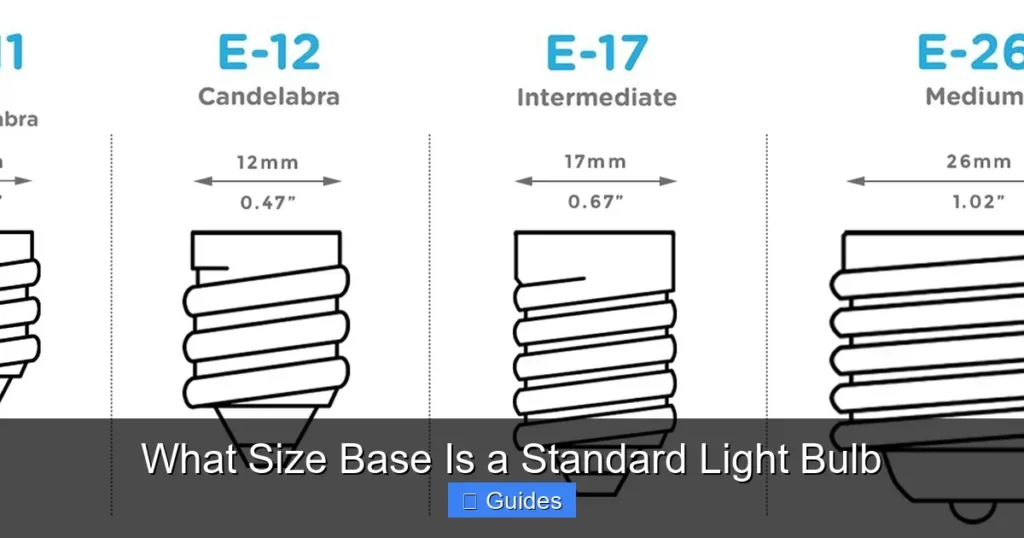
The most common light bulb bases belong to the “Edison Screw” series, named after Thomas Edison, who invented a popular screw-in socket. These bases are identified by the letter “E” followed by a number. The “E” stands for Edison, and the number indicates the diameter of the base in millimeters. For example, an E26 base has a diameter of 26 millimeters.
E26: The North American Workhorse
When you think about what size base is a standard light bulb in the US and Canada, the E26 is almost certainly it. This “medium” Edison screw base is ubiquitous. You’ll find it in a vast majority of household fixtures, from simple bedside lamps to complex chandelier setups. Light bulbs with E26 bases come in countless shapes and sizes, like the classic A19 (the traditional pear-shaped bulb), BR30 (reflector bulbs often used in recessed lighting), and PAR38 (larger outdoor floodlights). It’s designed for 120-volt systems, which is the standard household voltage in North America. Its widespread use makes it the undisputed champion of general-purpose lighting in the region.
E27: The European Equivalent
Across the Atlantic, the E27 medium screw base is the prevailing standard light bulb base in Europe and many other parts of the world. While E26 and E27 bases look almost identical and are often marketed as interchangeable, there are subtle differences. An E27 bulb is designed for 220-240-volt electrical systems, while an E26 is for 120-volt systems. The E27 base is typically a hair wider and taller than the E26, though usually by less than a millimeter. While you *can* often screw an E26 bulb into an E27 socket (or vice-versa), it’s not always recommended due to potential electrical differences and a less-than-perfect fit, which can affect safety and performance. Always match the bulb’s voltage to your region’s electrical supply.
Smaller Edison Screws: E12 and E17
Not all fixtures call for a medium base. For smaller, more decorative, or specialized lighting, you’ll encounter smaller Edison screw bases:
- E12 (Candelabra Base): This small screw base, measuring 12mm in diameter, is commonly found in decorative fixtures. Think chandeliers, sconces, night lights, and small accent lamps. Bulbs with E12 bases often come in flame-tip or torpedo shapes to complement these elegant fixtures. If you’re looking for a bulb for your dining room chandelier, chances are it needs an E12.
- E17 (Intermediate Base): Slightly larger than the E12 but smaller than the E26, the E17 base is 17mm in diameter. It’s less common than E26 or E12 but is typically used in appliances like microwave ovens, refrigerator lights, and some specialty desk lamps or ceiling fan lights. If your appliance bulb doesn’t fit an E12 or E26, an E17 might be what you’re looking for.
Larger Edison Screws: E39 and E40 (Mogul Base)
On the other end of the spectrum, for very large, high-wattage applications, you’ll find bigger Edison screw bases:
- E39 (Mogul Base): This heavy-duty 39mm base is the “mogul” standard in North America. It’s designed for industrial lighting, streetlights, high-bay warehouse fixtures, and very powerful outdoor floodlights. These bulbs are typically much larger and more powerful than anything you’d find in a residential setting.
- E40 (Goliath Base): Similar to the E39, the E40 is the European equivalent (40mm diameter) for high-wattage, industrial, or commercial lighting. Like E26 and E27, E39 and E40 are distinct but often confused due to their similar appearance and function.
Understanding Bayonet Cap (B-Series) Bases
While Edison screw bases dominate in North America, bayonet cap bases are very popular in other parts of the world, especially the UK, Ireland, Australia, New Zealand, and parts of Africa and Asia. Instead of screwing in, bayonet bulbs have two pins that slide into slots in the socket, which you then twist to lock the bulb in place. This design is robust and resistant to vibration, making them suitable for various applications.
B22d (BC): The UK and Commonwealth Standard
When UK residents talk about what size base is a standard light bulb, they are usually referring to the B22d, commonly known as a BC (Bayonet Cap). This base is 22mm in diameter and features two small pins on opposite sides that engage with grooves in the socket. It’s the go-to base for general household lighting in countries that adopted the British electrical standards. You’ll find B22 bulbs in everything from table lamps to ceiling pendants.
Smaller Bayonet Bases: BA15d, BA9s, and Others
Just like Edison screws, bayonet bases also come in smaller varieties for specific purposes:
- BA15d (Double Contact Bayonet): This 15mm base has two contacts at the bottom and two pins on the side. It’s often used in automotive lighting, marine applications, and some older specialty fixtures where a reliable, vibration-resistant connection is important.
- BA9s (Single Contact Bayonet): A smaller, 9mm base with a single contact at the bottom. These are frequently found in instrument panel lights, indicator lights, and some low-voltage decorative lighting.
- Other bayonet bases exist, such as SBC (Small Bayonet Cap – B15d) for some decorative or appliance bulbs, often found in older appliances or chandeliers that previously used candelabra screw bases in other regions.
Beyond the Screw and Bayonet: Other Common Bulb Bases
The world of light bulb bases extends far beyond the traditional screw and bayonet types. Modern lighting technology, especially LEDs and halogens, has introduced several other common base configurations designed for specific fixtures and applications.
GU Bases (Bi-Pin Bases)
These bases are characterized by two pins that either push straight in or push and twist into the socket. The “G” in GU often refers to “General Lighting” or “Glass,” while the “U” refers to a “Universal” fit (though this is somewhat of a misnomer). The number following GU indicates the distance between the center of the two pins in millimeters.
- GU10: This is a very popular twist-and-lock bi-pin base, primarily used for halogen spotlights and their LED equivalents. The GU10 has two thick pins that resemble small feet, spaced 10mm apart. You insert the bulb into the socket and twist it clockwise to lock it in place. They are common in track lighting, recessed lighting, and display lighting, often found in kitchens and living rooms.
- GU24: The GU24 is a twist-and-lock bi-pin base designed as an energy-efficient alternative to the E26/E27. It’s unique because it’s a “non-interchangeable” base, meaning you cannot screw a standard E26 bulb into a GU24 socket or vice versa. This was a deliberate design choice, particularly in places like California, to promote the use of energy-saving compact fluorescent (CFL) and LED bulbs. You simply push it in and twist to lock.
- G4, G9: These are smaller bi-pin bases often found in more compact or decorative fixtures. G4 bulbs are tiny, with two thin pins spaced 4mm apart, typically used in low-voltage desk lamps, under-cabinet lighting, and decorative pendants. G9 bulbs have two looped pins, spaced 9mm apart, and are commonly used in modern pendant lights, wall sconces, and small crystal fixtures. Both G4 and G9 bases usually house capsule-style halogen or LED bulbs.
MR16 Bases
MR16 is actually a bulb shape (Multifaceted Reflector, 16 eighths of an inch in diameter), but it’s very often associated with a specific base: the GU5.3.
- GU5.3: This bi-pin base has two pins spaced 5.3mm apart. It’s commonly used with low-voltage (typically 12V) MR16 halogen or LED spotlight bulbs in track lighting, recessed lighting, and landscape lighting. Unlike the GU10, the GU5.3 usually just pushes straight into the socket. Because they are low-voltage, these fixtures require a transformer to convert household line voltage down to 12V.
Fluorescent Tube Bases
Long, tubular fluorescent lights also have their own set of bases.
- Bi-Pin (G13 for T8/T12): The most common fluorescent tube bases are bi-pin types, particularly the G13. This base has two pins on each end of the tube, spaced 13mm apart. It’s found on standard T8 (1-inch diameter) and T12 (1.5-inch diameter) fluorescent tubes, which are widely used in offices, garages, and utility spaces.
- Compact Fluorescent (CFL) Bases: Smaller, U-shaped, or spiral CFLs often have proprietary multi-pin bases like GX23, G24q, or 2G11. These bases are designed to fit specific CFL types and usually cannot be interchanged with other bulb types due to their internal ballasts.
Practical Tips for Identifying and Choosing the Right Bulb Base
With so many options, how do you ensure you get the right light bulb base every time? Here are some straightforward tips:
Always Check the Old Bulb
This is your number one rule. Before you throw away a dead bulb, inspect its base carefully. Most bulbs have markings printed on the metal or plastic base that clearly state the base type (e.g., E26, E12, GU10, B22). If the lettering is faded, look at the shape and pin configuration. Does it screw in? Does it have two pins? How far apart are they? This will tell you what size base is a standard light bulb for that specific fixture.
Inspect the Fixture’s Socket
If the old bulb is missing or completely illegible, examine the socket itself. For screw-in bases, you can often visually gauge the diameter. For bi-pin bases, you might even find the base designation stamped near the pins. Note the number of contacts and the presence of any locking mechanisms (like for GU10 or GU24).
Consult the Manual or Manufacturer
For new or unusual fixtures, the best source of information is the product manual or the manufacturer’s website. They will explicitly state the required bulb base type. This is especially crucial for specialized or integrated LED fixtures where the “bulb” might not be easily replaceable.
Use an Adapter (with Caution)
Adapters exist that allow you to convert one base type to another (e.g., E26 to GU10, or E12 to E26). While these can seem convenient, use them with extreme caution.
- Safety First: Ensure the adapter and the bulb are rated for the fixture’s voltage and wattage. Overloading a fixture can be a fire hazard.
- Physical Fit: Adapters add length and sometimes width. Make sure the adapted bulb will physically fit within the fixture and its shade without touching anything or creating a heat trap.
- Aesthetics: Adapters can look unsightly, especially in open fixtures.
- Electrical Compatibility: Never use a voltage-transforming adapter without understanding the implications. For instance, putting a 12V bulb into a 120V socket with a simple base adapter will instantly destroy the bulb.
Consider Voltage and Wattage
The base size tells you *how* the bulb connects, but not *what power* it needs. Always match the bulb’s voltage (e.g., 120V, 240V, 12V) to your electrical supply and fixture. Also, ensure the bulb’s wattage (or LED equivalent) does not exceed the fixture’s maximum wattage rating, which is often printed on the socket itself. Using an LED means you can often put a much brighter (higher lumen) bulb in a fixture without exceeding the wattage limits, as LEDs draw significantly less power.
LED Conversions
Many people are upgrading to LED light bulbs. The good news is that most common LED bulbs are designed with traditional bases (E26, E12, B22, GU10, etc.) to allow for easy retrofitting. This means you can often swap out an old incandescent or halogen bulb for an energy-efficient LED without needing to change your fixture. Just ensure the LED bulb’s base matches your fixture’s socket.
Conclusion
So, what size base is a standard light bulb? As we’ve seen, it’s not a single, simple answer but rather a nuanced one, depending on where you are and the specific type of fixture you’re dealing with. In North America, the E26 medium screw base is king for general household lighting. In Europe, it’s often E27, and in the UK, the B22 bayonet cap holds the crown. Beyond these main players, a fascinating world of smaller Edison screws, bi-pins, and specialized fluorescent bases exists, each serving a unique purpose.
The key takeaway is that you don’t need to memorize every single base type. Instead, focus on the practical steps: always check the old bulb, inspect the socket, and consult manuals when in doubt. With this knowledge, you can confidently navigate the bewildering array of options and ensure your home is always perfectly lit. No more guessing games in the light bulb aisle – you’re now equipped to choose the right light bulb base every time!
🎥 Related Video: Standard Light Bulb – Size & Codes | Spec. Sense
📺 AMRE Supply
What does the A19 code describe? What is an E26 base? In this episode of Spec. Sense, Vance shows how to measure and how …
Frequently Asked Questions
What does the “E” in E26 or E12 stand for?
The “E” in base designations like E26 or E12 stands for “Edison Screw,” named after Thomas Edison. The number following the “E” indicates the diameter of the base in millimeters.
Are there adapters to change one light bulb base type to another?
Yes, adapters are available to convert various base types (e.g., E26 to GU10 or E12 to E26). However, always use them with caution, ensuring electrical compatibility (voltage and wattage) and proper physical fit within the fixture to prevent hazards.
What is the difference between a GU10 and a GU5.3 base?
A GU10 base has two thick, foot-like pins spaced 10mm apart and typically twist-locks into a 120V or 240V socket for spotlights. A GU5.3 base has two thinner pins spaced 5.3mm apart, usually pushes straight into a socket, and is commonly used for low-voltage (12V) MR16 spotlight bulbs requiring a transformer.
How can I tell the voltage of a light bulb I need?
The voltage requirement is typically printed on the bulb’s base or glass and usually matches your region’s household electrical supply (e.g., 120V in North America, 220-240V in Europe). Low-voltage bulbs (e.g., 12V for GU5.3) are also clearly marked and require a compatible transformer.
What is a “mogul” base?
A “mogul” base refers to very large screw-in bases, typically E39 (39mm diameter) in North America or E40 (40mm diameter) in Europe. These bases are designed for high-wattage, industrial, commercial, or street lighting applications due to their robust connection and larger size.
Is it safe to put an LED bulb into an old fixture?
Generally, yes, as long as the LED bulb’s base matches the fixture’s socket type (e.g., E26 LED into an E26 fixture) and its electrical specifications (voltage) are compatible with your supply. LEDs consume much less wattage, so they are usually well within an old fixture’s wattage limits, often reducing heat and energy use.
