


As an Amazon Associate, We earn from qualifying purchases.
Choosing the right light bulb for your living room isn’t just about watts anymore; it’s mostly about lumens. This guide helps you understand how to pick bulbs that create the perfect ambiance, considering room size, desired activities, and lighting layers. You’ll learn to translate old wattage expectations into modern lumen needs for a beautifully lit space.
Welcome, friend, to the wonderful, sometimes bewildering, world of home lighting! If you’ve ever stood in the bulb aisle at the store, scratching your head and wondering, “What wattage light bulb for living room do I really need?” – you’re absolutely not alone. It’s a common question, and one that, surprisingly, has a much more nuanced answer today than it did just a few years ago.
Gone are the days when picking a bulb meant simply grabbing a 60-watt or 100-watt incandescent. With the rise of energy-efficient LEDs, the old “wattage equals brightness” rule simply doesn’t apply anymore. Today, understanding what truly lights up your living room isn’t about how much power the bulb consumes (watts), but about how much light it *produces* (lumens). This guide will help you navigate this modern lighting landscape, ensuring your living room is not just illuminated, but perfectly lit for every mood and moment.
Imagine your living room bathed in a warm, inviting glow for a cozy movie night, or brightly lit for an afternoon of reading or board games. This isn’t magic; it’s the result of smart lighting choices. We’ll break down everything you need to know, from understanding lumens to layering different light sources, so you can transform your living room into the comfortable, functional, and beautiful space you’ve always wanted. Let’s dive in!
Key Takeaways
- Shift from Watts to Lumens: Forget old wattage numbers for brightness. Modern bulbs, especially LEDs, use far less power (watts) to produce the same or more light (lumens). Always look for lumens when comparing brightness.
- Assess Your Room’s Needs: Consider your living room’s size, ceiling height, wall colors, and how much natural light it gets. These factors influence how many lumens you’ll need to achieve comfortable brightness.
- Embrace Layered Lighting: The best living rooms use a mix of ambient (general), task (focused), and accent (decorative) lighting. This layering allows for flexibility, mood setting, and caters to various activities.
- Target Lumen Ranges: For general ambient lighting in a living room, aim for roughly 1,500 to 3,000 total lumens, distributed across multiple fixtures. Adjust this based on your specific room and preferences.
- Color Temperature Matters (Kelvin): Beyond brightness, choose a color temperature that fits your desired mood. Warm white (2700K-3000K) creates a cozy feel, while cooler whites (3500K-4000K) are more energetic.
- Don’t Forget Dimmers and Smart Options: Dimmable bulbs and smart lighting systems are game-changers. They provide unparalleled control over brightness and color temperature, allowing you to fine-tune the ambiance for any occasion.
Quick Answers to Common Questions
What is the ideal lumen range for a living room?
For general ambient lighting in a living room, aim for roughly 20 lumens per square foot. This means a 150 sq ft living room would target around 3,000 total lumens from all light sources.
Should I use warm or cool light for my living room?
Most people prefer warm white light (2700K-3000K) for living rooms because it creates a cozy, inviting, and relaxing atmosphere, similar to traditional incandescent bulbs.
Are LED bulbs a good choice for living rooms?
Yes, LEDs are an excellent choice for living rooms. They are energy-efficient, long-lasting, and come in a wide range of brightness (lumens) and color temperatures to suit any mood or function.
How many light fixtures do I need in a living room?
Instead of relying on a single overhead fixture, aim for multiple light sources. A combination of ambient (overhead), task (table/floor lamps), and accent lights (wall sconces, spotlights) provides the best flexibility and ambiance.
What’s the difference between lumens and watts?
Watts measure the amount of electricity a bulb consumes, while lumens measure the actual brightness or light output of a bulb. For choosing how bright your living room will be, always focus on lumens.
📑 Table of Contents
Beyond Watts: Understanding Lumens in Modern Lighting
For generations, we were taught that a higher wattage meant a brighter light. A 100-watt bulb was brighter than a 60-watt bulb, simple as that. But modern lighting technology, particularly LEDs (Light Emitting Diodes), has completely changed the game. If you’re still asking “what wattage light bulb for living room?”, it’s time to shift your perspective slightly.
The Old Wattage Myth vs. The New Lumen Reality
Wattage actually measures the amount of electricity a bulb uses, not its brightness. Incandescent bulbs were very inefficient; most of their energy was wasted as heat, with only a small fraction converted into visible light. Because their efficiency was fairly consistent across brands, wattage became a de facto standard for brightness. Everyone knew what a “60-watt glow” looked like.
LEDs, however, are incredibly efficient. They use a fraction of the electricity to produce the same amount of light as an incandescent bulb. So, a modern LED bulb that produces the same brightness as an old 60-watt incandescent might only consume 9 or 10 watts. If you only looked at watts, you’d think the LED was much dimmer, which isn’t true at all. This is why lumens are now the critical metric.
What is a Lumen Anyway?
A lumen (lm) is the true measure of a light bulb’s brightness. The more lumens a bulb has, the brighter it is, regardless of its wattage. Think of it like this: if wattage is how much fuel your car uses, lumens are how fast it goes. You want your car to go fast (be bright) without using too much fuel (watts). LEDs are the high-efficiency sports cars of the lighting world!
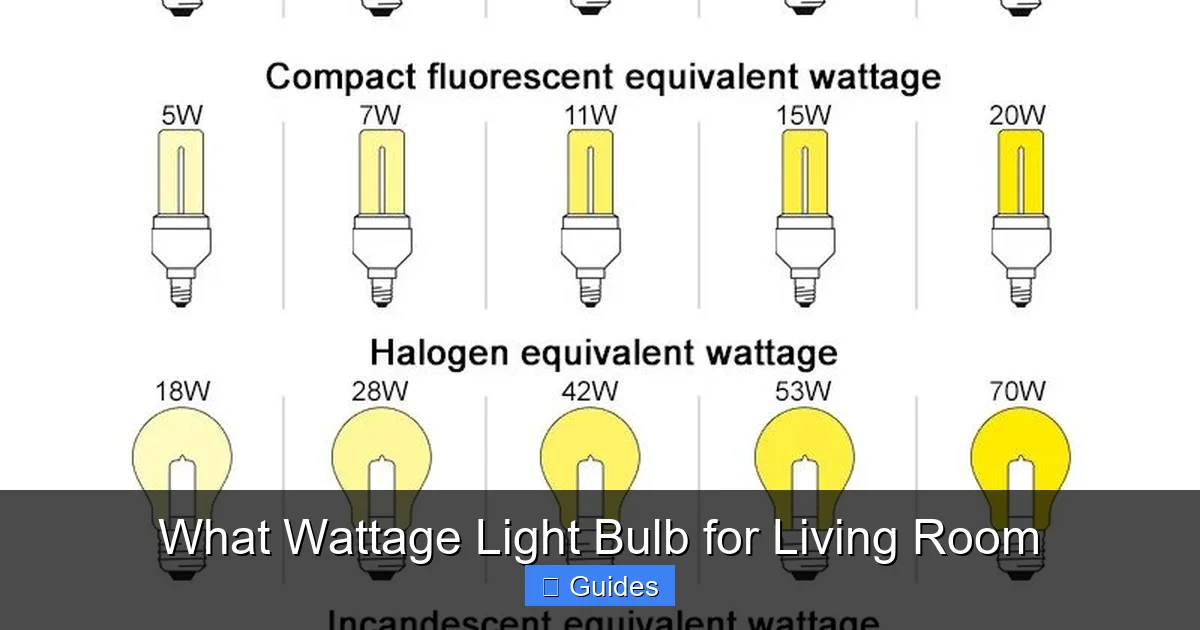
So, when you see an LED bulb box, you’ll notice it lists both wattage (e.g., 9W) and lumens (e.g., 800 lm). The lumens are what tell you how bright the bulb will actually be. To help you translate, here’s a rough guide for common incandescent equivalents:
- 40-watt incandescent equivalent: Roughly 450 lumens (LEDs usually 5-6W)
- 60-watt incandescent equivalent: Roughly 800 lumens (LEDs usually 8-10W)
- 75-watt incandescent equivalent: Roughly 1100 lumens (LEDs usually 10-13W)
- 100-watt incandescent equivalent: Roughly 1600 lumens (LEDs usually 14-17W)
This conversion chart is super helpful if you’re trying to replicate a brightness level you’re already familiar with.
Determining Your Living Room’s Lighting Needs
Visual guide about What Wattage Light Bulb for Living Room
Image source: i.pinimg.com
Now that we understand lumens, how many do you actually need for your living room? There’s no single magic number, as it depends on several factors unique to your space and lifestyle.
Room Size and Shape: The Foundation
The larger your living room, the more lumens you’ll need to adequately light it. A good starting point is to aim for about 20 lumens per square foot for general ambient lighting in a living room.
For example:
- A small living room (10 ft x 12 ft = 120 sq ft) might need around 2,400 lumens (120 sq ft * 20 lm/sq ft).
- A medium living room (15 ft x 20 ft = 300 sq ft) might need around 6,000 lumens.
- A large living room (20 ft x 25 ft = 500 sq ft) might need around 10,000 lumens.
Remember, these are *total* lumens distributed across multiple fixtures, not from a single bulb!
Wall Colors and Furnishings: Absorbing or Reflecting Light?
The colors in your living room play a huge role in how bright it feels.
- Light colors (whites, pastels): These reflect light, making a room feel brighter and more open. If your living room has light-colored walls and furniture, you might need slightly fewer lumens.
- Dark colors (deep blues, grays, browns): These absorb light, making a room feel cozier but also dimmer. If your living room features darker hues, you’ll likely need more lumens to achieve the same perceived brightness.
Consider the texture of your surfaces too. Shiny, reflective surfaces will bounce more light around than matte, absorbing ones.
Natural Light and Time of Day
Does your living room get a lot of natural light during the day? If so, you might not need as much artificial light during daylight hours. However, you’ll still want enough artificial lighting for evenings and cloudy days. Also, think about how you use the room. Is it primarily an evening relaxation spot, or a multi-purpose area used throughout the day?
Layering Light for the Perfect Ambiance
One of the biggest mistakes people make when lighting a living room is relying on a single overhead fixture. This often creates a flat, uninviting space with harsh shadows. The secret to a beautifully lit living room is “layered lighting,” which combines different types of light sources to create depth, dimension, and versatility.
Ambient Lighting: The General Glow
This is your foundational light, providing overall illumination for the room. It ensures you can move around safely and see general objects without squinting.
- Sources: Ceiling fixtures (flush mounts, semi-flush mounts, chandeliers), recessed lighting, track lighting, or even large floor lamps that bounce light off the ceiling.
- Lumen Target: This is where your 20 lumens per square foot calculation comes in. For a medium living room, you might aim for 4,000-6,000 lumens in total for ambient lighting, distributed among several fixtures. Each individual bulb for ambient light could be in the 800-1100 lumen range (equivalent to 60W-75W incandescent).
Task Lighting: Focused Brilliance
Task lighting is designed to illuminate specific activities like reading, crafting, or working on a laptop. It reduces eye strain and makes tasks more enjoyable.
- Sources: Table lamps, floor lamps (especially those with adjustable arms), desk lamps, or even picture lights if you’re illuminating artwork that requires focused attention.
- Lumen Target: For reading or other close-up tasks, you typically want a more concentrated light. A single task light can often provide 450-800 lumens (equivalent to 40W-60W incandescent) directly where it’s needed. The key is to direct the light without creating glare.
Accent Lighting: Highlighting Beauty
Accent lighting adds drama and visual interest to your living room. It draws attention to architectural features, artwork, plants, or cherished collections.
- Sources: Wall sconces, track lighting focused on specific objects, picture lights, small spot lights, or uplights placed behind furniture or plants.
- Lumen Target: Accent lights are usually lower in lumens, often in the 200-450 lumen range (equivalent to 25W-40W incandescent). The goal isn’t to flood the area with light, but to create a subtle highlight that makes an object stand out. Typically, accent lighting should be about three times brighter than the ambient light on the object it’s highlighting.
Choosing the Right Bulb Type and Features
Once you’ve nailed down the lumen requirements and lighting layers, it’s time to pick the actual bulbs. This is where features beyond just brightness come into play.
The Reign of LEDs: Efficiency and Longevity
When considering what wattage light bulb for living room, LEDs are almost always the best choice today.
- Energy Efficiency: They use significantly less electricity than incandescent or halogen bulbs, saving you money on your utility bills.
- Longevity: LEDs last for tens of thousands of hours, meaning you won’t be replacing them nearly as often.
- Durability: They are much more robust than traditional bulbs, as they don’t have a filament that can break.
- Versatility: LEDs come in a vast array of shapes, sizes, color temperatures, and dimmable options.
While they might have a higher upfront cost, their long-term savings and performance make them well worth the investment.
Color Temperature (Kelvin): Setting the Mood
Beyond brightness, the “color” of the light is crucial for setting the mood. This is measured in Kelvin (K).
- Warm White (2700K-3000K): This mimics the traditional warm glow of an incandescent bulb. It’s often described as soft, cozy, and inviting. Perfect for a relaxing living room atmosphere, especially in the evening.
- Neutral/Cool White (3500K-4000K): These temperatures are brighter and more energetic, similar to natural daylight or fluorescent lighting. They can be good for task-oriented areas or if you prefer a more vibrant, modern feel, but can sometimes feel a bit harsh in a living room.
- Daylight (5000K-6500K): Very bright, bluish-white light. While excellent for tasks requiring high visual acuity (like a workshop or office), it’s generally too stark and unwelcoming for a living room.
For most living rooms, especially those aiming for comfort and relaxation, bulbs in the 2700K-3000K range are ideal.
Dimmable Options and Smart Lighting
To truly master your living room’s ambiance, dimmers are non-negotiable. They allow you to adjust the brightness of your lights to suit any activity or time of day. Want a bright space for cleaning? Crank it up. Cozy movie night? Dim it down. Make sure the bulbs you buy are explicitly labeled “dimmable” if you plan to use them with a dimmer switch.
Smart lighting takes this control to the next level. With smart bulbs and hubs, you can:
- Control lights with your smartphone or voice assistant.
- Set schedules and routines.
- Change color temperature or even full colors on some advanced bulbs.
- Create “scenes” (e.g., “Movie Night” scene dims all lights to 20% and sets a warm temperature).
While smart lighting requires a bit more initial setup, the flexibility and convenience it offers for a living room are unmatched.
Practical Steps to Light Your Living Room
Ready to put it all together? Here’s a simple four-step process to light your living room like a pro.
Step 1: Measure and Assess
Start by measuring your living room’s length and width to calculate its square footage. Then, take a good look at your room’s characteristics:
- Are the walls light or dark?
- How many windows do you have, and which direction do they face?
- What activities do you primarily do in this room (reading, watching TV, entertaining, board games)?
- What existing light fixtures do you already have?
Step 2: Calculate Your Total Lumen Target
Using the 20 lumens per square foot guideline, calculate your ideal total lumen range. For example, a 150 sq ft room would aim for about 3,000 lumens. This is your target for *all* light sources combined.
Step 3: Distribute Light Sources Thoughtfully
Now, think about how you’ll achieve that total lumen target using your three layers of light:
- Ambient: If you have recessed lights, ceiling fixtures, or general floor lamps, these will contribute most to your ambient layer. Distribute bulbs with 800-1100 lumens (60W-75W equivalent) across these fixtures to get your base brightness. For example, four 800-lumen bulbs give you 3200 lumens – a good start for a medium-sized room.
- Task: Identify areas where you need focused light. Place table lamps or floor lamps with 450-800 lumen bulbs (40W-60W equivalent) next to reading chairs or sofas.
- Accent: Look for features you want to highlight. Use smaller, lower lumen bulbs (200-450 lumens, 25W-40W equivalent) in wall sconces, picture lights, or small directional fixtures.
Consider the *type* of bulb too. For recessed lighting, you might use BR30 or PAR38 bulbs; for table lamps, A19 bulbs are common.
Step 4: Test, Observe, and Refine
Once you’ve installed your chosen bulbs, turn them on! Live with the lighting for a few days.
- Does the room feel bright enough for daily activities?
- Are there any dark corners or harsh shadows?
- Do your task lights provide enough focused illumination without glare?
- Does the overall mood feel inviting and comfortable?
Don’t be afraid to experiment. Swap out a warmer bulb for a slightly cooler one if you feel the room is too yellow, or increase the lumen output in a particular fixture if an area feels dim. The beauty of modern lighting is the flexibility it offers.
Conclusion
Gone are the days of guessing what wattage light bulb for living room will work best. By understanding lumens, layering your light sources, and considering factors like color temperature and dimming capabilities, you can confidently create a living room that is both beautiful and perfectly functional.
Remember, lighting isn’t just about utility; it’s about creating an atmosphere. It shapes how you feel in a space and how others perceive it. So, take these tips, experiment, and don’t be afraid to adjust until your living room truly shines. Your perfect living room ambiance is just a few thoughtfully chosen light bulbs away!
🎥 Related Video: How to Choose a Lightbulb | Lowe's How-to
📺 Lowe’s Home Improvement
There are so many lightbulbs to choose from, so how do you know which one will work for you? Join DIY expert Caroline as she …
Frequently Asked Questions
How do I know what wattage bulb to use for a dimmer switch?
When using a dimmer switch, you should primarily look at the bulb’s lumen output for brightness, and ensure the bulb is explicitly labeled “dimmable.” Also, check the dimmer switch’s maximum wattage rating and ensure the total wattage of all connected bulbs does not exceed it, even with LEDs.
Can I mix different color temperatures in one living room?
While generally advisable to stick to a consistent color temperature for primary ambient lighting, you can strategically mix temperatures. For example, a warm ambient light can be complemented by a slightly cooler (but not harsh) task light for reading, as long as the transition feels natural and purposeful.
What does a “60-watt equivalent” LED mean?
A “60-watt equivalent” LED means the LED bulb produces roughly the same amount of brightness (around 800 lumens) as an old 60-watt incandescent bulb, but it does so using far less electricity (e.g., only 9-10 watts).
Should ceiling height affect my light bulb choice?
Absolutely! Taller ceilings mean light has further to travel, so you might need more total lumens to achieve the same perceived brightness as a room with lower ceilings. You may also consider fixtures that direct light downwards more effectively, or use more powerful bulbs in recessed lighting.
Is it bad to use a bulb with too many lumens?
Using a bulb with too many lumens can make a living room feel overly bright, sterile, or uncomfortable, potentially causing eye strain. While dimmers can mitigate this, it’s generally better to aim for the appropriate lumen range and then use dimmers to fine-tune rather than starting with excessively bright bulbs.
How can smart bulbs improve living room lighting?
Smart bulbs offer immense flexibility by allowing you to control brightness, color temperature, and even color directly from your phone or voice assistant. You can set scenes for different activities (e.g., movie night, reading, entertaining) and automate your lighting to match your daily routine, enhancing comfort and convenience.
