



As an Amazon Associate, We earn from qualifying purchases.
Understanding what wattage light bulb to choose is more complex than it used to be. While traditional watts indicated energy consumption, modern lighting focuses on lumens for brightness, marking a significant shift in how we illuminate our spaces. This guide helps you navigate the evolution from old incandescent bulbs to energy-efficient LEDs, ensuring you pick the perfect light for any space, saving energy, and ensuring safety in your home or office.
What Wattage Light Bulb
Have you ever stood in the light bulb aisle, staring at a confusing array of numbers and symbols, and wondered, “What wattage light bulb should I actually buy?” You’re not alone! For decades, choosing a light bulb was simple: you picked a 60-watt bulb for general lighting, a 100-watt bulb for brighter areas, and perhaps a 40-watt bulb for ambient mood lighting. It was straightforward because watts equaled brightness, right?
Well, times have changed dramatically. With the rise of energy-efficient technologies like LEDs, the concept of “what wattage light bulb” to choose has completely transformed. That familiar watt number no longer tells you how bright a bulb will be; instead, it mostly tells you how much energy it consumes. Modern lighting asks us to think in lumens, not just watts. This guide is here to demystify the new world of light bulbs, helping you make informed decisions for every corner of your home.
We’ll dive deep into what lumens are, why they’re so important, explore the different types of bulbs available today, and arm you with practical tips for selecting the perfect light for any situation. By the end, you’ll feel confident knowing exactly what wattage light bulb (or rather, what lumen output) is right for your needs, ensuring both optimal illumination and energy efficiency.
Key Takeaways
- Lumens are Key: Brightness is measured in lumens, which indicates the total amount of visible light emitted by a bulb. Focus on lumens, not just watts, when selecting a light bulb.
- Watts = Energy Use: Wattage tells you how much electricity a light bulb consumes, not how bright it is. Modern efficient bulbs produce more lumens for fewer watts.
- LEDs are Most Efficient: Light Emitting Diodes (LEDs) are the current standard, offering significant light output (lumens) while consuming very little wattage compared to older bulb types.
- Fixture Safety: Always check and respect your light fixture’s maximum wattage rating to prevent overheating, fire hazards, and damage. An LED bulb’s low actual wattage typically makes it safe for most fixtures.
- Room-Specific Lumens: Different rooms and activities require varying levels of brightness. General guidelines for lumens exist to help you light living rooms, kitchens, bedrooms, and task areas appropriately.
- Color Temperature Matters: Measured in Kelvin (K), color temperature influences the mood and feel of a room, ranging from warm, inviting light (lower K) to cool, crisp light (higher K).
- Energy Savings: Choosing energy-efficient “what wattage light bulb” options, especially LEDs, leads to substantial long-term savings on electricity bills and a reduced environmental footprint.
Quick Answers to Common Questions
What is the difference between lumens and watts?
Lumens measure the brightness of a light bulb (how much light it produces), while watts measure the energy consumption of the bulb (how much electricity it uses).
How do I know what wattage light bulb (or lumen equivalent) to buy for a 60-watt incandescent replacement?
For a brightness equivalent to an old 60-watt incandescent bulb, look for an LED bulb with an output of around 800 lumens. The LED’s actual wattage will be much lower, typically 8-12 watts.
Can I put an LED bulb in any light fixture?
Yes, in most cases. LED bulbs have very low actual wattage, so they are generally safe to use in fixtures rated for higher wattage incandescents. Always ensure the LED’s actual wattage is below the fixture’s maximum wattage rating, which it almost always will be.
What is color temperature and why does it matter?
Color temperature, measured in Kelvin (K), describes the visual appearance of the light emitted by a bulb. Lower Kelvin values (e.g., 2700K) produce warm, yellowish light, while higher values (e.g., 5000K) produce cool, bluish-white light. It matters because it significantly impacts the mood and functionality of a room.
Are LED bulbs truly worth the higher upfront cost?
Absolutely. While LEDs may cost more initially, their extreme energy efficiency and significantly longer lifespan lead to substantial long-term savings on electricity bills and replacement costs, making them a very worthwhile investment.
📑 Table of Contents
- The Great Shift: From Watts to Lumens and What It Means
- A Brief History of Light: The Evolution of Light Bulb Technology
- How to Choose the Right “Wattage Light Bulb” for Every Space (Lumens, Really!)
- Safety First: Understanding Fixture Wattage Limits
- The Eco-Friendly Choice: Energy Savings and Environmental Impact
- Conclusion
The Great Shift: From Watts to Lumens and What It Means
For generations, the simple answer to “what wattage light bulb do I need?” was a direct correlation between watts and brightness. A 60W bulb was brighter than a 40W, and everyone understood that. But with the advent of more efficient lighting, this direct relationship broke down. Let’s explore why.
What Watts Really Tell Us: Energy Consumption
Traditionally, when you picked a 60-watt incandescent bulb, you were essentially choosing a bulb that consumed 60 watts of electricity to produce light and a lot of heat. The “what wattage light bulb” question was about its power draw. Incandescent bulbs were notoriously inefficient; only about 10% of the energy they consumed was converted into visible light, with the rest lost as heat. This inefficiency is why they were eventually phased out in many regions.
Today, if you see an LED bulb listed as 9 watts, it means it only consumes 9 watts of power. However, that 9-watt LED might produce the same amount of light as an old 60-watt incandescent bulb. This is where the confusion began – the wattage no longer indicates brightness. It solely reflects energy consumption. Understanding this is crucial when deciding what wattage light bulb to use in your home or office.
Lumens: The True Measure of Brightness
If watts no longer tell us about brightness, what does? The answer is lumens. A lumen (lm) is the true measure of the total amount of visible light emitted by a light source. Think of it as a clear, consistent unit of brightness, regardless of the bulb’s technology.
When you’re comparing modern light bulbs, especially LEDs, you should always look for the lumen rating on the packaging. This number will tell you exactly how bright the bulb will appear. For example, if you want a bulb that provides similar brightness to an old 60-watt incandescent, you should look for an LED bulb that produces around 800 lumens. This focus on lumens completely changes how we approach the “what wattage light bulb” question.
Understanding Efficacy (Lumens per Watt)
To truly understand the efficiency of a light bulb, we can look at its efficacy, which is measured in lumens per watt (lm/W). This metric tells you how much light a bulb produces for every watt of electricity it consumes. A higher lumen-per-watt number indicates a more efficient bulb.
For instance, an old 60-watt incandescent bulb might produce about 800 lumens, giving it an efficacy of roughly 13 lm/W (800 lumens / 60 watts). A modern 9-watt LED bulb that also produces 800 lumens has an impressive efficacy of nearly 89 lm/W (800 lumens / 9 watts). This vast difference highlights why LEDs are so beneficial for energy savings and why focusing on lumens rather than just “what wattage light bulb” is essential.
Beyond Brightness: Color Temperature (Kelvin) and CRI
While lumens tell you about brightness, there are other important factors that influence how a space feels:
* **Color Temperature (Kelvin – K):** This measures the color appearance of the light, ranging from “warm” to “cool.” Lower Kelvin numbers (e.g., 2700K-3000K) produce a warm, yellowish light, similar to traditional incandescents, perfect for cozy spaces. Higher Kelvin numbers (e.g., 4000K-5000K) produce a cooler, bluer-white light, often preferred for task lighting or modern offices. Knowing your preferred color temperature is just as important as knowing what wattage light bulb to choose for brightness.
* **Color Rendering Index (CRI):** This measures how accurately a light source reveals the true colors of objects compared to natural light. A CRI of 100 is perfect (like natural daylight). Most good quality LEDs have a CRI of 80 or higher, which is generally suitable for residential use. For art studios or areas where color accuracy is critical, you might seek bulbs with a CRI of 90+.
A Brief History of Light: The Evolution of Light Bulb Technology
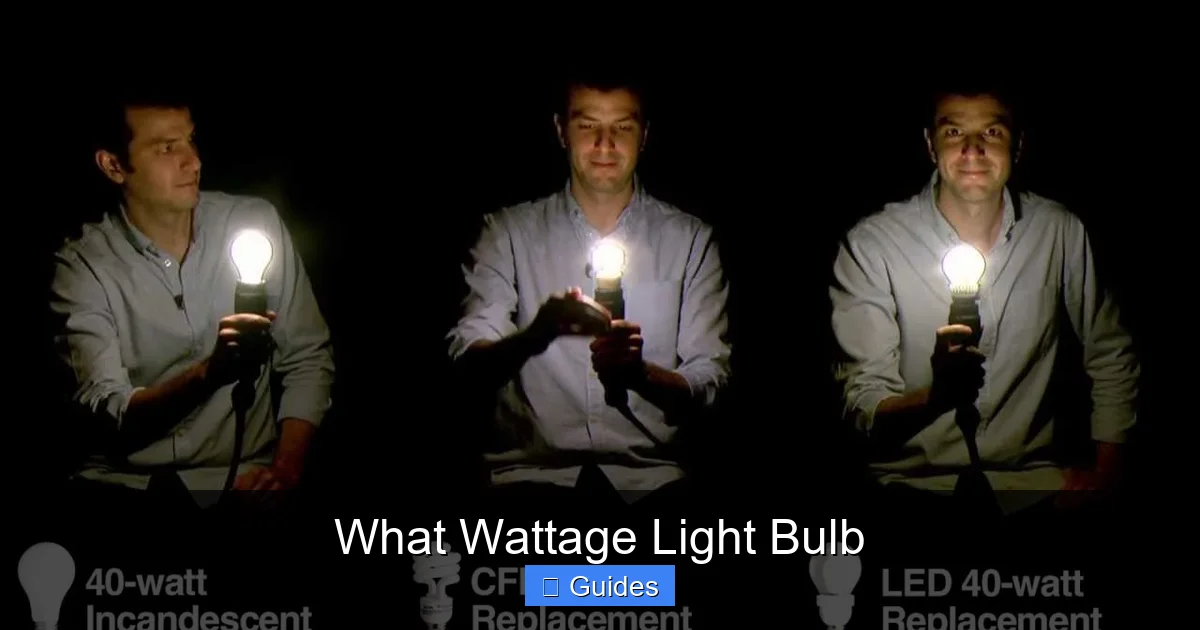
Visual guide about What Wattage Light Bulb
Image source: i.ytimg.com
Understanding the journey from the first practical light bulbs to today’s advanced LEDs helps to clarify why we now focus on lumens rather than just what wattage light bulb.
The Incandescent Era: Simple, Inefficient, but Beloved
For over a century, the incandescent light bulb was king. Invented by Thomas Edison, these bulbs produced light by heating a thin wire filament (usually tungsten) until it glowed white-hot. They offered a warm, comforting glow and were relatively inexpensive to produce. However, as mentioned, they were incredibly inefficient, wasting most of their energy as heat. The answer to “what wattage light bulb” was almost always an incandescent, and people just accepted the energy cost. This inefficiency eventually led to global efforts to phase them out in favor of more sustainable options.
Halogens and CFLs: Stepping Stones to Efficiency
As energy concerns grew, two new types of bulbs emerged as interim solutions:
* **Halogen Bulbs:** These were essentially improved incandescents, using a halogen gas inside the bulb to increase efficiency and lifespan slightly. They produced a bright, white light, often used in spotlights or task lighting, but still had significant energy consumption compared to later technologies.
* **CFLs (Compact Fluorescent Lamps):** These were the first widespread energy-saving bulbs. CFLs worked by passing electricity through a tube containing argon and a small amount of mercury vapor, causing a phosphor coating on the inside of the tube to emit light. They were significantly more efficient than incandescents, using about one-quarter of the energy for the same light output. However, they had drawbacks like a warm-up period, potential for flickering, and the presence of mercury, making disposal a concern. Choosing what wattage light bulb meant considering a CFL equivalent, which was often much lower than its incandescent counterpart.
The LED Revolution: Efficiency, Longevity, Features
Today, LEDs (Light Emitting Diodes) dominate the market, and for good reason. LEDs produce light when an electric current passes through a semiconductor material. They are astonishingly efficient, converting a much higher percentage of electricity into light compared to any previous technology.
The benefits of LEDs are numerous:
- Extreme Energy Efficiency: They use up to 85% less energy than incandescents for the same light output. This is why the “what wattage light bulb” question shifts to lumens.
- Incredible Longevity: LEDs can last for 25,000 to 50,000 hours or more, meaning you might not need to change a bulb for a decade or even two.
- Durability: Being solid-state lighting, they are more resistant to breakage than traditional glass bulbs.
- Instant On: No warm-up time, they provide full brightness immediately.
- Versatility: Available in a vast range of color temperatures, dimmable options, and even smart versions that you can control with your phone or voice assistant.
This revolution fundamentally changed how we approach the “what wattage light bulb” decision, making lumens the central focus.
How to Choose the Right “Wattage Light Bulb” for Every Space (Lumens, Really!)
Now that you understand lumens are the key, let’s look at practical guidelines for choosing the right brightness for different areas of your home. Forget trying to figure out what wattage light bulb you need; think lumens!
General Lumen Guidelines for Different Rooms
These are rough estimates and can vary based on personal preference and room specifics.
- Living Room: This is a multi-purpose space, often needing layered lighting. Aim for 1,500-3,000 total lumens. You might achieve this with several smaller bulbs in different fixtures (e.g., ceiling light, floor lamp, table lamps).
- Kitchen: Bright, clear light is essential for cooking and tasks. Look for 3,000-6,000 total lumens. Consider task lighting under cabinets in addition to overhead fixtures.
- Bedroom: A more relaxed space. 1,000-2,500 total lumens, often with warmer color temperatures. Dimmable options are a great choice here.
- Bathroom: Good lighting for grooming is crucial. 2,000-4,000 total lumens, often with cooler, brighter light around mirrors.
- Dining Room: An adjustable atmosphere is key. 1,000-2,000 total lumens, with dimming capability being highly recommended.
- Home Office/Study: Task-oriented lighting. 2,000-4,000 total lumens, generally with cooler white light for focus.
- Hallways/Entryways: General safety and welcoming light. 800-1,200 total lumens.
When pondering what wattage light bulb to use, convert your thoughts to how many lumens are needed for the function of the room.
Factors Influencing Your Lumen Needs
These guidelines are just a starting point. Several other factors play a role in how bright a room feels:
* **Room Size:** Larger rooms naturally require more lumens to feel adequately lit.
* **Ceiling Height:** High ceilings can absorb more light, so you might need slightly more lumens.
* **Wall and Decor Colors:** Lighter walls reflect light, making a room feel brighter with fewer lumens. Darker walls absorb light, requiring more lumens.
* **Natural Light:** Rooms with abundant natural light may need less artificial illumination during the day.
* **Personal Preference:** Some people simply prefer brighter spaces, while others like a softer ambiance.
* **Type of Fixture:** A bare bulb in a ceiling fixture will distribute light differently than a shaded lamp or a recessed light.
Practical Examples: Matching Light to Lifestyle
Let’s put this into practice. If you have a kitchen with dark cabinets and you love to cook, you might opt for higher lumen bulbs (e.g., 1000-1200 lumens per bulb) in your main overhead fixture, plus dedicated under-cabinet lighting. For a cozy bedroom with light-colored walls, you might use 800-lumen bulbs in bedside lamps and a 1200-lumen dimmable bulb in a ceiling fixture, all with a warm 2700K color temperature. Forget asking what wattage light bulb; ask what lumen bulb provides the best light for the activity.
Safety First: Understanding Fixture Wattage Limits
Even though we’re focusing on lumens for brightness, the “what wattage light bulb” question still matters significantly when it comes to safety and compatibility with your existing light fixtures.
Why Overwatting is Dangerous
Every light fixture, whether it’s a ceiling fan light, a desk lamp, or a recessed can, has a maximum wattage rating. This rating is crucial because it indicates the highest amount of power the fixture’s wiring, socket, and surrounding materials can safely handle without overheating. Exceeding this limit by inserting an incandescent bulb with a higher wattage can lead to:
* **Overheating:** Excessive heat can damage the fixture’s wiring, insulation, and socket, potentially causing short circuits.
* **Fire Hazard:** Prolonged overheating is a serious fire risk, especially if the fixture is near flammable materials.
* **Damage to Fixture:** The heat can warp plastic parts, crack glass, or scorch lamp shades, shortening the lifespan of your fixture.
* **Reduced Bulb Lifespan:** Even the bulb itself might burn out prematurely due to excessive heat.
So, when considering what wattage light bulb to use, always check the fixture’s label – usually a sticker inside the socket or on the fixture itself.
LED Wattage vs. Fixture Ratings: A Welcome Anomaly
Here’s where LEDs make things easy and safe. Because LED bulbs are so incredibly efficient, they consume very little actual wattage to produce a lot of light.
For example, if your fixture says “MAX 60W Incandescent,” you can safely install an LED bulb that *replaces* a 60W incandescent. This LED bulb might only consume 9-10 watts of actual power. Since 9 watts is far below the 60-watt maximum rating, it generates significantly less heat and is perfectly safe. In fact, you could likely put an LED “equivalent” to a 100W or even 150W incandescent into that same 60W-rated fixture (as long as the LED’s *actual* wattage is still well below 60W).
This is a key takeaway: an LED’s “equivalent wattage” (how bright it is compared to an old incandescent) is different from its “actual wattage” (how much power it consumes). Always check the LED’s *actual* wattage against your fixture’s *maximum* wattage. You will almost always find that LED’s actual wattage is very low and well within safety limits.
Dimmer Compatibility and Smart Bulbs
If you plan to use dimmers, ensure that both your LED bulbs and your dimmer switch are compatible with LED technology. Older incandescent dimmers might not work correctly with LEDs, leading to flickering, buzzing, or incomplete dimming. Look for “dimmable LED” on the bulb packaging and consider upgrading to an LED-compatible dimmer switch for the best performance.
Smart bulbs often have their own specific wattage ratings and may integrate dimming and color temperature controls directly within the bulb, managed via an app or smart home system. These usually have very low actual wattage, making them safe for most fixtures.
The Eco-Friendly Choice: Energy Savings and Environmental Impact
Choosing the right “what wattage light bulb” (read: the right lumens and efficiency) has significant positive impacts beyond just illuminating your space. It’s a choice that saves money and helps the planet.
Long-Term Cost Benefits of LEDs
The upfront cost of an LED bulb is often higher than traditional incandescents or even CFLs. However, this initial investment is quickly recouped through substantial energy savings and their incredibly long lifespan.
Consider this:
* An incandescent bulb might cost $1-$2 and last 1,000 hours, consuming 60 watts.
* An LED bulb offering the same brightness might cost $3-$5 and last 25,000 hours, consuming only 9 watts.
Over the lifetime of a single LED bulb, you would have bought 25 incandescent bulbs and paid significantly more in electricity. The cumulative savings across your entire home can be hundreds or even thousands of dollars over the years. This financial incentive makes the decision about what wattage light bulb a smart economic one.
Reducing Your Carbon Footprint
Energy production, especially from fossil fuels, contributes to greenhouse gas emissions and climate change. By choosing highly efficient LED bulbs, you significantly reduce your household’s electricity consumption. Less electricity used means less demand on power plants, leading to fewer carbon emissions. It’s a simple, yet powerful way to make a positive environmental impact from the comfort of your home. Selecting a truly energy-efficient what wattage light bulb is a step towards a greener future.
Proper Disposal and Recycling
While LEDs don’t contain mercury like CFLs, they do contain electronic components that are best recycled. Many municipalities offer recycling programs for electronics, and some retailers also accept old bulbs. Check with your local waste management services to understand how to properly dispose of your old bulbs. Making an informed choice about what wattage light bulb includes considering its end-of-life impact.
Conclusion
The journey from the simple “what wattage light bulb” question to understanding lumens, color temperature, and efficiency marks a significant evolution in how we light our homes and workplaces. The days of equating watts directly with brightness are behind us, replaced by a more nuanced and energy-conscious approach.
By focusing on lumens, respecting fixture wattage limits, and considering factors like color temperature and CRI, you can create perfectly illuminated spaces that are both comfortable and functional. Embracing LED technology isn’t just about keeping up with the times; it’s about making smart, safe, and sustainable choices that benefit your wallet and the planet. So next time you’re in the light bulb aisle, remember to look beyond the watts and shine a light on a brighter, more efficient future!
Frequently Asked Questions
What lumens equal a 40-watt light bulb?
To replace an old 40-watt incandescent bulb, you should look for an LED bulb that produces approximately 450 lumens. The actual wattage of this LED bulb will typically be around 5-6 watts, consuming significantly less energy.
What lumens equal a 100-watt light bulb?
If you’re looking to replace a traditional 100-watt incandescent bulb, seek an LED bulb with a lumen output of roughly 1600 lumens. This LED will usually consume only about 15-18 watts of electricity for the same brightness.
Is higher Kelvin brighter?
No, a higher Kelvin number indicates a cooler, bluer light color, not necessarily a brighter light. Brightness is measured in lumens. You can have a very bright (high lumen) bulb with a warm (low Kelvin) color temperature, or a dim (low lumen) bulb with a cool (high Kelvin) color temperature.
Do LED bulbs need special light fixtures?
Generally, no. Most LED bulbs are designed to fit standard sockets (like E26 or E12) and can be used in existing light fixtures. However, some specialized fixtures, particularly older enclosed ones, might limit heat dissipation, which could affect LED lifespan, so check manufacturer recommendations for specific enclosed fixtures.
Can I use a dimmable LED bulb with my old dimmer switch?
It depends. Older dimmer switches designed for incandescent bulbs may not be compatible with dimmable LEDs, leading to flickering, buzzing, or poor dimming performance. For optimal results, it’s recommended to use LED-compatible dimmer switches with dimmable LED bulbs.
How many lumens do I need for a small bedroom?
For a small bedroom (around 100-120 sq ft), a total of 1,000 to 1,500 lumens is often sufficient for general lighting. This can be achieved with one main ceiling fixture or a combination of smaller lamps, allowing for a comfortable and relaxed atmosphere.
