


As an Amazon Associate, We earn from qualifying purchases.
Many people think Thomas Edison solely invented the light bulb, but the story of when the first light bulb was made is much richer and more complex. It was a long journey involving numerous scientists and inventors over decades, each adding crucial pieces to the puzzle. Edison’s genius was in creating the first *practical* and *commercially viable* incandescent light bulb and an entire electrical system to power it, not in discovering the initial concept of electric light.
When you flip a switch and a room fills with light, it feels like magic, doesn’t it? It’s easy to take for granted this incredible convenience. Most of us probably think of one name when we imagine the person who gave us this wonder: Thomas Edison. But here’s a little secret: the story of when the first light bulb was made is far more complex and fascinating than a single inventor making a single discovery. It’s a tale woven with the threads of many brilliant minds, countless experiments, and decades of tireless effort.
Imagine a world lit only by candles, oil lamps, or gaslight. It was a flickering, often dangerous, and dim existence. The dream of a safe, bright, and consistent electric light captivated scientists and inventors for a long time. So, if you’re curious about the true journey of this invention, get ready to dive into history. We’re going to explore the many hands and minds that helped bring light to our world, uncovering the layers of innovation that led to the device we now call a light bulb. Understanding when the first light bulb was made means appreciating a long, collaborative process, not just one eureka moment.
Our journey will show you that while Edison certainly played a massive role, he stood on the shoulders of many giants. He didn’t invent electric light itself, but he revolutionized it, making it practical and accessible for homes and businesses everywhere. So, let’s peel back the layers of history and discover the full, sparkling truth about the invention of the electric light bulb.
Key Takeaways
- No Single Inventor: The light bulb, especially the first practical one, wasn’t invented by just one person; it was the result of a long series of contributions from many scientists and inventors over nearly 80 years.
- Early Experiments (1800s): Humphry Davy created the first electric arc lamp in 1802, demonstrating the potential for electric light, even though it wasn’t a “bulb.”
- The Incandescent Principle: Many early experimenters, including Warren de la Rue, James Bowman Lindsay, and Joseph Swan, worked on creating light by heating a filament with electricity inside a vacuum.
- Joseph Swan’s Breakthroughs: British physicist Joseph Swan made significant progress in the 1860s and 1870s, developing a long-lasting carbonized paper filament in a vacuum, publicly demonstrating functional light bulbs before Edison.
- Thomas Edison’s Contribution (1879): Edison’s pivotal achievement was inventing a *commercially practical* and *long-lasting* incandescent light bulb using a high-resistance bamboo filament and, crucially, developing an entire electrical generation and distribution system to make electric light widely usable.
- The Race for Practicality: The late 1870s saw a fierce competition among inventors to create a light bulb that was durable, affordable, and energy-efficient for everyday use.
- Collective Innovation: The light bulb’s invention is a prime example of how scientific and technological progress often stems from collective effort, building upon previous discoveries to achieve a revolutionary outcome.
Quick Answers to Common Questions
Who invented the electric light bulb first?
There isn’t one single inventor. Many people contributed. Joseph Swan created a functional, long-lasting incandescent light bulb before Thomas Edison, but Edison created the first commercially practical and widely adopted system.
When did Thomas Edison invent his light bulb?
Thomas Edison’s significant breakthrough with a long-lasting, high-resistance carbonized bamboo filament occurred in October 1879. He patented his improved lamp in January 1880.
Was Humphry Davy’s arc lamp the first light bulb?
No, Humphry Davy’s arc lamp, demonstrated in 1802, was the first sustained electric light, but it was not a “bulb” as we understand it. It created light via an electric arc between two carbon rods, making it too bright, hot, and impractical for home use.
What was the main difference between Edison’s bulb and earlier attempts?
Edison’s bulb, particularly his carbonized bamboo filament version, offered significantly longer life (over 1,200 hours) and high resistance, making it suitable for a central power generation and distribution system. He also developed the entire practical infrastructure for electric lighting.
Did Joseph Swan and Thomas Edison ever work together?
Yes, after initial legal disputes over patent infringement, Joseph Swan and Thomas Edison eventually merged their electric light companies in Britain in 1883 to form the “Edison & Swan United Electric Light Company.”
📑 Table of Contents
- The Dawn of Electrical Illumination: Early Experiments
- The Race for the Filament: Early Incandescent Attempts
- Joseph Swan’s Breakthrough and the Quest for Longevity
- Thomas Edison’s Contribution: The Practical, Commercial Bulb
- The “Who Was First?” Debate and Parallel Innovations
- Evolution Beyond the Incandescent Bulb
- Conclusion
The Dawn of Electrical Illumination: Early Experiments
The idea of using electricity to create light didn’t start with a “bulb” at all. It began with much more dramatic displays of electrical power. Way back in the early 1800s, scientists were just starting to understand electricity and its amazing potential. They played with batteries and wires, trying to figure out what electricity could do.
Humphry Davy’s Arc Lamp (1802)
One of the very first big breakthroughs came from a British chemist named Humphry Davy. In 1802, Davy showed off something truly remarkable. He connected two charcoal electrodes to a powerful battery. When he brought the electrodes close together, a brilliant, blinding arc of light jumped between them. This was the world’s first electric arc lamp. It was incredibly bright, much brighter than any candle or oil lamp. It was also very hot and quickly used up its charcoal electrodes. While it wasn’t a light bulb, it was the first real demonstration that electricity could produce continuous, intense light. It lit up a small theater in London, showing everyone the promise of electric illumination. It was a huge step in realizing that someday, we might light our homes with electricity. The arc lamp really paved the way for future inventions, inspiring others to think about harnessing this powerful energy source.
The Concept of Incandescence – Heating Things Up
Davy’s arc lamp was exciting, but it wasn’t practical for everyday use. It was too bright, too hot, and too dangerous. So, inventors started thinking about another way electricity could make light: incandescence. Incandescence is simply when something gets so hot that it glows. Think about a glowing ember in a fire. Scientists realized that if they could pass electricity through a thin wire, it would get very hot and start to glow, hopefully without bursting into flames or melting away instantly. This was the core idea for the incandescent light bulb. Many individuals then tried different materials and methods to achieve this effect safely and efficiently. This quest for a stable, glowing filament was a key part of the story of when the first light bulb was made.
The Race for the Filament: Early Incandescent Attempts
After Davy’s pioneering work, many inventors in different countries started experimenting with incandescent light. They all tried different materials, thinking about what kind of filament would get hot and glow without burning out too quickly. It was like a global scientific race, with everyone trying to find the perfect glowing material.
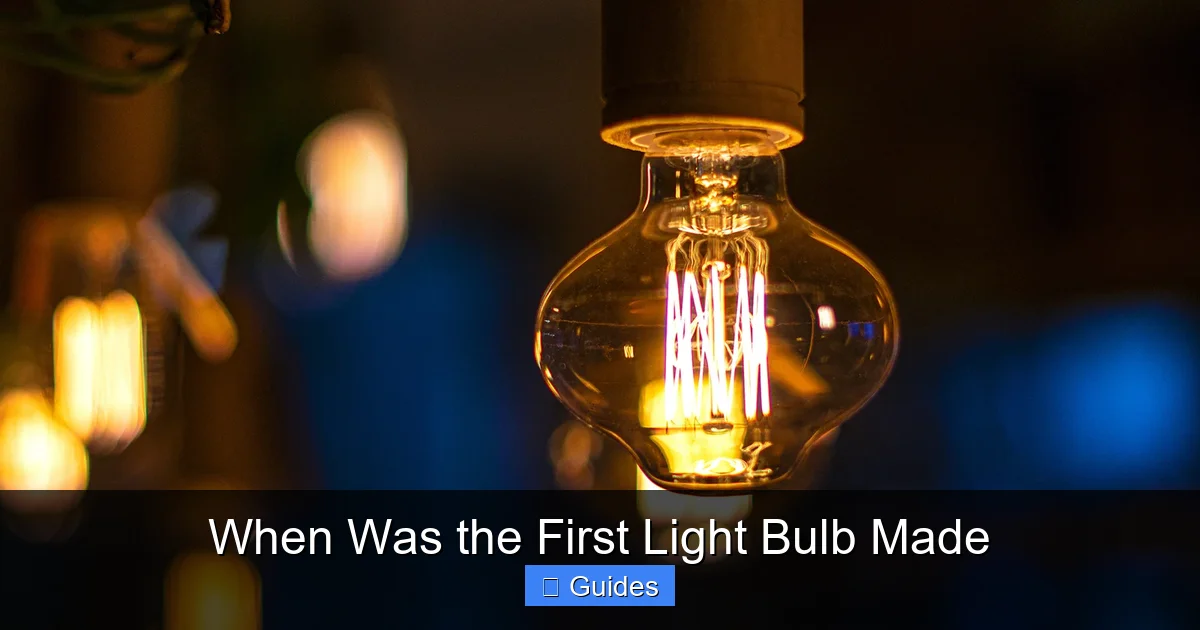
Visual guide about When Was the First Light Bulb Made
Image source: cdn.hswstatic.com
Warren de la Rue and Platinum (1820)
One early attempt came from British scientist Warren de la Rue. In 1820, he enclosed a coiled platinum filament in a vacuum tube. Platinum was a great choice because it has a very high melting point, meaning it could get incredibly hot and glow brightly without melting. He pumped all the air out of the tube to create a vacuum. Why a vacuum? Because oxygen makes things burn. Without oxygen, the filament wouldn’t burn up; it would just glow. His lamp worked! It gave off light. The problem? Platinum was, and still is, extremely expensive. A platinum light bulb would have been far too costly for anyone to use regularly. So, while technologically successful, it wasn’t a practical solution for general lighting.
James Bowman Lindsay’s Constant Light (1835)
In Scotland, in 1835, James Bowman Lindsay publicly demonstrated a constant electric light. He used a copper filament and showed that it could “burn” for a long time. While he didn’t patent his invention, his demonstration was a significant moment. It showed people that electric light could be sustained, not just a brief flash. Lindsay’s work was another piece of the puzzle, showing that the dream of a lasting electric light was within reach, even if the materials weren’t quite right yet.
Frederick de Moleyns’ Patent (1841)
Just a few years later, in 1841, a British inventor named Frederick de Moleyns obtained the first patent for an “electric lamp.” His design involved platinum wires placed within a vacuum inside a glass bulb. The patent describes how a powder of carbon could be used to create light by heating. This shows that the basic components of a modern light bulb – a filament, a vacuum, and a glass enclosure – were already being conceived and legally protected in the early 1840s. While we don’t know how long or brightly his specific lamp glowed, getting a patent was a formal recognition of the innovation brewing in the field.
Joseph Swan’s Early Work (1860)
Perhaps one of the most crucial figures before Edison was Joseph Swan, another British physicist. Swan began experimenting in the 1840s. By 1860, he developed a light bulb using carbonized paper filaments in an evacuated glass bulb. “Carbonized” means the paper was heated until it turned into nearly pure carbon, which is a good conductor of electricity and can get very hot. His early bulbs, however, suffered from two main issues: the vacuum pumps of the time weren’t very good, so some oxygen remained, making the filaments burn out quickly. Also, the electrical generators available couldn’t provide a consistent power supply. Despite these challenges, Swan was on the right track, showing the potential of carbon as a filament material. He was absolutely critical in the quest to answer when the first light bulb was made.
Joseph Swan’s Breakthrough and the Quest for Longevity
Joseph Swan didn’t give up. He kept working on his light bulb design for decades, driven by the belief that electric light could be practical. His persistence in the 1870s truly brought the incandescent light bulb much closer to reality.
Improving Vacuum Technology
A huge part of Swan’s later success came from advancements in vacuum pump technology. Remember how oxygen made filaments burn out? Better pumps meant he could create a much, much stronger vacuum inside his glass bulbs. This greatly extended the life of his carbonized filaments. With less oxygen, the carbon filament could glow for hours, even days, instead of just minutes. This was a game-changer. It meant that electric light could finally be reliable enough for practical use, though still not perfect. The improved vacuum technology was a silent hero in the story of when the first light bulb was made.
Carbon Filaments Refined
Swan didn’t just improve the vacuum; he also refined his carbon filaments. He experimented with different organic materials, carbonizing them to create thin, strong conductors. By the mid-1870s, he was using a specially treated cotton thread that, when carbonized, provided a durable and efficient filament. His dedication to finding the best material and conditions for his filament was remarkable. This refinement was essential for making a bulb that truly lasted.
Public Demonstrations and Early Usage (1878-1879)
By 1878 and into 1879, Joseph Swan was confidently demonstrating his working light bulbs in public. He lit up meeting halls, private homes, and even the street outside his lecture. His bulbs were quite effective and relatively long-lasting for the time. He installed the first working incandescent lamps in a British home in 1878 and in the Newcastle-upon-Tyne public library in 1879. These were not mere experiments; these were functional, glowing light bulbs providing real illumination. His work clearly established that the incandescent light bulb was possible and nearing practicality. When people ask when the first light bulb was made, Swan’s name is often overlooked, but his contributions are undeniable and crucial to the story.
Thomas Edison’s Contribution: The Practical, Commercial Bulb
While Joseph Swan was making great strides in England, across the Atlantic, Thomas Edison was working furiously in his famous “invention factory” in Menlo Park, New Jersey. Edison was not just an inventor; he was an entrepreneur and a visionary. He wasn’t just interested in *making* a light bulb; he wanted to create an entire system that would bring electric light to every home and city.
The Menlo Park “Invention Factory”
Edison approached invention differently. He had a team of skilled workers, technicians, and scientists. They didn’t just dabble; they systematically tested thousands of materials and designs. Edison famously said, “I have not failed 10,000 times. I have successfully found 10,000 ways that will not work.” This persistence and systematic approach were key to his success. He was driven by the goal of not just inventing, but of commercializing and democratizing electric light.
The Bamboo Fiber Filament (1879)
After experimenting with thousands of different materials – from platinum to various plant fibers – Edison and his team made a pivotal discovery in October 1879. They found that a carbonized bamboo fiber filament worked exceptionally well. It offered high resistance, which meant it could glow brightly without drawing too much current, making it more efficient and compatible with a central power station. Crucially, this bamboo filament could burn for an astonishing 1,200 hours – a huge leap in longevity compared to previous designs. This breakthrough was a turning point. It was the moment Edison truly delivered on his promise for a practical incandescent light bulb. This bulb, which glowed steadily for extended periods, is often what people mean when they ask when the first light bulb was made.
Creating a System, Not Just a Bulb
Here’s where Edison’s true genius shone. He realized that a light bulb alone wasn’t enough. You needed a whole system to make it work for the masses. This meant inventing and developing:
- Efficient and reliable electrical generators.
- A practical, low-cost electrical distribution network (wires, insulators).
- Meters to measure electricity usage so people could be billed.
- Safety devices like fuses.
- Light sockets and switches that were easy to use in homes.
Edison envisioned and built the entire infrastructure. He understood that without a complete system, even the best light bulb would remain a laboratory curiosity. His company built the first commercial central power plant in Pearl Street, New York City, in 1882, literally lighting up a section of the city. This holistic approach was what truly brought electric light into the modern age.
Patenting and Marketing
Edison secured a U.S. patent for his improved electric lamp in January 1880. He was also a master of marketing and public demonstration. He famously lit up Menlo Park itself, inviting the public to witness the marvel of his practical electric light system. These demonstrations captured the public’s imagination and convinced investors that electric light was the future. This combination of invention, system building, and shrewd business acumen cemented Edison’s place in history as the person who made electric light truly usable and widespread.
The “Who Was First?” Debate and Parallel Innovations
As you can see, the question of “when was the first light bulb made” is not simple. It sparked considerable debate and even legal battles between inventors.
Swan vs. Edison: Legal Battles and Collaboration
When Edison started selling his light bulbs in America, Joseph Swan, who had been demonstrating and even selling his own bulbs in Britain for years, felt that Edison had infringed on his work. This led to significant legal disputes. In the end, the two brilliant inventors decided to join forces. In 1883, they merged their companies in Britain to form the “Edison & Swan United Electric Light Company,” often called “Ediswan.” This collaboration acknowledged both men’s vital contributions and helped consolidate the market for incandescent light bulbs. It’s a great example of how invention is often a shared journey, even if it starts with competition.
Other Inventors in the Mix
It wasn’t just Swan and Edison. Many others were close to cracking the problem.
- Hiram Maxim: An American inventor, also developed and patented incandescent lamps in the late 1870s, experimenting with carbon filaments. He established the United States Electric Lighting Company.
- William Sawyer and Albon Man: These American inventors also developed a long-lasting incandescent lamp and founded the Sawyer-Man Electric Company, which later became part of Westinghouse.
These parallel inventions highlight how the technology was ripe for discovery. Multiple brilliant minds were working on the same problem at roughly the same time, each adding their piece to the puzzle of when the first light bulb was made. Edison’s genius lay in his ability to not only refine the bulb but also build the entire supporting ecosystem around it.
The Importance of a System
While many could make a bulb glow, Edison’s profound impact was in making it accessible and affordable. He provided the framework for an electrical world. Without the power stations, the wiring, the switches, and the meters, even the longest-lasting light bulb would have remained a novelty. So, when considering the full scope of when the first light bulb was made and became useful, Edison’s systematic approach is truly what stands out.
Evolution Beyond the Incandescent Bulb
The story of light doesn’t end with Edison and Swan. Their incandescent bulb was revolutionary, but technology always keeps moving forward. The goal remained the same: more light, less energy, longer life.
Tungsten Filaments (Early 1900s)
The carbonized bamboo filament was good, but it wasn’t perfect. In the early 1900s, scientists discovered that tungsten was an even better material for filaments. Tungsten has an incredibly high melting point and can glow much brighter and more efficiently than carbon. The first commercial tungsten filament lamps appeared around 1904, and by 1910, General Electric had developed methods to produce ductile (flexible) tungsten wire, making these bulbs durable and affordable. This invention greatly improved the incandescent bulb’s efficiency and brightness, making it the standard for decades. This was a significant evolution after the original question of when the first light bulb was made.
Fluorescent Lighting (Mid-20th Century)
Incandescent bulbs generate a lot of heat, which is wasted energy. Scientists looked for more efficient ways to produce light. This led to the development of fluorescent lighting in the mid-20th century. Fluorescent lamps work by passing electricity through a gas, which then emits ultraviolet light. This UV light then hits a special coating inside the bulb, making it glow with visible light. Fluorescent bulbs were much more energy-efficient and longer-lasting than incandescent bulbs, becoming popular in offices, schools, and eventually homes.
LED Technology (Late 20th/Early 21st Century)
The latest revolution in lighting is the LED (Light Emitting Diode). LEDs are semiconductor devices that produce light when an electric current passes through them. They are incredibly energy-efficient, long-lasting (some can last for tens of thousands of hours!), and durable. Though the first practical LED was invented in the early 1960s, it took many decades of development to create white, bright LEDs suitable for general lighting. Today, LEDs are rapidly replacing all other forms of lighting, marking the latest chapter in the ongoing quest for better illumination, far beyond the initial question of when the first light bulb was made.
Conclusion
So, when was the first light bulb made? As you can see, there isn’t a single, simple answer. It’s a story of gradual innovation, a relay race of scientific discovery and engineering breakthroughs. Humphry Davy showed the world the power of electric light, and many followed, experimenting with filaments and vacuums. Joseph Swan brought the incandescent light bulb to the cusp of practicality with his refined carbon filaments and improved vacuum technology.
And then came Thomas Edison, who didn’t just invent a better bulb with his bamboo filament, but engineered an entire system to make electric light a safe, reliable, and affordable reality for everyone. He made the light bulb practical, widely available, and truly transformative. It’s a story that beautifully illustrates how great inventions are often the culmination of many minds, working sometimes in competition, sometimes in collaboration, always building on what came before. The next time you flick on a light switch, remember the countless hours and brilliant minds that worked to bring that simple, yet profound, convenience into your life.
🎥 Related Video: Invention Of BULB | The Dr. Binocs Show | Best Learning Video for Kids | Preschool Learning
📺 Peekaboo Kidz
Here’s Presenting The Dr. Binocs Show SEASON 2 – Inventions Learn all about the Invention Of BULB from Dr. Binocs himself …
Frequently Asked Questions
Who is often mistakenly credited as the sole inventor of the light bulb?
Thomas Edison is often mistakenly credited as the sole inventor of the light bulb. While his contributions were monumental in making the light bulb practical and widespread, many other inventors and scientists made crucial discoveries before and during his time.
What was the earliest form of electric light?
The earliest form of electric light was the electric arc lamp, demonstrated by Humphry Davy in 1802. It produced a very bright, continuous light by creating an electric arc between two charcoal electrodes.
What challenges did early light bulb inventors face?
Early inventors faced challenges such as finding a filament material that would glow brightly without burning out quickly, creating a strong enough vacuum inside the glass bulb to prevent oxidation, and developing consistent electrical power sources.
Why was a vacuum important in early light bulbs?
A vacuum was crucial in early light bulbs because it removed oxygen from the bulb. Without oxygen, the filament could glow incandescently without quickly burning up or oxidizing, greatly extending its lifespan.
What material did Thomas Edison use for his successful filament?
Thomas Edison’s most successful early filament, which allowed his bulb to burn for over 1,200 hours, was made from carbonized bamboo fiber. He and his team tested thousands of different materials before this breakthrough.
How did Edison make the light bulb practical for everyday use?
Edison made the light bulb practical by not only inventing a long-lasting, high-resistance bulb but also by developing the entire electrical system around it. This included efficient generators, a distribution network, wiring, switches, and meters, making electric light accessible and affordable for homes and businesses.
