


As an Amazon Associate, We earn from qualifying purchases.
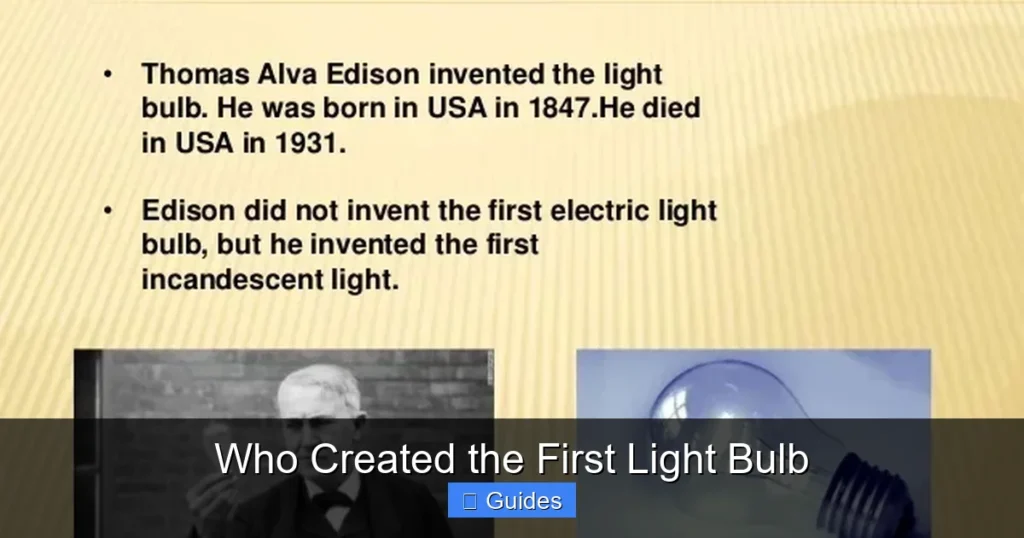
The creation of the first light bulb is a captivating story often mistakenly attributed to a single inventor. While Thomas Edison perfected and commercialized a durable, practical incandescent light bulb in 1879, many brilliant minds contributed to its development over decades. Scientists and inventors like Humphry Davy, Joseph Swan, and Hiram Maxim all made significant, independent strides in electric illumination, paving the way for the world-changing invention that brightens our lives today.
Have you ever stopped to think about the simple flick of a switch that banishes darkness from your room? It’s a miracle we often take for granted – instant light, on demand. But have you ever wondered, truly wondered, who created the first light bulb? If you’re like many people, a famous name probably springs to mind: Thomas Edison. And while Edison certainly played a monumental role in bringing electric light into our homes, the full story of the light bulb is much richer, more complex, and involves a whole cast of brilliant characters.
It’s a common misconception that a single inventor, toiling away in a solitary lab, suddenly had a “eureka!” moment and pulled a functioning light bulb out of thin air. The truth is far more fascinating. The incandescent light bulb, the one that revolutionized daily life and powered the second industrial revolution, wasn’t born from a single flash of genius. Instead, it was the culmination of decades of scientific experimentation, engineering challenges, and persistent innovation by numerous inventors across the globe. Think of it as a relay race, where each brilliant mind passed the baton, adding their piece to the puzzle, until a truly practical and widely adoptable solution emerged.
So, let’s embark on a journey through history, shedding light on the lesser-known pioneers and the pivotal moments that led to the invention of the device that literally lights up our world. We’ll explore the early, often quirky, attempts at electric illumination, understand the crucial breakthroughs, and finally, discover why one name shines brightest in the story of the first light bulb. Get ready to have your perceptions challenged and your understanding illuminated!
Key Takeaways
- No Single Inventor: The light bulb’s invention was a cumulative process, building on decades of scientific discovery and engineering efforts by multiple individuals across different countries.
- Early Pioneers Laid the Foundation: Scientists like Humphry Davy demonstrated early electric arc lamps, while others like Warren de la Rue experimented with vacuum tubes and platinum filaments long before Edison.
- Joseph Swan’s Independent Breakthroughs: British physicist Joseph Swan developed a long-lasting incandescent light bulb with carbonized paper filaments in the 1860s and 1870s, independently of Edison.
- Edison’s Focus on a Practical System: Thomas Edison’s genius lay not just in his 1879 bulb with a carbonized cotton thread filament, but in creating a complete, commercially viable system for electric lighting, including generators, wiring, and sockets.
- The Importance of Commercialization: While others created working light bulbs, Edison excelled at the systematic research, patenting, manufacturing, and distribution necessary to make electric light accessible and affordable to the masses.
- Innovation Continues: The incandescent bulb was just the beginning. Innovation continued with tungsten filaments, fluorescent lights, and modern LEDs, constantly improving efficiency and longevity.
Quick Answers to Common Questions
Who invented the incandescent light bulb?
While many contributed, Thomas Edison is most widely credited for inventing a commercially practical, long-lasting incandescent light bulb in 1879, and for creating the entire system for its widespread use.
Did Joseph Swan invent a light bulb before Edison?
Yes, British physicist Joseph Swan developed and demonstrated a functional incandescent light bulb with a carbonized filament independently in England several years before Edison’s breakthrough, showing it publicly in early 1879.
What was unique about Edison’s light bulb invention?
Edison’s genius lay in not just creating a durable carbonized filament light bulb (initially bamboo fiber), but also in developing a complete and commercially viable system for electric lighting, including generators, wiring, and sockets.
Why is there confusion about who created the first light bulb?
Confusion arises because numerous inventors, working independently across different countries, made significant contributions to electric light, often developing similar technologies around the same time.
Who demonstrated the very first electric light?
Humphry Davy demonstrated the first electric arc lamp in 1802, showing that electricity could produce light, though it was not a practical light bulb for general use.
📑 Table of Contents
The Spark of an Idea: Early Pioneers in Electric Light
The concept of using electricity to create light didn’t begin with a bulb; it started with a spark, quite literally. Long before anyone dreamed of a glass bulb with a glowing filament, scientists were experimenting with ways to generate light from electrical currents.
Humphry Davy and the Arc Lamp
Our story truly begins in the early 19th century. In 1802, British chemist Humphry Davy invented what he called an “electric arc lamp.” He connected two carbon rods to a powerful battery and brought the tips close together. The electric current jumped the gap, creating an intense, brilliant arc of light. Imagine a small, contained lightning bolt! While incredibly bright, Davy’s arc lamp was far from practical. It was expensive to power, burned out quickly, and produced harsh, flickering light and a lot of heat. It was more a scientific curiosity than a household item, but it proved that electricity could indeed produce light.
Beyond the Arc: Early Incandescent Attempts
The challenge then became: how to create a steady, durable, and less intense light? Inventors realized that instead of an arc, a material could be heated by electricity until it glowed – a process called incandescence. Many tried, and many failed.
* Warren de la Rue (1820): This British astronomer encased a coiled platinum filament in a vacuum tube and passed an electric current through it. Platinum was chosen because it has a high melting point. His design was efficient for its time, but platinum was far too expensive for widespread use. It was a beautiful scientific experiment, but not a commercial product.
* James Bowman Lindsay (1835): A Scottish inventor, Lindsay demonstrated a constant electric light, likely an incandescent one, to an audience in Dundee. He later focused more on wireless telegraphy, but his early work hinted at the possibilities.
* Frederick de Moleyns (1840): He received the first patent for an incandescent lamp in England. His design used powdered charcoal between two platinum wires, enclosed in a vacuum glass bulb. Again, durability and cost were major hurdles.
* John Wellington Starr (1845): An American inventor, Starr created a light bulb using a carbonized filament within a vacuum. He patented it in England. His design was quite advanced for its time, but tragically, Starr died young, and his work didn’t receive the recognition it deserved.
These early attempts, while not commercially successful, were crucial. They established the fundamental principles: a filament to glow, a vacuum to prevent the filament from burning up too quickly, and a source of electricity. Each inventor learned from the last, chipping away at the immense challenge of creating reliable electric light.
The Race for a Practical Bulb: Joseph Swan’s Contributions
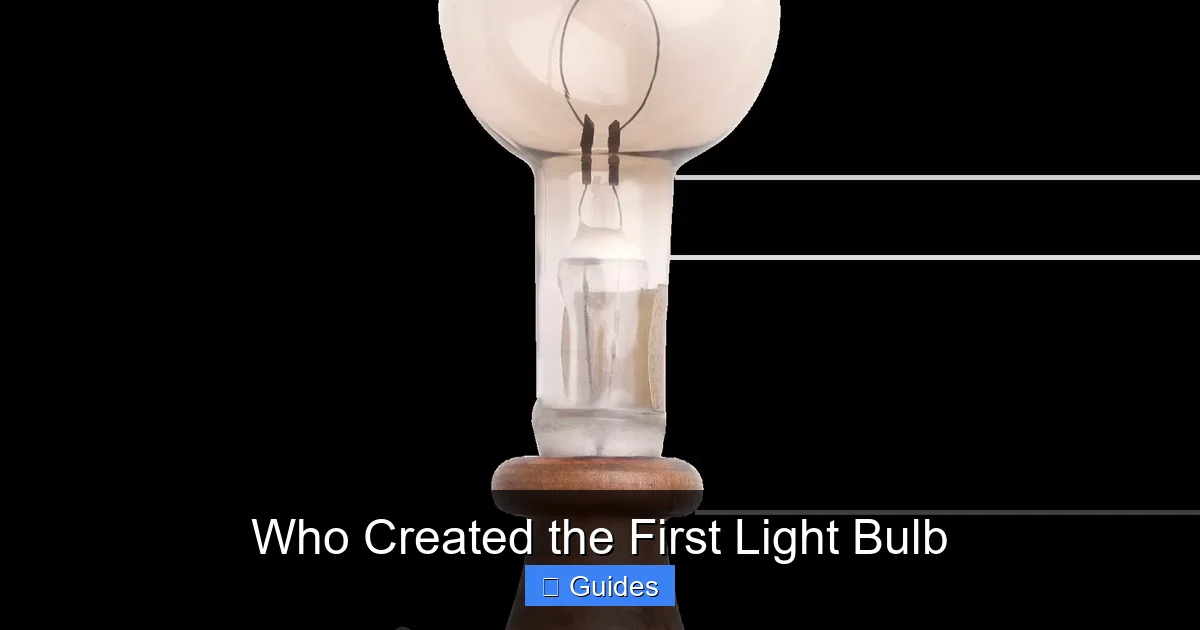
Visual guide about Who Created the First Light Bulb
Image source: res.cloudinary.com
As the 19th century progressed, the scientific community continued to push the boundaries of electric lighting. In England, one name stands out prominently in the development of the incandescent bulb: Joseph Swan.
Swan’s Persistent Pursuit
Joseph Wilson Swan was a brilliant British physicist and chemist who dedicated much of his career to improving the incandescent lamp. He understood the critical role of the vacuum in preventing the filament from rapidly oxidizing and burning out.
* Early Experiments (1860): Swan initially experimented with carbonized paper filaments in a vacuum. He demonstrated a working prototype in 1860, but the vacuum pumps of the era weren’t powerful enough to create a truly good vacuum, and his filaments were still too fragile and short-lived.
* The Breakthrough (1870s): The invention of improved vacuum pumps by Hermann Sprengel in 1865 was a game-changer. With better vacuums, Swan was able to make significant progress. By 1878, Swan developed a long-lasting light bulb using a thin, heat-treated carbon rod (made from cotton thread) in a nearly perfect vacuum. He demonstrated his lamp at a lecture in Newcastle upon Tyne in February 1879, illuminating a public hall. This was a hugely significant moment.
* Commercialization in the UK: Swan quickly began manufacturing and installing his bulbs in homes and public buildings in England. By 1881, the Savoy Theatre in London was entirely lit by Swan’s incandescent lamps – a dazzling display of modern technology!
Swan’s contributions were immense and independent. He had a truly practical, durable light bulb that could illuminate spaces effectively. He was not just an inventor but also an entrepreneur, bringing his invention to the public. However, across the Atlantic, another inventor was working feverishly on the same problem.
Edison’s Genius: Invention, Innovation, and Commercialization
When most people ask, “Who created the first light bulb?” the answer that typically echoes back is Thomas Edison. And while it’s important to recognize the many pioneers before him, Edison’s role was undeniably pivotal, not just for inventing *a* light bulb, but for inventing the *system* that made electric light ubiquitous.
The Menlo Park Approach
Thomas Edison was more than just an inventor; he was an innovator who understood the entire ecosystem required for an invention to succeed. His famous laboratory in Menlo Park, New Jersey, wasn’t just a workshop; it was an “invention factory,” a hub of systematic research and development, employing a team of skilled scientists and engineers.
Edison wasn’t interested in just creating *any* light bulb. He wanted to create a light bulb that was:
1. Long-lasting: It needed to last hundreds, if not thousands, of hours.
2. Affordable: It had to be cheap enough for ordinary people to buy.
3. Efficient: It needed to use a reasonable amount of electricity.
4. Part of a System: Crucially, it had to work seamlessly with generators, distribution wires, meters, and sockets – a complete infrastructure for electric lighting.
The Filament Hunt and the Breakthrough
Edison and his team embarked on an exhaustive search for the perfect filament material. They tested thousands of different substances: platinum, various metals, and countless plant fibers. It was an almost obsessive quest.
* The “Holy Grail” Filament (1879): After countless trials, in October 1879, Edison’s team achieved a breakthrough. They carbonized a cotton sewing thread and placed it inside a high-vacuum glass bulb. This humble carbonized thread glowed for over 13.5 hours. It wasn’t perfect, but it was a major step forward.
* The Bamboo Fiber (1880): Edison soon discovered that a carbonized bamboo fiber filament could last for over 1,200 hours. This was the commercial success he was looking for. This bulb became the foundation of his company’s light bulb production.
Edison’s Complete System
Edison’s true genius wasn’t just the bulb itself, but his vision for an entire electric lighting system. He developed:
* Improved Dynamos (Generators): To produce electricity efficiently.
* Wiring and Distribution Systems: To get electricity from the generators to homes and businesses.
* Sockets and Switches: User-friendly ways to connect and control the bulbs.
* Meters: To measure electricity consumption and bill customers fairly.
In 1882, Edison’s Pearl Street Station in New York City began operating, providing electric light to customers in Lower Manhattan. This was a defining moment, demonstrating that electric light could be practical, reliable, and widely distributed. This is why Edison often gets the primary credit – he didn’t just invent a bulb, he engineered a revolution.
Beyond Swan and Edison: Other Contributors
The story doesn’t end with Swan and Edison. The late 19th century was a time of intense competition and simultaneous invention. Many other brilliant minds were working on similar problems, sometimes independently, sometimes in direct competition.
Hiram Maxim and Others
* Hiram Maxim: An American inventor, perhaps best known for the Maxim gun, also developed incandescent light bulbs around the same time as Edison and Swan. He patented a carbon filament bulb in 1878 and improved it with a method of “flashing” the filament to increase its resistance and durability. He founded the U.S. Electric Lighting Company.
* William Sawyer and Albon Man: These American inventors also developed a practical incandescent lamp with a carbon filament and established the Sawyer-Man Electric Company, which became a significant competitor to Edison’s enterprise.
* St. George Lane Fox Pitt: Another British inventor who contributed to the development of incandescent lamps, especially regarding the production of carbon filaments.
The existence of multiple inventors developing similar technologies around the same time highlights a key aspect of invention: ideas often emerge when the underlying scientific and technological conditions are ripe. The advancements in vacuum technology, understanding of electricity, and material science meant that several individuals, working independently, were poised to make similar discoveries.
The “War of the Currents” and Beyond
The rivalry between companies like Edison’s General Electric and Westinghouse (which supported Nikola Tesla’s alternating current system) further fueled innovation and competition. This period, often called the “War of the Currents,” eventually led to the widespread adoption of AC power, making electric lighting even more efficient and far-reaching.
While the basic incandescent light bulb reached maturity by the 1880s, innovation didn’t stop. Later advancements included:
* Tungsten Filaments (early 20th century): Much stronger and more efficient than carbon, tungsten filaments became the standard, making bulbs even brighter and longer-lasting.
* Gas-filled Bulbs: Adding inert gases like argon or nitrogen inside the bulb further slowed down filament evaporation.
* Fluorescent Lights: A completely different technology offering higher efficiency.
* LEDs (Light-Emitting Diodes): The modern standard, offering incredible energy efficiency and longevity, proving that the quest for better light is an ongoing journey.
Why Does It Matter Who Was ‘First’?
You might be asking, with all these names and competing claims, why does it matter who was “first”? The concept of being “first” is often oversimplified in popular history. In reality, invention is rarely a singular event. It’s an iterative process, a series of improvements, refinements, and strategic decisions that collectively bring a new technology to fruition.
* The Nature of Invention: The light bulb’s story perfectly illustrates that invention is often a cumulative process. Each early attempt, even if unsuccessful, provided valuable data and insights that future inventors could build upon.
* The Role of Patents: Patents played a crucial role, granting inventors legal protection for their innovations. This led to fierce legal battles between Edison, Swan, Maxim, and others over who truly “owned” the invention, eventually leading to mergers and licensing agreements (e.g., Ediswan in the UK).
* Innovation vs. Invention: Edison’s genius was not just in *inventing* a bulb, but in *innovating* an entire system and successfully *commercializing* it. He understood that a great invention that nobody can use or afford is, in practical terms, less impactful than a slightly less original invention that becomes widely adopted.
* Learning from the Past: By understanding the full history, we gain a deeper appreciation for the collaborative nature of scientific progress and the sheer persistence required to solve complex engineering challenges. It reminds us that behind every modern convenience are countless hours of human ingenuity, trial, and error.
Conclusion
So, who created the first light bulb? The most honest and accurate answer is that no single individual did. It was a symphony of scientific exploration, engineering perseverance, and entrepreneurial vision. From Humphry Davy’s initial arc light to Joseph Swan’s practical incandescent lamps and Thomas Edison’s integrated system that brought electric light to the masses, countless brilliant minds contributed to this world-changing invention.
Edison certainly deserves immense credit for his systematic approach, his relentless pursuit of a practical filament, and his unparalleled ability to create and market a complete, reliable lighting system. His name became synonymous with the light bulb for very good reasons. However, remembering the contributions of pioneers like Swan and the many others who laid the groundwork enriches our understanding of this incredible journey. The light bulb stands as a testament to collective human ingenuity, a reminder that true progress often arises from shared knowledge, fierce competition, and a relentless desire to illuminate the unknown. And the next time you flip a switch, perhaps you’ll take a moment to appreciate the centuries of effort that brightened your world.
Frequently Asked Questions
Was Thomas Edison the only inventor of the light bulb?
No, Thomas Edison was not the sole inventor. Many scientists and inventors, including Humphry Davy, Joseph Swan, and Hiram Maxim, made crucial contributions to electric lighting technology and incandescent lamps before and during Edison’s work.
What was the main difference between Edison’s and Swan’s light bulbs?
While both Edison and Swan developed successful carbon filament bulbs around the same time, Edison’s primary focus was on creating a complete, integrated system for electric lighting that included generators, wiring, and distribution, making his bulb part of a commercially viable network.
When was the first commercially practical light bulb invented?
The first commercially practical light bulb is generally considered to be Thomas Edison’s version, patented in 1879, which used a carbonized cotton thread filament (and later bamboo fiber) that could last for hundreds of hours and was part of a robust electrical distribution system.
Why did early light bulbs burn out quickly?
Early light bulbs burned out quickly primarily because of poor vacuum technology, which allowed oxygen to remain inside the bulb. This oxygen would react with the hot filament, causing it to rapidly oxidize and disintegrate.
What material was used for the filament in Edison’s successful light bulb?
Edison’s most successful early light bulb used a carbonized bamboo fiber as its filament, which provided excellent longevity and durability compared to other materials tested at the time.
Did the invention of the light bulb involve legal disputes?
Yes, the invention of the light bulb involved significant legal disputes and patent battles, particularly between Edison and Joseph Swan’s companies, which eventually led to mergers and licensing agreements to resolve their competing claims.
