


As an Amazon Associate, We earn from qualifying purchases.
The invention of the incandescent light bulb was not the work of a single person but a culmination of contributions from numerous inventors over many decades. While Thomas Edison is widely credited for making the first commercially practical and long-lasting bulb, his success built upon significant advancements made by pioneers like Joseph Swan, Humphry Davy, and many others who experimented with electric light and filaments. Edison’s genius lay in perfecting the entire system, making electric light accessible and sustainable for homes and businesses worldwide.
Who Invented the Incandescent Light Bulb?
When you think about the incandescent light bulb, one name usually springs to mind: Thomas Edison. It’s a classic tale taught in schools and ingrained in popular culture – the brilliant inventor toiling away in his lab, finally discovering the secret to bringing light to the world. But what if I told you that the story of who invented the incandescent light bulb is far more complex, a tapestry woven with threads from many different hands over many decades?
The truth is, while Edison played a monumental role in making the incandescent light bulb a practical, everyday reality, he didn’t invent it out of thin air. Instead, he stood on the shoulders of giants, building upon the work of countless engineers, scientists, and tinkerers who had experimented with electric light for much of the 19th century. Understanding who truly invented the incandescent light bulb requires us to journey back in time and explore the collective genius that illuminated our world.
So, let’s peel back the layers of history and shed some light on the incredible journey of the incandescent light bulb, uncovering the often-forgotten pioneers and appreciating Edison’s unique genius in its proper context. It’s a story of persistence, innovation, and the relentless pursuit of progress.
Key Takeaways
- No Single Inventor: The incandescent light bulb was the result of a long evolutionary process, with contributions from multiple scientists and inventors across different countries over many decades, not a single ‘Eureka!’ moment.
- Early Pioneers Paved the Way: Inventors like Humphry Davy, Warren de la Rue, and others experimented with early forms of electric light and rudimentary filaments, laying crucial groundwork long before Edison or Swan.
- Joseph Swan’s Significant Contributions: British physicist Joseph Swan made critical advancements in the 1860s and 1870s, developing a practical, long-lasting carbon filament and creating a good vacuum, leading to public demonstrations in England.
- Thomas Edison’s Commercialization Genius: American inventor Thomas Edison’s primary contribution was perfecting a highly practical, long-lasting (over 1,200 hours) incandescent light bulb and, crucially, developing the entire system of electricity generation and distribution necessary to make it widely usable and commercially viable.
- Collaboration and Competition: Edison and Swan initially engaged in patent disputes but eventually merged their interests in some regions, forming the Edison & Swan United Electric Light Company, demonstrating how innovation often involves both competition and cooperation.
- Continuous Improvement: The incandescent light bulb continued to evolve after Edison and Swan, with later innovations like the tungsten filament (William Coolidge) and gas-filled bulbs (Irving Langmuir) significantly improving its efficiency and lifespan.
- A Monumental Impact: The invention and commercialization of the incandescent light bulb fundamentally transformed society, extending productivity, enhancing safety, and paving the way for the modern electrical age.
Quick Answers to Common Questions
Who is primarily credited with inventing the incandescent light bulb?
Thomas Edison is most widely credited with inventing the commercially practical and long-lasting incandescent light bulb, largely due to his development of a complete electrical system for its widespread use.
Did anyone invent an incandescent light bulb before Edison?
Yes, many inventors, including Joseph Swan, Humphry Davy, and Warren de la Rue, made significant advancements in electric lighting and rudimentary incandescent bulbs before Edison’s breakthrough.
What was Joseph Swan’s key contribution to the incandescent light bulb?
Joseph Swan developed a long-lasting incandescent light bulb using a carbonized cotton thread filament and a good vacuum in the late 1870s, making public demonstrations in England.
What made Edison’s incandescent light bulb so significant?
Edison’s primary innovation was developing a highly durable and inexpensive carbonized bamboo filament (lasting over 1,200 hours) and, critically, creating the entire system for electricity generation and distribution necessary for widespread adoption.
What material replaced carbon as the filament in incandescent light bulbs?
Tungsten, made ductile by William Coolidge, replaced carbon as the filament material in incandescent light bulbs in the early 20th century due to its higher melting point, allowing for brighter and more efficient bulbs.
📑 Table of Contents
- The Spark of Genius: Early Pioneers and the Path to Illumination
- Joseph Swan: Britain’s Luminary Breakthroughs
- Thomas Edison: The American Inventor’s Quest for Commercial Viability
- The “Light Bulb Wars” and Global Collaboration
- Beyond the Carbon Filament: Evolution of the Incandescent Light Bulb
- The Legacy of the Incandescent Light Bulb
The Spark of Genius: Early Pioneers and the Path to Illumination
The idea of using electricity to create light wasn’t new when Edison started his work in the late 1870s. In fact, people had been experimenting with it for nearly 80 years! These early attempts might not look like the incandescent light bulb we recognize today, but they were crucial first steps.
Humphry Davy’s Arc Light (Early 1800s)
Our journey begins with British chemist Humphry Davy. In 1802, using what was then the world’s most powerful battery, he demonstrated that electricity could create light. He connected wires to a battery and then to a piece of charcoal, causing the charcoal to glow brightly. This wasn’t an incandescent light bulb; it was an “arc lamp,” producing light by creating an electric arc between two carbon rods. While incredibly bright, arc lamps were too hot, too bright, and burned too quickly for home use. They were, however, revolutionary for public spaces and street lighting.
The First Filaments and Vacuums (Mid-1800s)
After Davy, many other brilliant minds picked up the torch (pun intended!). The challenge was clear: how to make electric light safer, less intense, and more importantly, *last longer*. The key to the incandescent light bulb lay in two main areas: the filament (the material that glows) and the vacuum (the environment it glows in).
* Warren de la Rue (1820): This British astronomer encased a platinum coil in a vacuum tube and passed an electric current through it. Platinum was a great choice because it has a high melting point, but it was far too expensive for practical use. Still, his work with a coiled filament in a vacuum was a significant conceptual leap towards the incandescent light bulb.
* James Bowman Lindsay (1835): A Scottish inventor, Lindsay publicly demonstrated a constant electric light, lighting up a room in Dundee. He claimed to be able to “read a book at a distance of one and a half feet from the light.” While he didn’t pursue patents, his work showed the potential of electric light for domestic use.
* Frederick de Moleyns (1841): An English inventor who patented a design for a light bulb using platinum wires inside a vacuum bulb. His design was an important step, though still not commercially viable.
* John Wellington Starr (1840s): An American who reportedly patented an incandescent light bulb using a carbon filament in an evacuated glass bulb. Sadly, Starr died young, and his patents or specific contributions aren’t always widely recognized, but his ideas were certainly aligned with later successful designs.
These early inventors understood that a filament needed to be heated to incandescence (glowing hot) and that doing so in a vacuum would prevent it from quickly burning up (oxidizing). Their challenge was finding the right materials and the technology to create a strong enough vacuum. Without reliable vacuum pumps, their bulbs often failed quickly due to residual oxygen.
Joseph Swan: Britain’s Luminary Breakthroughs
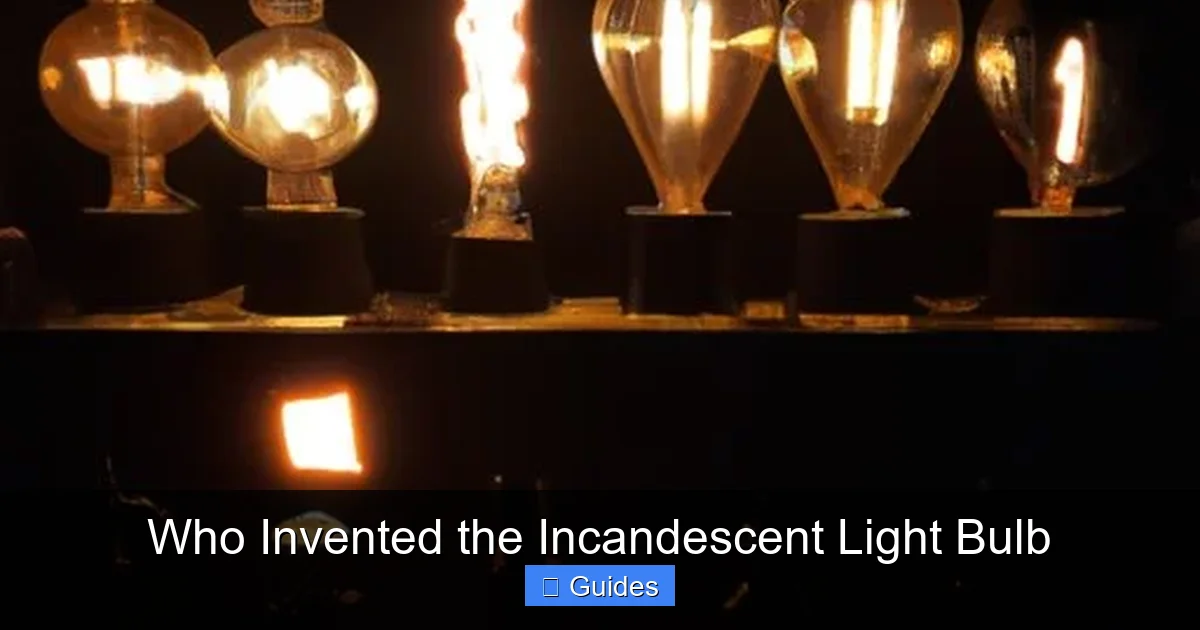
Visual guide about Who Invented the Incandescent Light Bulb
Image source: lihpao.com
As the 19th century progressed, technology, particularly vacuum pump technology, improved dramatically. This set the stage for one of the most significant pre-Edison contributors to the incandescent light bulb: Joseph Swan.
Swan’s Early Experiments (1850s)
Joseph Swan, a British physicist and chemist, began experimenting with light bulbs as early as the 1850s. He focused on using carbonized paper filaments in an evacuated glass bulb. His early efforts were hampered by poor vacuum technology; the filaments burned out quickly.
The 1870s Re-emergence and Improvement
It wasn’t until the mid-1870s, with the invention of the Sprengel mercury vacuum pump (allowing for a much better vacuum), that Swan made a major breakthrough. In 1878, he developed a long-lasting electric light bulb using a thin, carbonized cotton thread as a filament. This thread had high electrical resistance, meaning it would glow brightly when current passed through it.
By December 1878, Swan publicly demonstrated his incandescent light bulb in Newcastle, England. His bulbs lasted for a substantial period and were practical for illumination. He went on to light his own house and several public buildings in England, showcasing a truly viable electric light source. Swan patented his light bulb in England in 1878, making him a true pioneer in creating a commercially practical incandescent light bulb.
Thomas Edison: The American Inventor’s Quest for Commercial Viability
While Joseph Swan was making waves in England, across the Atlantic, Thomas Edison was famously working in his Menlo Park, New Jersey, “invention factory.” Edison, known for his systematic approach to invention, wasn’t just interested in *a* light bulb; he wanted to create an *entire system* that would bring electric light into every home and business.
Edison’s Menlo Park Lab
Edison’s genius lay in his methodical experimentation and his vision for a complete system. He famously said, “I have not failed. I’ve just found 10,000 ways that won’t work.” His team tried thousands of different materials for filaments, from platinum and iridium to various types of paper and plant fibers.
The “One Thousand Experiments” Myth and Reality
The popular myth suggests Edison tried 1,000 or even 10,000 filaments before succeeding. While an exaggeration, it highlights his relentless pursuit. He wasn’t just looking for *any* light; he sought a long-lasting, inexpensive, and efficient incandescent light bulb. His breakthrough came in October 1879, when his team discovered that a carbonized cotton thread filament could last for 13.5 hours. This was an improvement, but not enough.
Then, in late 1879, Edison and his team found that a carbonized bamboo filament could burn for over 1,200 hours. This was a game-changer! It was cheap to produce, readily available, and offered a fantastic lifespan, making the incandescent light bulb truly practical for everyday use. Edison filed his key patent for “an electric lamp with a carbon filament” in 1879.
The Key Innovation: The System
Edison’s most profound contribution wasn’t just the bulb itself, but the *entire electrical system* surrounding it. He understood that a practical incandescent light bulb was useless without an efficient and affordable way to generate and distribute electricity. He designed:
* **Improved Dynamos:** To generate electricity reliably.
* **A Distribution Grid:** A network of wires to carry electricity to homes.
* **Fuses and Meters:** For safety and billing.
* **Sockets and Switches:** For user convenience.
This holistic approach is what truly set Edison apart. He didn’t just invent a product; he created an industry. His central power station on Pearl Street in New York City, which began operation in 1882, proved that his system could power an entire district, making electric light accessible and affordable. This is why Edison often gets the lion’s share of credit for the incandescent light bulb – he made it work on a grand scale.
The “Light Bulb Wars” and Global Collaboration
Given that both Joseph Swan and Thomas Edison developed highly effective incandescent light bulbs around the same time, it’s not surprising that patent disputes arose.
Patent Disputes and Legal Battles
In the late 1870s and early 1880s, Edison and Swan found themselves in a legal battle, particularly in the United Kingdom, over who had the rights to the incandescent light bulb. Swan’s earlier public demonstrations and patents in England gave him a strong claim there, while Edison’s robust system and later, highly durable filament gave him an advantage in the U.S.
The core of the dispute often revolved around the quality of the vacuum and the type of carbon filament used. Both men were brilliant, and both had independently arrived at similar conclusions regarding the need for a high-resistance carbon filament in a good vacuum.
Edison & Swan United Electric Light Company
Rather than engage in protracted and costly legal battles that could hinder the growth of the nascent electric lighting industry, the two rivals eventually joined forces in the UK. In 1883, they merged their operations to form the Edison & Swan United Electric Light Company, often simply called “Ediswan.” This collaboration allowed them to pool their patents and expertise, consolidating their market position and accelerating the adoption of electric lighting. It’s a fantastic example of how even intense competition can sometimes lead to productive collaboration, benefiting consumers and industry alike.
International Diffusion of Technology
The combined efforts of Edison and Swan, along with other inventors and companies, rapidly led to the global spread of incandescent light bulbs. Their designs and systems were licensed, adapted, and improved upon worldwide, ushering in an era of unprecedented progress and change. The incandescent light bulb illuminated cities, factories, and homes, changing daily rhythms and extending productivity into the night.
Beyond the Carbon Filament: Evolution of the Incandescent Light Bulb
Even after Edison and Swan’s breakthroughs, the incandescent light bulb continued to evolve. Innovation never truly stops, and the journey to a more efficient and effective light source was far from over.
Tungsten’s Ascendancy (Early 20th Century)
The carbon filament, while a huge step forward, wasn’t perfect. It was relatively fragile and not as efficient as it could be. Scientists continued to search for better materials. The early 1900s saw the introduction of metal filaments, with tantalum and osmium briefly gaining traction.
The real game-changer arrived with tungsten. Tungsten has the highest melting point of any metal, allowing it to glow much brighter and more efficiently without melting. However, working with tungsten was difficult; it was brittle.
* William Coolidge (1903-1910): An American physicist working for General Electric, Coolidge developed a process to make tungsten ductile (moldable into fine wires). This “ductile tungsten” filament, patented in 1910, revolutionized the incandescent light bulb. Tungsten bulbs were brighter, lasted longer, and were more energy-efficient than their carbon counterparts. This remains the standard filament material for traditional incandescent light bulbs.
Gas-Filled Bulbs (Irving Langmuir)
Another significant improvement came from Irving Langmuir, another General Electric scientist. In 1913, he discovered that filling the incandescent light bulb with an inert gas, like argon or nitrogen, could significantly reduce the evaporation of the tungsten filament. This made the bulb last even longer and allowed it to operate at higher temperatures for greater efficiency and brightness. This innovation marked the peak of incandescent light bulb technology.
The Incandescent Bulb’s Peak and Decline
For over a century, the incandescent light bulb reigned supreme, illuminating homes, businesses, and public spaces across the globe. It was a symbol of modernity and progress. However, its fundamental principle – creating light by generating heat – made it inherently inefficient. A large percentage of the energy consumed by an incandescent light bulb is wasted as heat, not light.
As energy efficiency became a more pressing concern, especially in the late 20th and early 21st centuries, the incandescent light bulb began to be phased out in favor of more energy-efficient alternatives like compact fluorescent lamps (CFLs) and, more recently, light-emitting diodes (LEDs). While LEDs are now the dominant technology, they stand on the shoulders of the incandescent light bulb, which first showed us the power of electric illumination.
The Legacy of the Incandescent Light Bulb
So, who invented the incandescent light bulb? The answer isn’t a single name, but a story of collective human ingenuity. It’s a story of Humphry Davy lighting the first arc, of Warren de la Rue envisioning a filament in a vacuum, of Joseph Swan perfecting the carbon filament and vacuum technology, and of Thomas Edison creating the complete, commercially viable system that brought electric light to the masses. It’s also the story of continuous improvement by people like William Coolidge and Irving Langmuir.
The incandescent light bulb did more than just light up rooms; it transformed society. It extended the workday, enhanced safety, spurred urban development, and profoundly changed human behavior and culture. It paved the way for the entire electrical infrastructure that powers our modern world. Without the foundational work on the incandescent light bulb, the digital age and countless other technological advancements might never have happened.
The legacy of the incandescent light bulb reminds us that true innovation is often a long, collaborative process, built brick by brick, idea by idea, by countless individuals. While Thomas Edison justly receives much credit for his pivotal role, honoring the full spectrum of inventors involved gives us a richer, more accurate understanding of one of humanity’s most transformative inventions. The incandescent light bulb, in all its iterations, truly lit up the world.
Frequently Asked Questions
Was Thomas Edison the sole inventor of the incandescent light bulb?
No, Thomas Edison was not the sole inventor. The incandescent light bulb was a product of continuous innovation and refinement by many individuals over several decades. Edison’s genius lay in perfecting the design and, crucially, developing the entire system for its practical and widespread commercial use.
What were some of the key challenges early inventors faced when trying to create an incandescent light bulb?
Early inventors faced challenges such as finding a filament material that could glow brightly without quickly melting or burning up, and creating a sufficiently strong vacuum inside the bulb to prevent the filament from oxidizing and failing rapidly.
How did Joseph Swan and Thomas Edison resolve their patent disputes?
In the United Kingdom, Joseph Swan and Thomas Edison eventually resolved their patent disputes by merging their interests. They formed the Edison & Swan United Electric Light Company (Ediswan) in 1883, combining their expertise and patents to dominate the British market.
Why did the incandescent light bulb eventually get phased out in many places?
The incandescent light bulb was largely phased out due to its inefficiency. A significant portion of the electricity it consumed was converted into heat rather than light, making it less energy-efficient compared to newer technologies like compact fluorescent lamps (CFLs) and light-emitting diodes (LEDs).
What was the importance of the vacuum in the incandescent light bulb?
The vacuum inside the incandescent light bulb was crucial because it removed oxygen. Without oxygen, the filament could be heated to incandescence without rapidly burning up (oxidizing), significantly extending the bulb’s lifespan and making it a practical light source.
How did the invention of the incandescent light bulb change society?
The incandescent light bulb dramatically changed society by extending the workday and night, enhancing safety, and fostering urban development. It enabled people to work and socialize after sunset, paving the way for the modern electrical grid and countless technological advancements that rely on readily available electric light.
