


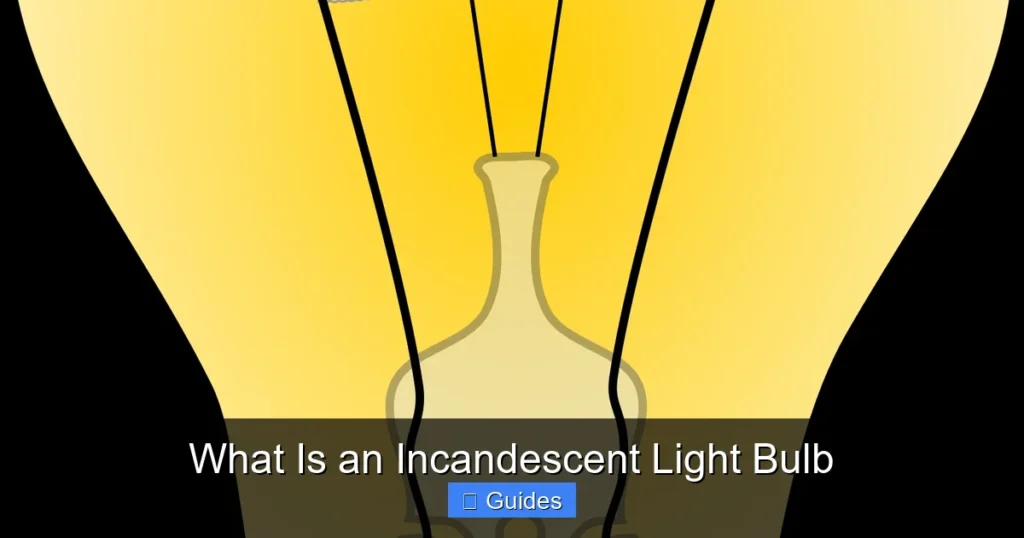
As an Amazon Associate, We earn from qualifying purchases.
An incandescent light bulb is a classic lighting device that produces light by heating a wire filament to incandescence using an electric current. Encased in a glass bulb, typically filled with an inert gas, it generates a warm, familiar glow. While largely phased out due to energy inefficiency, its simple design and excellent color rendering made it the dominant light source for decades, leaving a significant mark on modern living.
What Is an Incandescent Light Bulb?
Have you ever stopped to think about the humble light bulb? Not the fancy LED ones we use today, but the classic, glowing orb that symbolized invention and brought light into our homes for over a century. We’re talking about the incandescent light bulb – a simple yet revolutionary device that literally changed the way we live, work, and play after sunset. For many of us, it’s the iconic image that springs to mind when we hear the word “bulb.”
But what exactly *is* an incandescent light bulb? How does it work? And why, despite its monumental impact, has it largely disappeared from our shelves? Join me on a friendly journey to unravel the story of this illuminating invention. We’ll explore its inner workings, its fascinating history, its brilliant advantages, and its inevitable shortcomings, understanding why it was once the king of illumination and why its reign came to an end. Get ready to shed some light on this incandescent classic!
Key Takeaways
- Simple Principle: An incandescent light bulb works by passing an electric current through a thin wire filament (usually tungsten), heating it until it glows brightly.
- Key Components: Its main parts include a glass envelope (bulb), a tungsten filament, support wires, an inert gas fill (like argon), and an electrical base.
- Energy Inefficiency: A significant drawback of incandescent bulbs is their low energy efficiency; about 90% of the energy consumed is released as heat, with only 10% converted into visible light.
- Warm, Familiar Light: Incandescent bulbs are known for producing a warm, comforting light with excellent color rendering, making colors appear natural and vibrant.
- Historical Significance: Though developed over time by many inventors, Thomas Edison is widely credited with commercializing the first practical, long-lasting incandescent light bulb, transforming daily life.
- Phase-Out and Legacy: Due to global energy efficiency standards, traditional incandescent bulbs have been largely phased out, but their legacy lives on in specialized applications and the design inspiration for modern alternatives.
Quick Answers to Common Questions
What is the main component of an incandescent light bulb that produces light?
The main component is the filament, typically a thin coiled wire made of tungsten, which heats up and glows when electricity passes through it.
Why do incandescent bulbs get so hot?
Incandescent bulbs get hot because a significant portion (around 90-95%) of the electrical energy they consume is converted into heat rather than visible light, making them quite inefficient.
Who is credited with inventing the practical incandescent light bulb?
While many contributed, Thomas Edison is widely credited with commercializing the first practical and long-lasting incandescent light bulb around 1879, along with a complete electrical lighting system.
What gas is often found inside an incandescent light bulb?
Incandescent light bulbs are often filled with an inert gas like argon, nitrogen, or a mixture, to slow down the evaporation of the tungsten filament and extend the bulb’s lifespan.
Are incandescent light bulbs still available for purchase?
Traditional general-purpose incandescent light bulbs have been largely phased out due to energy efficiency regulations, but specialized incandescent bulbs for appliances, heat lamps, or decorative purposes may still be available.
📑 Table of Contents
- The Anatomy of an Incandescent Light Bulb: A Look Inside
- How an Incandescent Light Bulb Works: The Science of Light
- A Brief History: Lighting Up the World
- The Pros and Cons of Incandescent Lighting
- Understanding Incandescent Bulb Specifications: Watts, Lumens, and Color
- The Legacy and Future of Incandescent Light Bulbs
- Conclusion: The Enduring Glow of an Icon
The Anatomy of an Incandescent Light Bulb: A Look Inside
Let’s start by dissecting the star of our show. An incandescent light bulb might seem like a simple piece of glass, but it’s a clever combination of components working in harmony. Think of it like a miniature, contained sun, designed to glow on command.
The Glass Envelope (Bulb)
This is the most visible part – the glass “bulb” itself. It’s typically pear-shaped, but can come in various forms (round, tubular, candle-shaped, etc.). Its primary job is to encapsulate the internal components and, crucially, to keep oxygen out. Why no oxygen? Because the filament, when hot, would quickly burn up if exposed to air. This glass is usually soda-lime glass, chosen for its clarity and heat resistance.
The Filament: The Heart of the Glow
At the very center of the incandescent light bulb’s magic is the filament. This is a thin, coiled wire, usually made from tungsten. Tungsten is chosen for a very good reason: it has an incredibly high melting point (over 3,400°C or 6,192°F). This allows it to get extremely hot without melting, which is exactly what we need for it to glow. The filament is coiled to make it more compact and to increase its resistance, which in turn helps it heat up more efficiently.
Support Wires and Lead-in Wires
The delicate filament needs to be held in place. That’s where the support wires come in. These thin wires, often made of molybdenum, provide mechanical support to the filament. The lead-in wires, typically made of nickel-iron, carry the electricity from the base through the stem press to the filament. These wires must conduct electricity well and be able to withstand the heat generated by the filament.
The Inert Gas Fill
Remember how we said the glass envelope keeps oxygen out? Well, most modern incandescent light bulbs aren’t just a vacuum inside. They’re filled with an inert gas, such as argon, nitrogen, or a mixture of both. This gas helps to slow down the evaporation of the tungsten filament. Without it, the tungsten would evaporate faster, depositing on the inside of the bulb (creating that darkened appearance you sometimes see on old bulbs) and significantly shortening the bulb’s lifespan. The gas also helps to dissipate some of the heat, though this is a minor effect compared to prolonging filament life.
The Base (Cap)
The base is what connects the incandescent light bulb to your lamp socket. The most common type is the screw base (like the Edison screw, E26 or E27), but bayonet bases (like the B22) are also widely used. The base serves two crucial functions: it provides a physical connection to hold the bulb in place, and it offers the electrical contacts to deliver power to the filament. Inside the base, you’ll find a metal contact at the very bottom, insulated from the threaded shell by a glass insulator.
How an Incandescent Light Bulb Works: The Science of Light
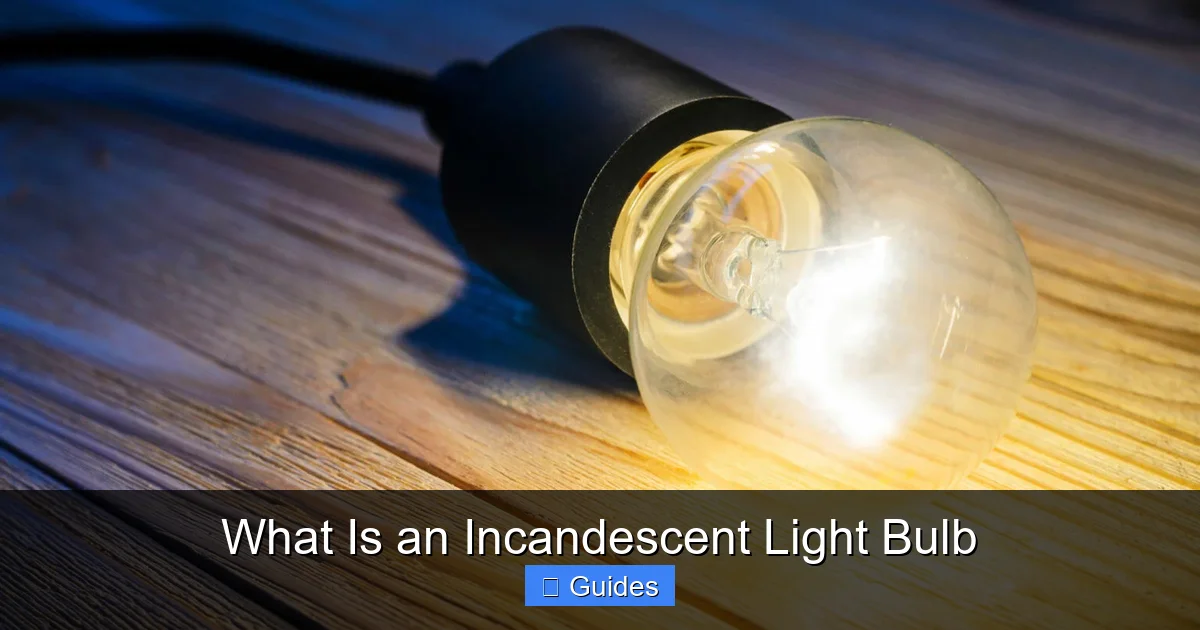
Visual guide about What Is an Incandescent Light Bulb
Image source: lamphq.com
Now that we know what’s inside, let’s explore the fundamental principle behind an incandescent light bulb: incandescence. It’s actually quite simple, yet incredibly effective.
Electricity Meets Resistance
When you flip a light switch, electricity flows from the power source, through your lamp’s wiring, and into the incandescent light bulb’s base. The electricity travels up the lead-in wires and encounters the tungsten filament. This filament is specifically designed to have a high electrical resistance.
Heating Up to a Glow
As the electricity tries to push through this resistance, it encounters friction at a molecular level. This friction converts electrical energy into heat energy. The filament quickly heats up – we’re talking thousands of degrees Celsius (around 2,700°C or 4,900°F for a typical bulb). At this extreme temperature, the tungsten filament begins to glow brightly, emitting visible light. This process of producing light from heat is called “incandescence.” Think of a blacksmith heating metal in a forge – it first glows dull red, then bright orange, then yellow, and eventually almost white, as it gets hotter and hotter. The incandescent light bulb works on the same principle, but with a much higher temperature to achieve a brighter, whiter light.
Light and Heat: An Inefficient Trade-off
Here’s where the incandescent light bulb’s primary drawback comes into play. While it produces light, a significant portion of the energy it consumes is converted into heat – infrared radiation – rather than visible light. In fact, a traditional incandescent bulb is only about 5-10% efficient in converting electrical energy into light. The other 90-95% is wasted as heat. This is why an incandescent bulb gets so hot to the touch, and why leaving one on in a small room can noticeably raise the temperature. This inefficiency is ultimately what led to its decline as more energy-efficient alternatives emerged.
A Brief History: Lighting Up the World
The story of the incandescent light bulb isn’t a simple tale of one inventor having a sudden “aha!” moment. It’s a progression of scientific discovery and engineering refinement, with many brilliant minds contributing along the way.
Early Discoveries and Experiments
The concept of generating light from electricity dates back to the early 19th century. Humphry Davy demonstrated the first electric arc lamp in 1802, using a large battery to create an arc between two charcoal rods. While brilliant, it wasn’t practical for home use. Throughout the 1840s and beyond, various inventors experimented with different materials for filaments and ways to create a vacuum inside a glass enclosure. Joseph Swan, an English physicist, made significant progress in the 1860s and 70s, developing a long-lasting light bulb using carbonized paper filaments in a vacuum.
Edison’s Contribution: Practicality and Commercialization
While Joseph Swan had a working incandescent light bulb, it was Thomas Edison and his team in the United States who, around 1879, developed a highly practical, long-lasting, and commercially viable incandescent light bulb. Edison didn’t *invent* the light bulb from scratch, but his genius lay in perfecting key aspects:
- Better Vacuum: His team significantly improved the vacuum pump technology, creating a near-perfect vacuum inside the bulb to prevent the filament from burning out quickly.
- Superior Filament: After thousands of experiments with different materials, Edison found that a carbonized cotton thread (and later bamboo fibers) provided a sufficiently long lifespan (around 1200 hours).
- High Resistance Filament: This was crucial for practical home use. A high-resistance filament meant that the bulb could be used in parallel circuits without requiring massive amounts of current, making a central power generation and distribution system feasible for the first time.
- Complete System: Edison didn’t just invent a bulb; he created an entire electrical lighting system, including generators, wiring, sockets, and meters, making electric light accessible and affordable for the masses.
Edison’s incandescent light bulb became the standard for artificial illumination for the next century, fundamentally transforming society by extending the day, making factories more productive, and improving safety and convenience.
The Pros and Cons of Incandescent Lighting
Despite its eventual decline, the incandescent light bulb had distinct advantages that made it indispensable for so long, alongside its critical disadvantages.
The “Pros”: What We Loved About Incandescent Bulbs
- Instant On: Flip the switch, and you get immediate, full brightness. No warm-up time needed.
- Excellent Color Rendering: Incandescent bulbs emit a continuous spectrum of light, which means they render colors very accurately and beautifully. This is measured by the Color Rendering Index (CRI), where incandescent bulbs typically score a perfect 100. Colors under an incandescent light look natural and vibrant.
- Warm, Inviting Light: The light produced by an incandescent light bulb is typically a warm white, usually around 2700K (Kelvin) color temperature. This soft, yellowish glow is often perceived as cozy, comforting, and flattering, making it ideal for residential settings and restaurants.
- Perfect Dimmability: Incandescent bulbs dim flawlessly with simple, inexpensive dimmers. As you reduce the voltage, the filament glows less brightly and produces an even warmer light, which is often desirable for creating ambiance.
- Low Initial Cost: Historically, incandescent bulbs were very cheap to manufacture and buy.
- Simple Technology: The internal workings are straightforward, making them robust to power fluctuations and easy to understand.
The “Cons”: Why They Faded Away
- Energy Inefficiency: This is the biggest drawback. As discussed, 90-95% of the energy consumed by an incandescent light bulb is converted into heat, not light. This translates to higher electricity bills and a larger carbon footprint compared to modern alternatives. For example, a 60-watt incandescent bulb produces about the same amount of light (lumens) as an 8-10 watt LED bulb.
- Short Lifespan: A typical incandescent bulb lasts only about 750 to 1,000 hours. The filament eventually thins out from evaporation and breaks, or it can be damaged by physical shock. This means frequent replacements.
- Heat Output: While the warmth can be comforting in winter, the heat generated by incandescent bulbs can be a disadvantage, especially in hot climates or in enclosed fixtures. It can contribute to cooling costs and, if misused, pose a fire hazard.
- Fragility: The glass envelope and delicate filament make incandescent bulbs relatively fragile and susceptible to breakage from drops or impacts.
Understanding Incandescent Bulb Specifications: Watts, Lumens, and Color
Before the age of LEDs, we primarily looked at “watts” when buying a bulb. But understanding an incandescent light bulb fully means looking beyond just how much power it consumes.
Watts (W): Power Consumption
Wattage tells you how much electrical power the incandescent light bulb consumes. A higher wattage means more power used and, generally, more light produced, but also more heat. For example, a 100W bulb uses more electricity than a 60W bulb. In the past, people would choose bulbs based on watts, assuming higher watts meant brighter light.
Lumens (lm): Actual Brightness
Lumens measure the actual amount of visible light produced by a bulb, regardless of how much power it uses. This is the true indicator of brightness. While a 60W incandescent bulb might produce around 800 lumens, a modern LED bulb can achieve the same 800 lumens using only 8-10 watts. As lighting technology evolved, lumens became the more important metric.
Color Temperature (Kelvin – K): The Warmth of Light
Color temperature describes the perceived “warmth” or “coolness” of the light.
- Warm White (2700K – 3000K): Incandescent light bulbs naturally produce light in this range. It’s a soft, yellowish light, similar to candlelight or a sunset. This is what we typically associate with cozy living spaces.
- Cool White (3500K – 4100K): Brighter, more neutral white light, often used in offices or kitchens.
- Daylight (5000K – 6500K): Very bright, bluish-white light, mimicking natural daylight.
Incandescent bulbs are almost exclusively in the “warm white” range, contributing to their beloved ambiance.
CRI (Color Rendering Index): How True Colors Appear
CRI is a scale from 0 to 100 that indicates how accurately a light source renders colors compared to natural daylight. A perfect 100 CRI means colors will look vibrant and true. Incandescent bulbs, because they emit a full, continuous spectrum of light, have a CRI of 100, which is one of their strongest advantages for applications where accurate color representation is crucial (e.g., art studios, retail displays).
The Legacy and Future of Incandescent Light Bulbs
While traditional general-purpose incandescent light bulbs have largely been phased out in many parts of the world due to energy efficiency regulations, their story isn’t quite over. Their legacy is profound, and they still have niche applications.
Global Phase-Out
Starting in the early 2000s, governments worldwide began implementing regulations to ban or restrict the sale of inefficient incandescent light bulbs. The aim was to reduce energy consumption, lower greenhouse gas emissions, and promote more efficient lighting technologies like CFLs (compact fluorescent lamps) and, more recently, LEDs (light-emitting diodes). This phase-out has significantly shifted the lighting market.
Niche Applications
Despite the phase-out, you’ll still find incandescent bulbs in specific uses where their unique properties are either beneficial or where energy efficiency isn’t the primary concern:
- Oven and Appliance Lights: Their ability to withstand high temperatures makes them suitable for oven interiors.
- Heat Lamps: Because they produce so much heat, incandescents are still used in heat lamps for food service or animal husbandry.
- Indicator Lights: Small, low-wattage incandescent indicator bulbs are sometimes used in electronics or control panels for their simplicity and clear visibility.
- Specialty Lighting: Some artistic, decorative, or vintage fixtures might still use specific incandescent light bulbs to achieve a particular aesthetic, or for their excellent dimming properties.
- Nostalgia and Filaments: The classic “Edison bulb” look, with visible filaments, has seen a resurgence in decorative lighting. These are often LED versions designed to mimic the incandescent aesthetic.
The Paved Path for Innovation
The incandescent light bulb undeniably paved the way for all modern lighting. It established the standards for sockets, lamp shapes, and the very concept of accessible electric light. Its inefficiencies spurred the innovation that led to more efficient alternatives. Modern LEDs often strive to replicate the warm glow and high color rendering that incandescent bulbs provided, demonstrating their lasting influence on our perception of “good” light.
Conclusion: The Enduring Glow of an Icon
From its humble beginnings as a glowing filament in a vacuum, the incandescent light bulb transformed our world, extending the day and illuminating every facet of modern life. It taught us the power of electricity and the comfort of controllable light. While its reign as the primary light source has ended, replaced by more energy-efficient successors, its impact is indelible.
The incandescent light bulb stands as a testament to human ingenuity – a simple device with profound consequences. It represents an era of innovation, a warm glow of nostalgia, and a foundational step in our journey toward a brighter, more illuminated future. So next time you see that classic pear-shaped bulb, take a moment to appreciate the enduring brilliance of the incandescent light bulb, a true icon of invention.
Frequently Asked Questions
What makes an incandescent light bulb emit light?
An incandescent light bulb emits light through incandescence. An electric current heats a high-resistance tungsten filament to an extremely high temperature (around 2,700°C), causing it to glow brightly and produce visible light.
Why were incandescent bulbs eventually phased out?
Incandescent bulbs were phased out primarily due to their low energy efficiency. They convert about 90-95% of electricity into heat and only a small fraction into light, leading to higher energy consumption and environmental impact compared to modern alternatives like LEDs.
Do incandescent bulbs work with dimmers?
Yes, incandescent bulbs work exceptionally well with standard dimmers. As the voltage is reduced, the filament glows less brightly, and the light often takes on an even warmer, more amber hue, creating a pleasant ambiance.
What is the typical lifespan of an incandescent light bulb?
The typical lifespan of a general-purpose incandescent light bulb is relatively short, usually ranging from 750 to 1,000 hours. This is significantly shorter than modern LED bulbs, which can last tens of thousands of hours.
What is the color temperature of incandescent light?
Incandescent light bulbs naturally produce a “warm white” light, typically in the range of 2700-3000 Kelvin (K). This warm, yellowish glow is often associated with comfort and coziness in residential and hospitality settings.
Are there any advantages of incandescent bulbs over LEDs?
While less efficient, incandescent bulbs offer a perfect Color Rendering Index (CRI) of 100, meaning colors appear very true. They also dim flawlessly with simple dimmers and instantly produce a warm, full-spectrum light without any flicker or warm-up time, which some users still prefer for specific applications or aesthetics.
