


As an Amazon Associate, We earn from qualifying purchases.
The question of “who invented the light bulb?” has a more complex answer than often assumed. While Thomas Edison is widely credited for developing the first commercially practical and long-lasting incandescent light bulb in 1879, he stood on the shoulders of many earlier innovators. Numerous scientists and inventors contributed crucial advancements over decades, laying the groundwork for Edison’s successful design and the widespread adoption of electric light.
Who Invented the Light Bulb?
Have you ever wondered who invented the light bulb? It’s one of those questions that seems to have a simple, straightforward answer, right? Most people immediately think of one name: Thomas Edison. His image is almost synonymous with the incandescent bulb, forever linked to bringing light to the world. But what if I told you the true story is far more complex, a dazzling tapestry woven by many brilliant minds over several decades, rather than a single eureka moment?
The reality is that no single person “invented” the light bulb. Instead, it was a long, incremental process of discovery and refinement, building upon the work of countless scientists, engineers, and tinkerers. Edison certainly played a pivotal role in creating a practical, commercially viable, and long-lasting incandescent light bulb, but his success was built on a foundation laid by many unsung heroes before him. This article will shine a light on the fascinating journey of electric illumination, exploring the contributions of these pioneers and ultimately clarifying why Edison often gets the primary credit.
So, let’s embark on a journey through history, from the earliest sparks of electric light to the familiar glow of the modern bulb. Prepare to have your understanding of this groundbreaking invention illuminated! The question of who invented the light bulb truly opens up a world of collaborative innovation.
Key Takeaways
- No Single Inventor: The light bulb, as we know it, was not the creation of one individual but the culmination of over 70 years of scientific research and experimentation by numerous inventors worldwide.
- Early Pioneers Paved the Way: Scientists like Humphry Davy, Warren de la Rue, and Joseph Swan made critical contributions by experimenting with electric arcs, vacuum tubes, and different filament materials long before Edison.
- Joseph Swan’s Significant Role: British physicist Joseph Swan developed a functional, long-lasting incandescent light bulb in the 1860s and 1870s, independently of Edison, leading to legal disputes and eventual collaboration.
- Edison’s Breakthroughs: Thomas Edison’s key innovation was not just creating light, but developing a highly effective, long-lasting, and commercially viable incandescent bulb using a carbonized bamboo filament, coupled with an entire system for power generation and distribution.
- Systemic Innovation: Edison’s genius lay in his systematic approach – he didn’t just invent a bulb, but a complete lighting system, including generators, wiring, and safety devices, making electric light accessible and practical for homes and businesses.
- Ongoing Evolution: Even after Edison, the light bulb continued to evolve, with inventors like Lewis Howard Latimer and Willis R. Whitney further improving filament durability and manufacturing processes, leading to modern incandescent and subsequent lighting technologies.
- A Collaborative Human Endeavor: The story of the light bulb is a powerful testament to incremental innovation, international collaboration (and competition), and the shared human drive to harness electricity for illumination.
Quick Answers to Common Questions
Who is generally credited with inventing the practical incandescent light bulb?
Thomas Edison is generally credited with developing the first commercially practical and long-lasting incandescent light bulb in 1879.
Did Edison invent the very first electric light?
No, Humphry Davy created the first electric arc lamp in 1802, long before Edison’s incandescent bulb.
What was Joseph Swan’s role in the invention of the light bulb?
Joseph Swan was a British physicist who also developed a functional incandescent light bulb with a carbon filament around the same time as Edison, leading to joint ventures and significant contributions.
What was unique about Edison’s approach to the light bulb?
Edison’s unique approach involved not just inventing the bulb, but also developing an entire system for generating and distributing electricity, making electric light practical and accessible for widespread use.
What material was key to Edison’s successful long-lasting filament?
Edison found that a carbonized bamboo filament provided the durability and longevity needed for a commercially viable incandescent light bulb.
📑 Table of Contents
- The Dawn of Electric Light: Early Experiments
- Pioneering Filaments and Vacuums
- Joseph Swan’s Breakthrough and Rivalry with Edison
- Thomas Edison: The Master of Practicality
- Beyond Edison: Continuous Improvements and Global Contributions
- Why Edison Gets the Credit: A Legacy of Innovation and System Building
- Conclusion
The Dawn of Electric Light: Early Experiments
Long before Edison entered the scene, scientists were captivated by the idea of using electricity to create light. The earliest forms of electric lighting were quite different from the bulbs we know today, but they were crucial steps on the path to practical illumination. Understanding these initial forays helps answer who invented the light bulb by showing the foundation upon which later inventors built.
Humphry Davy and the Arc Lamp
The very first glimmer of electric light is often attributed to British chemist Humphry Davy. In 1802, using a large battery, he demonstrated an “electric arc lamp.” He connected two charcoal electrodes to a battery, causing them to glow brightly when they were brought close together. This created an intense, albeit short-lived and impractical, burst of light. Davy’s arc lamp was too bright, flickery, and consumed too much power to be useful for general illumination, but it proved that electric light was possible. It was a spectacular scientific curiosity that sparked further research.
The Challenge of Incandescence
The next major hurdle was harnessing incandescence – light produced by heating a material until it glows. While Davy’s arc lamp used an electric arc, the concept of heating a filament was a different challenge. Scientists struggled with finding materials that could withstand extreme temperatures without quickly burning out. The quest for a durable filament and a reliable vacuum system would define much of the early competition to invent the light bulb.
Pioneering Filaments and Vacuums
Visual guide about Who Invented the Light Bulb?
Image source: mysteriesofcanada.com
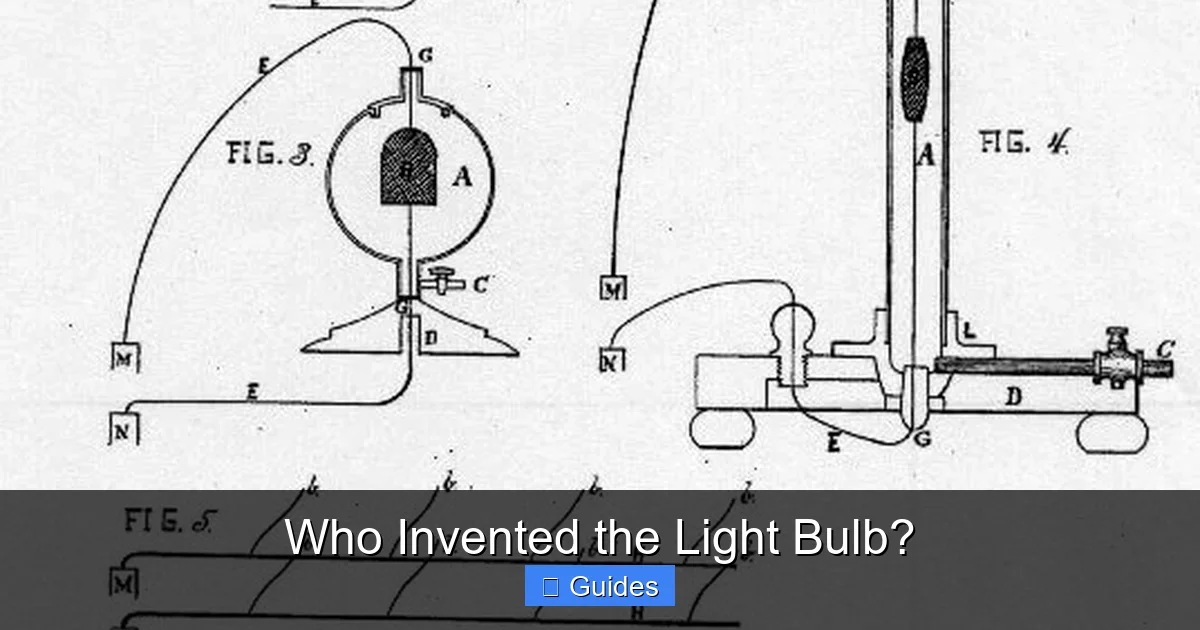
The idea of creating light by heating a filament to incandescence was a persistent dream. Several inventors came remarkably close to a functional incandescent bulb in the decades leading up to Edison’s breakthrough. Their work is essential context when considering who invented the light bulb.
Warren de la Rue’s Platinum Filament
In 1840, British scientist Warren de la Rue enclosed a coiled platinum filament in a vacuum tube and passed an electric current through it. Platinum was chosen for its high melting point, allowing it to glow brightly without melting too quickly. The vacuum prevented the filament from reacting with oxygen and burning out immediately. While it produced an efficient light, platinum was incredibly expensive, making de la Rue’s bulb impractical for commercial use. It was a superb technical achievement, demonstrating the importance of both the filament material and the vacuum.
Joseph Swan’s Early Attempts
British physicist and chemist Joseph Swan made significant strides in the 1860s. He experimented with carbonized paper filaments in a vacuum bulb. By 1860, Swan had already demonstrated a working incandescent light, but the vacuum technology of the time was inadequate, causing the filaments to burn out quickly. His early bulbs were short-lived, but they clearly showed the promise of a carbon filament in an evacuated glass bulb. Swan’s persistent efforts highlight the iterative nature of invention and his vital place in the story of who invented the light bulb.
Henry Woodward and Mathew Evans
Across the Atlantic, in 1874, Canadian inventors Henry Woodward and Mathew Evans patented a light bulb with carbon rods in a nitrogen-filled glass bulb. They even tried to commercialize their invention but were unsuccessful. Eventually, they sold their patent to Thomas Edison in 1879. This transaction shows how various inventive paths converged, with Edison often acquiring rights to existing ideas to further his own research.
Joseph Swan’s Breakthrough and Rivalry with Edison
Joseph Swan’s dedication to improving the incandescent bulb eventually bore fruit, leading to a direct rivalry with Thomas Edison that further complicates the question of who invented the light bulb.
Improved Vacuum and Carbon Filaments
By the late 1870s, advancements in vacuum pump technology allowed Swan to create a much better vacuum in his bulbs. In 1878, he developed a long-lasting light bulb using a thin, carbonized cotton thread filament inside a fully evacuated glass bulb. He publicly demonstrated his lamp in Newcastle, England, in December 1878 and soon began installing lighting in homes and public buildings. Swan’s bulb was highly effective and practical, generating considerable excitement in Britain. His achievements undeniably place him among the key figures in the invention of the light bulb.
The “War of the Currents” and Patent Disputes
Swan’s success in England coincided with Edison’s similar breakthroughs in the United States. This led to a period of intense competition and patent disputes, particularly in the UK. Both inventors had patented similar devices around the same time, leading to legal battles. In a display of pragmatism, the two rivals eventually joined forces, forming the Edison & Swan United Electric Light Company in 1883, known as “Ediswan.” This collaboration effectively resolved their disputes and allowed them to dominate the market together. This episode underscores that the invention was truly a global race.
Thomas Edison: The Master of Practicality
While many contributed to the early development of electric light, Thomas Edison’s name remains synonymous with the invention of the light bulb. His genius wasn’t just in creating a bulb, but in making it practical, affordable, and part of an entire system.
The Menlo Park “Invention Factory”
Edison’s approach was distinct. At his famous Menlo Park laboratory in New Jersey, he employed a team of skilled researchers and mechanics, creating an “invention factory.” Instead of isolated experiments, Edison pursued innovation systematically, testing thousands of materials and designs. When asked who invented the light bulb, it’s important to remember this systematic approach. He wasn’t just looking for *a* light bulb; he was looking for *the* light bulb – one that would be sustainable and widely adoptable.
The Quest for a Long-Lasting Filament
Edison understood that a commercially viable bulb needed a long-lasting, high-resistance filament that could be powered by a central generating station. His team famously tested over 6,000 different materials, from fish lines to human hairs. In October 1879, after extensive experimentation, Edison achieved a breakthrough with a carbonized cotton thread filament that could glow for 13.5 hours. This was a significant improvement over previous designs.
The Carbonized Bamboo Filament
Edison continued to refine his design. After testing various plant fibers, his team discovered that a carbonized bamboo filament offered superior durability and lasted for an incredible 1,200 hours. This was the critical component that made his bulb practical for widespread use. Patented in 1880, this became the standard for incandescent light bulbs for many years.
Inventing the System, Not Just the Bulb
Perhaps Edison’s greatest contribution was not just the bulb itself, but the entire system required to deliver electricity to homes and businesses. He designed and built the first central power station (Pearl Street Station in New York City, 1882), developed generators, distribution networks, fuses, meters, switches, and sockets. His holistic approach transformed electric light from a laboratory curiosity into an everyday utility. He understood that a fantastic light bulb was useless without the infrastructure to power it. This comprehensive vision is a key reason why Edison is so widely associated with the invention of the light bulb.
Beyond Edison: Continuous Improvements and Global Contributions
The story of the light bulb didn’t end with Edison and Swan. Innovation continued, with many other individuals and companies refining the technology and making it even more efficient and affordable.
Lewis Howard Latimer’s Contributions
An African American inventor and draftsman, Lewis Howard Latimer was a crucial figure in improving the incandescent light bulb. As an employee of Edison Electric Light Company, Latimer patented an improved method for manufacturing carbon filaments in 1881, making them more durable and cost-effective. His work was vital in making Edison’s bulbs practical for mass production and widespread adoption. He also supervised the installation of electric lights in cities across the United States, including New York, Philadelphia, and Montreal.
The Tungsten Filament
The carbon filament, while a massive step forward, eventually gave way to even better materials. In the early 20th century, inventors like Willis R. Whitney (General Electric) and William Coolidge developed and perfected the tungsten filament. Tungsten has a much higher melting point than carbon, allowing bulbs to burn brighter and last even longer. This innovation, patented in 1904 (Whitney) and further improved in 1910 (Coolidge), completely revolutionized the incandescent bulb and remains the material of choice for traditional incandescent lights to this day. This continuous improvement showcases that invention is rarely a finished product.
Other Notable Contributions
Many others made significant contributions:
- Nikola Tesla: While more famous for his work on alternating current (AC) power systems, Tesla’s innovations were crucial for long-distance electricity transmission, which ultimately allowed electric light to reach homes far from power plants.
- Irving Langmuir: A Nobel laureate at General Electric, Langmuir introduced the gas-filled incandescent lamp in 1913, significantly reducing filament evaporation and increasing bulb life and efficiency by filling the bulb with an inert gas like argon or nitrogen.
These contributions, alongside countless others in areas like glass blowing, vacuum technology, and electrical engineering, illustrate that the light bulb is a truly collaborative human achievement. The question of “who invented the light bulb?” truly has a global and multi-generational answer.
Why Edison Gets the Credit: A Legacy of Innovation and System Building
Given the extensive list of contributors, why does Thomas Edison’s name almost exclusively pop up when you ask “who invented the light bulb?” The answer lies in the scope and impact of his work.
Edison didn’t just create a light-emitting device; he engineered a complete, practical, and commercially viable solution for electric lighting. His success wasn’t merely in the bulb itself, but in:
- The Long-Lasting Filament: His carbonized bamboo filament offered unprecedented durability.
- High Resistance: This allowed bulbs to be wired in parallel, meaning if one bulb burned out, the others remained lit – a critical feature for a functional lighting system.
- Mass Production: He developed manufacturing techniques that made bulbs affordable and widely available.
- The Entire Electrical System: Crucially, he designed and built the power generation and distribution infrastructure that made electric lighting accessible to the general public.
Edison combined scientific ingenuity with an astute understanding of practical application and commercialization. He took disparate ideas and improvements, synthesized them, and then engineered a complete system that could truly “light up the world.” While others illuminated flashes of brilliance, Edison brought sustained, accessible, and revolutionary illumination. It’s for these reasons that his name has become synonymous with the invention of the light bulb in the popular imagination.
Conclusion
So, who invented the light bulb? As we’ve seen, it’s a story far richer and more collaborative than a single inventor toiling in isolation. From Humphry Davy’s initial arc light to Joseph Swan’s carbon filament bulbs, and then to Thomas Edison’s systematic approach to creating a practical bulb and an entire electrical distribution system, the journey of electric light is a testament to human ingenuity.
Edison’s contribution was immense, particularly his ability to integrate various existing ideas into a commercially successful product and, crucially, to build the infrastructure necessary for its widespread adoption. However, it’s vital to remember that he stood on the shoulders of giants, refining and perfecting concepts that many others had pioneered. The light bulb is a shining example of how science and technology advance through shared knowledge, relentless experimentation, and the collective efforts of brilliant minds across generations. The next time you flip a switch, remember the countless individuals who contributed to that moment of illumination, each playing a part in answering the complex question of who invented the light bulb.
Frequently Asked Questions
Was Edison the only inventor working on the light bulb?
Absolutely not. Many inventors across the world, including Joseph Swan in Britain, Humphry Davy, and Warren de la Rue, were experimenting with electric lighting and incandescent bulbs long before or concurrently with Edison. The development was a collaborative and competitive global effort.
What made Edison’s light bulb different from previous designs?
Edison’s primary breakthrough was creating a light bulb with a high-resistance, long-lasting filament (carbonized bamboo) that could burn for hundreds of hours. Crucially, he also designed a complete electrical generation and distribution system, making the bulb practical and affordable for widespread use.
What role did the vacuum play in early light bulbs?
A vacuum inside the glass bulb was critical to prevent the filament from oxidizing and burning out quickly. Early inventors struggled with creating effective vacuums, but improved technology allowed later designs, like Swan’s and Edison’s, to achieve much longer bulb lifetimes.
Did anyone improve upon Edison’s light bulb design?
Yes, many inventors and engineers continued to improve the light bulb. Lewis Howard Latimer improved the carbon filament manufacturing process, and later, tungsten filaments, developed by Willis R. Whitney and William Coolidge at General Electric, significantly increased bulb brightness and lifespan, becoming the standard for incandescent bulbs.
Why do most people attribute the invention solely to Thomas Edison?
Thomas Edison is widely credited because he developed the first practical, commercially successful, and widely marketed incandescent light bulb, along with the complete system needed to power it. His comprehensive approach and significant publicity cemented his place in public consciousness, overshadowing the many other critical contributors.
How long did it take for the light bulb to go from invention to widespread use?
While early electric light demonstrations occurred in the early 1800s, it took several decades of scientific advancement and engineering refinement. Edison’s practical bulb emerged in 1879, and with his development of central power stations, electric light began to see widespread adoption in urban areas throughout the 1880s and 1890s, becoming common in homes and businesses by the early 20th century.
