


As an Amazon Associate, We earn from qualifying purchases.
The question of who made the first light bulb isn’t straightforward; it’s a tale of many inventors. While Thomas Edison is often credited for the light bulb, he actually developed the first *practical, long-lasting, and commercially viable* incandescent light bulb. Many others contributed crucial discoveries and prototypes over decades, paving the way for his ultimate success.
Have you ever wondered who made the first light bulb? It’s a question that often brings one name to mind: Thomas Edison. But like many great inventions, the story of the light bulb is far more complex and fascinating than a single flash of genius. It’s a testament to human ingenuity, persistent experimentation, and the collaborative spirit of science, even when inventors were working independently across continents.
Imagine a world without electric light. For centuries, humanity relied on fire, candles, and gas lamps. These provided limited illumination, carried significant fire risks, and often produced harmful fumes. The dream of a clean, safe, and powerful artificial light source was a powerful motivator for many brilliant minds throughout the 18th and 19th centuries. The journey to the modern light bulb wasn’t a sprint but a marathon, involving countless experiments, failures, and small, incremental successes.
So, let’s turn on the lights and explore the true history behind this revolutionary invention. We’ll discover that while Thomas Edison certainly played a pivotal role in making electric light practical and widespread, he stood on the shoulders of giants. Many individuals contributed crucial pieces to the puzzle long before Edison’s famous carbonized bamboo filament illuminated his laboratory for over 13 hours.
Key Takeaways
- No Single Inventor: The light bulb, as we know it, was not the creation of one person but the culmination of contributions from numerous scientists and inventors over several decades.
- Early Precursors: Sir Humphry Davy created the first electric arc lamp in 1802, demonstrating the potential of electric light, long before any incandescent bulb.
- The Filament Challenge: Key to a practical light bulb was finding a durable, long-lasting filament material and creating a vacuum inside the bulb. Many inventors, including Joseph Swan and Heinrich Goebel, experimented with different filaments like platinum and carbonized materials.
- Joseph Swan’s Significant Role: British physicist Joseph Swan developed and patented an effective incandescent light bulb with a carbonized paper filament and a good vacuum system years before Edison’s breakthrough, even demonstrating it publicly.
- Thomas Edison’s Breakthrough: Edison’s genius lay in his systematic approach and relentless experimentation to create a *practical, commercially viable, and long-lasting* light bulb. His team found success with a carbonized bamboo filament that could last for hundreds of hours and developed an entire system for its distribution.
- The Importance of Iteration: The invention of the light bulb is a prime example of how scientific and technological progress is often iterative, building upon the work, failures, and successes of many predecessors.
- Beyond the Bulb: Edison’s contribution extended beyond just the bulb; he designed the entire infrastructure (power generators, wiring, meters) needed to make electric lighting accessible and useful for homes and businesses.
Quick Answers to Common Questions
Who is often mistakenly credited with inventing the light bulb?
Thomas Edison is most often mistakenly credited with solely inventing the light bulb.
Who invented the first electric arc lamp?
Sir Humphry Davy invented the first electric arc lamp in 1802.
What was Edison’s main contribution to the light bulb?
Edison’s main contribution was developing the first practical, long-lasting, and commercially viable incandescent light bulb and the entire electrical distribution system to power it.
Which British inventor worked on the light bulb concurrently with Edison?
Joseph Swan, a British physicist and chemist, worked on and patented an effective incandescent light bulb concurrently with Edison.
What material did Edison use for his long-lasting filament breakthrough?
Edison used a carbonized bamboo fiber filament for his breakthrough, which significantly extended the bulb’s lifespan.
📑 Table of Contents
- The Long Road to Illumination: Early Pioneers and Their Discoveries
- Early Attempts and Unsung Heroes: Paving the Way
- Thomas Edison’s Breakthrough: The Practical, Commercial Light Bulb
- Collaboration and Competition: Edison vs. Swan
- Beyond Edison and Swan: Continuous Refinements
- Conclusion: A Symphony of Inventors
The Long Road to Illumination: Early Pioneers and Their Discoveries
The concept of electric light didn’t just appear out of nowhere. It evolved from a long line of scientific discoveries about electricity itself. Before anyone could even dream of an incandescent bulb, scientists had to understand how to generate and control electrical current. The early 19th century was a time of intense discovery in the field of electromagnetism.
Humphry Davy and the First Electric Light
Our story truly begins in 1802 with Sir Humphry Davy, a brilliant English chemist. Using an early electric battery, Davy demonstrated that electricity could produce light. He connected two charcoal electrodes to a battery, causing an intense, brilliant spark to jump between them. This phenomenon became known as the “electric arc” and Davy’s invention was the world’s first electric lamp – the arc lamp.
While revolutionary, Davy’s arc lamp was far from practical for everyday use. It was extremely bright, consumed a lot of power, and its carbon rods burned away quickly, requiring constant adjustment. It was more of a scientific curiosity or a powerful light for large public spaces (like lighthouses or streetlights) than something you’d put in your home. However, it proved a crucial point: electricity could indeed produce light. This was a critical first step on the path to who made the first light bulb.
The Quest for Incandescence: Beyond the Arc
The arc lamp was one form of electric light, but inventors also pursued another principle: incandescence. Incandescence is the emission of light by a body when it’s heated to a high temperature. Think of a blacksmith’s glowing metal or a hot coal. The challenge was to create a material that could get hot enough to glow brightly without quickly melting or burning up.
Throughout the mid-19th century, many inventors around the world began experimenting with various materials and designs to create an incandescent electric light. They faced several major hurdles:
- The Filament Material: What material could get hot enough to glow brightly but last for a reasonable amount of time?
- The Vacuum: If the filament was exposed to oxygen, it would quickly burn up. A vacuum (or inert gas) inside a glass bulb was essential to protect the filament.
- Durability and Efficiency: The bulb needed to last long enough to be useful and produce enough light without consuming excessive amounts of power.
Early Attempts and Unsung Heroes: Paving the Way
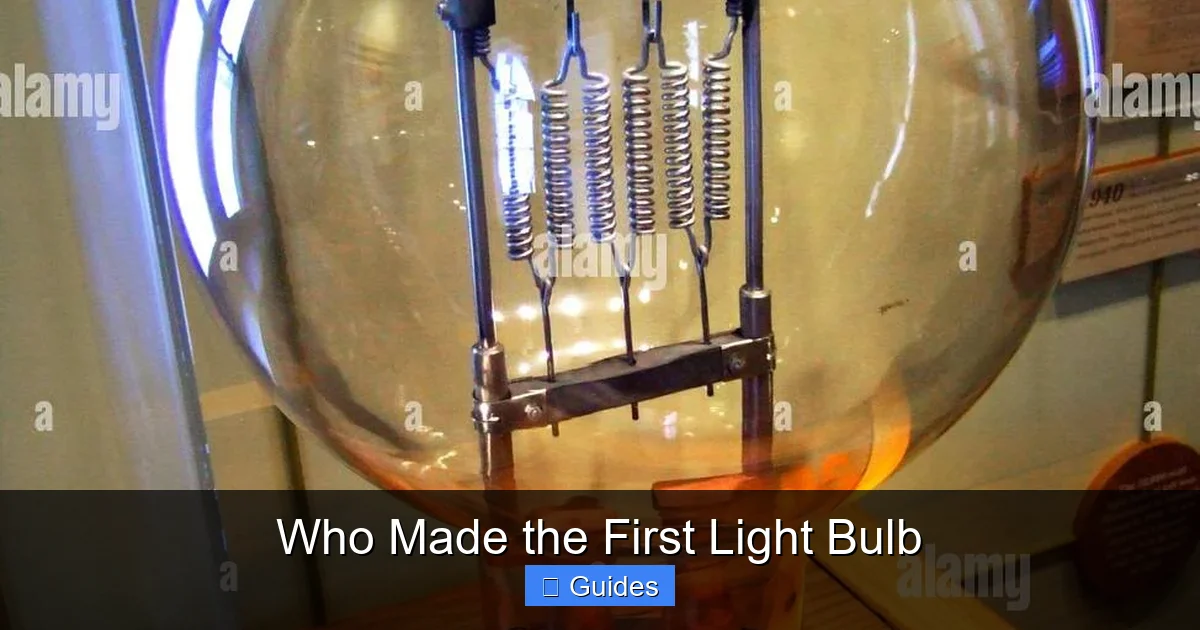
Visual guide about Who Made the First Light Bulb
Image source: c8.alamy.com
Before Edison, many brilliant minds contributed significantly to the development of the incandescent light bulb, often making breakthroughs that were ahead of their time or lacked the final practical touches needed for widespread adoption.
Frederick de Moleyns and the Platinum Coil
In 1840, British inventor Frederick de Moleyns obtained the first patent for an incandescent light bulb. His design involved heating a platinum coil within a vacuum tube. Platinum was chosen for its high melting point. While a valid concept, de Moleyns’ design was not efficient or long-lasting enough for practical use. It was an important step, however, in defining the basic components of what would become the light bulb.
The Contributions of J.W. Starr and Heinrich Goebel
Around the 1840s, American inventor J.W. Starr also made significant progress. He demonstrated a light bulb using a carbon filament within a vacuum. Starr, unfortunately, died young, and his work did not receive the recognition it deserved at the time.
Another unsung hero is Heinrich Goebel, a German clockmaker and inventor who immigrated to the United States. As early as 1854, Goebel allegedly created some of the earliest practical incandescent light bulbs using carbonized bamboo splints as filaments, encased in evacuated glass bottles (perfume bottles, no less!). He reportedly used these to light his New York shop and even demonstrated them in public. While his work was significant, he never patented his invention, and it largely went unrecognized for decades, only coming to light later during patent disputes. Goebel’s use of bamboo, however, foreshadowed one of Edison’s key breakthroughs.
Joseph Swan’s Breakthroughs in England
Perhaps the most significant predecessor to Edison was Joseph Swan, a British physicist and chemist. Swan had been working on incandescent light bulbs for decades. In 1860, he developed a bulb using carbonized paper filaments in an evacuated glass bulb. He even obtained a patent in 1860. However, the vacuum pumps available at the time weren’t powerful enough to create a sufficient vacuum, meaning his filaments still had a relatively short lifespan.
It wasn’t until the late 1870s, with improved vacuum technology, that Swan made his most significant progress. By 1878, he had developed a long-lasting light bulb using a thin, heat-treated carbonized cotton thread filament in a nearly perfect vacuum. He publicly demonstrated his lights in England in December 1878 and patented them in 1880. Swan’s bulbs were quite practical and efficient.
Thomas Edison’s Breakthrough: The Practical, Commercial Light Bulb
This brings us to the inventor most commonly associated with the light bulb: Thomas Alva Edison. While many had created working incandescent bulbs before him, Edison’s genius lay not just in inventing *a* bulb, but in inventing a *system* and a *practical, long-lasting, and commercially viable* light bulb that could truly revolutionize everyday life.
The Edison Approach: Systematic Innovation
Edison’s approach was famously methodical and relentless. He established his “invention factory” in Menlo Park, New Jersey, where he and his team of researchers conducted thousands of experiments. They understood that a successful light bulb wasn’t just about the bulb itself; it required an entire infrastructure:
- A Long-Lasting Filament: This was the core challenge.
- A High Vacuum: To prevent the filament from burning up.
- Practical Design: A screw-in base, standard voltage, and easy manufacturability.
- Power Generation and Distribution: Central power stations, wiring, fuses, and meters to deliver electricity to homes and businesses.
Edison’s goal was nothing less than to replace gas lighting entirely. He famously said, “I have not failed 10,000 times. I have successfully found 10,000 ways that will not work.”
The Search for the Perfect Filament
Edison and his team, most notably Francis Upton, focused intensely on the filament. They tested thousands of different materials: platinum, various metals, and different types of carbonized paper and plant fibers.
On October 22, 1879, after extensive trials, Edison’s team achieved a breakthrough. They used a carbonized cotton thread filament inside a high-vacuum glass bulb. This bulb famously burned for 13.5 hours. While still not ideal for widespread use, it was a huge step forward in terms of longevity.
Edison wasn’t satisfied. He continued his search, and in 1880, he discovered that a carbonized bamboo fiber filament provided an even longer lifespan. This filament could glow for over 1,200 hours, making the light bulb truly practical and economical for general use. This was the defining moment for who made the first light bulb in a *practical* sense. His U.S. patent for an electric lamp was granted on January 27, 1880.
The Edison Electric Light System
Edison’s vision went far beyond the bulb. He also developed the entire electrical utility system. In 1882, he opened the Pearl Street Station in New York City, the world’s first central power plant. This station provided electricity to 59 customers, marking the dawn of commercial electricity. His innovations included everything from the generators to the wiring in buildings and the socket for the bulb itself. This holistic approach is why Edison’s name is so strongly linked to the light bulb’s success.
Collaboration and Competition: Edison vs. Swan
Interestingly, Edison and Swan’s work overlapped significantly, leading to patent disputes. Swan had been demonstrating his effective bulbs in England before Edison’s famous 1879 breakthrough. Ultimately, in 1883, the two inventors decided to pool their resources and formed the Edison & Swan United Electric Light Company in Great Britain. This collaboration resolved their patent conflicts and combined their strengths, leading to even more rapid development and adoption of electric lighting.
This partnership highlights a crucial lesson in innovation: even when competition is fierce, collaboration can sometimes lead to greater overall progress. It shows that the answer to who made the first light bulb is not a simple “either/or” but often a “both/and.”
Beyond Edison and Swan: Continuous Refinements
The story of the light bulb didn’t end with Edison and Swan. Their bulbs, while revolutionary, were still relatively inefficient by modern standards. The search for better filaments continued.
The Tungsten Filament
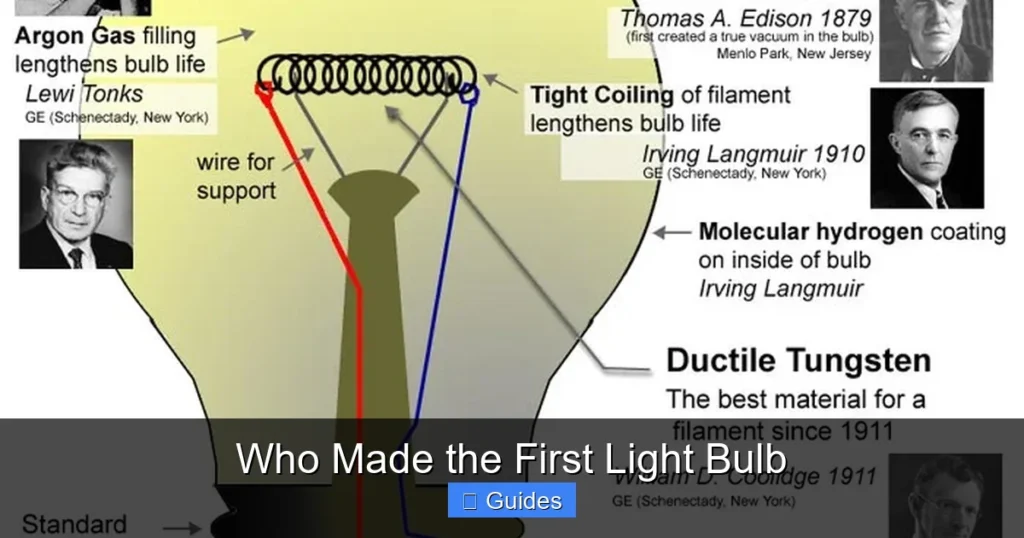
The next major leap came in the early 20th century with the introduction of the tungsten filament. Tungsten has the highest melting point of any metal, meaning it could be heated to a much higher temperature than carbonized bamboo without melting. Higher temperatures mean brighter light and greater efficiency.
- In 1904, Hungarian engineers Sándor Just and Franjo Hanaman patented the tungsten filament.
- In 1906, General Electric engineers, including Willis Whitney, developed a method for making ductile tungsten, which was strong enough for commercial use.
- By 1913, Irving Langmuir, another GE engineer, discovered that filling the bulb with an inert gas (like argon or nitrogen) instead of a vacuum further increased the filament’s lifespan and efficiency.
These advancements led to the modern incandescent bulb that remained largely unchanged for nearly a century. This demonstrates that even after a “breakthrough,” innovation continues in iterative steps, each making the product better, cheaper, or more efficient.
Modern Lighting: LEDs and Beyond
Today, incandescent light bulbs are being phased out in many parts of the world due to their energy inefficiency. Light Emitting Diodes (LEDs) and Compact Fluorescent Lamps (CFLs) represent the next evolution in lighting technology. These modern lights use entirely different principles to produce illumination, offering significantly greater energy efficiency and much longer lifespans.
This continuous evolution underscores that invention is never truly “finished.” The desire for better, more efficient, and more sustainable solutions drives ongoing innovation, building upon the foundational work of all those who contributed to the first light bulb.
Conclusion: A Symphony of Inventors
So, who made the first light bulb? The answer is a chorus of brilliant minds rather than a solo act. Sir Humphry Davy sparked the initial idea with his arc lamp. Frederick de Moleyns, J.W. Starr, and Heinrich Goebel made early strides with incandescent designs and different filament materials. Joseph Swan brought the incandescent bulb to a high level of practicality, even demonstrating it publicly years before Edison’s final triumph.
And then there’s Thomas Edison. His enduring legacy isn’t that he was the *absolute first* to make an electric light bulb. Rather, his unparalleled contribution was in developing the *first practical, durable, and commercially viable incandescent light bulb* and, crucially, building the entire electrical generation and distribution system needed to bring electric light into homes and businesses worldwide. He transformed a scientific curiosity into a global utility.
The story of the light bulb is a powerful reminder that truly transformative inventions are often the result of cumulative knowledge, shared experimentation, and iterative improvements over time. It’s a journey of thousands of small steps taken by many dedicated individuals, each contributing their piece to illuminate our world. So, the next time you flip a switch, remember the many inventors who collectively brought light to our lives.
Frequently Asked Questions
Was Thomas Edison the only inventor of the light bulb?
No, Thomas Edison was not the only inventor of the light bulb. Many scientists and inventors contributed to its development over several decades, making crucial discoveries and creating early prototypes before Edison’s work.
What distinguished Edison’s light bulb from earlier versions?
Edison’s light bulb was distinguished by its practicality, durability, and commercial viability. He developed a long-lasting filament (carbonized bamboo) and an efficient vacuum, but critically, he also built the entire system for power generation and distribution, making electric light accessible to the public.
Who was Joseph Swan, and what was his role?
Joseph Swan was a British physicist and chemist who developed and patented an effective incandescent light bulb with a carbonized paper filament and a good vacuum system years before Edison’s major breakthrough. He was a significant co-inventor.
When was the first electric light demonstrated?
The very first form of electric light, an arc lamp, was demonstrated by Sir Humphry Davy in 1802. Early incandescent light bulbs began to appear from the 1840s onwards, with practical versions emerging in the late 1870s.
Why is it important to know about multiple inventors of the light bulb?
It’s important to know about multiple inventors because it highlights that major technological advancements are often the result of cumulative knowledge and iterative improvements by many individuals, not just a single “Eureka!” moment. It shows the collaborative and competitive nature of scientific progress.
What material made the modern incandescent bulb possible?
The tungsten filament, developed in the early 20th century, made the modern incandescent bulb possible. Tungsten’s high melting point allowed for brighter, more efficient, and longer-lasting bulbs compared to earlier carbon filaments.
