


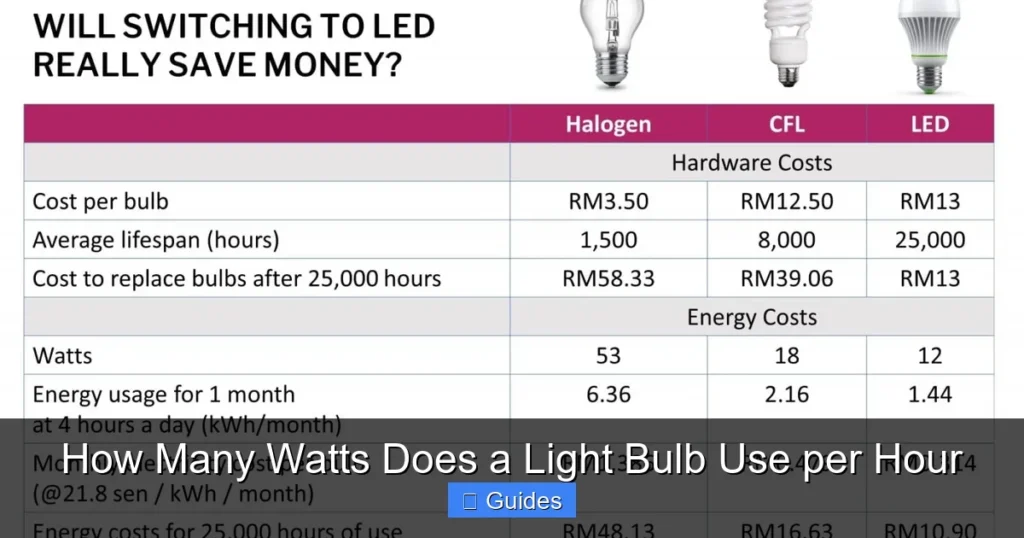
As an Amazon Associate, We earn from qualifying purchases.
Understanding how many watts a light bulb uses per hour is key to managing your energy consumption. While a bulb’s wattage indicates its instantaneous power, its actual energy usage over time is measured in watt-hours or kilowatt-hours (kWh). Modern LED bulbs dramatically reduce this energy usage compared to older incandescents, leading to significant savings on your electricity bill and benefiting the environment.
How Many Watts Does a Light Bulb Use per Hour
Have you ever looked at a light bulb and wondered, “Exactly how much energy is this little glowing orb sucking up?” It’s a common question, and one that often leads to a bit of confusion, especially when we talk about “watts per hour.” Many of us intuitively think of watts as a measure of how much a device “uses” over a period, but in reality, watts tell a slightly different story. Understanding this distinction is not just an academic exercise; it’s key to making smarter choices for your home, your wallet, and even the planet.
Light bulbs are ubiquitous in our lives, illuminating our homes, offices, and streets. Yet, their energy consumption often remains a mystery hidden behind technical terms like “watts” and “lumens.” The truth is, “watts per hour” isn’t quite the right way to think about it. Watts measure power—the rate at which energy is used at any given moment. To understand actual energy consumption over time, like in an hour, we need to think in terms of watt-hours or, more commonly for billing, kilowatt-hours (kWh).
In this comprehensive guide, we’re going to demystify light bulb energy usage. We’ll break down the difference between watts and watt-hours, show you how to calculate precisely how much energy your light bulbs consume, explore the amazing evolution of bulb technology, and arm you with practical tips to slash your electricity bill. By the end, you’ll have a crystal-clear understanding of how many watts a light bulb uses per hour, empowering you to make informed decisions about your lighting.
Key Takeaways
- Watts vs. Watt-Hours: A light bulb’s wattage (e.g., 60W) represents its instantaneous power consumption, not its energy usage “per hour.” Energy consumed over time is measured in watt-hours (Wh) or kilowatt-hours (kWh).
- Calculating Hourly Energy Use: To find out how much energy a bulb consumes in an hour, simply take its wattage and express it as watt-hours. For example, a 60-watt bulb uses 60 watt-hours (0.06 kWh) in one hour.
- Modern Bulbs are Energy Efficient: Older incandescent bulbs consumed much more power (e.g., 60W) to produce light. Modern LED bulbs achieve the same brightness with significantly lower wattage (e.g., 8-10W), drastically reducing energy use.
- Direct Impact on Your Bill: The lower the wattage of your light bulb, the less electricity (kWh) it consumes, directly translating into lower electricity bills, especially when factoring in many bulbs used over many hours.
- Environmental Benefits: Switching to lower-wattage, energy-efficient bulbs like LEDs reduces overall electricity demand, helping to decrease carbon emissions and conserve natural resources.
- Simple Savings Strategies: Practical tips like upgrading to LEDs, using dimmers and smart lighting, maximizing natural light, and simply turning off lights when not needed can lead to substantial energy savings.
Quick Answers to Common Questions
How do I calculate a light bulb’s cost per hour?
To calculate a light bulb’s cost per hour, divide its wattage by 1000 to get kilowatts (kW). Then, multiply this kilowatt value by your local electricity rate per kilowatt-hour (kWh). For example, a 9W LED at $0.16/kWh costs (9/1000) * $0.16 = $0.00144 per hour.
Is a 60W LED bulb brighter than a 60W incandescent bulb?
No, a 60W LED bulb would be significantly *brighter* than a 60W incandescent bulb, or rather, a 60W LED bulb is typically much brighter than needed for general home lighting. A modern LED bulb usually only needs about 8-10 watts to produce the same brightness (lumens) as an old 60-watt incandescent bulb. If you found a 60W LED, it would be extremely bright, likely equivalent to a 400-600W incandescent.
Do smart bulbs use electricity when they are off?
Yes, smart bulbs typically use a very small amount of electricity even when “off” because they remain in standby mode to maintain a connection to your Wi-Fi or Bluetooth network, allowing them to receive commands. This “phantom load” is usually less than 1 watt, but it is not zero.
What is the difference between lumens and watts?
Watts measure the amount of electrical power a light bulb consumes (how much energy it draws), while lumens measure the total amount of visible light emitted by the bulb (how bright it is). For energy efficiency, you want high lumens per watt.
How much energy can I save by switching to LED bulbs?
You can save a significant amount of energy, typically 75% to 90%, by switching from traditional incandescent bulbs to LED bulbs. For instance, an 8-watt LED can produce the same amount of light as a 60-watt incandescent, representing an 86% energy saving.
📑 Table of Contents
Decoding the Watt: Understanding Power vs. Energy
The journey to understanding light bulb energy consumption starts with a firm grasp of basic electrical terms. It might sound a bit technical, but we promise to keep it simple and friendly!
What Exactly is a Watt?
Think of watts like the speedometer in your car. When you’re driving at 60 miles per hour, that’s your instantaneous speed. It tells you how fast you’re going right *now*. In the same way, a watt (W) is a unit of power that tells you the rate at which electrical energy is being used at any specific moment. A 60-watt light bulb, for instance, uses 60 watts of power the instant you flip the switch and it lights up. It doesn’t mean it uses 60 watts *over* an hour; it means its *rate* of energy consumption is 60 watts while it’s active.
So, if a light bulb is rated at 60 watts, that’s its power draw. It’s a measure of its electrical appetite at any given second it’s on. This rating helps you understand how bright a traditional bulb might be or how much heat it might generate, but it doesn’t directly tell you its cost to run over a period of time.
The Crucial Difference: Watts vs. Watt-Hours (and Kilowatt-Hours)
This is where the “per hour” part of our question truly comes into play. While watts measure power (the “speed” of energy use), watt-hours (Wh) and kilowatt-hours (kWh) measure actual energy consumption (the “distance traveled”).
To return to our car analogy: if you drive at 60 miles per hour for one hour, you’ve traveled 60 miles. “Miles per hour” is your speed (like watts), and “miles” is the distance (like watt-hours or kWh).
* Watt-hour (Wh): This is the amount of energy consumed by a device using one watt of power for one hour. So, if a 60-watt light bulb is on for one hour, it consumes 60 watt-hours of energy.
* Kilowatt-hour (kWh): Since watt-hours can quickly become large numbers, electricity companies typically measure and bill you in kilowatt-hours. One kilowatt-hour is simply 1,000 watt-hours. So, a 60-watt bulb running for one hour consumes 0.06 kilowatt-hours (60 Wh / 1000 = 0.06 kWh).
This distinction is fundamental. When you ask “how many watts does a light bulb use per hour,” you’re really asking about its *energy consumption* over an hour, which is measured in watt-hours or kilowatt-hours.
How Many Watts Does a Light Bulb *Actually* Use?
Let’s get down to the practical application. How do you find out the wattage of your bulb, and how do you then calculate its hourly energy consumption?
The Label Tells the Story
The easiest way to find out how many watts a light bulb uses is to simply look at the bulb itself or its packaging. Every light bulb sold will have its wattage clearly printed on it. For older incandescent bulbs, you might see “60W,” “100W,” etc. For newer LED bulbs, you’ll also see a wattage rating, but it will be much lower, perhaps “9W” or “15W.”
Remember, this number is the bulb’s power rating. So, if you have a 60-watt bulb, it uses 60 watts of power when it’s on. This is its *instantaneous* draw.
Calculating Energy Consumption per Hour
Now, let’s convert that wattage into a measure of energy consumed over an hour. This is where we figure out how many watts a light bulb uses per hour in terms of actual energy.
The calculation is straightforward:
Energy Consumed (in kWh) per hour = (Bulb’s Wattage / 1000) * 1 hour
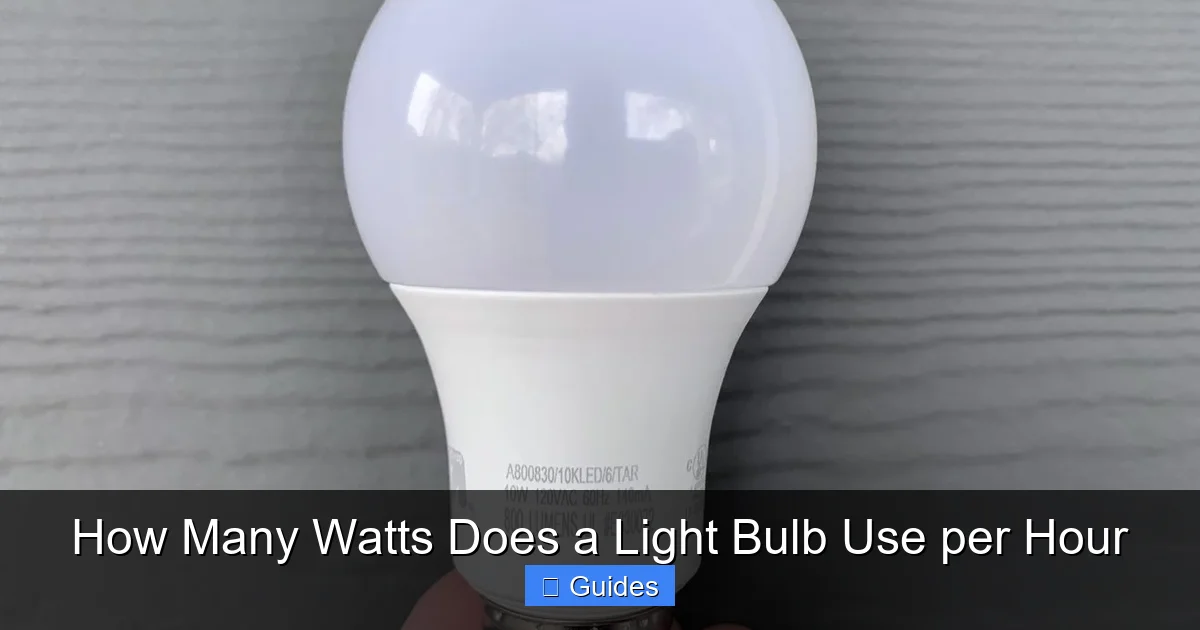
Visual guide about How Many Watts Does a Light Bulb Use per Hour
Image source: footprinthero.com
Let’s walk through an example:
* Old 60-watt Incandescent Bulb:
* Wattage: 60W
* Energy consumed in one hour: (60 W / 1000) * 1 hour = 0.06 kWh
* So, a 60-watt incandescent bulb uses 0.06 kilowatt-hours of electricity in one hour.
* Modern 9-watt LED Bulb (equivalent brightness to 60W incandescent):
* Wattage: 9W
* Energy consumed in one hour: (9 W / 1000) * 1 hour = 0.009 kWh
* Thus, a 9-watt LED bulb uses 0.009 kilowatt-hours of electricity in one hour.
Notice the huge difference! This simple calculation immediately highlights why upgrading your bulbs can save you so much money. The question of “how many watts does a light bulb use per hour” quickly becomes a story of significant savings.
The Evolution of Light Bulbs and Energy Efficiency
Our understanding of how many watts a light bulb uses per hour has dramatically changed with advancements in lighting technology. Not all bulbs are created equal when it comes to energy consumption.
Incandescent Bulbs: The Energy Guzzlers
For over a century, the incandescent light bulb was king. These bulbs work by heating a tiny filament wire to such a high temperature that it glows. The problem? Most of the energy they consume (around 90%) is wasted as heat, not light. This makes them incredibly inefficient.
* Typical Wattages: You’d commonly find 40W, 60W, 75W, and 100W incandescent bulbs.
* Hourly Usage: A 100-watt incandescent bulb, for example, would use 0.1 kWh every hour it’s on. Multiply that by many bulbs and many hours, and the cost quickly adds up. This is a significant answer to how many watts does a light bulb use per hour in its traditional form.
CFLs: A Step Towards Efficiency
Compact Fluorescent Lamps (CFLs) emerged as a more energy-efficient alternative to incandescents. They work by passing an electric current through a tube containing argon and a small amount of mercury vapor, which then excites a phosphor coating inside the tube to produce visible light.
* Energy Savings: CFLs typically use about 75% less energy than incandescents for the same amount of light. A CFL producing the same light as a 60W incandescent might only use 13-15 watts.
* Hourly Usage: A 13-watt CFL would use 0.013 kWh per hour. A clear improvement in how many watts a light bulb uses per hour.
* Pros and Cons: While more efficient, CFLs had some drawbacks, including a warm-up period, sometimes an undesirable light quality, and the presence of small amounts of mercury, requiring special disposal.
LEDs: The Modern Marvels
Light-Emitting Diodes (LEDs) represent the pinnacle of modern lighting technology. LEDs produce light through the movement of electrons in a semiconductor material. They are incredibly efficient because they convert almost all their energy directly into light, with very little wasted as heat.
* Dramatic Energy Savings: LEDs use up to 85-90% less energy than incandescents and significantly less than CFLs to produce the same brightness. An LED bulb that matches the light output of a 60W incandescent might only consume 8-10 watts.
* Hourly Usage: An 8-watt LED bulb uses a tiny 0.008 kWh per hour. This is an incredible reduction in how many watts a light bulb uses per hour.
* Other Benefits: LEDs also boast an incredibly long lifespan (tens of thousands of hours), instant full brightness, durability, and often superior light quality with a wide range of color temperatures.
Real-World Impact: What Does This Mean for Your Wallet and the Planet?
Understanding how many watts a light bulb uses per hour isn’t just about numbers; it has tangible effects on your electricity bill and the environment.
Calculating Your Electricity Bill Impact
Let’s put those hourly consumption numbers into a broader context: your electricity bill. The average cost of electricity in the U.S. is roughly $0.16 per kilowatt-hour (kWh), though this varies by region.
Let’s compare the annual cost of running one light bulb for 4 hours a day:
* Old 60-watt Incandescent Bulb:
* Hourly consumption: 0.06 kWh
* Daily consumption: 0.06 kWh/hour * 4 hours/day = 0.24 kWh/day
* Annual consumption: 0.24 kWh/day * 365 days/year = 87.6 kWh/year
* Annual cost (at $0.16/kWh): 87.6 kWh * $0.16/kWh = $14.02 per year
* Modern 9-watt LED Bulb (60W equivalent):
* Hourly consumption: 0.009 kWh
* Daily consumption: 0.009 kWh/hour * 4 hours/day = 0.036 kWh/day
* Annual consumption: 0.036 kWh/day * 365 days/year = 13.14 kWh/year
* Annual cost (at $0.16/kWh): 13.14 kWh * $0.16/kWh = $2.10 per year
For just *one* bulb, the annual savings are $14.02 – $2.10 = $11.92. Now, imagine you have 20 light bulbs in your home, and you upgrade them all. That’s nearly $240 in savings per year, just from switching out your bulbs! This dramatically changes the perspective on how many watts a light bulb uses per hour and its financial implications.
Beyond the Bill: Environmental Benefits
The environmental impact of reduced energy consumption from light bulbs is equally significant.
* Reduced Carbon Footprint: A large portion of electricity in many regions is generated by burning fossil fuels, which releases greenhouse gases into the atmosphere. By using less electricity for lighting, you directly contribute to fewer emissions and a smaller carbon footprint.
* Less Demand on Power Plants: Energy-efficient lighting reduces the overall demand on power grids, potentially decreasing the need for new power plant construction and easing the strain on existing infrastructure.
* Longer Bulb Life = Less Waste: LEDs not only use less energy but also last much longer than incandescent and CFL bulbs. This means fewer bulbs ending up in landfills, reducing waste and the resources needed for manufacturing new ones.
Practical Tips for Saving Energy (and Money) on Lighting
Armed with the knowledge of how many watts a light bulb uses per hour and the benefits of efficiency, let’s look at actionable steps you can take today.
1. Switch to LEDs: The Single Most Impactful Change
If you still have incandescent or even older CFL bulbs, transitioning to LEDs is by far the most effective way to reduce your lighting energy consumption. Don’t just look at the wattage when buying; also check the “lumens” (a measure of brightness). A modern LED will offer comparable lumens to an old incandescent at a fraction of the wattage. For example, look for an 800-lumen LED to replace a 60-watt incandescent.
2. Smart Lighting Solutions
Technology offers even more ways to save:
- Dimmers: If your lights are dimmable, using a dimmer switch reduces the power draw and extends bulb life. Less brightness means less wattage being used at that moment.
- Motion Sensors: For areas like hallways, bathrooms, or outdoor lights, motion sensors ensure lights are only on when someone is present. This drastically cuts down on unnecessary run time.
- Smart Bulbs & Switches: These allow you to control lights remotely, set schedules, and even integrate with voice assistants. Never accidentally leave a light on again!
3. Optimize Natural Light
The cheapest light is free! Make the most of natural daylight:
- Open Curtains and Blinds: During the day, let the sun do its job.
- Strategic Placement of Mirrors: Mirrors can reflect natural light deeper into a room, brightening it without extra electricity.
- Light-Colored Decor: Lighter paint colors and furniture reflect light, making rooms feel brighter.
4. Turn Off Lights When Not Needed
This might seem obvious, but it’s often overlooked. Get into the habit of flipping the switch when you leave a room, especially if you’ll be gone for more than a few minutes. Even efficient LEDs consume some energy, so turning them off is always the best way to save.
Conclusion
So, how many watts does a light bulb use per hour? The simplest answer is that a light bulb’s wattage is its instantaneous power rating, and to truly understand its hourly energy consumption, you need to think in terms of watt-hours or kilowatt-hours. A 60-watt bulb consumes 60 watt-hours (or 0.06 kWh) of energy in one hour.
The evolution from incandescent to CFLs and now to highly efficient LEDs has revolutionized how we light our homes and the energy footprint of our lighting choices. By understanding these differences and embracing modern, energy-efficient LED technology, you’re not just saving a few dollars here and there; you’re making a substantial positive impact on your utility bills, reducing your environmental footprint, and contributing to a more sustainable future. The power to save is quite literally in your hands—or rather, at the flick of a switch!
Frequently Asked Questions
What does “wattage” mean on a light bulb?
Wattage on a light bulb indicates its power consumption, which is the rate at which it uses electrical energy at any given moment it’s turned on. It doesn’t tell you how much energy it uses over time, but rather its instantaneous electrical demand.
How is electricity consumption measured for billing?
Electricity consumption for billing purposes is measured in kilowatt-hours (kWh). One kilowatt-hour is the amount of energy consumed by a device using 1,000 watts for one hour. Your utility company charges you a rate per kWh for the total electricity used.
Are all LED bulbs equally energy efficient?
While all LED bulbs are far more energy-efficient than incandescent bulbs, there can be slight variations in efficiency among different LED models and brands. Newer generations of LEDs continue to improve, offering more lumens per watt, meaning they provide more light for even less power.
Does dimming a light bulb save electricity?
Yes, dimming a light bulb generally saves electricity. When you dim a bulb, you reduce the amount of power it draws, thereby decreasing its wattage and subsequent energy consumption. This means fewer watt-hours are used over time, leading to savings.
How does bulb lifespan relate to energy savings?
A longer bulb lifespan, as seen with LEDs, contributes to overall savings beyond just lower wattage. It means less frequent bulb replacement, saving you money on new bulbs and the time and effort of changing them, while also reducing waste.
Should I turn off LED lights when leaving a room for a short time?
Yes, it’s generally still recommended to turn off LED lights when leaving a room, even for a short time, to maximize energy savings. While LEDs are efficient and turning them on and off doesn’t significantly shorten their lifespan like it might for older CFLs, any time they are off, they consume zero energy (beyond standby for smart bulbs), which is the most efficient state.
