


As an Amazon Associate, We earn from qualifying purchases.
Understanding how many watts is a light bulb is essential, but it’s not the full story for modern lighting. While watts measure energy consumption, lumens indicate brightness, which is now the key metric. This guide will walk you through the evolution from power-hungry incandescents to super-efficient LEDs, helping you choose the right brightness and save on your energy bill.
Have you ever stood in the lighting aisle, staring at a dizzying array of light bulbs, and wondered, “Seriously, how many watts is a light bulb these days?” If so, you’re definitely not alone! For decades, picking a light bulb was simple: you wanted a bright light, you grabbed a 100-watt bulb. Need something softer? A 40-watt bulb. It was intuitive, direct, and seemed to make perfect sense.
But then, things got complicated. New types of bulbs appeared – CFLs, then LEDs – and suddenly, a “60-watt equivalent” bulb only used 9 watts! This shift has left many of us scratching our heads, trying to understand what “watts” truly mean for our lighting choices in the modern era. This guide is here to clear up the confusion, helping you understand not just how many watts a light bulb consumes, but what that really means for your home, your energy bill, and the ambiance of your spaces.
Key Takeaways
- Watts Measure Energy, Lumens Measure Brightness: Historically, we associated higher watts with brighter light, but with modern LEDs, watts indicate how much energy the bulb consumes, while lumens tell you how bright the light actually is. Focus on lumens for brightness.
- LEDs Offer Significant Energy Savings: LED bulbs consume far fewer watts than traditional incandescent bulbs to produce the same amount of light (lumens). Switching to LEDs can drastically reduce your electricity bill and your carbon footprint.
- Incandescent Wattage is a Reference Point: Many modern bulb packages still provide an “incandescent equivalent wattage” (e.g., “60W Equivalent”) to help consumers understand the approximate brightness they’re getting, even if the LED only consumes 9-10 watts.
- Choosing the Right Brightness (Lumens) Matters: Different rooms and tasks require different light levels. A living room might need 1500-3000 lumens, while a reading lamp might need 450-800 lumens. Match the lumen output to your specific lighting needs.
- Dimming Capabilities Vary: If you plan to use a dimmer, ensure your light bulb (especially LEDs) is explicitly labeled as “dimmable.” Not all bulbs are compatible with standard dimmers, and using a non-dimmable bulb on a dimmer can cause flickering or damage.
- Color Temperature (Kelvin) Affects Ambiance: Beyond brightness, consider the color temperature, measured in Kelvin (K). Lower K values (2700K-3000K) produce warm, yellowish light, while higher values (4000K-5000K+) create cooler, bluer light, impacting the mood of a room.
Quick Answers to Common Questions
How many watts is a standard LED light bulb?
A standard LED light bulb designed to replace a 60-watt incandescent bulb typically consumes around 9 to 10 watts, while still providing similar brightness (about 800 lumens).
What is the difference between watts and lumens for a light bulb?
Watts measure the amount of electrical energy a light bulb consumes, while lumens measure the actual amount of visible light or brightness the bulb produces. For modern bulbs, lumens are the key indicator of how bright a light will be.
Why are LED bulbs so much more energy-efficient than incandescent bulbs?
LEDs are more energy-efficient because they convert most of the electrical energy into light, whereas incandescent bulbs waste about 90% of their energy as heat. This means LEDs require far fewer watts to produce the same amount of light as incandescents.
Can I replace any old incandescent bulb with an LED bulb of the same “equivalent wattage”?
Yes, generally you can. If an LED bulb is labeled as a “60W Equivalent,” it means it will produce a similar amount of light (lumens) as a traditional 60-watt incandescent, but it will consume much less energy (fewer actual watts).
Does a higher wattage LED bulb mean it’s brighter?
Not necessarily. While a higher wattage LED might *tend* to be brighter, it’s not a direct correlation like with incandescents. Always check the lumen output on the packaging to accurately determine the bulb’s brightness, as lumens are the true measure of light output.
📑 Table of Contents
- Understanding the Basics: Watts vs. Lumens – The Modern Light Bulb Language
- The Evolution of Light Bulbs: A Wattage Journey
- Choosing the Right Light Bulb: It’s About Lumens, Not Just Watts
- Energy Efficiency and Cost Savings: The Power of Low Wattage
- Beyond Basic Wattage: Smart Lighting and Future Trends
- Conclusion: Embrace the Lumens, Understand the Watts
Understanding the Basics: Watts vs. Lumens – The Modern Light Bulb Language
The first and most important thing to grasp about “how many watts is a light bulb” in today’s world is the distinction between watts and lumens. This is the cornerstone of modern lighting.
Watts: The Measure of Energy Consumption
Traditionally, when you asked “how many watts is a light bulb,” you were indirectly asking about its brightness. With old incandescent bulbs, there was a direct correlation: more watts meant more energy consumed, which in turn meant more light. A 100-watt incandescent bulb consumed 100 watts of electricity per hour and produced a certain amount of light.
However, watts are fundamentally a measure of *power consumption*. It tells you how much electricity the bulb uses, not how much light it emits. Think of it like this: if you have two cars, one a small, efficient hybrid and the other a large, gas-guzzling SUV, they might both get you to the same destination. The SUV consumes more fuel (watts) to do the same job (produce light/travel).
Lumens: The True Measure of Brightness
With the advent of energy-efficient lighting like CFLs and especially LEDs, the old “watts = brightness” rule no longer applies. This is where lumens come in. Lumens (lm) are the standard unit of measurement for the total amount of visible light emitted by a source. When you ask “how bright is this light bulb?”, you should be looking for its lumen output.
A modern LED bulb can produce the same amount of light (lumens) as an old incandescent bulb while consuming significantly fewer watts. For example:
- A traditional 60-watt incandescent bulb produced about 800 lumens.
- A modern LED bulb producing 800 lumens might only consume 9-10 watts.
- A 100-watt incandescent produced around 1600 lumens.
- An LED equivalent might only use 15-18 watts for the same 1600 lumens.
So, when you’re shopping for a new bulb, don’t just ask “how many watts is a light bulb?” Instead, ask “how many lumens does this light bulb produce?” and then check the watts to see how energy-efficient it is.
The Evolution of Light Bulbs: A Wattage Journey
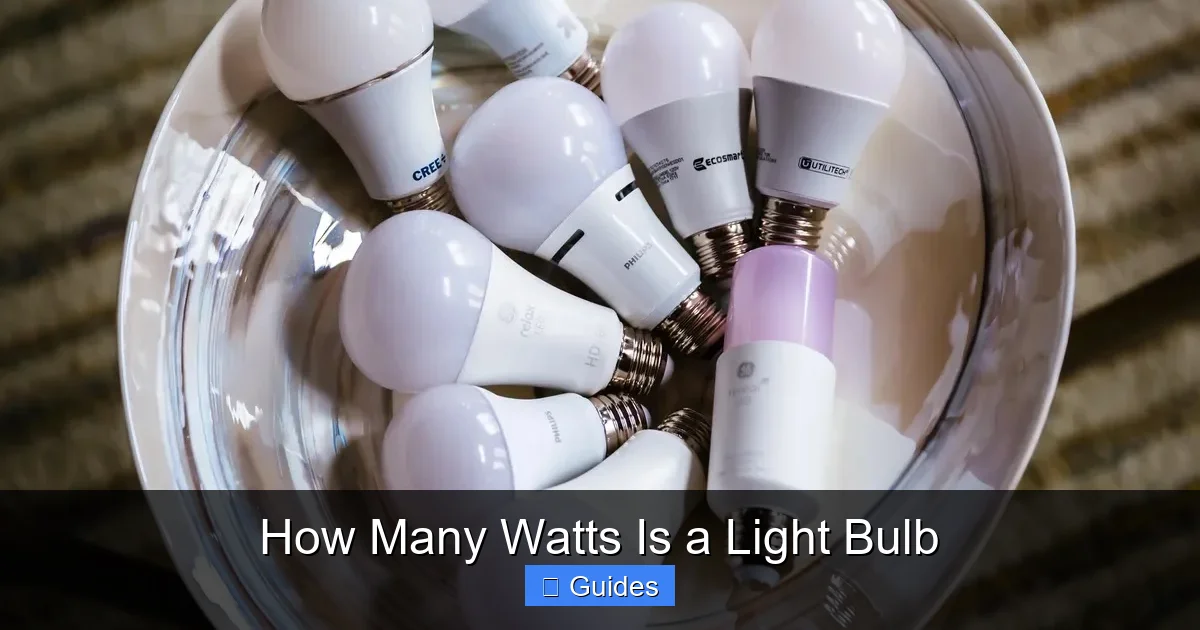
Visual guide about How Many Watts Is a Light Bulb
Image source: storables.com
To truly understand how many watts is a light bulb today, it helps to look back at the journey of lighting technology.
Incandescent Bulbs: The Original Watt-Hogs
These were the classic bulbs with a thin wire filament that glowed when electricity passed through it. They were cheap to produce and gave off a warm, comfortable light.
- Typical Wattage: 40W, 60W, 75W, 100W, 150W.
- Energy Efficiency: Very inefficient. About 90% of the energy they consumed was wasted as heat, not light. This is why a 100-watt incandescent bulb got so hot.
- Brightness (Lumens): Approximately 12-17 lumens per watt. A 60W incandescent produced around 800 lumens.
When someone asked “how many watts is a light bulb” historically, they were almost always referring to an incandescent bulb.
Halogen Bulbs: A Slightly More Efficient Incandescent
Halogen bulbs are a type of incandescent bulb that uses a halogen gas to increase light output and bulb life. They are slightly more efficient than traditional incandescents but still generate a lot of heat.
- Typical Wattage: Often similar to incandescents for equivalent brightness, but slightly lower (e.g., 43W halogen for 60W incandescent equivalent).
- Energy Efficiency: Better than standard incandescents, but still not great.
- Brightness (Lumens): Around 18-22 lumens per watt.
Compact Fluorescent Lamps (CFLs): The First Big Efficiency Leap
CFLs were the first widely available energy-saving alternative. They work by passing an electric current through a tube containing argon and a small amount of mercury vapor, causing ultraviolet light that then excites a fluorescent coating on the inside of the tube, producing visible light.
- Typical Wattage: Significantly lower than incandescents for the same brightness (e.g., 13W for 60W incandescent equivalent).
- Energy Efficiency: Much better than incandescents, using about 75% less energy.
- Brightness (Lumens): Approximately 50-70 lumens per watt.
- Drawbacks: Contained mercury, took time to reach full brightness, not all were dimmable, and had a different light quality that some people disliked.
CFLs started the confusion about “how many watts is a light bulb” because their low wattage didn’t immediately translate to their actual brightness in people’s minds.
Light Emitting Diodes (LEDs): The Current Champion of Efficiency
LEDs are the most advanced and energy-efficient lighting technology available today. They produce light by passing current through a semiconductor material.
- Typical Wattage: Extremely low for the amount of light produced (e.g., 9-10W for 60W incandescent equivalent, 15-18W for 100W equivalent).
- Energy Efficiency: Outstanding. They use up to 85-90% less energy than incandescents and significantly less than CFLs.
- Brightness (Lumens): Varies widely, but typically 70-120+ lumens per watt, and continually improving.
- Benefits: Long lifespan (25,000+ hours), instant on, durable, cool to the touch, available in various color temperatures and smart features.
When you ask “how many watts is a light bulb” for an LED, you’re really asking about its energy efficiency, because its lumen output is the primary indicator of its performance.
Choosing the Right Light Bulb: It’s About Lumens, Not Just Watts
Now that you understand the crucial difference between watts and lumens, let’s talk about how to choose the right bulb for your needs. Forget the old “how many watts is a light bulb” mindset and embrace lumens!
Step 1: Determine the Brightness (Lumens) You Need
The amount of light you need depends on the room size and the activity taking place there. Here’s a general guide:
- Ambient Lighting (General Illumination):
- Living Room: 1500-3000 lumens (distributed among multiple fixtures)
- Bedroom: 1000-2000 lumens (can be lower for relaxing)
- Kitchen: 3000-6000 lumens (task lighting is crucial here)
- Dining Room: 1500-3000 lumens (often with dimmers)
- Bathroom: 2000-4000 lumens (good for grooming)
- Hallways/Stairs: 800-1200 lumens
- Task Lighting (Specific Activities):
- Reading Lamp: 450-800 lumens (focused light)
- Under-cabinet Kitchen Lighting: 400-800 lumens per fixture
- Desk Lamp: 800-1200 lumens
These are just guidelines. Consider using a combination of general, accent, and task lighting for a well-lit and versatile space. Remember, it’s easier to dim a bright light than to make a dim light brighter!
Step 2: Consider the Color Temperature (Kelvin)
Beyond brightness, the “color” of the light significantly impacts the mood of a room. This is measured in Kelvin (K).
- Warm White (2700K-3000K): Similar to incandescent bulbs, this light has a yellowish hue, creating a cozy, relaxing atmosphere. Ideal for living rooms, bedrooms, and dining areas.
- Cool White / Neutral White (3500K-4100K): A more balanced white light, good for kitchens, bathrooms, offices, or workshops where you need good visibility without harshness.
- Daylight (5000K-6500K): A bright, bluish-white light that mimics natural daylight. Excellent for task-oriented areas like workshops, garages, or reading nooks where focus is key.
When looking at how many watts is a light bulb, also check its Kelvin rating to ensure it matches the desired ambiance.
Step 3: Check for Dimmability
If you have dimmer switches, ensure the LED bulb you choose is explicitly labeled “dimmable.” Not all LEDs are compatible with older dimmer switches, and using a non-dimmable bulb can lead to flickering, buzzing, or damage to the bulb or dimmer. If you’re upgrading to LED, you might also need to upgrade your dimmer switch to an LED-compatible one for optimal performance.
Step 4: Look at the Wattage (Energy Consumption)
Once you’ve found a bulb with the right lumens, color temperature, and dimmability, *then* look at how many watts is a light bulb to understand its energy efficiency. The lower the wattage for your desired lumen output, the more money you’ll save on your electricity bill. This is where LEDs truly shine.
Energy Efficiency and Cost Savings: The Power of Low Wattage
The difference in how many watts is a light bulb between old incandescents and new LEDs directly translates to significant energy savings. Let’s crunch some numbers.
Imagine a single light fixture that’s on for 3 hours a day:
- Old 60W Incandescent:
- Energy consumption per day: 60 watts * 3 hours = 180 watt-hours = 0.18 kWh
- Energy consumption per year: 0.18 kWh * 365 days = 65.7 kWh
- New 9W LED (60W equivalent):
- Energy consumption per day: 9 watts * 3 hours = 27 watt-hours = 0.027 kWh
- Energy consumption per year: 0.027 kWh * 365 days = 9.855 kWh
If your electricity costs, say, $0.15 per kWh:
- Incandescent Annual Cost: 65.7 kWh * $0.15/kWh = $9.86
- LED Annual Cost: 9.855 kWh * $0.15/kWh = $1.48
That’s an annual saving of over $8 per bulb, per year! Multiply that by all the bulbs in your house, and the savings quickly add up to hundreds of dollars. Plus, LEDs last much longer (often 15-25 times longer), meaning fewer replacement costs and less hassle.
By choosing bulbs with lower wattage but the same or higher lumen output, you’re not just getting the light you need; you’re actively contributing to a lower energy bill and a smaller carbon footprint. This is the biggest practical benefit of understanding how many watts is a light bulb in the modern context.
Beyond Basic Wattage: Smart Lighting and Future Trends
The world of lighting continues to evolve, moving beyond just how many watts is a light bulb to offer even more convenience and efficiency.
Smart Lighting Systems
Smart bulbs connect to your home Wi-Fi and can be controlled via smartphone apps, voice assistants (like Alexa or Google Assistant), or smart home hubs. They often offer:
- Tunable White Light: Adjust the color temperature from warm white to cool white throughout the day.
- Color Changing: Millions of color options to set any mood.
- Dimming without a Dimmer Switch: Built-in dimming functionality via the app.
- Scheduling and Automation: Set lights to turn on/off at specific times, or integrate with motion sensors.
- Energy Monitoring: Some smart hubs can even track the energy consumption (watts) of individual smart bulbs.
While smart bulbs might have slightly higher wattage than their non-smart LED counterparts (due to the embedded electronics), the control and optimization they offer can lead to further energy savings by ensuring lights are only on when needed and at the optimal brightness.
The Continued Push for Efficiency
The trend for “how many watts is a light bulb” will continue downwards for a given lumen output. Researchers are constantly improving LED technology, making them even more efficient, brighter, and cheaper. We’re also seeing more specialized lighting, such as human-centric lighting that adjusts based on our circadian rhythms, and germicidal UV-C lighting for disinfection.
Circular Economy in Lighting
Future trends also include designing bulbs for easier recycling or even repair, moving towards a more circular economy where products last longer and their components are reused, rather than simply discarded. This holistic view considers not just the operational wattage but the entire lifecycle energy and resource consumption.
Conclusion: Embrace the Lumens, Understand the Watts
So, how many watts is a light bulb? The simple answer is: it depends on the type of bulb, and for modern bulbs, it’s primarily an indicator of energy consumption, not brightness. The days of equating high wattage with superior illumination are behind us.
Today, the key takeaway is this: focus on lumens for brightness, and then look at watts to understand energy efficiency. By embracing LED technology and understanding these core concepts, you can transform your home’s lighting, save money on your electricity bills, and contribute to a more sustainable future, all while enjoying perfectly lit spaces. The next time you’re in the lighting aisle, you’ll be able to confidently choose the right bulb, not just asking “how many watts is a light bulb,” but “how many lumens does this efficient bulb provide?” Happy lighting!
🎥 Related Video: How to Choose a Lightbulb | Lowe's How-to
📺 Lowe’s Home Improvement
There are so many lightbulbs to choose from, so how do you know which one will work for you? Join DIY expert Caroline as she …
Frequently Asked Questions
What is the average wattage of a common household LED bulb?
The average wattage of a common household LED bulb, replacing a traditional 60-watt incandescent, is usually between 9 to 10 watts. For brighter applications, like a 100-watt equivalent, it might be 15 to 18 watts.
How do I know what wattage LED bulb to buy?
Instead of focusing on wattage, look for the lumen output you need. For general guidance, an 800-lumen LED replaces a 60W incandescent, and a 1600-lumen LED replaces a 100W incandescent. The LED’s actual wattage will then tell you its energy efficiency.
Does wattage affect the color of the light?
No, wattage primarily affects energy consumption and indirectly brightness (for incandescents). The color of the light, or color temperature, is measured in Kelvin (K) and is independent of wattage. Look for the Kelvin rating (e.g., 2700K for warm white, 5000K for daylight) to choose your desired light color.
Can I use a higher wattage LED bulb in a fixture rated for lower wattage incandescent?
Yes, you usually can, as long as you’re comparing the *actual* wattage of the LED, not its “incandescent equivalent.” For example, a fixture rated for a maximum 60W incandescent can safely accommodate an LED that’s a “100W equivalent” because the LED’s actual wattage (e.g., 15W) is well below the 60W limit.
What does “wattage equivalent” mean on an LED bulb?
“Wattage equivalent” on an LED bulb packaging tells you what old incandescent bulb brightness it roughly matches. So, a “60W equivalent” LED bulb produces about the same brightness as a 60-watt incandescent but consumes far fewer actual watts (e.g., 9W).
Is it true that LED bulbs don’t get hot, even if they have a “wattage equivalent”?
LED bulbs do produce some heat, but it’s significantly less than incandescent bulbs and it’s typically dissipated through a heat sink at the base, not through the light-emitting surface. This means they are much cooler to the touch and waste less energy as heat, regardless of their “equivalent wattage.”
