


As an Amazon Associate, We earn from qualifying purchases.
Figuring out the correct light bulb size doesn’t have to be a guessing game! This comprehensive guide demystifies bulb dimensions by explaining the crucial differences between bulb shape (like A19 or PAR30) and base type (such as E26 or GU10). You’ll learn practical steps, from checking old bulbs to measuring, ensuring you confidently choose the right fit for any fixture, enhancing both aesthetics and functionality in your home.
Finding the right light bulb can sometimes feel like a treasure hunt, full of cryptic codes and confusing measurements. You’ve probably been there: standing in the lighting aisle, staring at a dizzying array of bulbs, unsure which one will actually fit your lamp or ceiling fixture. It’s a common frustration, but it doesn’t have to be. Once you understand the simple system behind light bulb sizing, you’ll be able to confidently choose the perfect bulb every single time.
This guide is designed to demystify the process and teach you exactly how to determine light bulb size. We’ll break down the codes, explain the measurements, and give you practical steps to ensure you never buy the wrong bulb again. From the humble pear-shaped bulb to specialized spotlights, we’ll cover everything you need to know about shapes, bases, and crucial dimensions. Get ready to illuminate your understanding and become a light bulb sizing pro!
Key Takeaways
- Bulb Size Components: A light bulb’s “size” is defined by two primary characteristics: its shape code (e.g., A19, PAR30) and its base type (e.g., E26, GU10). Both must match your fixture.
- Decoding Shape Codes: Shape codes typically consist of a letter (indicating the bulb’s form) followed by a number that represents the maximum diameter in eighths of an inch for many common types (e.g., A19 is 19/8 inches or 2 3/8 inches wide).
- Understanding Base Types: The base specifies how the bulb connects to the fixture. Edison screw bases (E12, E26) are measured by their diameter in millimeters, while bi-pin bases (GU10, G4) indicate the spacing between their pins in millimeters.
- Practical Determination Steps: To accurately determine light bulb size, first check for markings on the old bulb itself, then consult the fixture for specifications, or measure the old bulb/socket if no information is available.
- Fixture Limitations are Crucial: Always consider your fixture’s maximum wattage, voltage, and physical space limitations. Inserting a bulb that’s too powerful or physically too large can pose safety risks or prevent proper operation.
- Beyond Size: While knowing how to determine light bulb size is key, also consider lumens (brightness), color temperature (warmth/coolness), and dimmability to ensure the bulb meets your specific lighting needs and preferences.
Quick Answers to Common Questions
What do the letters and numbers on a light bulb shape code mean?
The letter indicates the bulb’s general shape (e.g., ‘A’ for arbitrary/standard, ‘G’ for globe, ‘PAR’ for parabolic aluminized reflector). The number usually indicates the bulb’s maximum diameter in eighths of an inch.
How do I know if a bulb has an E12 or E26 base?
E12 (candelabra) is 12mm in diameter and smaller, typically found in chandeliers. E26 (medium/standard) is 26mm in diameter and is the most common screw base for household lamps and fixtures.
Can I put any LED bulb into a fixture designed for incandescent bulbs?
Generally yes, as long as the LED’s base and physical size match the fixture. However, always ensure the LED’s wattage equivalent respects the fixture’s maximum wattage rating, and if using a dimmer, verify the LED is specifically labeled “dimmable.”
What’s the difference between an R-type and a PAR-type bulb?
Both are reflector bulbs, but PAR (Parabolic Aluminized Reflector) bulbs offer a more precise and focused beam with better light control, making them suitable for outdoor or accent lighting. R (Reflector) bulbs have a simpler, less precise beam spread.
Why is it important to check the “MAX WATTAGE” on my fixture even if I’m using an LED?
The “MAX WATTAGE” rating is primarily a thermal safety limit for the fixture, designed for incandescent bulbs that produce a lot of heat. While LEDs produce less heat, exceeding this limit can still damage the fixture over time or lead to fire hazards due to inadequate heat dissipation, especially in enclosed fixtures.
📑 Table of Contents
Understanding the Basics: What “Size” Really Means for Light Bulbs
When we talk about “light bulb size,” it’s not just one simple number. In fact, a bulb’s “size” is determined by two main characteristics: its shape and its base. Think of it like a shoe: you need to know both the style (sneaker, boot, sandal) and your foot size (e.g., US size 9) to get the right fit. For light bulbs, you need to match both the bulb’s physical form and the way it connects to the fixture.
Decoding Bulb Shapes
The shape of a light bulb is usually indicated by a letter or a series of letters, often followed by a number. This combination tells you about the bulb’s general form and its maximum diameter. Most commonly, the number refers to the maximum diameter of the bulb in eighths of an inch.
* A-Type (A19, A21): This is perhaps the most common shape, often called “standard” or “traditional.” It’s the classic pear-shaped bulb we all recognize. An A19 bulb, for instance, has a maximum diameter of 19/8 inches, or 2 3/8 inches. The “A” stands for “Arbitrary” or “Standard.”
* B, C, CA, F-Type (B10, C7, CA10, F15): These are typically smaller, decorative bulbs often found in chandeliers, night lights, or candelabra fixtures. They usually have a bullet, flame, or candle-like shape. For example, a C7 bulb is 7/8 inches in diameter.
* G-Type (G25, G30): “G” stands for “Globe.” These bulbs are perfectly round and are often used in vanity lights, exposed fixtures, or decorative applications where the bulb itself is part of the aesthetic. A G25 bulb is 25/8 inches in diameter.
* T-Type (T6, T8, T10): “T” indicates a “Tubular” shape. These are slender, often elongated bulbs, commonly used in appliance lights, display cases, or certain decorative fixtures. The numbers here can sometimes refer to the diameter in eighths of an inch, but for longer fluorescent tubes (like T8 or T12), it refers to the diameter in eighths of an inch. For smaller decorative T-bulbs, it’s still diameter in 1/8 inches.
* R, BR, PAR-Type (R20, BR30, PAR38): These are reflector bulbs, designed to direct light in a specific direction.
* “R” (Reflector) bulbs have a simple, conical reflector.
* “BR” (Bulged Reflector) bulbs have a wider “bulge” to provide a broader flood of light.
* “PAR” (Parabolic Aluminized Reflector) bulbs are typically more precise, with a stronger, more focused beam, often used outdoors or in track lighting.
The number, again, indicates the diameter in eighths of an inch. So, a PAR38 is 38/8 inches wide.
* MR-Type (MR16): “MR” stands for “Multifaceted Reflector.” These are small, often low-voltage bulbs with a distinctive faceted surface inside the reflector, creating a crisp beam of light. The number usually refers to the diameter in eighths of an inch, so an MR16 is 16/8 inches (or 2 inches) in diameter.
* S-Type (S11, S14): “S” for “Sign.” These bulbs often have a straightforward, slightly elongated spherical shape and are common in signs, string lights, or novelty applications.
* ED-Type (ED17, ED28): “ED” means “Ellipsoidal Dimpled.” These are larger, often industrial or commercial bulbs, characterized by their egg-like shape with dimples.
Understanding these shape codes is the first critical step in how to determine light bulb size for any given fixture.
The Crucial Role of the Base
Once you know the shape, the next vital piece of information is the bulb’s base type. The base is the part of the bulb that screws or plugs into the light fixture’s socket. Using the wrong base is like trying to put a square peg in a round hole – it simply won’t fit.
The most common base types are:
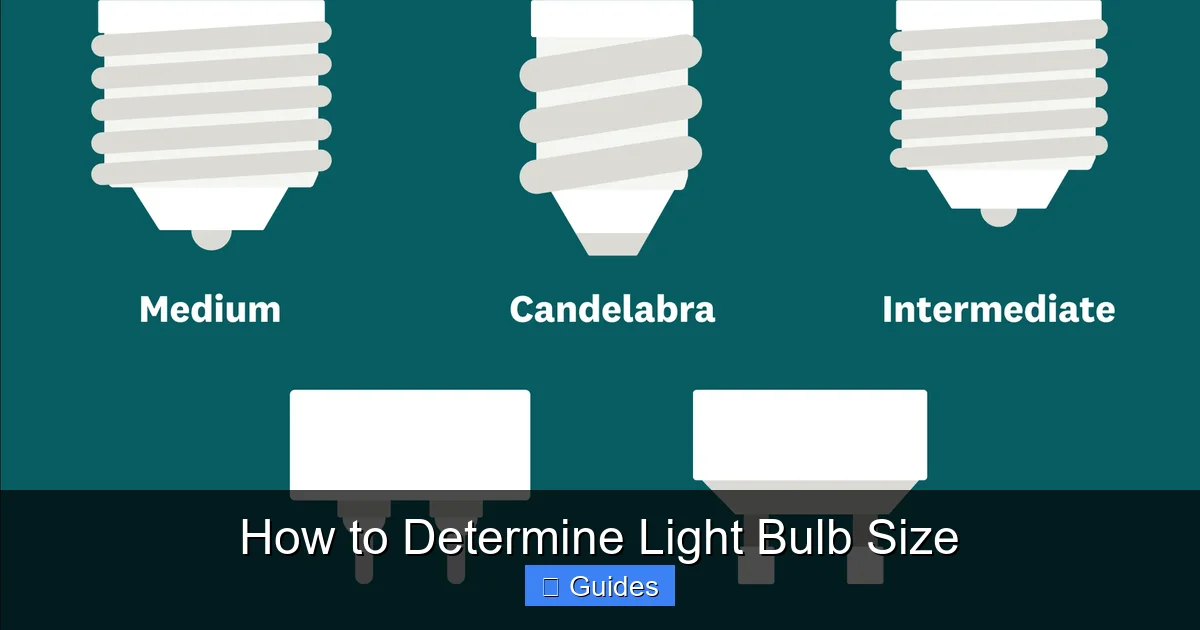
* Edison Screw Bases: These are the familiar screw-in bases. They are denoted by an “E” (for Edison) followed by a number, which indicates the base’s diameter in millimeters. We’ll dive deeper into these common bases in the next section.
* Bi-Pin Bases: Characterized by two pins that push into the socket. These are common in spotlights, track lighting, and some low-voltage applications. They’re typically denoted by a “G” followed by a number indicating the distance between the pins in millimeters.
* Bayonet Bases: Instead of screwing in, these bases have two small pins on the sides that twist and lock into place in the socket. They are less common in North America for standard household lighting but are still found in some specialized fixtures, automotive lights, and appliances.
* Wedge Bases: These are small, glass or plastic-based bulbs where the wire contacts are embedded in the base itself. Often used in automotive, landscape, or small decorative lights.
* GU24 Base: A specific two-prong, twist-and-lock base designed for energy-efficient bulbs, particularly prevalent in California due to energy regulations.
To successfully determine light bulb size, you must identify both the correct shape and the correct base type.
The Numbering System: A Guide to Dimensions
Visual guide about How to Determine Light Bulb Size
Image source: media.angi.com
Now that we’ve covered the basics, let’s get into the specifics of the numbering systems you’ll encounter when learning how to determine light bulb size.
Edison Screw Bases: E12, E17, E26, E39
These are the most common bases in North America for household lighting. The “E” stands for Edison, and the number is the diameter of the screw base in millimeters (mm).
* E12 (Candelabra Base): Measuring 12mm in diameter, this is the smallest common screw base. You’ll often find E12 bulbs in chandeliers, candelabra fixtures, night lights, and some decorative lamps. Their shapes are typically C7, B10, or F15.
* E17 (Intermediate Base): At 17mm in diameter, this base is less common in modern homes but can still be found in some older fixtures, appliance bulbs (like for microwaves), or specialized lamps.
* E26 (Medium/Standard Base): This is the workhorse of household lighting, measuring 26mm (approximately 1 inch) in diameter. If you’re looking for a standard screw-in bulb for a table lamp, floor lamp, or ceiling fixture, chances are it uses an E26 base. Common shapes for E26 include A19, A21, G25, BR30, and PAR38.
* E39 (Mogul Base): This is the largest common Edison screw base, measuring 39mm in diameter. E39 bulbs are typically used for high-wattage, industrial, or commercial applications, like in large warehouse or street lights. They are not usually found in residential settings.
Bi-Pin Bases: GU10, G4, G9
Bi-pin bases, identifiable by their two prongs, are popular in fixtures where a compact, often directional light is needed. The “G” in their designation often refers to “glass” as the base material, and the number indicates the center-to-center distance between the pins in millimeters.
* GU10: This base features two thick pins with small feet that twist and lock into the socket. GU10 bulbs are commonly used in track lighting, recessed lighting, and spotlights, providing a focused beam of light. They are often MR16 or PAR16 shapes.
* G4, G6.35, G9: These are “push-in” bi-pin bases, meaning the pins simply push into the corresponding holes in the socket.
* G4: Has pins 4mm apart. Often found in small, low-voltage puck lights, under-cabinet lighting, or decorative fixtures.
* G6.35: Pins are 6.35mm apart. Similar applications to G4 but for slightly higher wattage or different fixtures.
* G9: Features two loop-shaped pins 9mm apart. G9 bulbs are compact and often used in modern, compact fixtures, especially in European designs, providing bright, direct light.
Other Common Bases: Bayonet, Wedge, GU24
While less prevalent than Edison screw or bi-pin for general household use, these bases are important to recognize.
* Bayonet Bases (B22d, BA15d): These have two small side pins that fit into L-shaped slots in the socket. A push and twist motion locks them in. The number refers to the base diameter in millimeters. B22d (22mm double-contact) is common in the UK and Australia. BA15d (15mm double-contact) is found in some appliances and RVs.
* Wedge Bases (W5W, 921): These are usually small, often glass-encased bases where the electrical contacts are part of the base itself. They are common in automotive interior lights, some landscape lighting, and small decorative applications.
* GU24 Base: This is a special twist-and-lock base with two prongs, designed to prevent the use of incandescent bulbs in certain energy-efficient fixtures. It’s often found in recessed lighting or ceiling fans in areas with strict energy codes. It ensures that only energy-saving bulbs (CFL or LED) can be installed.
Knowing these specific numbering conventions is key to accurately understanding how to determine light bulb size for any lighting need.
Practical Steps to Determine Light Bulb Size
Now that you’re familiar with the different types of bulb shapes and bases, let’s go through the practical steps you can take to figure out exactly what kind of bulb you need.
Check the Old Bulb Itself
This is, hands down, the easiest and most reliable method. Most light bulbs have their specifications printed or etched directly onto the base or the glass. Before you discard a bulb, always take a moment to look at it closely.
* Look for Codes: You’ll typically find a combination of letters and numbers like “A19 E26,” “PAR30 E26,” “MR16 GU10,” or “C7 E12.” This tells you both the shape and the base.
* Other Information: While you’re at it, note down other useful information also printed on the bulb, such as wattage (W), lumens (lm), color temperature (K), and whether it’s dimmable. This will help you find a perfect replacement in terms of light output and quality.
* Take a Photo: If you’re heading to the store, snap a quick picture of the bulb’s markings with your phone. This way, you have all the information readily available without having to remember it.
Consult the Fixture or Lamp Socket
If the old bulb is missing, unreadable, or shattered, your next best bet is to check the fixture itself.
* Look for Stickers or Engravings: Many lamps and light fixtures have a sticker or an engraving near the socket that specifies the maximum wattage allowed and, sometimes, the recommended bulb type. For example, it might say “MAX 60W TYPE A” or “Use GU10 Bulb Only.” This is a crucial clue in how to determine light bulb size for that specific fixture.
* Physical Examination: Observe the socket. Is it a screw-in type or does it have two pinholes? What is the approximate diameter of the screw opening or the spacing of the pinholes? This visual check can quickly narrow down the base type.
Measure If All Else Fails
If you can’t find any markings on the bulb or fixture, don’t despair! You can take matters into your own hands and measure.
* Measuring Bulb Shape Diameter:
1. If you have the old bulb, use a ruler or tape measure to find its maximum diameter in inches.
2. Once you have the diameter in inches, multiply that number by 8. This will give you the numerical part of the shape code. For example, if a bulb is 2.375 inches wide (2 and 3/8 inches), then 2.375 * 8 = 19. So, you’re likely looking for an A19 bulb (if it’s pear-shaped).
* Measuring Base Diameter (for Edison Screw Bases):
1. Carefully measure the diameter of the screw base (or the screw opening in the fixture) in millimeters. An E26 base will measure about 26mm, an E12 about 12mm, and so on. Even a rough measurement can help you decide if it’s a candelabra (E12) or standard (E26) size.
* Measuring Pin Spacing (for Bi-Pin Bases):
1. If you have a bi-pin base, measure the distance between the centers of the two pins in millimeters. This will give you the number for bases like G4, G9, or GU10. For GU10, also note the thicker “feet” on the pins.
Remember to be precise with your measurements to accurately determine light bulb size.
When to Use a Bulb Size Chart
Online bulb size charts are fantastic resources if you have partial information or need to visualize the different types. If you know the shape but not the base, or vice versa, a chart can help you cross-reference and confirm your findings. Many lighting retailers and manufacturers offer these charts on their websites.
Beyond Size: Other Important Bulb Factors
While knowing how to determine light bulb size is paramount, there are other considerations that will ensure your lighting perfectly meets your needs.
Wattage vs. Lumens: The Modern Measurement
For decades, we relied on wattage to tell us how bright a bulb would be. However, wattage actually measures energy consumption. With the rise of energy-efficient LEDs, lumens (lm) have become the true indicator of brightness.
* Lumens: A 60-watt incandescent bulb typically produced around 800 lumens. When buying an LED, look for the lumen rating to match the brightness you desire. For example, a 9W LED can produce 800 lumens, replacing a 60W incandescent.
* Wattage for Safety: Always respect the “MAX WATTAGE” rating on your fixture. Even if you’re using a low-wattage LED (e.g., 9W LED in a fixture rated for MAX 60W), this rating is important for heat dissipation and electrical safety.
Color Temperature: Setting the Mood
Color temperature, measured in Kelvin (K), describes the perceived “warmth” or “coolness” of the light.
* Warm White (2700K – 3000K): Emits a soft, yellowish glow, similar to traditional incandescents. Ideal for living rooms, bedrooms, and dining areas where a cozy atmosphere is desired.
* Neutral White (3500K – 4100K): A more balanced, pure white light. Good for kitchens, offices, or workshops where you need good visibility without too much warmth or coolness.
* Cool White/Daylight (5000K – 6500K): Emits a bright, bluish-white light, similar to natural daylight. Excellent for task lighting, garages, security lighting, or anywhere high clarity and alertness are important.
Dimmability and Smart Features
If you plan to use a dimmer switch, you absolutely need a bulb labeled “dimmable.” Not all LEDs are dimmable, and using a non-dimmable bulb on a dimmer can cause flickering, buzzing, or premature bulb failure. For added convenience, consider smart bulbs that can be controlled via apps, voice commands, and offer adjustable color temperature or RGB color options.
Common Mistakes and How to Avoid Them
Even with all this knowledge, it’s easy to make a small oversight. Here are some common pitfalls when trying to determine light bulb size and how to avoid them.
Mixing Up Shape and Base
A common mistake is assuming that a certain shape *always* goes with a certain base. While an A19 bulb almost always has an E26 base, and a C7 often has an E12 base, it’s not a universal rule. For instance, you can find MR16 bulbs with either a GU10 base or a G4 base. Always double-check both the shape code and the base type to ensure a perfect match when you determine light bulb size. If the old bulb says “PAR30 E26,” make sure your new bulb has both “PAR30” and “E26.”
Ignoring Fixture Limitations
It’s tempting to put the brightest bulb you can find into a lamp, but this can be dangerous. Over-wattage can lead to overheating, damaging the fixture, or even causing a fire. Always adhere to the maximum wattage specified on your fixture, even with LEDs. While an LED might only draw 10 watts, if the fixture says “MAX 40W,” it’s primarily a thermal limitation designed for older incandescent bulbs. Ensure the physical size of the LED also fits within the fixture’s confines, especially in enclosed spaces where heat dissipation is critical.
Forgetting About Clearance
Sometimes a bulb might have the correct base and even the correct wattage, but it’s simply too big to fit inside the fixture’s housing or decorative elements. This is especially true for recessed lighting (can lights) where a BR40 bulb might be too large for a fixture designed for a BR30. Or, a decorative globe bulb (G30) might hit the shade of a lamp. Always consider the physical space available in the fixture, particularly its depth and width, after you determine light bulb size by code. This is a crucial practical step to ensure the bulb not only fits but also allows for proper airflow, which is essential for LED longevity.
Conclusion
Congratulations! You’ve navigated the sometimes-tricky world of light bulb sizing and are now equipped with the knowledge to confidently choose the right bulb every time. Remember, the key to how to determine light bulb size lies in understanding the two main components: the bulb’s shape (like A19 or PAR30, with the number often indicating diameter in eighths of an inch) and its base type (like E26 or GU10, with numbers indicating millimeters).
By consistently checking the old bulb, consulting your fixture, or taking careful measurements, you can avoid frustration and ensure your lighting always fits perfectly. Don’t forget to also consider lumens for brightness, Kelvin for color temperature, and dimmability for functionality. With these tips in your toolkit, you’re ready to illuminate any space with precision and ease!
🎥 Related Video: Standard Light Bulb – Size & Codes | Spec. Sense
📺 AMRE Supply
What does the A19 code describe? What is an E26 base? In this episode of Spec. Sense, Vance shows how to measure and how …
Frequently Asked Questions
What’s the difference between a bulb’s shape and its base?
A bulb’s shape refers to its physical form (e.g., pear-shaped A19, round G25, or directional PAR30). The base is the part that connects to the fixture, determining how it plugs or screws in (e.g., E26 screw-in, GU10 twist-lock). Both shape and base are critical for the bulb to fit and function correctly.
How do I measure a light bulb’s base if there are no markings?
For Edison screw bases, measure the diameter of the metal screw part in millimeters. An E26 base will be about 26mm, and an E12 will be about 12mm. For bi-pin bases, measure the distance between the center of the two pins in millimeters to determine types like G4, G9, or GU10.
My light fixture says “Use Type A Bulb.” What does that mean?
“Type A Bulb” refers to the classic pear-shaped A-type bulb, like an A19 or A21. This designation indicates the fixture is designed for this common shape and will typically have an E26 (standard) screw base. Always confirm the diameter (e.g., A19) if possible, but an A19 E26 is usually the intended fit.
Can I use a larger bulb (e.g., PAR38) in a fixture designed for a smaller one (e.g., PAR30)?
No, you generally shouldn’t. While the base might be the same (e.g., E26 for both PAR30 and PAR38), the larger bulb’s physical dimensions might not fit the fixture’s opening or depth. Overly large bulbs can lead to aesthetic issues, poor light distribution, or even overheating if airflow is restricted in an enclosed fixture.
What are lumens and why are they important when choosing a new bulb?
Lumens (lm) are a measure of a light bulb’s brightness or light output. Unlike wattage, which measures energy consumption, lumens tell you exactly how much light a bulb produces. It’s important because it allows you to choose an LED replacement that provides the same or desired level of brightness as your old incandescent, regardless of its lower wattage.
Should I consider color temperature when replacing a light bulb?
Yes, absolutely! Color temperature, measured in Kelvin (K), significantly impacts the ambiance of a room. Warm white (2700K-3000K) creates a cozy feel, neutral white (3500K-4100K) is balanced, and cool white/daylight (5000K-6500K) provides bright, crisp light. Choosing the right color temperature ensures your new bulb matches the desired mood and function of the space.
