


As an Amazon Associate, We earn from qualifying purchases.
Many believe Thomas Edison was the sole inventor of the light bulb, but the truth is far more complex and collaborative. The journey to modern illumination involved countless scientists and inventors, each building upon previous discoveries over decades. While Edison certainly played a crucial role in creating a practical, commercially viable light bulb system, he stood on the shoulders of giants, making him a key innovator rather than the singular inventor of the light bulb.
Who Was the Inventor of the Light Bulb
Imagine a world without light bulbs. Dark streets, flickering candles, and limited productivity after sunset. It’s almost impossible to picture our modern lives without the steady, bright glow that we often take for granted. This essential invention revolutionized how we live, work, and interact, literally bringing light to our darkest hours.
When asked, “who was the inventor of the light bulb?” most people immediately think of one name: Thomas Edison. And while Edison’s contributions were undoubtedly monumental and vital to making electric light widespread and practical, the full story of the light bulb’s creation is far richer, more complex, and involves a cast of brilliant characters stretching back decades before Edison even entered the scene. It’s a tale not of a single ‘aha!’ moment, but of persistent experimentation, incremental improvements, and a global race to harness electricity for illumination.
So, let’s peel back the layers of history and discover the true, fascinating journey behind electric light. You’re about to find out that the question of who was the inventor of the light bulb has a much more nuanced answer than you might expect, highlighting the collaborative spirit and gradual evolution inherent in almost every significant technological advancement.
Key Takeaways
- No Single Inventor: The light bulb was not invented by one person in a single moment, but rather evolved through the contributions of many scientists and inventors over several decades.
- Early Precursors: Humphry Davy created the first electric arc lamp in the early 1800s, demonstrating the principle of electric light, albeit in a non-practical form for homes.
- Joseph Swan’s Contributions: British inventor Joseph Swan developed and patented a practical incandescent light bulb with a carbonized filament and a vacuum long before Edison, facing issues with filament lifespan.
- Edison’s Systemic Approach: Thomas Edison’s genius lay in his ability to create a highly efficient, long-lasting (over 1,200 hours), and affordable light bulb, alongside an entire electrical generation and distribution system, making electric lighting widely accessible.
- The Importance of Iteration: The story of the light bulb is a prime example of how major inventions are often the result of continuous improvement and iteration on previous ideas, rather than a singular, sudden discovery.
- Global Race and Collaboration: Many inventors around the world were simultaneously working on similar problems, leading to parallel discoveries and later, patent disputes, highlighting a global race for innovation.
Quick Answers to Common Questions
Who is commonly credited with inventing the light bulb?
Thomas Edison is most commonly credited with inventing the practical, long-lasting incandescent light bulb.
Did anyone invent an electric light before Thomas Edison?
Yes, many inventors created various forms of electric light, including arc lamps and early incandescent bulbs, long before Edison’s successful design.
What was Joseph Swan’s contribution to the light bulb?
Joseph Swan developed a practical incandescent light bulb with a carbonized filament in a vacuum in the late 1870s, making significant breakthroughs parallel to Edison.
What made Edison’s light bulb so successful?
Edison’s light bulb was successful because he developed a highly durable, affordable, and efficient carbonized bamboo filament that could last over 1,200 hours, and he also created an entire electrical generation and distribution system to power it.
Is the light bulb truly the invention of one person?
No, the light bulb is the result of continuous improvements and discoveries by numerous scientists and inventors over many decades, making it a collaborative invention rather than the work of a single individual.
📑 Table of Contents
- The Spark of Discovery: Beyond a Single ‘Aha!’ Moment
- The Very First Glow: Early Electric Illumination (Before Edison)
- The Race for a Practical Incandescent Lamp
- Thomas Edison’s Breakthrough: The System Builder
- A Global Symphony of Innovation and Legal Battles
- Beyond Incandescence: The Light Bulb’s Ongoing Evolution
- Conclusion
The Spark of Discovery: Beyond a Single ‘Aha!’ Moment
The human desire to conquer darkness is as old as humanity itself. For centuries, fire, candles, and oil lamps were our only options. The advent of electricity in the 19th century opened up entirely new possibilities, sparking intense curiosity and competition among scientists and inventors to create a safer, brighter, and more convenient form of artificial light. The common narrative simplifies this journey, often attributing the invention solely to Thomas Edison. However, understanding who was the inventor of the light bulb requires us to challenge this popular misconception.
Challenging the Myth of Solitary Genius
Most groundbreaking inventions, from the automobile to the computer, are not the product of a single genius working in isolation. Instead, they emerge from a long lineage of ideas, failures, and incremental improvements made by countless individuals. The light bulb is a perfect example of this iterative process. Many hands and minds contributed to its development, each solving a piece of the puzzle that eventually led to the practical light bulb we know today. Thinking about who was the inventor of the light bulb as one person doing it all would be missing the bigger, more inspiring picture of human ingenuity.
Why the Light Bulb Story is Different
The popular focus on Edison often overlooks the critical scientific principles established by early pioneers and the practical advancements made by his contemporaries. What Edison excelled at was not necessarily inventing the light bulb from scratch, but rather perfecting it, making it durable, affordable, and commercially viable, and then building an entire system around it. This distinction is crucial when we discuss who was the inventor of the light bulb. It wasn’t just about making light; it was about making light *work* for everyone, everywhere.
The Very First Glow: Early Electric Illumination (Before Edison)
The journey to the light bulb began long before Edison was born. The early 19th century saw significant advancements in understanding electricity, which laid the groundwork for electric lighting. These initial explorations might not look like modern light bulbs, but they were the crucial first steps toward harnessing electrical energy for illumination.
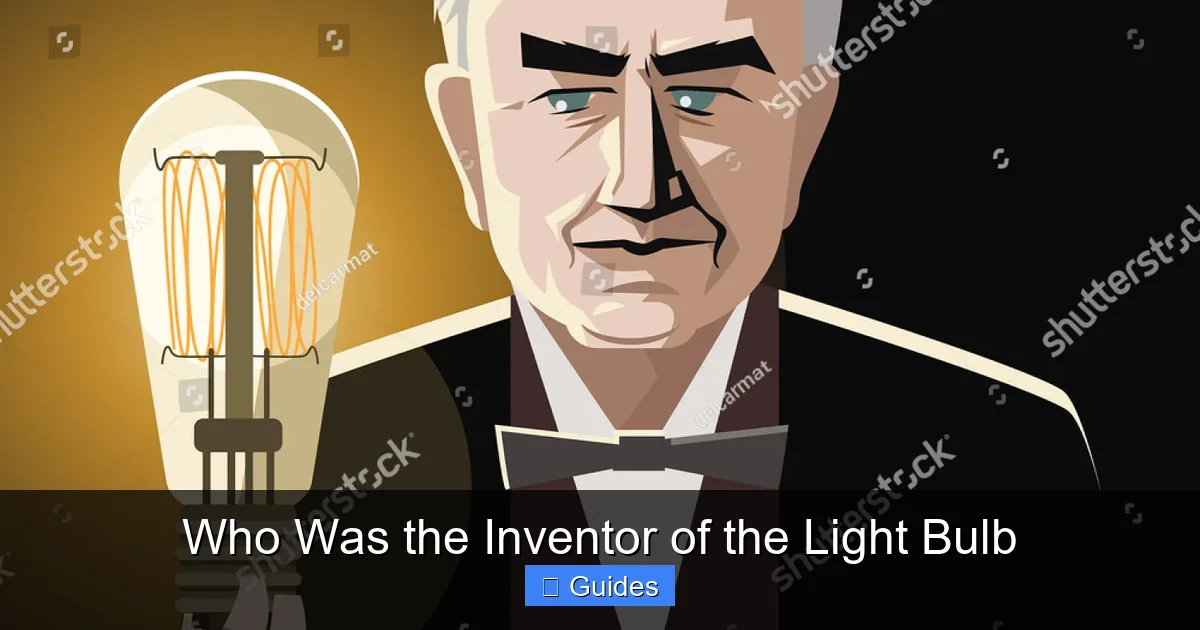
Visual guide about Who Was the Inventor of the Light Bulb
Image source: image.shutterstock.com
Humphry Davy and the Arc Lamp (Early 1800s)
The true dawn of electric light began in 1802 with the brilliant British chemist Humphry Davy. Using a powerful electric battery, Davy demonstrated that electricity could produce light. He connected two charcoal rods to a battery, and as he brought them close together, a dazzlingly bright arc of light appeared between them. This phenomenon became known as the “electric arc lamp.” While incredibly bright, Davy’s arc lamp was far too intense, hot, and short-lived for practical indoor use. It consumed vast amounts of power and quickly burned through the carbon rods. However, it was a monumental proof of concept, showing that electricity could indeed illuminate the darkness. This demonstration certainly predates any discussion of who was the inventor of the light bulb in its incandescent form, but it’s an indispensable part of the story.
Proto-Bulbs and Persistent Problems
Following Davy’s discovery, many other inventors experimented with different materials and designs to create a more practical and sustainable light source. These early experiments often involved heating a thin strip of metal, like platinum, or a carbon rod, inside a glass bulb from which air had been removed (a vacuum). The idea was to prevent the filament from burning out too quickly by reacting with oxygen. However, these early “proto-bulbs” faced significant challenges:
- Short Lifespan: Filaments would burn out within minutes or hours.
- High Cost: Materials like platinum were expensive.
- Inefficiency: A lot of energy was wasted as heat.
- Poor Vacuum Technology: Creating a truly effective vacuum inside the bulb was difficult with the technology available.
These persistent problems highlighted that while the concept of an incandescent light was understood, making it practical and affordable was a monumental task. Every failed experiment, however, brought inventors closer to understanding what was needed. These were crucial steps for anyone asking who was the inventor of the light bulb.
The Race for a Practical Incandescent Lamp
As the 19th century progressed, the race to develop a commercially viable electric light intensified. Multiple inventors across the globe were working on similar problems, often unaware of each other’s specific breakthroughs. This period truly shows why answering “who was the inventor of the light bulb” with a single name is an oversimplification.
Joseph Swan’s Parallel Path
One of the most significant figures in this race was the British physicist and chemist Joseph Swan. Swan had been experimenting with incandescent lighting for decades. In 1860, he developed a light bulb using carbonized paper filaments in a vacuum bulb. This was a crucial step, but the vacuum pumps of the time weren’t good enough, and his filaments still didn’t last long. However, he kept at it. By the late 1870s, around the same time Edison was making his biggest strides, Swan made significant breakthroughs:
- Improved Vacuum Pumps: With better vacuum technology available, he could create a much higher vacuum inside his bulbs, greatly reducing filament degradation.
- Carbonized Cotton Thread: In 1878, Swan publicly demonstrated a long-lasting light bulb using a thin, carbonized cotton thread as a filament. His bulb could glow for hours, which was a huge improvement over previous attempts.
Swan patented his incandescent lamp in Britain in 1878 and began installing electric lights in homes and public buildings there, even illuminating a theatre in Gateshead, England, in 1881. His work clearly established him as a key contender in the discussion of who was the inventor of the light bulb, particularly in its practical incandescent form.
Paving the Way with Vacuum Technology
The development of better vacuum pumps was truly a game-changer for incandescent lighting. Before these advancements, it was nearly impossible to remove enough oxygen from inside a glass bulb to prevent the filament from rapidly burning out. As vacuum technology improved, it became possible to create a near-perfect vacuum, which dramatically extended the life of the carbon filaments. This wasn’t a single invention in itself, but a vital technological enabler that allowed inventors like Swan and later Edison to achieve longer-lasting bulbs. Without this, the answer to who was the inventor of the light bulb would be much more limited, as practical applications would be impossible.
Thomas Edison’s Breakthrough: The System Builder
While many inventors contributed to the concept and early prototypes of the incandescent light, it was Thomas Edison who perfected the practical, long-lasting, and commercially viable light bulb and, crucially, built an entire system around it. This is where his legacy as *the* inventor often takes root, but it’s important to understand the specific nature of his contributions when discussing who was the inventor of the light bulb.
The Quest for Longevity and Affordability
Edison understood that for electric light to replace gas lamps and candles, it needed to be two things: long-lasting and inexpensive. Early electric lights were short-lived and costly. Beginning in 1878, Edison dedicated himself and his team at Menlo Park, New Jersey, to finding the perfect filament material. He famously tested thousands of materials, from plant fibers to human hair, in a relentless pursuit of the ideal filament.
This systematic approach to experimentation, testing countless variations, was a hallmark of Edison’s genius. He wasn’t just looking for *a* filament; he was looking for the *best* filament for mass production and widespread adoption. His team’s extensive trials and errors were critical in moving the light bulb from a laboratory curiosity to a practical commodity, greatly influencing the popular perception of who was the inventor of the light bulb.
Carbonized Filaments and the Edison Effect
After trying platinum and various metals, Edison turned his attention to carbonized materials. In October 1879, after hundreds of experiments, Edison and his team achieved a significant breakthrough: a carbonized cotton thread filament that lasted for an astonishing 13.5 hours. This was quickly followed by an even more successful experiment with a carbonized bamboo filament, which could burn for over 1,200 hours!
This long-lasting, relatively inexpensive filament, combined with a much-improved vacuum pump developed by Hermann Sprengel, allowed Edison to create a bulb that was truly viable for public use. It was this longevity, coupled with its affordability, that solidified Edison’s place in history. Interestingly, during his work, Edison also observed a phenomenon where current flowed from a heated filament to a separate electrode inside the bulb – a discovery known as the “Edison effect,” which later became fundamental to the development of vacuum tubes and electronics.
Beyond the Bulb: Edison’s Ecosystem
Edison’s vision went far beyond just the light bulb itself. He realized that a bulb was useless without an entire infrastructure to support it. His true genius, and why he’s so often credited as the inventor, was in creating a complete electrical system, which included:
- Efficient Dynamos (Generators): To produce electricity on a large scale.
- A Grid for Distribution: Wires and conduits to deliver electricity to homes and businesses.
- Meters: To measure electricity consumption for billing.
- Switches and Sockets: To safely control and connect bulbs.
In 1882, Edison opened the Pearl Street Station in New York City, establishing the world’s first central power plant and distribution system. This was the moment electric light truly became practical for the masses. Without this comprehensive system, even the best light bulb would have remained a novelty. This systemic innovation is why many credit Edison when asked who was the inventor of the light bulb, as he made it a functional reality for society.
A Global Symphony of Innovation and Legal Battles
The story of who was the inventor of the light bulb is not confined to just Swan and Edison. Many other brilliant minds around the world were also making significant contributions, often leading to fierce competition and legal disputes over patents.
Other Notable Contributors
The spirit of invention was truly global during this period:
- William Sawyer and Albon Man (USA): In 1878, these American inventors patented an incandescent lamp that used a carbon rod as a filament. They founded the Sawyer-Man Electric Company, which later became part of Westinghouse Electric.
- Henry Woodward (Canada): Patented an incandescent lamp in 1874 using carbon rods in a nitrogen-filled globe. He later sold his patent to Edison.
- Alexander Lodygin (Russia): In 1874, Lodygin obtained a Russian patent for an incandescent lamp that used a carbon rod filament in a vacuum-sealed glass vessel. He even used rare metals like osmium for filaments.
- St. George Lane Fox Pitt (UK): Developed and patented his own version of an incandescent light bulb in 1878, focusing on plant fiber filaments and distributing systems.
- Hiram Maxim (USA): Known for his machine gun, Maxim also developed an improved incandescent lamp, using petroleum distillate vapor to carbonize filaments, resulting in longer life. He competed directly with Edison.
These examples illustrate that the invention of the light bulb was a widespread quest, with numerous individuals contributing vital pieces to the overall puzzle. The collective efforts make the simple question of “who was the inventor of the light bulb” deeply inadequate.
Patent Disputes and the Sharing of Knowledge
Given the simultaneous developments by multiple inventors, it’s no surprise that fierce patent battles ensued. Edison and Swan, for instance, found themselves in a legal struggle over incandescent lamp patents in Britain. Eventually, they merged their companies in 1883 to form the Edison & Swan United Electric Light Company, or “Ediswan,” to resolve the disputes and pool their resources. This merger highlights how competition can sometimes lead to collaboration, ultimately benefiting the advancement of technology.
These legal challenges, while costly and time-consuming, also served to clarify patent rights and, in some ways, helped standardize the technology, paving the way for wider adoption. The period was a wild west of innovation, where the true answer to who was the inventor of the light bulb often boiled down to legal interpretations and commercial success.
Beyond Incandescence: The Light Bulb’s Ongoing Evolution
The story of the light bulb didn’t end with Edison or Swan. The invention continued to evolve significantly throughout the 20th and 21st centuries. Inventors and scientists kept pushing the boundaries, leading to even more efficient and diverse lighting solutions. This ongoing evolution further underscores that invention is a continuous process.
From Tungsten to LEDs
A major breakthrough came in the early 20th century with the introduction of the tungsten filament. Tungsten, with its incredibly high melting point, allowed bulbs to burn brighter and last even longer than Edison’s bamboo filaments. This innovation, developed by General Electric and other companies, became the standard for incandescent bulbs for nearly a century.
More recently, the focus has shifted dramatically towards energy efficiency. Fluorescent lamps, compact fluorescent lamps (CFLs), and light-emitting diodes (LEDs) have revolutionized lighting once again. LEDs, in particular, offer unparalleled energy efficiency, durability, and versatility, continuing the light bulb’s evolutionary journey. Each of these advancements represents another chapter in the answer to who was the inventor of the light bulb, demonstrating that the quest for better illumination never truly stops.
Conclusion
So, who was the inventor of the light bulb? As we’ve seen, the answer isn’t a simple name or a single date. It’s a complex tapestry woven from the threads of countless brilliant minds, persistent experimentation, and incremental improvements spanning over eight decades. From Humphry Davy’s initial arc lamp in 1802 to Joseph Swan’s practical carbon-filament bulb in the 1870s, and then to Thomas Edison’s masterful development of a long-lasting, affordable bulb and the entire electrical distribution system to power it, the journey to modern illumination was a truly collaborative human endeavor.
Thomas Edison holds a special place in history not as the sole inventor, but as the visionary who transformed a scientific curiosity into a practical, mass-market reality. He took the existing knowledge and prototypes, dramatically improved them, and crucially, created the infrastructure necessary for electric light to profoundly change daily life for millions. He made light accessible, reliable, and affordable, something no one else had managed to do on such a scale. Without his systematic approach, the light bulb might have remained a niche technology for much longer.
The story of the light bulb reminds us that innovation is rarely a solitary flash of genius. Instead, it’s often a testament to collective human effort, building upon the successes and failures of those who came before. So, the next time you flip a switch and your room fills with light, remember the global symphony of inventors, scientists, and engineers who each played a vital role in answering the monumental question of who was the inventor of the light bulb and ultimately, bringing light to the world.
🎥 Related Video: The Real Inventor of The Light Bulb!
📺 The Curious Collective
Subscribe Here! ➡️- https://www.youtube.com/channel/UCm1_7L_1spH950PNk0DqX8Q?sub_confirmation=1 Thomas Edison …
Frequently Asked Questions
Who was the very first person to demonstrate electric light?
The very first person to demonstrate electric light was Humphry Davy in 1802. He created an electric arc lamp using a large battery and charcoal rods, producing a brilliant but impractical light.
What was the main problem with early incandescent light bulbs?
The main problem with early incandescent light bulbs was their short lifespan. Filaments would quickly burn out due to the poor vacuum technology and unsuitable materials, making them impractical for widespread use.
Why is Thomas Edison often seen as the primary inventor of the light bulb?
Thomas Edison is often seen as the primary inventor because he perfected the light bulb to be long-lasting, affordable, and commercially viable. More importantly, he developed the entire electrical generation and distribution system needed to make electric lighting accessible to the public.
Did Edison and Swan ever work together?
Yes, after patent disputes in Britain, Thomas Edison and Joseph Swan merged their companies in 1883 to form the Edison & Swan United Electric Light Company, pooling their resources and resolving legal conflicts.
What type of filament did Edison use for his successful light bulb?
For his most successful and widely adopted light bulb, Edison initially used a carbonized cotton thread, but then found a much longer-lasting solution with a carbonized bamboo filament, which could burn for over 1,200 hours.
Has the light bulb continued to evolve since Edison’s time?
Absolutely. The light bulb has continued to evolve dramatically, from the introduction of tungsten filaments in the early 20th century to the development of fluorescent lamps, and more recently, highly energy-efficient LED technology, constantly improving efficiency and longevity.
