



As an Amazon Associate, We earn from qualifying purchases.
Understanding what’s the brightest light bulb isn’t as simple as checking wattage. True brightness is measured in lumens, and modern LED technology offers incredible efficiency and high lumen output for most everyday needs. While industrial-grade lights can be exceptionally bright, choosing the *best* bright bulb means balancing lumens with application, energy efficiency, and other important factors like color temperature.
Hey there! Ever found yourself squinting at a dark corner or trying to illuminate a vast space and wondered, “Whats the brightest light bulb I can get?” It’s a question many of us ask, especially when we’re trying to banish shadows, light up a workshop, or simply make our living room feel more vibrant. You might think the answer is as simple as picking the bulb with the highest wattage, but if you’ve been to a hardware store recently, you’ll know that things have changed quite a bit.
The world of light bulbs has evolved dramatically beyond the old incandescent bulbs your grandparents used. Today, we have a fantastic array of technologies, each with its own strengths and weaknesses. So, whether you’re a homeowner, a DIY enthusiast, or just curious, understanding what truly makes a light bulb “bright” and which types offer the most intense illumination is key. Let’s dive in and shed some light on this illuminating topic!
Prepare to learn why watts are no longer the primary indicator of brightness, which bulb technologies are leading the charge, and how to pick the perfect bright bulb for any situation. By the end of this guide, you’ll be an expert on finding what’s the brightest light bulb for your specific needs, confidently navigating the choices from cozy home lighting to powerful industrial solutions.
Key Takeaways
- Lumens are Key: Forget watts when thinking about brightness; lumens are the accurate measure of a light bulb’s total light output. The higher the lumen count, the brighter the bulb.
- LEDs Dominate Everyday Brightness: For residential and commercial applications, LEDs offer the best combination of high lumen output, energy efficiency, and long lifespan, making them the default choice for finding what’s the brightest light bulb for general use.
- HID Lights for Extreme Brightness: For specialized, industrial, or professional uses like stadium lighting, film sets, or searchlights, High-Intensity Discharge (HID) lamps can achieve truly extraordinary lumen levels, far exceeding common LEDs.
- Brightness is Contextual: The “brightest” bulb isn’t always the “best” bulb. Your specific needs and the application (e.g., ambient lighting vs. task lighting, indoor vs. outdoor) dictate the ideal lumen output.
- Beyond Lumens: Factors like color temperature (warm vs. cool light), beam angle (focused vs. dispersed), and Color Rendering Index (CRI) significantly impact how brightness is perceived and how effective the light is.
- Energy Efficiency Matters: While seeking the brightest light bulb, always consider energy efficiency. High lumens per watt mean more light for less electricity, saving you money and reducing environmental impact.
Quick Answers to Common Questions
What is the brightest type of light bulb for home use?
For home use, LED bulbs are the brightest and most efficient option. You can find consumer-grade LEDs offering over 2,000 lumens, equivalent to or brighter than old 150-watt incandescent bulbs.
How is light bulb brightness measured?
Light bulb brightness is measured in lumens (lm). The higher the lumen number, the brighter the light output of the bulb.
Are higher watt bulbs always brighter?
No, not anymore. Watts measure energy consumption, not brightness. Modern, energy-efficient bulbs like LEDs produce much more light (lumens) per watt than older technologies.
What’s the brightest color temperature for light?
Cooler color temperatures (e.g., 5000K “Daylight”) often appear and feel brighter to the human eye, even at the same lumen output, compared to warmer color temperatures (e.g., 2700K “Soft White”).
Can I put the brightest light bulb in any fixture?
You should always check the fixture’s maximum wattage rating. While modern LEDs consume much less wattage, putting a physically large or very high lumen bulb in a small enclosed fixture might cause heat issues if not designed for it. Always ensure the bulb’s size and heat dissipation are appropriate.
📑 Table of Contents
Understanding Brightness: Lumens vs. Watts
For decades, we’ve been conditioned to associate brightness with watts. A 100-watt bulb was brighter than a 60-watt bulb, simple right? Well, not anymore! With the advent of energy-efficient lighting, watts have become a measure of energy consumption, not brightness.
The Lumens Revolution: Why it Matters
The true measure of a light bulb’s brightness is its lumen output. Lumens (lm) quantify the total amount of visible light emitted by a source. Think of it like this: if you have a garden hose, watts are how much water you use, but lumens are how much water actually comes out. More lumens mean more light.
When you’re shopping for what’s the brightest light bulb, your focus should always be on the lumen rating. A modern LED bulb, for instance, can produce the same amount of light (lumens) as an old incandescent bulb while using significantly fewer watts. This is why a “60W equivalent” LED bulb might only consume 9-10 watts but still provide around 800 lumens – the brightness you’d expect from the old 60-watt bulb.
Debunking the Wattage Myth
The shift from watts to lumens is a good thing for consumers and the planet. It encourages manufacturers to create more efficient bulbs, and it helps you, the buyer, make smarter choices. If you want a brighter room, you now look for a higher lumen number, not necessarily a higher wattage. This means you can get what’s the brightest light bulb available without worrying about your electricity bill skyrocketing.
For example, if you need a very bright bulb for a garage, don’t just grab a 150-watt incandescent. Instead, look for an LED bulb that offers 2,000 to 3,000 lumens or even more. This LED will give you superior brightness and consume a fraction of the power.
The Contenders: Different Light Bulb Technologies and Their Brightness Potential
To understand what’s the brightest light bulb, we need to look at the different technologies available today. Each has a role, but some are clearly superior when it comes to sheer light output.
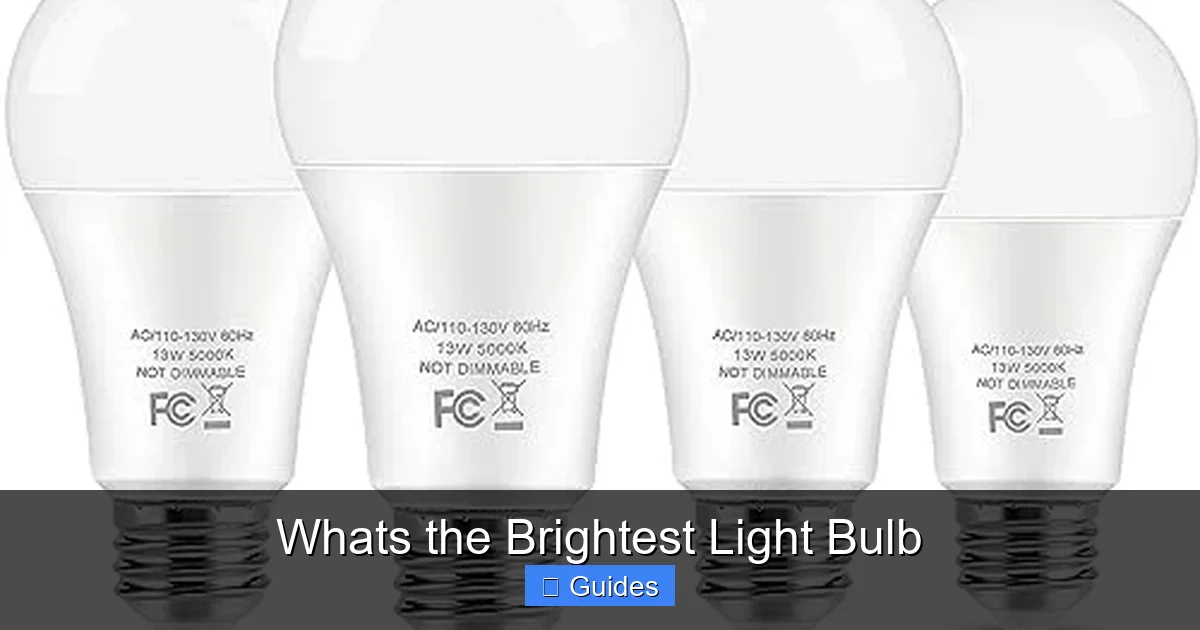
Visual guide about Whats the Brightest Light Bulb
Image source: m.media-amazon.com
Incandescent: The Old Guard (and why it’s not the brightest)
Incandescent bulbs work by heating a tiny wire filament until it glows. They’re inefficient, converting most of their energy into heat rather than light. A typical 100-watt incandescent bulb produces around 1,600 lumens. While familiar, they’re far from what’s the brightest light bulb technology available and are being phased out in many places due to energy inefficiency.
Halogen: A Brighter Incandescent Cousin
Halogen bulbs are a type of incandescent light that uses halogen gas to improve efficiency and lifespan. They burn hotter and brighter than traditional incandescents for the same wattage. A 72-watt halogen can produce about 1,490 lumens, similar to a 100-watt incandescent, but still not at the top for raw brightness. They offer good color rendering but are still inefficient compared to newer tech.
CFLs: Energy-Efficient but Falling Behind
Compact Fluorescent Lamps (CFLs) were once the go-to for energy efficiency. They work by passing an electric current through a tube containing argon and a small amount of mercury vapor, exciting the mercury atoms and producing ultraviolet light, which then makes a phosphor coating glow. A 23-watt CFL can produce around 1,600 lumens, comparable to a 100-watt incandescent. While more efficient than incandescents, they contain mercury, can take time to warm up to full brightness, and are now largely surpassed by LEDs for overall performance and brightness.
LEDs: The Reigning Champions of Everyday Brightness
Light Emitting Diodes (LEDs) are the current kings of general lighting. They produce light when an electric current passes through a semiconductor material. LEDs are incredibly efficient, converting a high percentage of energy into light with very little heat. This efficiency allows them to produce a lot of lumens per watt. For example, you can easily find consumer-grade LED bulbs offering 1,600 to 2,600 lumens (equivalent to a 100W-150W incandescent) while using only 15-25 watts. Some specialty residential LEDs can even reach 5,000 lumens or more. When considering what’s the brightest light bulb for home or office use, LEDs are almost always the answer.
- Pros: Extremely efficient, long lifespan, instant-on, wide range of color temperatures and designs, excellent dimming capabilities (with compatible bulbs/dimmers).
- Cons: Higher upfront cost (though quickly recouped in energy savings), sensitive to heat if not properly managed.
HID Lights: The Industrial Powerhouses
When it comes to truly extreme brightness, beyond what most homes would ever need, High-Intensity Discharge (HID) lamps take the crown. These include Metal Halide, High-Pressure Sodium, and Mercury Vapor lamps. They work by passing an electric arc through a mixture of gases and metal salts. HIDs are incredibly powerful, producing tens of thousands of lumens from a single bulb. Think stadium lights, streetlights, film set lighting, or powerful searchlights – that’s where HIDs shine.
- Pros: Unmatched lumen output for raw power, very high efficiency for their specific applications.
- Cons: Require a ballast to operate, long warm-up times, significant heat production, not suitable for residential use due to size, heat, and light quality.
So, if you’re asking “whats the brightest light bulb” in an absolute, no-holds-barred sense for industrial applications, HIDs are the answer. But for practical, everyday use, LEDs are king.
What’s the Brightest Light Bulb for Your Needs?
Knowing which technology is generally brightest is one thing, but figuring out what’s the brightest light bulb for *your* specific situation is another. It’s all about context!
Home Lighting: Balancing Brightness with Comfort
For your home, “brightest” often means “appropriately bright.” You don’t want your living room to feel like a sports arena! Here’s a general guide for home lumens:
- Ambient/General Lighting:
- Living Room: 1,500 – 3,000 lumens (often spread across multiple fixtures)
- Bedroom: 800 – 2,000 lumens
- Kitchen: 3,000 – 6,000 lumens (combining general and task lighting)
- Bathroom: 4,000 – 8,000 lumens (good bright light is essential here)
- Task Lighting: For reading nooks, kitchen counters, or craft areas, you might want more focused brightness. An LED spotlight bulb with 400-800 lumens aimed directly at your task can be very effective without overwhelming the whole room.
- Dimmer Switches: To give you flexibility, consider installing dimmer switches, especially with your brightest LED bulbs. This allows you to adjust the light level to suit the mood or task.
Professional & Specialty Applications: Where Extreme Brightness Shines
When you need serious illumination, such as for a film set, a large outdoor event, or a commercial warehouse, what’s the brightest light bulb means a high-lumen, often industrial-grade solution.
- Stadium Lights: These are typically powerful HID (Metal Halide) lamps, or increasingly, arrays of very high-lumen LEDs, often reaching hundreds of thousands to millions of lumens to light up vast fields.
- Film/Photography Sets: Professional lighting for film or photography can range from a few thousand lumens for smaller softboxes to tens of thousands for powerful fresnel lights, often using specialized LED or HMI (a type of HID) technology.
- High Bay Warehouse Lighting: Large warehouses require extensive general lighting. High-lumen LED high bay fixtures (typically 15,000 to 50,000 lumens each) are commonly used to ensure adequate visibility across wide areas.
Outdoor & Security Lighting: Powering Up the Night
For outdoor use, especially security lighting, you’ll want a bright, robust solution. LEDs are excellent here due to their durability and efficiency.
- Floodlights: For illuminating a backyard, driveway, or commercial exterior, LED floodlights commonly range from 1,500 to 10,000 lumens, depending on the area size and desired intensity.
- Streetlights: Modern streetlights are rapidly transitioning to high-lumen LED arrays, replacing older HID lamps. These provide efficient, uniform light for public safety.
- Motion-Sensor Lights: Often used for security, these benefit from instant-on LED brightness, with common outputs of 1,000-3,000 lumens to deter intruders or light your way.
Beyond Lumens: Other Factors Affecting Perceived Brightness
While lumens are the absolute measure of light output, how bright a light *feels* to your eyes can be influenced by other factors. It’s not just about what’s the brightest light bulb on paper.
Color Temperature: Warm vs. Cool Light
Color temperature, measured in Kelvins (K), describes the “warmth” or “coolness” of the light. Lower Kelvin values (2700K-3000K) produce a warm, yellowish light, similar to an incandescent bulb. Higher Kelvin values (4000K-6500K) produce a cooler, whiter, or even bluish light.
A cooler light (e.g., 5000K “Daylight” LED) often *feels* brighter and more invigorating than a warmer light of the same lumen output. This is why task lighting or workshop lighting often uses cooler color temperatures – they improve alertness and visibility. For cozy living spaces, however, warmer lights are usually preferred, even if they don’t *feel* as intensely bright.
Beam Angle: Directing the Glow
The beam angle refers to how wide or narrow the light spreads out from the bulb. A narrow beam angle concentrates the light into a smaller area, making that area intensely bright, even with fewer total lumens. Think of a spotlight. A wide beam angle, like that of an omnidirectional bulb, spreads the light out, providing general ambient illumination over a larger space, which might feel less “bright” in any single spot.
If you’re looking for what’s the brightest light bulb to highlight a specific object or create a task light, a narrow beam angle is crucial. For general room lighting, a wider beam angle is usually better.
CRI (Color Rendering Index): Seeing True Colors
CRI measures how accurately a light source reveals the true colors of objects compared to natural daylight. A high CRI (90+) means colors look vibrant and true. While CRI doesn’t directly measure brightness, a light with a poor CRI (below 80) can make objects look dull or washed out, making the space feel less well-lit and less “bright” in a qualitative sense.
For areas where color accuracy is important, like kitchens, art studios, or retail displays, investing in high-CRI bulbs will make everything appear clearer and more naturally illuminated, contributing to a sense of overall brightness and quality of light.
How to Choose the Brightest (and Best) Bulb for You
Now that you’re armed with knowledge, here’s a practical guide to finding what’s the brightest light bulb that perfectly suits your needs.
Check the Lumens
This is your number one priority. Ignore the “wattage equivalent” on the packaging if you want true brightness. Go directly for the lumen number. For general room illumination, typical bulbs range from 800-1600 lumens. For intense brightness in a workshop or garage, aim for 2500+ lumens per fixture.
Consider the Application
- Ambient Lighting: For overall room brightness, look for omnidirectional bulbs with a wide beam angle and appropriate lumens for the room size.
- Task Lighting: For reading or focused work, choose bulbs with narrower beam angles (like a PAR or BR type) and a higher lumen output directed at the task area. A cooler color temperature (4000K-5000K) often works well here.
- Accent Lighting: For highlighting artwork or architectural features, choose bulbs with very narrow beam angles (spotlights) and often a lower lumen count, as the goal isn’t overall brightness but focused illumination.
- Outdoor/Security: Prioritize high lumens (1500-10000+), durability, and weather resistance. Often, a cooler color temperature (5000K+) is preferred for visibility.
Think Energy Efficiency and Lifespan
While you’re hunting for what’s the brightest light bulb, don’t forget the practicalities. LEDs offer the best efficiency (lumens per watt) and the longest lifespan. This means lower electricity bills and less frequent bulb changes, making them the most cost-effective choice in the long run, even if their initial price is higher.
Don’t Forget Dimmability and Smart Features
If you want the ability to adjust your bright light, ensure the bulb is “dimmable” and that you have a compatible dimmer switch. Many bright LED bulbs also come with smart features, allowing you to control brightness, color temperature, and even schedule lighting from your phone, adding another layer of convenience and customization to your lighting setup.
By keeping these factors in mind, you’ll be able to confidently select a bulb that doesn’t just meet your brightness requirements but also enhances your space efficiently and effectively. Finding what’s the brightest light bulb is less about a single answer and more about making the right choice for your unique needs.
Conclusion
So, what’s the brightest light bulb? The answer isn’t a simple one-size-fits-all, but it’s much clearer now. For nearly all residential and commercial needs, LEDs are the reigning champions, offering fantastic lumen output, incredible energy efficiency, and a long lifespan. You can find LED bulbs that deliver thousands of lumens, easily surpassing the brightness of old incandescent bulbs while consuming far less power.
However, if you’re talking about extreme, industrial-level illumination for stadiums or specialized applications, High-Intensity Discharge (HID) lamps can still provide unmatched raw brightness. But for practical purposes, when you’re asking “whats the brightest light bulb” for your home, garage, or office, always look for high lumen LED options. Remember to also consider color temperature, beam angle, and CRI to ensure the light not only feels bright but also looks great and performs optimally for its intended purpose. Happy lighting!
🎥 Related Video: halonix 50 watt LED astron jumbo blaze unboxing | halonix astron 50 watt bulb #halonix #astronjumbo
📺 Gtfuturetechnology
Frequently Asked Questions
What is the difference between lumens and watts?
Lumens measure the total amount of visible light produced by a bulb, which is its brightness. Watts, on the other hand, measure the amount of electrical power the bulb consumes. When asking “whats the brightest light bulb,” always focus on lumens.
What are the benefits of choosing an LED bulb for brightness?
LED bulbs offer superior brightness per watt, meaning they provide high lumen output while using significantly less electricity. They also have an exceptionally long lifespan, turn on instantly, and are available in a wide range of brightness levels and color temperatures.
Is there such a thing as “too bright” for a room?
Yes, absolutely. Too much brightness can cause glare, eye strain, and create an uncomfortable, clinical atmosphere, especially in living spaces. It’s important to choose a lumen level appropriate for the room’s size and purpose, and consider dimmers for flexibility.
What are HID lights used for if they are the absolute brightest?
High-Intensity Discharge (HID) lights, like metal halides, are used for extremely high-brightness applications where massive illumination is needed over large areas. Common uses include stadium lighting, streetlights, large industrial warehouses, and specialized professional lighting for film or events.
How do I know how many lumens I need for a room?
A general guideline is 20 lumens per square foot for ambient lighting, but this can vary based on room function. For example, kitchens and bathrooms often benefit from 50-70 lumens per square foot, while bedrooms might be fine with 10-20. Consider consulting a lighting guide or experimenting with different lumen outputs.
Do smart bulbs offer brighter options?
Many smart bulbs are LED-based and offer a wide range of brightness, often comparable to standard non-smart LEDs. The main advantage is the ability to easily adjust the brightness (and often color temperature) remotely via an app or voice control, giving you ultimate flexibility over your light output.
