


As an Amazon Associate, We earn from qualifying purchases.
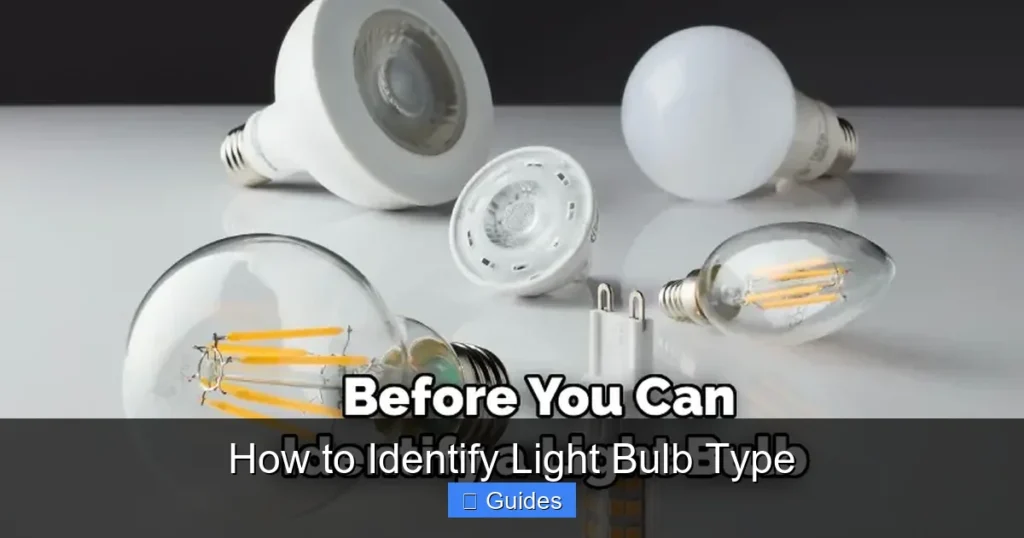
Struggling to replace a burnt-out bulb? Our comprehensive guide makes it easy to identify light bulb type! We’ll walk you through understanding bases, shapes, and technologies like LED, incandescent, CFL, and halogen. Learn to decode bulb markings and confidently choose the right bulb for any fixture, saving you time and frustration.
How to Identify Light Bulb Type
Ever stared blankly at a burnt-out light bulb, utterly baffled by the myriad of options at the hardware store? You’re not alone! Replacing a light bulb seems like a simple task until you realize there are dozens of different shapes, sizes, bases, and technologies available. Getting the wrong one can mean wasted time, money, and a still-dark room.
But don’t worry! This comprehensive guide is here to demystify the world of light bulbs and teach you exactly how to identify light bulb type with confidence. We’ll break down everything you need to know, from the smallest pin to the latest smart features, so you can always pick the perfect replacement bulb. Let’s shed some light on this common household challenge!
Key Takeaways
- Understanding Bulb Bases is Crucial: The base (the part that screws or plugs into the fixture) is the most critical factor for compatibility. Common types include screw-in (Edison), pin-type (bi-pin, GU-series), and bayonet bases.
- Bulb Shape Influences Appearance and Spread: Different shapes like A-type, BR, PAR, MR, G, and T serve various aesthetic and functional purposes, affecting light distribution and fit in fixtures.
- Identify the Lighting Technology: Modern bulbs primarily fall into LED, Incandescent, Halogen, or CFL categories, each with distinct energy efficiency, lifespan, and light quality characteristics. LEDs are generally the most energy-efficient and long-lasting.
- Always Check the Bulb’s Markings: Look for essential information printed on the bulb itself, such as wattage (W), lumens (lm), color temperature (K), voltage (V), and whether it’s dimmable. This data is vital for a suitable replacement.
- Take the Old Bulb with You: When in doubt, physically bringing the old bulb to the store or comparing it directly to options online is the most reliable way to ensure you get the correct match.
- Consider Special Features: Beyond basic identification, think about dimmability, smart features, outdoor ratings, or specific appliance needs when choosing a replacement bulb.
Quick Answers to Common Questions
What is the most important factor when identifying a light bulb for replacement?
The most important factor is the bulb’s base type (e.g., E26, GU10, G9) as it dictates whether the bulb will physically fit and make electrical contact with your light fixture.
How do I know if an LED bulb is dimmable?
You must check the bulb’s packaging or markings directly on the bulb itself for the word “Dimmable” or a dimmable symbol (a circle with a diagonal line and an arrow). Not all LEDs are dimmable.
What do the numbers in E26 or G25 mean?
For Edison screw bases like E26, the number (26) indicates the diameter of the base in millimeters. For globe shapes like G25, the number (25) refers to the bulb’s maximum diameter in eighths of an inch.
Can I use a 12V bulb in a 120V fixture?
No, you absolutely cannot. Using a 12V bulb in a standard 120V household fixture will instantly burn out the bulb and could pose a safety hazard. Always match the voltage requirements.
What is the difference between lumens and watts?
Watts (W) measure the energy consumed by the bulb. Lumens (lm) measure the actual brightness of the light produced. For modern bulbs, always prioritize lumens for brightness when comparing options.
📑 Table of Contents
The Foundational Three: Base, Shape, and Technology
When you’re trying to figure out how to identify light bulb type, it essentially boils down to three core characteristics: the base, the shape, and the lighting technology. These three elements dictate compatibility with your fixture, the appearance of the bulb, and how it performs in terms of light output and energy efficiency. Mastering these will give you a strong foundation.
Understanding the Light Bulb Base: The Compatibility King
The bulb’s base is arguably the most critical piece of information when you need to identify light bulb type. It’s the part that connects electrically and mechanically to your light fixture. If the base doesn’t match, the bulb simply won’t fit or work.
- Edison Screw Bases (E-type): These are the most common in North America and many other parts of the world. They feature a threaded base that screws into a socket. The “E” stands for Edison, and the number following it indicates the diameter of the base in millimeters.
- E26 (Medium/Standard): This is the most prevalent screw-in base in the U.S. and Canada, often found in table lamps, ceiling fixtures, and outdoor lights.
- E12 (Candelabra): Smaller than E26, these are common for decorative fixtures, chandeliers, night lights, and some appliance bulbs.
- E17 (Intermediate): Less common but still found, particularly in some appliance bulbs (like microwaves) or older fixtures.
- E39 (Mogul): A much larger base, typically used for high-wattage industrial or commercial lighting.
- Bayonet Bases (B-type or BA-type): Popular in the UK and Australia, these bases have two pins that protrude from the side and twist into a socket, rather than screw in.
- B22d (Standard Bayonet): Similar in function to E26 but with a push-and-twist mechanism.
- BA15d, BA15s: Often used for smaller automotive bulbs or specialized low-voltage applications.
- Pin-Type Bases (GU, G, MR-type): These bases use two or more pins that either push into a socket or twist and lock. They are very common for halogen and LED spotlights, puck lights, and track lighting.
- GU10: Features two thick pins with “feet” that twist and lock into place. Often found in recessed lighting and track lights.
- GU24: A two-pin twist-lock base designed for energy-efficient bulbs, specifically to prevent incandescent bulbs from being used.
- G4, G6.35, G9: Small bi-pin (two-pin) bases often used in decorative fixtures, under-cabinet lighting, or smaller spotlights. The number indicates the distance between the pins in millimeters. G9s have a loop-shaped pin.
- MR16 (GU5.3, GX5.3): A common two-pin base for low-voltage (12V) halogen or LED spotlights. The “5.3” indicates 5.3mm between pins.
- Fluorescent Tube Bases: Linear fluorescent bulbs (T8, T12) typically have two pins at each end (bi-pin). The distance between these pins, and the diameter of the tube itself, determine the exact type.
- G13 (Medium Bi-Pin): Standard for T8 and T12 fluorescent tubes.
- G5 (Miniature Bi-Pin): For slimmer T5 fluorescent tubes.
Tip: When you need to identify light bulb type, always check the old bulb’s base for markings. Often, the base type (E26, GU10, etc.) is stamped directly onto the metal or plastic.
Decoding Bulb Shapes: Form and Function
The shape of a light bulb influences its appearance, how it fits into a fixture, and even how the light is distributed. Bulb shapes are usually identified by a letter indicating the general form, followed by a number representing the bulb’s maximum diameter in eighths of an inch (for many common types).
- A-Type (Arbitrary or Standard):
- A19, A21: The classic “pear-shaped” bulb we all recognize. A19 is the most common for general lighting.
- B-Type or C-Type (Bullet or Candelabra):
- B10, C7, C15: Slender, often pointed or blunt-tipped bulbs. Used in chandeliers, decorative fixtures, and night lights.
- G-Type (Globe):
- G16.5, G25, G30, G40: Round, globe-shaped bulbs. Popular in vanity strips, pendant lights, and decorative applications where the bulb is visible. The number refers to the diameter in eighths of an inch (e.g., G25 is 25/8 inches or 3.125 inches).
- BR-Type (Bulged Reflector):
- BR30, BR40: These have a wide, floodlight-like shape with a reflective coating inside to direct light forward. Commonly used in recessed can lights for broad illumination.
- PAR-Type (Parabolic Aluminized Reflector):
- PAR20, PAR30, PAR38: More intense and directional than BR bulbs, with a stronger beam. Used for spotlights, track lighting, and outdoor floodlights. PAR bulbs have a flatter face compared to BRs.
- MR-Type (Multifaceted Reflector):
- MR16: Small, directional bulbs with a faceted reflector, often used in track lighting, recessed lights, and display lighting. They typically use a bi-pin base.
- T-Type (Tubular):
- T3, T4, T6, T8, T10, T12: Long, cylindrical bulbs, ranging from very slender appliance bulbs to the larger fluorescent tubes. The number indicates the diameter in eighths of an inch (e.g., T8 is 8/8 = 1 inch diameter).
- S-Type (Straight-Sided):
- S14: A straight-sided decorative bulb, often used in string lights or sign lighting.
Remember: The shape and size might limit your options based on the fixture’s physical constraints. Always check the clearance.
Identifying Light Bulb Technology: Efficiency and Light Quality
The technology inside the bulb determines its energy efficiency, lifespan, initial cost, and the quality of light it produces. Knowing how to identify light bulb type by its technology is key to making informed choices.
- Incandescent Bulbs:
- Appearance: Classic glass bulb, often with a visible filament.
- Characteristics: Produces warm, full-spectrum light (high CRI), instant-on. Very inefficient, most energy is lost as heat. Short lifespan (around 750-1,000 hours). Being phased out in many regions due to energy inefficiency.
- Halogen Bulbs:
- Appearance: Smaller than incandescents, sometimes with a clear outer glass envelope and a smaller inner capsule. Often used for spotlights (MR16, PAR) or decorative G9, G4 bulbs.
- Characteristics: A type of incandescent bulb, but more efficient and longer-lasting (around 2,000-4,000 hours) due to halogen gas inside. Produces bright, white light. Still hot and less efficient than LEDs.
- CFLs (Compact Fluorescent Lamps):
- Appearance: Distinctive spiral or U-shaped glass tubes, often with a plastic base.
- Characteristics: Significantly more energy-efficient than incandescents (about 75% less energy). Longer lifespan (around 8,000-10,000 hours). Can take a moment to reach full brightness and may not dim well. Contain mercury, requiring special disposal.
- LEDs (Light Emitting Diodes):
- Appearance: Highly varied. Can mimic traditional incandescent shapes (A-type, globe, candle) or have distinctive designs (e.g., flat panels, integrated chips). Often have a heat sink (fins) at the base.
- Characteristics: The most energy-efficient and longest-lasting option (25,000+ hours). Instant-on, available in a wide range of color temperatures (warm to cool white), and excellent dimming capabilities in compatible models.
- Smart Bulbs:
- Appearance: Typically look like standard LED bulbs but often have internal components visible through the base.
- Characteristics: An LED bulb with integrated Wi-Fi or Bluetooth connectivity, allowing control via a smartphone app, voice assistant, or smart home hub. Can change color, dim, and be scheduled.
Pro Tip: If you’re replacing an old bulb, consider upgrading to an LED. You’ll save significantly on energy bills and enjoy a much longer lifespan.
Beyond the Basics: Markings, Voltage, and Special Features
Once you’ve got a handle on the base, shape, and technology, it’s time to dig into the details printed on the bulb itself. These markings are vital for ensuring you get a replacement that performs exactly as expected.
Decoding the Markings on the Bulb
Most light bulbs, especially newer ones, have a wealth of information printed on the glass or base. Taking a moment to read these details can save you a lot of guesswork when you identify light bulb type.
- Wattage (W): This indicates the power consumption of the bulb. For older incandescent and halogen bulbs, it also roughly correlated to brightness. For LEDs, it’s about energy use, not brightness.
- Lumens (lm): This is the true measure of a bulb’s brightness, regardless of its technology. A higher lumen number means a brighter light. For example, a common 60W incandescent equivalent LED might produce around 800 lumens.
- Color Temperature (K): Measured in Kelvin, this tells you the “warmth” or “coolness” of the light.
- 2700K-3000K: “Warm White” – similar to traditional incandescents, often used in living rooms and bedrooms for a cozy feel.
- 3500K-4100K: “Cool White” or “Neutral White” – good for kitchens, offices, and workspaces.
- 5000K-6500K: “Daylight” – very bright, bluish-white light, excellent for task lighting or areas needing high visibility.
- Voltage (V): Most household bulbs are 120V (in North America) or 220-240V (in Europe/Asia). However, some specialty bulbs (like MR16 spotlights or landscape lights) are low voltage (12V) and require a transformer. Always match the voltage to your fixture.
- Dimmable: Look for “Dimmable” or a dimmable symbol (a circle with a diagonal line and an arrow). Not all bulbs, especially older CFLs or some LEDs, are dimmable, and using a non-dimmable bulb on a dimmer switch can cause flickering or damage.
- CRI (Color Rendering Index): This measures how accurately a light source reveals the true colors of objects compared to natural light. A higher CRI (80+) is generally better for applications where color accuracy is important.
- Life Expectancy (Hours/Years): Indicates how long the bulb is expected to last. LEDs often boast tens of thousands of hours.
Essential Tip: When in doubt, take a picture of all the markings on the old bulb!
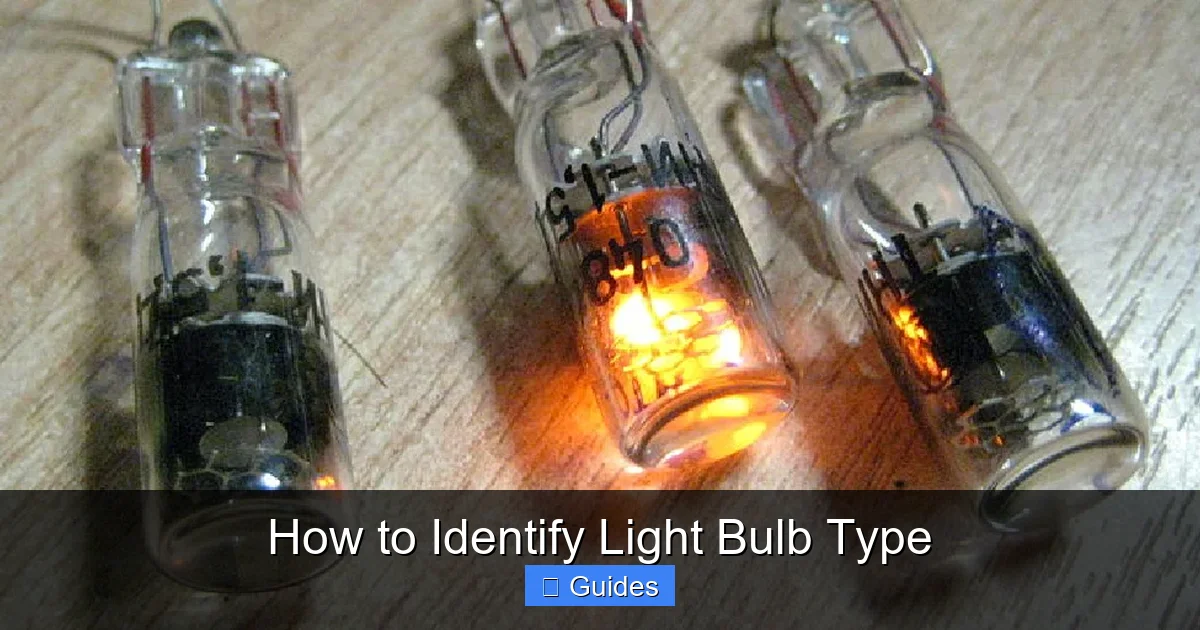
Visual guide about How to Identify Light Bulb Type
Image source: brightlighthub.com
Considering the Fixture and Application
The type of fixture and where it’s located also play a big role in how to identify light bulb type that’s right for you.
- Open vs. Enclosed Fixtures: Some LED bulbs are not designed for fully enclosed fixtures because they require airflow for heat dissipation. Overheating can significantly shorten an LED’s lifespan. Check the packaging for “suitable for enclosed fixtures.”
- Dimmers: As mentioned, ensure your replacement bulb is dimmable if used with a dimmer switch. Moreover, ensure your dimmer switch is compatible with LED bulbs, as older incandescent dimmers might not work correctly.
- Outdoor Use: Bulbs for outdoor use should be rated for wet locations or at least damp locations, depending on exposure to the elements. These ratings often involve specific materials and seals.
- Appliance Bulbs: Microwaves, ovens, and refrigerators often use unique, small bulbs designed to withstand specific temperatures or vibrations. These are typically E12 or E17 bases, sometimes with a unique shape.
Practical Steps to Successfully Identify Light Bulb Type
Now that you’re armed with all this knowledge, let’s put it into practice. Here’s a step-by-step approach to confidently identify light bulb type for any situation.
Step 1: Safely Remove the Old Bulb
Before anything else, ensure the fixture is turned OFF and cool to the touch. Carefully unscrew or unclip the old bulb. Be gentle, especially if it’s broken or an older, fragile incandescent.
Step 2: Examine the Base
This is your first and most important clue.
- Is it screw-in (Edison)? Look for E26, E12, E17, E39 stamped on the metal.
- Is it push-and-twist (Bayonet)? Look for B22d.
- Does it have two pins? Measure the distance between the pins (in mm) and look at their shape (e.g., GU10, GU5.3, G9).
- Is it a long tube with pins at each end? This indicates a fluorescent tube.
Step 3: Analyze the Shape and Size
Hold the bulb up.
- Is it the classic pear shape (A19)?
- Is it a globe (G25)?
- Is it a spotlight (MR16, PAR, BR)? Note the diameter if possible.
- Is it a candle flame or bullet shape (C7, B10)?
- Is it a long tube (T8, T5)? Measure its diameter.
Don’t forget the physical dimensions. Measure the overall length and widest diameter if the fixture has tight space constraints.
Step 4: Read All Markings
Carefully inspect the glass or plastic of the bulb, especially near the base, for any printed information.
- Look for Wattage (W) and Lumens (lm): Note the original wattage for guidance, but prioritize lumens for brightness with new LEDs.
- Find Color Temperature (K): This helps you match the light’s warmth or coolness.
- Check Voltage (V): Crucial for specialty bulbs (12V) vs. standard household (120V/240V).
- Search for “Dimmable”: Essential if you have a dimmer switch.
- Identify Technology: Is it a coiled CFL, a visible filament incandescent, or an LED with a heat sink?
Step 5: Consider the Application
Think about where the bulb is used.
- Is it in an enclosed fixture?
- Is it outdoors?
- Is it in an appliance?
- Do you need special features like smart control or a specific beam angle?
Step 6: Purchase Your Replacement
With all this information, you can now confidently shop for a new bulb.
- Best Practice: Take the old bulb with you to the store or have photos of it (especially the base and markings) readily available when shopping online.
- Match Key Specs: Prioritize matching the base type and voltage. Then, match lumens for brightness and Kelvin for color temperature. Finally, ensure the shape fits the fixture.
- Upgrade to LED: If replacing an incandescent or CFL, seriously consider an LED equivalent that matches your desired lumens and color temperature.
Conclusion
Identifying the right light bulb type doesn’t have to be a daunting task. By systematically examining the bulb’s base, shape, technology, and markings, you can confidently navigate the vast array of options available. This guide on how to identify light bulb type empowers you to make smart, efficient lighting choices for every corner of your home. So next time a bulb goes out, you’ll be a lighting expert, ready to brighten your space with ease!
Frequently Asked Questions
How can I identify a light bulb if there are no markings visible?
If markings are completely gone, first identify the base type (screw-in, pin, bayonet) and measure its diameter or pin spacing. Then, visually match the bulb’s shape and approximate size. Finally, take the old bulb to a hardware store or search online using a visual description of the base and shape, focusing on common sizes like E26 A19.
Is it okay to replace an incandescent bulb with an LED?
Yes, replacing an incandescent bulb with an LED equivalent is highly recommended. LEDs are significantly more energy-efficient, last much longer, and produce less heat. Just ensure you match the base type, desired brightness (lumens), and color temperature (Kelvin), and check if the LED is dimmable if used with a dimmer.
What does “color temperature” mean for a light bulb?
Color temperature, measured in Kelvin (K), describes the perceived “warmth” or “coolness” of the light. Lower Kelvin values (e.g., 2700K-3000K) produce a warm, yellowish light, while higher values (e.g., 5000K-6500K) produce a cooler, bluer “daylight” effect. Choose based on the ambiance you want for the room.
Why do some bulbs have two pins and others have a screw base?
The difference in bases primarily relates to the bulb’s design and intended application. Screw bases (Edison) are common for general household lighting. Pin bases (like GU10, G9, MR16) are frequently used for spotlights, track lighting, or specialty fixtures where a compact or directional light source is needed.
What should I do if my fixture has an unusual bulb base?
If you encounter an unusual bulb base, carefully remove the old bulb and try to find any identifying numbers or letters stamped on the base itself. Take a clear photo of the base and the entire bulb. You might need to visit a specialized lighting store or consult the fixture’s manufacturer for specific replacement recommendations.
Can I use any dimmable LED bulb with my existing dimmer switch?
While an LED bulb might be labeled “dimmable,” not all LED dimmable bulbs are compatible with all dimmer switches. Older dimmer switches designed for incandescent bulbs may cause flickering or incomplete dimming with LEDs. For optimal performance, consider upgrading to an LED-compatible (often called “universal” or “electronic low voltage”) dimmer switch.
