


As an Amazon Associate, We earn from qualifying purchases.
Navigating the world of light bulbs often starts with understanding their bases. For most homes in North America, what base size is a standard light bulb is the Medium Edison Screw, known as E26. This versatile base powers everything from table lamps to ceiling fixtures. While E26 is the most common, understanding other bases like E12 (candelabra) and bi-pin types will ensure you always pick the perfect bulb for any fixture.
Ever found yourself staring blankly at a wall of light bulbs at the hardware store, wondering which one will actually fit your lamp? You’re not alone! It’s a common dilemma, and often, the biggest hurdle isn’t choosing the right brightness or color temperature, but simply figuring out what base size is a standard light bulb. It might seem like a small detail, but getting the base size right is absolutely crucial for your bulb to fit, function safely, and illuminate your space properly.
The world of light bulbs can feel a bit like a secret language, full of letters and numbers like E26, E12, GU10, and more. But don’t worry, it’s actually quite logical once you understand the system. This guide is here to demystify light bulb bases and arm you with the knowledge to confidently select the perfect bulb every single time. We’ll explore what base size is a standard light bulb in most homes, delve into other popular types, and share practical tips for making the right choice.
Key Takeaways
- The Standard for North America: The E26 Medium Edison Screw base is the most common and widely recognized standard light bulb base size in the United States and Canada, powering the vast majority of residential fixtures.
- E27 is the European Twin: While E26 is North American, its European counterpart, E27, is largely interchangeable due to nearly identical dimensions, though voltage compatibility must always be checked.
- Letter and Number System: Light bulb bases are identified by a letter (E for Edison screw, G for bi-pin, B for bayonet) followed by a number indicating the base’s diameter in millimeters or pin spacing.
- Beyond the Standard: Other common bases include E12 (candelabra, for smaller, decorative bulbs), E17 (intermediate), E39/E40 (mogul, for large, high-wattage applications), and various bi-pin bases (like GU10, G9) for spotlights.
- How to Identify: The easiest way to determine the correct base size is to check the old bulb itself for markings, measure the base’s diameter, or consult the fixture’s instructions.
- Mismatch Risks: Using an incorrect base size can lead to improper fit, electrical hazards, or simply the bulb not working, making proper identification crucial for safety and functionality.
- Adapters Exist, Use with Caution: While adapters can convert one base type to another (e.g., E12 to E26), they should be used judiciously, considering potential aesthetic issues, fixture limitations, and maintaining electrical safety.
Quick Answers to Common Questions
What does “E26” mean in light bulb bases?
E26 refers to an Edison screw base with a diameter of 26 millimeters. It is the most common standard light bulb base size in North America.
Can I use an E27 bulb in an E26 socket?
Physically, an E27 bulb can often screw into an E26 socket due to their similar dimensions. However, E27 bulbs are designed for 220-240V systems, while E26 sockets are for 120V. Using an E27 in a 120V E26 socket will likely result in a very dim or non-functional bulb and is not recommended for performance or safety.
What’s the difference between an Edison screw and a bi-pin base?
An Edison screw base (like E26) is threaded and screws into the socket, making both physical and electrical contact. A bi-pin base (like GU10) has two pins that push or twist into the socket to establish contact.
Are candelabra bulbs only for chandeliers?
No, while candelabra (E12) bulbs are very popular for chandeliers and wall sconces due to their smaller size and decorative appearance, they are also commonly found in night lights, some decorative accent lamps, and even specific appliances like oven range hoods.
How can I tell if my bulb is 120V or 240V?
The voltage rating is almost always printed on the light bulb itself, usually on the metal base or the glass. If the bulb came with a fixture, the fixture or its manual would also specify the required voltage.
📑 Table of Contents
- Understanding Light Bulb Bases: The Foundation of Illumination
- The Standard Bearer: What Base Size Is a Standard Light Bulb in North America (E26)
- Beyond the Standard: Other Common Light Bulb Base Sizes You’ll Encounter
- How to Identify Your Light Bulb Base Size: A Practical Guide
- Tips for Choosing the Right Light Bulb and Avoiding Mismatches
- Conclusion: Light Up Your Life with Confidence
Understanding Light Bulb Bases: The Foundation of Illumination
Before we dive into specifics, let’s clarify what a light bulb base actually is. Simply put, it’s the part of the light bulb that connects it to the electrical socket of your fixture. It’s the physical and electrical interface that allows power to flow from the fixture to the bulb, bringing light into your life. The base ensures a secure physical connection and establishes the electrical contact needed for the bulb to glow.
Why are there so many different base sizes, you might ask? It comes down to a few key factors: standardization, specific applications, and safety. Different regions adopted different standards over time, leading to variations. Furthermore, a small nightlight doesn’t need the same robust connection as a high-wattage industrial floodlight, and decorative fixtures often require smaller, more discreet bases. Each base type is designed to meet particular needs, from power handling to physical fit and aesthetic appeal.
The Naming Convention: Letters and Numbers Explained
Most light bulb base names follow a straightforward system that tells you a lot about the bulb at a glance. You’ll typically see a letter followed by a number. Let’s break it down:
- The Letter: This usually indicates the base type.
- E: Stands for “Edison screw.” This is by far the most common type, where the base screws into the socket. Named after Thomas Edison, who popularized this design.
- G: Stands for “bi-pin” or “multi-pin.” These bases have two or more pins that push or twist into the socket.
- B: Stands for “bayonet.” Common in the UK and Australia, these bases have two pins that push in and twist to lock.
- S: Single contact bayonet.
- D: Double contact bayonet.
- F: Single pin.
- P: Pre-focus.
- R: Recessed contact.
- W: Wedge base.
- The Number: This number typically indicates the diameter of the screw base in millimeters (for Edison types) or the distance between the center of the pins in millimeters (for bi-pin types). So, an E26 base has a screw diameter of 26 millimeters.
Understanding this system is your first step to identifying what base size is a standard light bulb and all its relatives. It’s like knowing the language of light!
The Standard Bearer: What Base Size Is a Standard Light Bulb in North America (E26)
When someone asks, “what base size is a standard light bulb?” in the United States or Canada, the answer is almost always the E26 Medium Edison Screw. This is the king of light bulb bases in North America, found in nearly every household fixture you can imagine. From your bedside table lamp to your kitchen’s ceiling light, chances are it uses an E26 base.
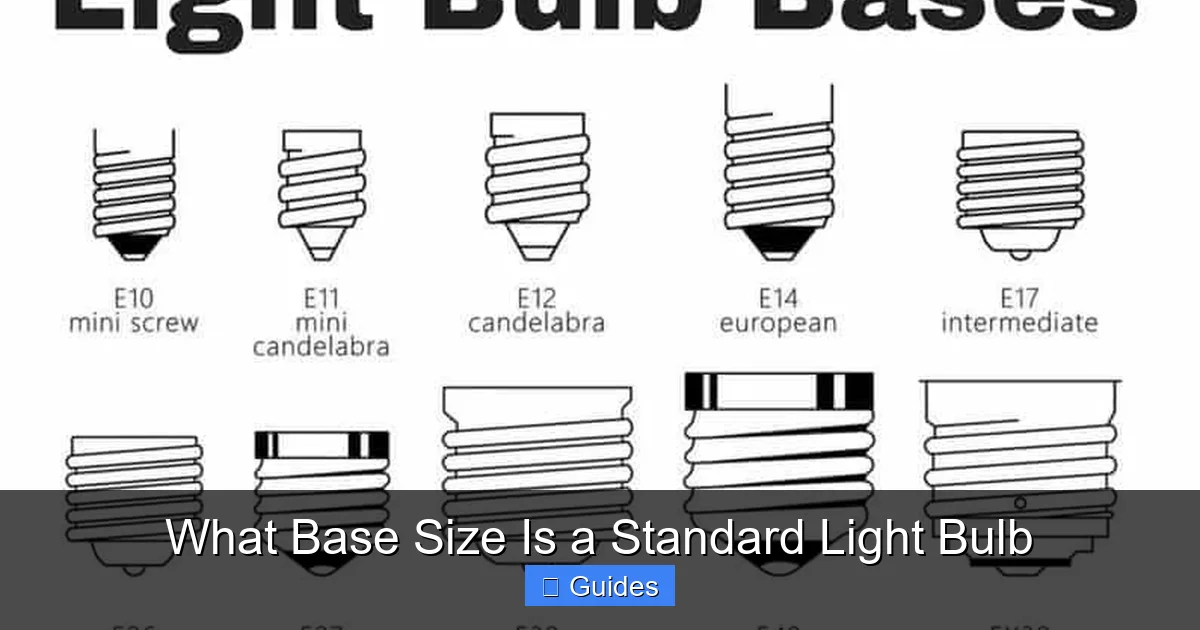
Visual guide about What Base Size Is a Standard Light Bulb
Image source: homestratosphere.com
E26: Your Everyday Champion
The E26 base has a diameter of 26 millimeters (about 1 inch) at its widest point. It’s designed for 120V electrical systems, which is the standard household voltage in North America. Its prevalence makes it incredibly convenient; you’ll find E26 bulbs in a vast array of shapes, sizes, wattages, and technologies, including incandescent, CFL, and LED.
- Where you’ll find it:
- Table and floor lamps
- Ceiling fan lights
- Recessed lighting (often with PAR or BR bulb shapes)
- Pendant lights
- Outdoor porch lights
- Most general-purpose household fixtures
If you’re buying a general-purpose light bulb for a common fixture in your North American home, the E26 is almost certainly what you need. It’s the default, the workhorse, the reliable choice.
E27: The European Cousin
It’s worth briefly mentioning the E27 base. This is the standard in Europe and many other parts of the world that use 220-240V electrical systems. The “27” also refers to its diameter of 27 millimeters. You might be thinking, “That’s only 1 millimeter difference from E26!” And you’d be right. E26 and E27 bases are mechanically almost identical and are often physically interchangeable. You can sometimes screw an E27 bulb into an E26 socket and vice-versa.
However, mechanical compatibility does not mean electrical compatibility. E26 bulbs are designed for 120V, and E27 bulbs for 220-240V. Using an E26 bulb in a 240V E27 socket will likely burn out the bulb instantly. Using an E27 bulb in a 120V E26 socket might work, but the bulb will be very dim or not work correctly, and it’s not recommended due to potential safety issues and reduced performance. Always match the bulb’s voltage rating to your home’s electrical supply, regardless of physical fit.
Beyond the Standard: Other Common Light Bulb Base Sizes You’ll Encounter
While the E26 answers what base size is a standard light bulb for most situations, it’s far from the only base out there. You’ll frequently encounter other types, especially for specialized fixtures or decorative lighting. Knowing these will save you a trip back to the store!
E12 Candelabra Base: Small and Decorative
The E12 Candelabra base is the smaller sibling of the E26. With a diameter of 12 millimeters, these bases are designed for smaller, often decorative bulbs that mimic the look of candles. They are very common in:
- Chandeliers
- Wall sconces
- Night lights
- Some decorative accent lamps
- Oven range hoods
E12 bulbs are typically not used for general room illumination due to their smaller size and lower light output, but they are essential for adding ambiance and decorative flair.
E17 Intermediate Base: The Less Common Middle Child
The E17 Intermediate base sits between the E12 and E26 in size, with a diameter of 17 millimeters. It’s less common than E12 or E26 but still has its niche. You might find E17 bulbs in:
- Some older desk lamps
- Certain types of appliances (like microwave ovens)
- Occasionally in decorative lighting fixtures
If you encounter an E17, it’s usually because the original fixture specified it. They aren’t widely available in every retail store, but specialty lighting shops will carry them.
E39/E40 Mogul Base: For Heavy-Duty Lighting
At the other end of the spectrum from the E12 is the E39 Mogul base (E40 in Europe). These are much larger bases, with a diameter of 39 millimeters (E39) or 40 millimeters (E40). They are designed for high-wattage, high-lumen bulbs used in industrial and commercial applications, or for very large residential spaces with specific needs. You’ll typically find them in:
- Street lights
- Warehouse lighting
- High-bay fixtures
- Large outdoor floodlights
- Specialty stage or studio lighting
You won’t often find an E39 bulb in a standard home fixture, but it’s good to know they exist for those specific heavy-duty lighting needs.
Bi-Pin Bases (GU10, G9, GU5.3/MR16): The Pin Connectors
Bi-pin bases, characterized by two pins protruding from the bulb’s base instead of a screw thread, are very common for spotlighting and certain types of recessed fixtures. The number indicates the distance between the center of the pins in millimeters.
- GU10: A very popular bi-pin base, particularly for track lighting and recessed downlights. It has two short, stubby pins that spread slightly at the end, requiring a “push and twist” motion to lock into the socket.
- G9: Features two loop-shaped pins. G9 bulbs are compact and often used in decorative fixtures, small accent lights, and under-cabinet lighting. They usually operate on line voltage (120V or 240V).
- GU5.3 (MR16): This base has two longer, thinner pins spaced 5.3 millimeters apart. MR16 refers to the bulb shape, and it typically uses a GU5.3 base. These bulbs often operate on low voltage (12V) and require a transformer, making them popular for landscape lighting and some recessed lighting applications.
Bayonet Bases (B15, B22): The Push-and-Twist Kind
While less common in North America, bayonet bases are very prevalent in the United Kingdom, Ireland, Australia, and parts of India. Instead of screwing in, bayonet bulbs have two small pins on the side of the base that slide into L-shaped slots in the socket and then twist to lock. The common sizes are:
- B22 (BC – Bayonet Cap): The standard household size in these regions, with a 22mm diameter.
- B15 (SBC – Small Bayonet Cap): A smaller version, with a 15mm diameter, used for smaller fixtures, similar to E12 candelabra.
Wedge Bases (W5W, W3W): For Automotive and Indicators
Wedge bases are characterized by a flat, glass base with two small wires protruding from the bottom. The entire base itself is typically glass. They are mostly found in automotive applications for interior lights, dashboard lights, and indicator lights, as well as some specialized appliance lighting. The bulb simply pushes into a friction-fit socket.
How to Identify Your Light Bulb Base Size: A Practical Guide
So, you’re faced with an empty socket or a burnt-out bulb, and you need to figure out what base size you need. Here’s a straightforward approach:
1. Check the Old Bulb
This is by far the easiest and most reliable method. Most light bulbs have their base type, voltage, and sometimes wattage printed right on the metal or glass base. Look for markings like “E26,” “E12,” “GU10,” or “A19/E26.” The bulb type and base type are often listed together (e.g., “A19/E26” means an A19 shape bulb with an E26 base).
2. Measure the Base Diameter
If the markings are worn off or unreadable, grab a ruler or measuring tape. For screw-in (Edison) bases, measure the diameter across the widest part of the metal screw base in millimeters. Remember, E26 is 26mm, E12 is 12mm, and so on. For bi-pin bases, measure the distance between the centers of the two pins.
3. Consult the Fixture or Manufacturer Information
Sometimes, the base information is listed on the light fixture itself, often on a sticker inside the socket or on the fixture’s instruction manual. If you still have the packaging for the fixture, that’s another great place to look. This method is especially useful if you’ve inherited a fixture without a bulb.
4. Take a Picture and Ask an Expert
If all else fails, take a clear photo of the old bulb’s base (or the empty socket) and show it to a knowledgeable salesperson at a lighting or hardware store. They can usually identify it for you on the spot. Many online bulb retailers also have excellent guides or customer service that can help identify obscure bases.
Tips for Choosing the Right Light Bulb and Avoiding Mismatches
Now that you know what base size is a standard light bulb and how to identify other types, here are some essential tips to ensure you always pick the perfect bulb:
Always Check Before You Buy
This cannot be stressed enough. A quick check of the old bulb’s base or the fixture’s specifications will save you time, money, and frustration. Don’t assume that because it “looks about right” it will fit.
Consider Voltage Compatibility
As mentioned with E26 and E27, physical fit doesn’t always mean electrical compatibility. Always ensure the bulb’s voltage rating matches your home’s electrical supply. This is particularly important when importing bulbs or dealing with specialty low-voltage lighting (like some landscape lights that use 12V bulbs).
When in Doubt, Bring the Old Bulb
If you’re unsure, or the base is unusual, simply unscrew the old bulb and take it with you to the store. This is the simplest way to guarantee a match.
Using Adapters: Proceed with Caution
There are adapters available that can convert one base type to another (e.g., an E12 socket to accept an E26 bulb, or vice-versa). While these can be useful in specific situations, use them with care:
- Height and Aesthetics: Adapters add length to the bulb, which might make it protrude too far from the fixture or be aesthetically unpleasing.
- Wattage Limits: Ensure the adapter and the fixture are rated for the bulb’s wattage.
- Safety: Always use certified adapters and ensure they are securely installed. Avoid overloading circuits. Generally, it’s safer and better to use a bulb with the correct native base.
LED Retrofits: A Smart Choice, But Still Check Bases
Many people are upgrading to energy-efficient LED bulbs. Thankfully, most LED bulbs are designed as “retrofits,” meaning they come in standard base sizes like E26, E12, GU10, etc., so they can directly replace old incandescents or CFLs without needing new fixtures. However, you still need to know what base size is a standard light bulb for your fixture to get the right LED retrofit.
Conclusion: Light Up Your Life with Confidence
No longer should the light bulb aisle be a source of confusion! By now, you should confidently know that for most homes in North America, what base size is a standard light bulb is the E26 Medium Edison Screw. You’re also familiar with its common relatives like the E12 candelabra and various bi-pin bases, along with the practical steps to identify any bulb base you encounter.
Understanding light bulb bases is not just about making the right purchase; it’s about ensuring safety, functionality, and getting the desired illumination for your space. With this knowledge, you can confidently navigate the vast array of lighting options, choose the correct bulbs every time, and keep your home beautifully and safely lit. Happy bulb hunting!
🎥 Related Video: Standard Light Bulb – Size & Codes | Spec. Sense
📺 AMRE Supply
What does the A19 code describe? What is an E26 base? In this episode of Spec. Sense, Vance shows how to measure and how …
Frequently Asked Questions
What is the most common light bulb base in the US?
The most common light bulb base in the United States, and indeed throughout North America, is the E26 Medium Edison Screw. This base type is used in the vast majority of household lighting fixtures, from table lamps to ceiling lights and recessed cans.
What does the “E” stand for in E26?
The “E” in E26 stands for “Edison,” referring to the screw-in base design patented by Thomas Edison. The number “26” denotes the diameter of the screw base in millimeters, making it easy to identify its size.
Are E26 and E27 bases interchangeable?
Mechanically, E26 and E27 bases are nearly identical in size and can often be screwed into each other’s sockets. However, they are designed for different voltage systems (E26 for 120V, E27 for 220-240V), meaning they are not electrically interchangeable without proper voltage conversion, which is generally not recommended.
What is a candelabra base bulb used for?
A candelabra base bulb, identified as E12, is a smaller screw-in base primarily used for decorative lighting. You’ll find them in chandeliers, wall sconces, night lights, and other fixtures where a smaller, more discreet bulb is desired for accent lighting or ambiance.
How do I know what base my existing light bulb has if there are no markings?
If the markings on your light bulb are gone, the best way to determine the base size is to carefully measure the diameter of the screw base in millimeters (for Edison types) or the distance between the center of the pins (for bi-pin types). You can then compare this measurement to common base sizes like 26mm for E26, 12mm for E12, or 10mm for GU10.
Can I use an adapter to change a light bulb base type?
Yes, adapters are available to convert one base type to another (e.g., E12 to E26). While they offer flexibility, it’s generally best to use the correct native base if possible. Always ensure the adapter and fixture can handle the bulb’s wattage, consider how the adapter affects the bulb’s position in the fixture, and prioritize electrical safety by using certified products.
