


As an Amazon Associate, We earn from qualifying purchases.
E26 is the standard screw-in base size for most light bulbs used in North America, indicating a 26-millimeter diameter. This crucial specification ensures compatibility, allowing you to confidently select the correct bulb for nearly all your household fixtures. Knowing what E26 means simplifies your shopping and guarantees a perfect, safe fit every time.
Have you ever found yourself standing in the light bulb aisle, staring at a dizzying array of boxes, each with its own mysterious combination of letters and numbers? It can feel a bit like trying to decipher an ancient code, right? You just want to replace a burned-out bulb, but suddenly you’re faced with terms like “A19,” “BR30,” “lumens,” “Kelvin,” and then there’s that ever-present “E26.” What does E26 even mean on a light bulb, and why does it seem so important?
I totally get it. It’s easy to feel overwhelmed. But trust me, understanding what E26 means is actually one of the simplest and most crucial pieces of information you need when buying light bulbs for your home, especially in North America. It’s the key to ensuring your new bulb fits perfectly and safely into your lamp or fixture. Think of it as the foundational knowledge that will make all your future light bulb purchases a breeze.
In this comprehensive guide, we’re going to demystify E26 once and for all. We’ll break down exactly what those letters and numbers signify, why they matter, and how this knowledge will empower you to choose the right light bulb with confidence every single time. By the end of our chat, you’ll be navigating the light bulb aisle like a pro, ready to illuminate your space perfectly.
Key Takeaways
- E26 is North America’s standard: It’s the most common screw base.
- Always match bulb and fixture: Verify E26 for proper fit.
- “E” signifies Edison screw base: This design is a universal standard.
- “26” means 26mm diameter: This defines the base size precisely.
- Base size differs from voltage: E26 doesn’t indicate electrical rating.
- Avoid forcing incompatible bulbs: Mismatching can cause damage or hazard.
- E27 is the international equivalent: They are often interchangeable due to similarity.
Quick Answers to Common Questions
What exactly does E26 mean on a light bulb?
The “E” in E26 refers to an Edison screw base, which is the standard screw-in type of bulb base. The “26” indicates the diameter of the base in millimeters, so it’s 26mm wide.
Is E26 the standard light bulb size in the United States?
Yes, absolutely! When you’re looking for a standard light bulb in North America, chances are you need an E26 base, making it incredibly common for household lamps and fixtures.
Can I use an E26 bulb in a different size socket, like an E27?
While E26 and E27 bases are very similar in size (26mm vs 27mm), it’s generally recommended to match the bulb to the socket. Using the wrong size might lead to an improper fit or connection, potentially causing issues.
Are there other types of “E” light bulb bases besides E26?
Definitely! You’ll find a range of Edison screw bases, such as E12 (candelabra base, common for decorative bulbs) and E17 (intermediate base). Each number signifies a different diameter for various lighting needs.
Why is knowing what E26 means important when buying light bulbs?
Understanding what E26 means on a light bulb ensures you purchase the correct bulb that fits your fixture perfectly. This prevents frustrating trips back to the store and guarantees proper functionality and safety for your lighting.
📑 Table of Contents
- What Does E26 Literally Mean? Decoding the Edison Screw
- Why Understanding E26 is Crucial for Every Homeowner
- Common Light Bulbs That Use the E26 Base
- Navigating Beyond E26: Other Important Bulb Specifications
- Tips for Choosing the Right E26 Bulb Every Time
- Common E26 Bulb Types at a Glance
- Conclusion
What Does E26 Literally Mean? Decoding the Edison Screw
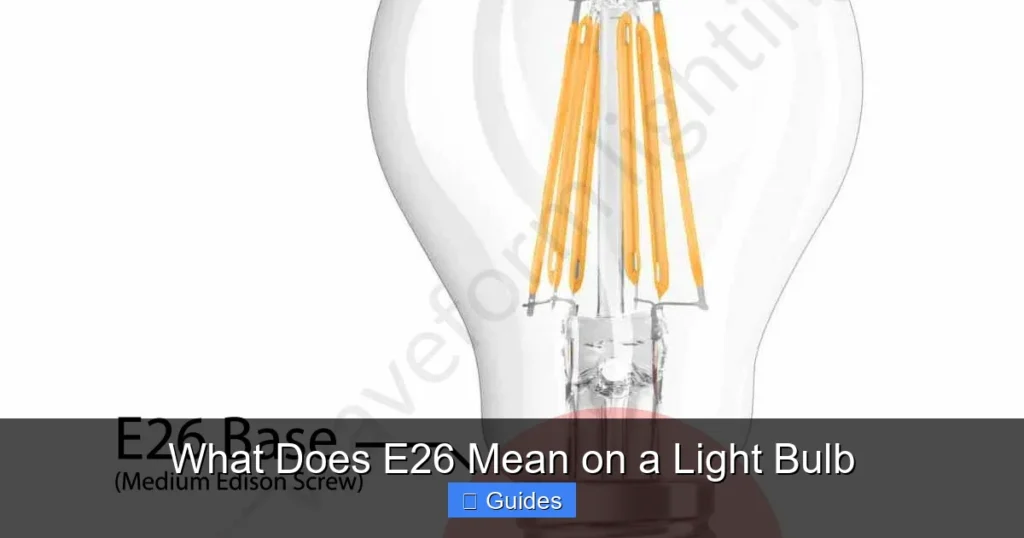
Let’s dive straight into the heart of the matter: what does E26 mean on a light bulb? The answer is surprisingly straightforward and incredibly important for compatibility. When you see E26, you’re looking at the specifications for the bulb’s base – the part that screws into your light fixture.
The “E” for Edison
The “E” in E26 stands for “Edison Screw.” This designation is a direct nod to none other than Thomas Edison, who popularized this screw-in base design for his incandescent light bulbs. His design was so effective and easy to use that it became a global standard, especially in places like North America, Japan, and parts of South America. So, whenever you see an “E” followed by numbers on a light bulb base, you know it’s an Edison screw base, designed to twist into a matching socket.
The “26” for Millimeters
Now, for the numbers: the “26” in E26 refers to the diameter of the screw base in millimeters. Specifically, it means the base is 26 millimeters wide. This measurement is crucial because it dictates whether the bulb will fit snugly and securely into your fixture’s socket. If you try to put a bulb with a different diameter base into an E26 socket, it simply won’t fit correctly, or worse, it could create an unsafe electrical connection.
Why is E26 so Common?
The E26 light bulb base is incredibly common because it’s the standard for most household screw-in light bulbs in North America (the U.S. and Canada). This means that the vast majority of your table lamps, floor lamps, ceiling fixtures, and even many outdoor lights will likely require an E26 base bulb. Its widespread adoption simplifies bulb replacement for consumers and ensures broad compatibility across different brands and fixture types.
Why Understanding E26 is Crucial for Every Homeowner
Knowing what does E26 mean on a light bulb isn’t just a fun fact; it’s a practical necessity that impacts safety, functionality, and even your wallet. Let’s explore why this seemingly small detail holds such big importance.
Visual guide about What Does E26 Mean on a Light Bulb
Image source: storables.com
Safety First: Avoiding Mismatches
Imagine trying to screw a smaller bulb into a larger socket, or vice-versa. It either wobbles precariously or simply won’t go in. Beyond the frustration, an improperly fitted light bulb can be a safety hazard. A loose connection can lead to flickering lights, arcing, overheating, and potentially even electrical fires. By always matching your fixture’s requirement (which is almost certainly E26 in North America) with an E26 light bulb, you ensure a secure and safe electrical connection, protecting your home and family.
Perfect Fit: The Key to Functionality
Beyond safety, the correct fit ensures your bulb works as intended. An E26 light bulb in an E26 socket means the electrical contacts align perfectly, allowing the bulb to receive power consistently. Without this perfect alignment, your bulb might not light up at all, or it might flicker intermittently, leading to annoying disruptions and premature bulb failure. Who wants that when all you want is reliable light?
Saving Time and Money
There’s nothing more annoying than buying a new light bulb, getting home, and realizing it doesn’t fit. This means another trip to the store, more time wasted, and potentially the hassle of returns. By understanding that most of your fixtures require an E26 light bulb, you can confidently grab the right one the first time. This simple knowledge saves you valuable time, prevents frustration, and helps you avoid unnecessary expenses on bulbs you can’t even use.
Common Light Bulbs That Use the E26 Base
The beauty of the E26 base is its incredible versatility. It’s not just for one type of bulb; rather, it’s the standard screw-in base for a vast array of light bulb shapes and technologies. Let’s look at some of the most common E26 light bulb types you’ll encounter.
The Versatile A19: Your Everyday Hero
When you picture a “standard” light bulb, you’re likely thinking of an A19 bulb. The “A” refers to its general shape (traditional pear-like), and “19” indicates its diameter in eighths of an inch (19/8 inches, or about 2.375 inches at its widest point). The A19 bulb almost exclusively uses an E26 base. These are your go-to bulbs for lamps, ceiling lights, and general lighting throughout your home. They are available in incandescent, CFL, and most commonly, LED versions.
Spotlights and Floodlights: BR and PAR Series
For recessed lighting, track lighting, or outdoor floodlights, you’ll often see BR or PAR series bulbs, and guess what? Many of these also come with an E26 base.
- BR (Bulged Reflector) bulbs: These have a wider flood beam and are excellent for general ambient lighting in recessed cans. Common sizes include BR30 (3.75 inches in diameter) and BR40 (5 inches).
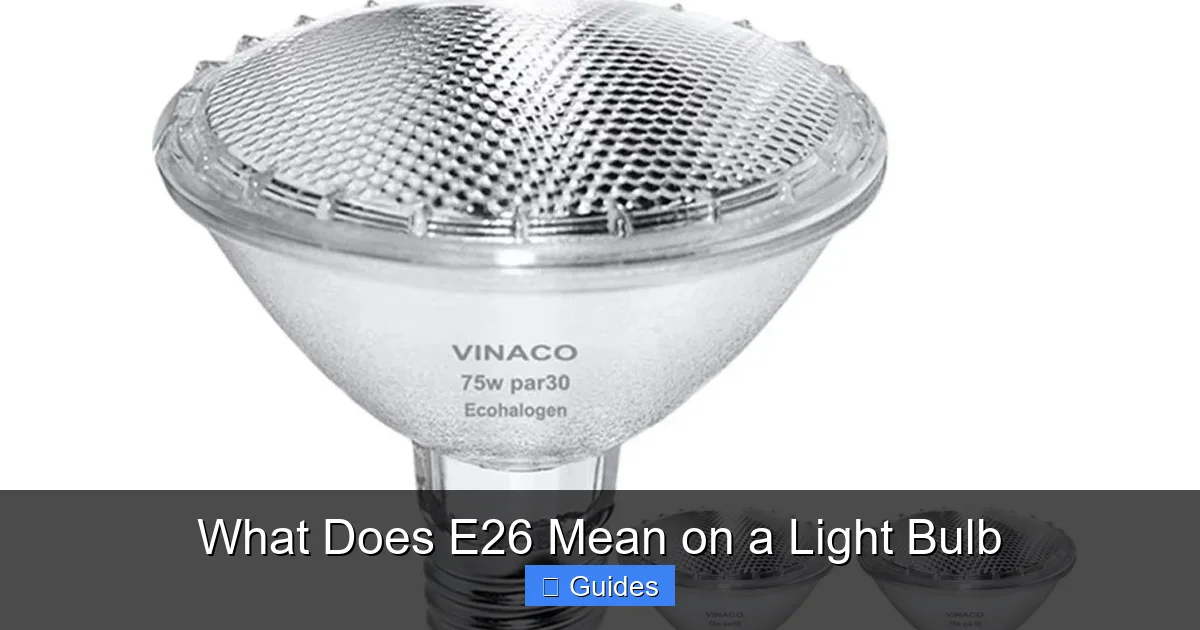
- PAR (Parabolic Aluminized Reflector) bulbs: These offer a more focused, intense beam of light, often used for outdoor security or accent lighting. Common sizes include PAR20, PAR30, and PAR38 (4.75 inches).
Both BR and PAR bulbs are perfect examples of how the E26 base adapts to specialized lighting needs.
Decorative and Specialty E26 Bulbs
Beyond the functional, the E26 base also serves a world of decorative and specialty bulbs.
- G Series (Globe) bulbs: Shaped like a sphere, these are often used in vanity lights or open fixtures where the bulb itself is visible. Sizes like G25 and G30 are common with an E26 base.
- ST Series (Vintage Edison) bulbs: These “squirrel cage” filament style bulbs, often found in sizes like ST64, are popular for their antique aesthetic and warm glow, perfect for exposed fixtures. They almost always feature an E26 base.
- Candelabra E26 Base (not to be confused with E12 candelabra): While “candelabra” often refers to the smaller E12 base, some larger decorative candelabra-style bulbs can have an E26 base, especially in fixtures designed for more light output or larger aesthetics.
This variety truly highlights the widespread application of the E26 light bulb base.
LED Technology: The Modern E26 Standard
Today, the vast majority of new bulbs purchased are LEDs (Light Emitting Diodes) due to their incredible energy efficiency and long lifespan. Thankfully, nearly all household LED bulbs designed to replace traditional incandescents come with an E26 base. This means you can easily upgrade your existing fixtures to energy-saving LED technology without needing to change your lamps or sockets. When you’re shopping for an LED bulb, you’ll almost certainly be looking for an E26 LED light bulb.
Navigating Beyond E26: Other Important Bulb Specifications
While understanding what does E26 mean on a light bulb is paramount for fit, it’s just one piece of the puzzle. Once you’ve got the base size sorted, there are other crucial specifications to consider to ensure you get the right kind of light for your space. These factors influence brightness, color, energy consumption, and overall functionality.
Brightness: Lumens, Not Just Watts
For years, we associated brightness with wattage. A 100-watt bulb was brighter than a 60-watt bulb. However, with the rise of energy-efficient CFLs and LEDs, wattage no longer directly correlates with brightness. Instead, you need to look at lumens (lm).
- Wattage (W): This measures the amount of electricity a bulb consumes. An E26 LED light bulb might use only 10 watts to produce the same light as a 60-watt incandescent. Always check your fixture’s maximum wattage rating to avoid overloading it, even with energy-efficient bulbs.
- Lumens (lm): This is the true measure of a bulb’s light output or brightness. If you want a bulb as bright as an old 60-watt incandescent, look for around 800 lumens. For a brighter 100-watt equivalent, aim for 1600 lumens.
Color Temperature: Setting the Mood
The “color” of light can dramatically change the feel of a room. This is measured in Kelvin (K).
- Warm White (2700K-3000K): This mimics traditional incandescent light, offering a cozy, inviting glow often preferred in living rooms, bedrooms, and dining areas.
- Cool White (3500K-4100K): A more neutral, crisp light, good for kitchens, bathrooms, or offices where you need better visibility.
- Daylight (5000K-6500K): Bright, bluish-white light that simulates natural daylight, ideal for task lighting, garages, or areas where you need to see true colors.
Choosing the right color temperature for your E26 light bulb can make a huge difference in ambiance.
Dimmability and Smart Features
Not all bulbs are dimmable, and trying to dim a non-dimmable bulb can lead to flickering, buzzing, or even damage to the bulb or dimmer switch.
- Dimmable: If you have a dimmer switch, make sure your E26 light bulb is explicitly labeled as “dimmable.” Dimmable LEDs offer a great range of light control.
- Smart Features: Many modern E26 LED light bulbs now come with smart capabilities, allowing you to control them via Wi-Fi or Bluetooth, change colors, set schedules, and even integrate with voice assistants.
Voltage: A Quick Check
In North America, household electricity typically runs at 120 volts (V). Almost all E26 light bulbs sold in this region are designed for 120V. If you’re traveling or buying bulbs internationally, always double-check the voltage to ensure compatibility, but for home use in the US and Canada, it’s usually safe to assume 120V.
Tips for Choosing the Right E26 Bulb Every Time
Now that you’re an expert on what does E26 mean on a light bulb and the other important specs, let’s put it all together with some practical tips to make your next bulb purchase stress-free and successful.
Always Check Your Fixture’s Requirements
Before you even leave for the store (or click “add to cart”), take a quick look at your light fixture. Many fixtures have a sticker or label that specifies the maximum wattage or lumens recommended. This is a critical safety measure. Even if you’re buying an energy-efficient E26 LED light bulb that consumes fewer watts, make sure its physical size (e.g., A19, BR30) fits within the fixture’s housing or shade.
Read the Bulb Packaging Carefully
Don’t just grab the first box that looks right. Take a moment to read the packaging. It will clearly state the base type (e.g., E26), lumens (brightness), Kelvin (color temperature), estimated lifespan, wattage, and whether it’s dimmable. This information is there to help you make an informed decision and find the perfect E26 light bulb for your needs.
Think About the Room’s Vibe
Consider the function and mood of the room where the bulb will go.
- Living Room/Bedroom: Often benefits from warm white (2700K-3000K) and dimmable options for a cozy atmosphere.
- Kitchen/Bathroom/Home Office: Cool white (3500K-4100K) or daylight (5000K) might be better for task lighting and alertness.
- Outdoor/Utility: Bright daylight (5000K+) with higher lumens is usually preferred for security and visibility.
Matching the light’s characteristics to the space’s purpose is key to satisfaction.
When in Doubt, Ask!
If you’re still unsure, don’t hesitate to ask a store associate or consult the manufacturer’s website. Most lighting experts are happy to help you decipher the codes and find the ideal E26 light bulb for your specific application. It’s always better to ask than to buy the wrong bulb.
Common E26 Bulb Types at a Glance
Here’s a quick reference table to help you identify some popular E26 light bulb shapes and their common uses. This overview can be handy when you’re trying to quickly match a bulb to a specific fixture or aesthetic.
| Bulb Shape | Common Use | Key Characteristic | E26 Compatibility |
|---|---|---|---|
| A19 | General lighting (lamps, ceiling fixtures) | Classic pear shape; versatile | Standard for E26 |
| BR30 / BR40 | Recessed lighting, track lighting | Bulged reflector; wide flood beam | Commonly E26 |
| PAR38 | Outdoor floodlights, security lights | Parabolic reflector; focused beam | Commonly E26 |
| G25 / G30 | Vanity lights, decorative fixtures | Globe shape; exposed bulb aesthetics | Commonly E26 |
| ST64 | Vintage/Edison style, open fixtures | Teardrop shape, visible filament | Standard for E26 |
| CFL (Spiral) | Energy-saving general lighting | Compact fluorescent spiral tube | Commonly E26 |
Conclusion
So, there you have it! The mystery of what does E26 mean on a light bulb is no longer a mystery to you. You now understand that “E” stands for Edison screw, and “26” denotes the 26-millimeter diameter of the base – the standard screw-in size for most household light bulbs in North America. This simple piece of knowledge is your ticket to confidence and ease in the sometimes-confusing world of lighting.
Remember, choosing the right light bulb isn’t just about brightness or color; it starts with ensuring a safe and perfect fit. By focusing on the E26 light bulb specification first, and then considering lumens, Kelvin, and dimmability, you’re equipped to make smart, informed decisions every time. No more guesswork, no more frustrating trips back to the store. You’re ready to brighten up your home like a lighting pro!
Go forth and illuminate your world with confidence, knowing exactly what E26 means on a light bulb and how it empowers your choices. Happy lighting!
Frequently Asked Questions
What exactly does E26 mean on a light bulb?
E26 refers to the size and type of the screw base on a light bulb. The “E” stands for Edison screw, named after Thomas Edison, and the “26” indicates the diameter of the base in millimeters. It’s the most common medium screw-in base type.
Is E26 the standard light bulb size in the US and Canada?
Yes, E26 is indeed the standard medium screw-in base for most household light bulbs in North America, including the United States and Canada. This means if you buy a typical bulb for a lamp or ceiling fixture, it will almost certainly be an E26 base.
Can I use an E26 bulb in a lamp that specifies a different base?
No, it’s generally not recommended and often won’t fit correctly. Using a bulb with the wrong base size can lead to improper contact, damage to the fixture, or even a fire hazard. Always match the bulb base to the fixture’s socket type for safety and proper function.
What’s the difference between an E26 and an E27 light bulb?
The main difference is a minor variation in diameter, with E26 being 26mm and E27 being 27mm. While they are very similar in appearance and often physically interchangeable, E26 is the standard in North America (120V regions) and E27 is standard in Europe and other 220-240V regions. It’s best to use the bulb specified for your region and fixture.
Does the E26 designation tell me anything about the bulb’s brightness or wattage?
No, the E26 designation only refers to the physical size and type of the bulb’s screw base. It provides no information about the bulb’s brightness (lumens), power consumption (watts), color temperature, or technology (LED, incandescent, CFL). You’ll find that information elsewhere on the bulb’s packaging.
How can I determine if my existing fixture requires an E26 light bulb?
For most household fixtures in North America, it’s highly likely to be an E26 base. You can visually inspect the socket; if it’s a medium screw-in type, it’s almost certainly E26. Alternatively, check the current bulb you’re replacing, as the base type is often printed on it or its packaging.
