


As an Amazon Associate, We earn from qualifying purchases.
When asked “what year did Thomas Edison invent the light bulb,” the answer is specifically 1879, when he patented a commercially practical, long-lasting incandescent light. While many inventors contributed to electric light before him, Edison’s crucial innovation was developing a durable carbon-filament bulb and, more importantly, a complete, scalable electrical distribution system that brought light into homes and businesses, truly revolutionizing the world.
Welcome, fellow history buffs and curious minds! There’s a question that often sparks debate and sometimes a little confusion: “what year did Thomas Edison invent the light bulb?” It’s one of those classic trivia questions that seems straightforward but actually hides a fascinating story of innovation, perseverance, and a touch of historical nuance. If you’re picturing a lone genius suddenly striking gold with a brilliant idea out of thin air, you might be surprised by the full picture.
The truth is, while Thomas Edison is undeniably famous for the light bulb, the journey to practical electric light was a long and winding road with many brilliant minds contributing along the way. Edison’s genius wasn’t necessarily in being the very first to create a light-emitting device, but rather in taking existing concepts and transforming them into something truly revolutionary: a long-lasting, economically viable, and widely distributable electric light system that genuinely changed the world. So, let’s peel back the layers and discover the definitive answer, along with the incredible context that makes Edison’s contribution so significant.
Key Takeaways
- The Crucial Year is 1879: Thomas Edison received his patent for a practical incandescent light bulb in 1879, marking the year his significant improvements made electric lighting viable.
- Edison “Improved” More Than “Invented”: Edison did not invent the concept of electric light itself, which had been explored by many before him. His genius lay in refining existing ideas into a durable, commercially practical, and economically feasible product.
- Carbonized Cotton Thread was Key: Edison’s breakthrough filament material was a high-resistance, carbonized cotton thread, which provided a much longer lifespan (over 13 hours initially) compared to previous designs.
- A System, Not Just a Bulb: Edison’s true innovation extended beyond the bulb itself. He developed an entire electrical generation and distribution system—including generators, wiring, fuses, and meters—making widespread use of electric light possible.
- Competition and Collaboration: Edison was not alone in his pursuit. Other inventors like Joseph Swan were working on similar solutions, leading to eventual collaborations and patent agreements.
- Transformative Impact: Edison’s work fundamentally changed society, ushering in an era of extended working hours, enhanced safety, and the growth of modern urban environments, setting the stage for future electrical advancements.
Quick Answers to Common Questions
What is the definitive year Thomas Edison patented his practical light bulb?
Thomas Edison received his patent for a practical incandescent light bulb in 1880, based on his breakthrough work in 1879. So, 1879 is the year of his key invention.
Did Edison invent electric light from scratch?
No, Edison did not invent the concept of electric light itself. Many inventors before him experimented with different forms of electric illumination.
What was Edison’s key innovation with the light bulb?
Edison’s key innovation was creating a long-lasting (initially over 13 hours), high-resistance, carbonized filament (initially cotton thread) and a high vacuum in a glass bulb, making the light bulb commercially practical and durable.
What else did Edison invent alongside the light bulb?
Edison developed an entire electrical generation and distribution system, including efficient generators, wiring, fuses, meters, sockets, and switches, to make electric light widely accessible.
What material did Edison first use for his practical light bulb filament in 1879?
In 1879, Edison successfully used a high-resistance, carbonized cotton sewing thread as the filament for his practical incandescent light bulb.
📑 Table of Contents
The Core Question: What Year Did Thomas Edison “Invent” the Light Bulb?
Let’s cut right to the chase for the precise answer to “what year did Thomas Edison invent the light bulb.” Thomas Edison filed his patent application for an “improvement in electric lights” on November 4, 1879, and it was granted as U.S. Patent 223,898 on January 27, 1880. This means that 1879 is the pivotal year for Edison’s version of the incandescent light bulb, as this is when his major breakthrough was achieved and documented.
The Breakthrough of 1879
In October 1879, after countless experiments (reputedly over 1,200 failures!), Edison and his team at Menlo Park, New Jersey, achieved a significant milestone. They created an incandescent light bulb that used a high-resistance, carbonized cotton thread filament inside a vacuum-sealed glass bulb. This particular bulb glowed for over 13 hours, a dramatic improvement over previous attempts by others, which often lasted only minutes or a few hours. This seemingly modest duration was a monumental step toward commercial viability. It meant electric light could now be a practical alternative to gas lamps and candles, not just a fleeting novelty. The light bulb created in what year did Thomas Edison invent the light bulb truly marked a turning point.
Why “Improvement” is a Better Word than “Invention”
It’s crucial to understand why many historians prefer to say Edison “improved” or “developed” the light bulb rather than “invented” it from scratch. The concept of creating light by running electricity through a filament in a vacuum wasn’t new. For decades before Edison, numerous scientists and inventors had dabbled with electric illumination. What made Edison’s work revolutionary was his relentless pursuit of practicality. He wasn’t just interested in *making* a bulb light up; he wanted to make one that:
- Lasted a long time (durability).
- Was relatively inexpensive to produce (affordability).
- Used a moderate amount of electricity (efficiency).
- Could be safely and easily installed in homes and businesses (usability).
This comprehensive approach is why the question “what year did Thomas Edison invent the light bulb” points to 1879, as that was the year he solved these critical practical challenges.
A Century of Bright Ideas: Early Pioneers Before Edison
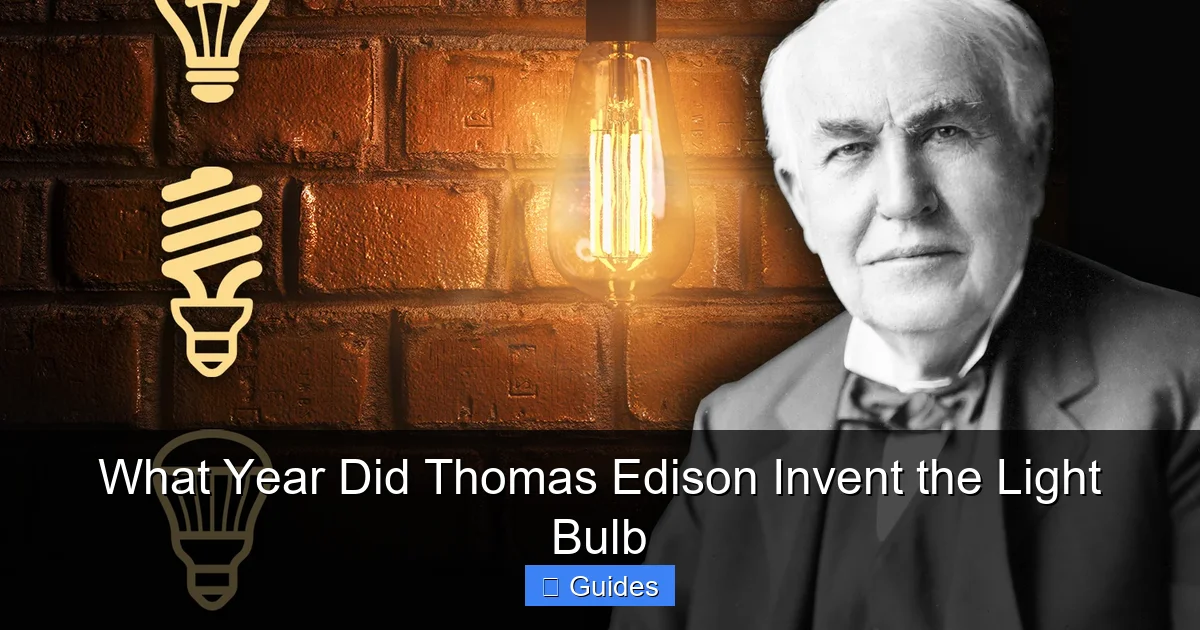
Visual guide about What Year Did Thomas Edison Invent the Light Bulb
Image source: opiniondynamics.com
To fully appreciate Edison’s contribution, it’s essential to acknowledge the shoulders he stood on. Electric light was a concept explored by many before him.
Humphry Davy and the Arc Lamp (Early 1800s)
As early as 1802, British chemist Humphry Davy demonstrated the first electric arc lamp. He connected wires to a battery and a piece of charcoal, producing a brilliant, albeit flickering and impractical, light. While too bright, hot, and short-lived for domestic use, Davy’s arc lamp was the very first glimpse of converting electricity into continuous light. It showed the potential, setting the stage for others to follow.
Joseph Swan’s Early Filaments (Mid-1800s)
Fast forward to the 1860s and 1870s, and we find another British chemist, Joseph Swan, making significant strides. Swan experimented with carbonized paper filaments in a vacuum bulb. He produced an early incandescent light bulb that demonstrated reasonable success. By 1860, he even showed a working light bulb, but the vacuum technology of the time wasn’t perfect, and his bulbs had short lifespans. He continued to refine his work, eventually developing long-lasting bulbs around the same time as Edison, leading to a later patent dispute and eventual collaboration.
Other Notable Contributors
Many other inventors contributed pieces to the puzzle:
- Warren de la Rue (1820): Used a coiled platinum filament in a vacuum tube, an expensive but effective design.
- James Bowman Lindsay (1835): Demonstrated a constant electric light in Dundee, Scotland.
- Frederick de Moleyns (1841): Patented an incandescent lamp using charcoal powder between two platinum wires.
- Heinrich Goebel (1850s): Claimed to have invented a long-lasting incandescent bulb using carbonized bamboo filaments. While debated, his work highlights concurrent exploration.
These early efforts were crucial. They established the fundamental principles and demonstrated the possibility of electric light, providing a foundation for Edison’s focused practical development in the year did Thomas Edison invent the light bulb.
Edison’s Genius: More Than Just a Bulb
The true genius of Thomas Edison lies not just in improving a filament but in his holistic approach to bringing electric light to the masses. When people ask “what year did Thomas Edison invent the light bulb,” they’re often implicitly asking about the entire system.
The Quest for a Practical Filament
Edison understood that the filament was the heart of the incandescent bulb. It needed to be high-resistance (to glow brightly without drawing too much current), durable (to last a long time), and relatively inexpensive. He tested thousands of materials: platinum, various metals, and countless organic substances. His famous breakthrough came with the carbonized cotton sewing thread filament in 1879. Later, his team found that a carbonized bamboo fiber filament offered an even longer lifespan (up to 1200 hours), becoming the standard for years. This persistent experimentation was key to the specific light bulb developed in what year did Thomas Edison invent the light bulb.
Creating the Entire Electrical System
This is where Edison truly shone as an innovator and visionary. He didn’t just invent a better bulb; he invented the *infrastructure* necessary to power it. Imagine having a fantastic new light bulb but no way to get electricity to your home reliably or safely. It would be useless! Edison saw this big picture and set out to create:
- Efficient Generators: He designed more powerful and stable dynamos (generators) to produce electricity on a large scale.
- A Distribution Network: This included a complete system of wiring, conduits, and insulation to safely transport electricity from the power station to individual users.
- Measurement Devices: He developed the electric meter to track consumption, allowing for billing – a crucial business component.
- Safety Devices: Fuses and circuit breakers were necessary to prevent fires and protect equipment.
- Sockets and Switches: User-friendly devices were needed to turn the lights on and off and connect them to the power supply.
Edison’s Menlo Park laboratory wasn’t just inventing a bulb in 1879; it was building the entire ecosystem for modern electric power. This comprehensive approach is a hallmark of his genius and differentiates his contribution from others. He wasn’t just selling light bulbs; he was selling *light*.
The Business Acumen and Marketing
Beyond the technical marvels, Edison was also a shrewd businessman and a master of public demonstration. He understood that to succeed, his invention had to be reliable, safe, and perceived as superior to gas lighting. His famous public demonstrations, like lighting up Menlo Park in December 1879, captivated the public and proved that electric light was not only possible but also practical and beautiful. These demonstrations, coming on the heels of the light bulb created in what year did Thomas Edison invent the light bulb, were critical for adoption. He later established the Edison Electric Light Company, laying the foundation for many modern utility companies.
The Impact of Edison’s Innovation: Lighting Up the World
The practical electric light bulb, perfected by Edison in 1879, unleashed a cascade of societal changes that are still felt today.
Residential and Commercial Transformation
Before Edison, homes and businesses relied on candles, oil lamps, and gaslight – all of which presented fire hazards, emitted soot and unpleasant odors, and provided relatively dim illumination. Electric light offered:
- Safety: Significantly reduced fire risk.
- Cleanliness: No smoke, soot, or fumes.
- Convenience: Instant on/off with a flick of a switch.
- Brighter Light: Improved visibility for work and leisure.
This transformed homes into safer, cleaner, and more inviting spaces. It allowed factories and offices to extend working hours into the night safely, boosting productivity and economic growth. The widespread adoption that followed “what year did Thomas Edison invent the light bulb” marked the true beginning of the modern era.
A Shift in Daily Life and Work
Electric light had profound effects on daily routines. Nightlife, once limited, began to flourish. Streets became safer due to better illumination. People could read, study, and socialize for longer hours, impacting education and culture. The rise of multi-shift factory work became more feasible, leading to industrial expansion. It changed how cities were designed, how businesses operated, and how individuals interacted with their environment after dark.
The Birth of Modern Utilities
Edison’s development of the complete electrical system laid the groundwork for modern utility companies. The establishment of the Pearl Street Station in New York City in 1882, the world’s first central power plant supplying electricity to customers, was a direct consequence of his vision. This model of centralized power generation and distribution became the blueprint for the electrical grids that power our world today.
Beyond Edison: The Evolution Continues
While we mark 1879 as the year Thomas Edison introduced his practical light bulb, the story of electric lighting didn’t end there. It continued to evolve and improve.
Tungsten Filaments and Extended Lifespans
Edison’s carbon filament was revolutionary for its time, but even it had limitations. In the early 20th century, inventors discovered that tungsten, a metal with an incredibly high melting point, made for a much more efficient and longer-lasting filament. Companies like General Electric (co-founded by Edison) played a significant role in popularizing tungsten filament bulbs, which could last thousands of hours and produce brighter light.
Fluorescent, Halogen, and LED Innovations
The 20th and 21st centuries saw even more dramatic advancements:
- Fluorescent Lamps (1930s): More energy-efficient and cooler than incandescents, though they often contained mercury.
- Halogen Lamps (1950s): A type of incandescent bulb that uses a halogen gas to improve efficiency and life.
- LED (Light Emitting Diode) Lighting (Late 20th Century – Present): The most significant revolution since Edison, LEDs are incredibly energy-efficient, long-lasting, and versatile, transforming everything from home lighting to gigantic public displays.
Each of these innovations built upon the foundation laid by pioneers like Humphry Davy, Joseph Swan, and crucially, Thomas Edison, whose practical light bulb of 1879 set the stage for all that followed.
So, when you consider “what year did Thomas Edison invent the light bulb,” remember that 1879 wasn’t just about a single item. It was about the culmination of persistent effort to create a practical product, supported by a groundbreaking system that delivered reliable, affordable, and safe electric light to the world. It was a moment that quite literally illuminated the future.
In conclusion, while electric light had a long lineage of inventors, Thomas Edison’s patent for a practical, long-lasting incandescent light bulb in 1879, combined with his development of an entire electrical distribution system, marked the true beginning of the age of widespread electric illumination. His contributions were not just an invention but a complete transformation, making the question “what year did Thomas Edison invent the light bulb” a gateway to understanding a pivotal moment in human history.
Frequently Asked Questions
Who invented the light bulb before Thomas Edison?
Numerous inventors contributed to the development of electric light before Edison. Notable figures include Humphry Davy, who demonstrated the arc lamp in 1802, and Joseph Swan, who developed early incandescent light bulbs with carbonized paper filaments in the 1860s and 1870s.
Why is Thomas Edison so famous for the light bulb if others worked on it?
Edison is famous because he was the first to develop a *commercially practical and long-lasting* incandescent light bulb, which used a durable filament (initially carbonized cotton thread) and an effective vacuum. More importantly, he also created the entire system—generators, wiring, meters—needed to deliver electricity and light to homes and businesses on a wide scale.
What was unique about Edison’s light bulb in 1879?
Edison’s 1879 light bulb was unique because it achieved a significantly longer lifespan (over 13 hours, later extended with bamboo filaments) and consumed less power than previous designs. This durability and efficiency made it a viable replacement for gas and oil lamps, truly revolutionizing illumination.
How long did Edison’s first practical light bulb last?
Edison’s initial successful carbonized cotton thread filament bulb, demonstrated in October 1879, lasted for over 13 hours. Subsequent improvements, especially with carbonized bamboo filaments, extended the lifespan to over 1200 hours, making it highly practical for general use.
Did Edison and Joseph Swan have a rivalry over the light bulb?
Yes, there was a patent rivalry between Edison and Joseph Swan, particularly in the UK, where Swan had patented his own incandescent lamp. They eventually resolved their disputes by forming a joint company, the Ediswan United Electric Light Company, in 1883, to market their bulbs together.
What impact did Edison’s light bulb have on society?
Edison’s practical light bulb and electrical system profoundly impacted society by reducing fire hazards, extending working and leisure hours, making cities safer, and spurring the growth of modern utilities. It ushered in an era of unprecedented productivity and fundamentally changed daily life, paving the way for the electric age.
