


As an Amazon Associate, We earn from qualifying purchases.
When it comes to “what is the standard light bulb size,” there isn’t one single answer, but rather a most common combination for household use. The widely accepted “standard” typically refers to the A19 bulb shape with an E26 screw base in North America, often called a “medium” or “Edison” base. Understanding base types, bulb shapes, and their corresponding numerical designations is key to finding the perfect fit for your light fixtures.
What Is the Standard Light Bulb Size?
Have you ever stood in the light bulb aisle, completely overwhelmed by the sheer variety of shapes, sizes, and cryptic codes? You’re certainly not alone! It’s a common scenario: you just need a light bulb, but suddenly you’re faced with A19, E26, BR30, GU10, candelabra, medium base, and a dizzying array of numbers. It makes you wonder, “What is the standard light bulb size, anyway?”
The simple truth is, there isn’t just one single, universally agreed-upon “standard” light bulb size. Instead, what most people refer to as standard is actually the most common combination of bulb shape and base type found in typical household fixtures in a specific region. In North America, this usually means a particular style of bulb and a specific type of screw-in base. But to truly understand what fits where, and to navigate the world of lighting confidently, it helps to break down the components that make up a bulb’s “size.”
This guide will illuminate the mysteries behind light bulb sizing, from the crucial base that connects to your fixture, to the shape that dictates how light is dispersed, and the numbers that define their physical dimensions. By the end, you’ll not only know what the most common “standard light bulb size” is but also how to confidently choose the right bulb for any lamp or fixture in your home.
Key Takeaways
- No Single “Standard”: While many people ask “what is the standard light bulb size,” there isn’t just one universal answer. The “standard” typically refers to the most common type for general household use in a specific region.
- A19 with E26 Base is Most Common: In North America, the A19 bulb shape paired with an E26 screw-in base (often called a “medium” or “Edison” base) is the most prevalent and what many consider the “standard light bulb size” for general lighting.
- Base Type is Crucial for Fit: The base is the part that screws or plugs into the fixture. Common types include E26 (medium screw), E12 (candelabra screw), GU10 (twist-and-lock bi-pin), and E14 (small screw, common in Europe).
- Bulb Shape Determines Appearance & Light Spread: Shapes like A (classic general purpose), G (globe), BR (bulged reflector), PAR (parabolic aluminized reflector), and MR (multifaceted reflector) impact how the light looks and where it shines.
- Numbers Indicate Diameter: The number following the shape letter (e.g., A19, BR30) represents the bulb’s maximum diameter in eighths of an inch. An A19 bulb is 19 eighths of an inch, or 2 3/8 inches, at its widest point.
- Always Check the Fixture: The safest way to ensure you buy the correct bulb is to check the existing bulb or the fixture’s label for wattage, base type, and sometimes shape recommendations.
- Consider More Than Size: Beyond physical dimensions, factor in lumens (brightness), color temperature (warmth/coolness), wattage equivalence, and dimmability for optimal lighting performance.
Quick Answers to Common Questions
What is generally considered the “standard” light bulb size in the US?
In the United States and Canada, the A19 bulb shape with an E26 medium screw-in base is widely considered the “standard” light bulb size for general household use.
What do “E26” and “A19” mean?
“E26” refers to the base type, specifically an Edison screw base with a 26mm diameter. “A19” refers to the bulb’s shape (classic pear shape) and its maximum diameter (19 eighths of an inch).
Can I put an E27 bulb into an E26 socket?
While an E27 bulb might physically screw into an E26 socket (and vice versa) due to their similar dimensions, it’s generally not recommended. E27 is common in 220-240V regions, whereas E26 is for 120V regions, so there can be voltage incompatibility, and the fit might not be perfectly secure.
How do I know what size bulb my lamp needs?
The best way is to check the existing bulb or look for a label on the light fixture itself. The label usually specifies the maximum wattage and the required base type (e.g., E26, E12).
Are BR30 bulbs a “standard” size?
BR30 bulbs (Bulged Reflector, 30 eighths of an inch diameter) are a standard size for specific applications, particularly 5-inch and 6-inch recessed can lights. They are not considered the general “standard light bulb size” in the same way an A19 is for overall household lighting.
📑 Table of Contents
The “Standard” That Isn’t So Standard: Understanding Bulb Bases
When you ask, “What is the standard light bulb size?”, the first and most critical component to consider is the base. This is the part of the bulb that connects physically and electrically to your light fixture. If the base doesn’t match, the bulb simply won’t fit or work.
Edison Screw Bases (E-Bases)
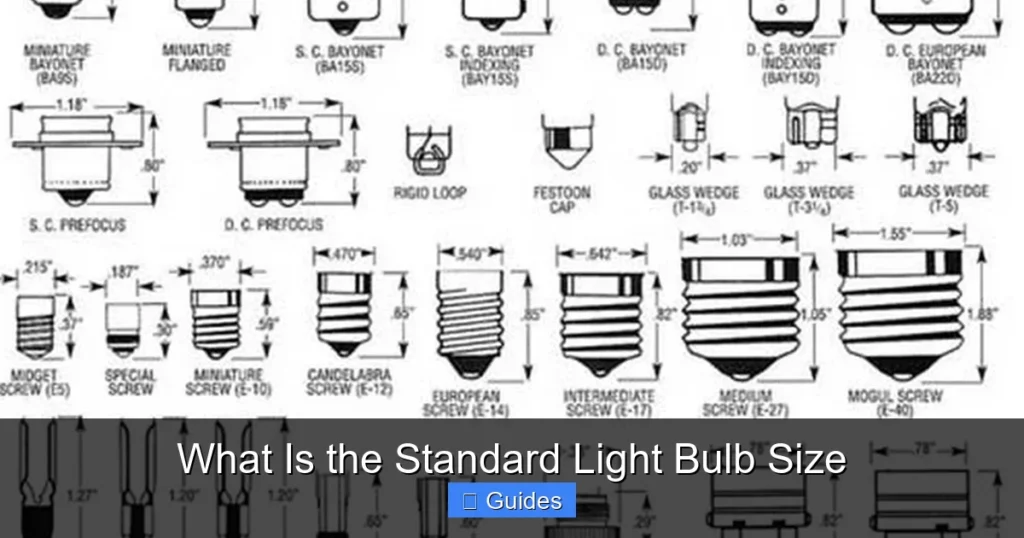
These are the most common type for general lighting, especially in North America. They get their “E” designation from Thomas Edison, who developed the screw-in design. The number following the “E” indicates the diameter of the base in millimeters (mm).
* E26 (Medium Base / Standard Base): This is arguably what most people mean when they refer to the “standard light bulb size” in the United States and Canada. The E26 base has a 26mm diameter. You’ll find it on most common household bulbs for ceiling fixtures, table lamps, and floor lamps. If you’re replacing a general-purpose bulb in North America, chances are it’s an E26.
* E12 (Candelabra Base): Smaller than the E26, the E12 base has a 12mm diameter. These are commonly found in decorative fixtures like chandeliers, sconces, nightlights, and some small accent lamps. They often pair with decorative bulb shapes like B (blunt tip) or C (flame tip).
* E17 (Intermediate Base): Less common than E26 or E12, the E17 base is 17mm in diameter. You might find these in some older fixtures, desk lamps, or specialty appliances.
* E27 (European Standard): While very similar in appearance to the E26, the E27 base is the standard in many European and other 220-240V regions. It has a 27mm diameter. Although they look almost identical, using an E26 bulb in an E27 socket (or vice-versa) can sometimes lead to an imperfect fit or potential issues, especially with different voltage systems. Always check your fixture’s voltage and base type.
Bi-Pin and Twist-and-Lock Bases
These bases use two pins to connect to the fixture rather than a screw-in mechanism.
* GU10: This base features two short, thick pins that twist and lock into place. GU10 bulbs are very common in track lighting, recessed lighting, and some display lighting. The “GU” indicates the base type, and “10” refers to the distance between the center of the two pins in millimeters.
* GU24: This is a special twist-and-lock base designed to prevent the use of traditional screw-in incandescent bulbs, often found in energy-efficient fixtures. It’s used for CFLs and LEDs.
* G4, G6.35, G9: These are smaller bi-pin bases, often used in task lighting, under-cabinet lighting, or decorative fixtures. The number indicates the pin spacing in millimeters. G9 bulbs are particularly popular in modern decorative fixtures, often featuring a loop-shaped pin base.
Bayonet Bases (B-Bases)
More common in the UK and other Commonwealth countries, bayonet bases feature two pins that push in and twist to lock.
* BA15d (SBC – Small Bayonet Cap): Often found on smaller bulbs.
* B22d (BC – Bayonet Cap): The standard full-size bayonet base, common in general household lighting in regions where bayonet is prevalent.
Understanding the base type is your first step in determining “what is the standard light bulb size” for *your specific fixture*. Always check the existing bulb or the fixture itself.
Decoding Bulb Shapes and Sizes: Beyond the Base
Visual guide about What Is the Standard Light Bulb Size
Image source: i.ytimg.com
Once you’ve identified the correct base, the next part of the “standard light bulb size” puzzle is the bulb’s shape and its physical dimensions. The letter in a bulb’s designation tells you its general shape, while the number indicates its diameter.
The Classic A-Shape (General Purpose)
* A-Shape: This is the classic, familiar pear-shaped bulb we all picture. It’s designed for general illumination and omnidirectional light distribution.
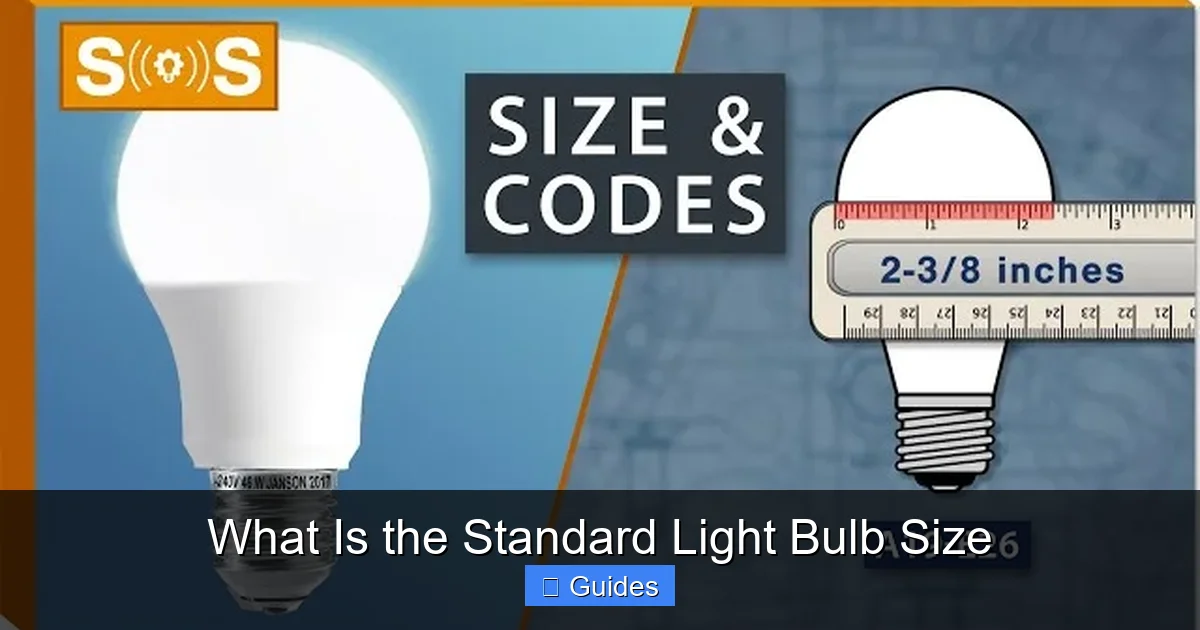
* A19: This is the champion of the “what is the standard light bulb size” debate. The A19 is the most common general-purpose bulb in North America. The “A” signifies its traditional shape, and the “19” indicates its maximum diameter is 19 eighths of an inch (which is 2 and 3/8 inches, or approximately 60mm). So, an A19 bulb with an E26 base is the quintessential “standard light bulb size” for most homes.
* A21, A23: These are slightly larger A-shaped bulbs, often used when more light output is needed or in larger fixtures where a bigger bulb looks better. An A21 is 21 eighths of an inch in diameter, and an A23 is 23 eighths of an inch.
Decorative B and C Shapes
These bulbs are designed to be seen and often add to the aesthetic of a fixture, especially in chandeliers or exposed bulb applications.
* B-Shape (Blunt Tip): Also known as a “bullet” or “torpedo” shape, these bulbs have a rounded, blunt tip. Common sizes include B10 or B11, indicating a diameter of 10 or 11 eighths of an inch. They often come with E12 candelabra bases.
* C-Shape (Flame Tip): Similar to B-shapes but tapering to a pointed, flame-like tip. These are very popular in chandeliers and decorative sconces, typically with E12 bases. C7 or C9 are common sizes.
* F-Shape (Flame): Similar to C-shape but often with a slightly more pronounced flame-like curvature, for a more dramatic decorative effect.
Globe Shapes (G-Shapes)
* G-Shape: These are perfectly spherical or globe-shaped bulbs. They’re often used in vanity strips, pendant lights, or fixtures where the bulb is exposed and a clean, uniform look is desired.
* G16.5, G25, G30, G40: The number again refers to the diameter in eighths of an inch. G16.5 is a common size for bathroom vanity lights, while larger sizes like G25 or G30 are popular for exposed pendant lighting.
Reflector and Spotlight Shapes (R, BR, PAR, MR)
These bulbs are designed to direct light in a specific direction, making them ideal for recessed lighting, track lighting, or outdoor security lighting.
* R-Shape (Reflector): These bulbs have an internal reflective coating to direct light forward.
* R20: Common in recessed can lights, 20 eighths of an inch in diameter.
* BR-Shape (Bulged Reflector): Similar to R-shapes but with a wider, bulged profile, allowing for a broader light spread.
* BR30: Very common in 5-inch and 6-inch recessed can lights. Its diameter is 30 eighths of an inch (3.75 inches). This is another common contender for a “standard light bulb size” in specific applications like downlighting.
* BR40: Larger than BR30, typically used in larger recessed fixtures or for broader area lighting.
* PAR-Shape (Parabolic Aluminized Reflector): These are highly efficient reflector bulbs, designed for precise light control. They have a more structured, often faceted, appearance and are excellent for spotlights or floodlights, both indoors and outdoors.
* PAR16, PAR20, PAR30, PAR38: The numbers indicate the diameter in eighths of an inch. PAR38 bulbs are often used outdoors for security or landscape lighting, while PAR20 and PAR30 are common in indoor recessed or track lighting.
* MR-Shape (Multifaceted Reflector): These are typically smaller, low-voltage bulbs with a faceted reflector, designed for highly directional spotlighting.
* MR11, MR16: Common in track lighting, display lighting, and landscaping. They usually have a bi-pin base (like GU10 for MR16s) and operate on low voltage (12V), requiring a transformer, although 120V versions are available.
What Do the Numbers Mean? Decoding Diameter
We’ve touched on it, but let’s clarify: the number following the letter in a bulb’s shape designation always refers to its maximum diameter, measured in *eighths of an inch*.
So:
* An **A19** bulb is 19/8 inches wide, which equals 2.375 inches or about 60 mm.
* A **BR30** bulb is 30/8 inches wide, which equals 3.75 inches or about 95 mm.
* A **G25** bulb is 25/8 inches wide, which equals 3.125 inches or about 79 mm.
This standardized measurement system helps ensure you can consistently find the correct width of bulb for your fixture, preventing bulbs from being too wide to fit into a housing or too small to look proportional.
Beyond Size: Important Considerations When Buying a Bulb
Knowing what is the standard light bulb size (or the specific size you need) is crucial for physical fit, but there’s more to choosing the right bulb for optimal lighting.
Lumens (Brightness)
Forget watts for brightness! Watts measure energy consumption; lumens measure light output. A 60-watt equivalent LED bulb might only use 8-10 watts but produce around 800 lumens, which is the brightness of an old 60-watt incandescent. Always check the lumen output to ensure you’re getting the desired brightness.
Color Temperature (Kelvin)
This describes the warmth or coolness of the light, measured in Kelvin (K).
* 2700K – 3000K: Warm White/Soft White. This is similar to traditional incandescent bulbs, creating a cozy, inviting atmosphere.
* 3500K – 4000K: Neutral White/Bright White. A more balanced, energizing light, good for kitchens, offices, or bathrooms.
* 5000K – 6500K: Daylight. A very cool, bluish-white light, ideal for task lighting, reading, or mimicking natural daylight.
Wattage Equivalence and Energy Efficiency
With the prevalence of LED bulbs, you’ll often see “XX-watt equivalent.” This tells you what an LED bulb’s brightness would be compared to an older incandescent, while its actual wattage (e.g., 9W) indicates its low energy consumption. Always opt for LEDs for significant energy savings and longer lifespan.
Dimmability
Not all LED bulbs are dimmable. If you plan to use a dimmer switch, make sure the bulb explicitly states it is dimmable. Also, ensure your dimmer switch is compatible with LED technology; older dimmers designed for incandescents may cause flickering or buzzing with LEDs.
Smart Features
Modern bulbs can connect to your home Wi-Fi or Bluetooth, allowing you to control them with your smartphone or voice assistant. You can change brightness, color temperature, and even color for an enhanced lighting experience.
Practical Tips for Choosing the Right Bulb
Now that you’re armed with knowledge about what is the standard light bulb size and all its variations, here are some practical tips for your next bulb-buying trip:
Check the Fixture Label
Most light fixtures have a label (often inside the socket, on the canopy, or under a shade) that specifies the maximum wattage and sometimes the required bulb base type (e.g., “Max 60W, E26”). Always adhere to the maximum wattage to prevent overheating and fire hazards.
Bring the Old Bulb
When in doubt, take the old bulb with you to the store. This is the absolute best way to ensure you match both the base type and the physical size and shape. The packaging often has a diagram illustrating the exact bulb.
Understand Your Needs
Think about the purpose of the light. Do you need bright task lighting for a kitchen, warm ambient light for a living room, or directional light for artwork? This will help you choose the right shape, lumens, and color temperature, even once you’ve figured out what is the standard light bulb size for the fixture.
Don’t Be Afraid to Ask
If you’re still unsure, specialized lighting stores or even the lighting section of larger hardware stores often have knowledgeable staff who can help you identify the correct bulb.
Conclusion
Navigating the world of light bulbs might seem complex at first, but with a little understanding, it becomes much clearer. While “what is the standard light bulb size” might seem like a simple question, the answer is nuanced, depending on your region and the specific application. In North America, the A19 shape with an E26 medium screw base is the go-to for general household lighting – your everyday “standard.”
However, remember that there’s a whole family of sizes and shapes for every lighting need, from the tiny E12 candelabra to the powerful PAR38 floodlight. By paying attention to the base type, understanding the shape codes, and noting the diameter measurements, you’ll always be able to pick the perfect bulb. No more guesswork, no more wasted trips to the store – just bright, perfectly lit spaces throughout your home!
🎥 Related Video: Standard Light Bulb – Size & Codes | Spec. Sense
📺 AMRE Supply
What does the A19 code describe? What is an E26 base? In this episode of Spec. Sense, Vance shows how to measure and how …
Frequently Asked Questions
What is the difference between E26 and E12 bases?
The main difference is their diameter and common application. E26 is a 26mm “medium” or “standard” screw base found on most general-purpose household bulbs. E12 is a smaller 12mm “candelabra” screw base, typically used for decorative bulbs in chandeliers, sconces, or nightlights.
What does the number in a bulb’s name (like A19 or BR30) signify?
The number following the letter (e.g., 19 in A19, 30 in BR30) indicates the maximum diameter of the bulb in eighths of an inch. So, an A19 bulb is 19/8 inches (2.375 inches) wide at its broadest point.
Can I use an LED bulb in any fixture that used an incandescent bulb?
Generally, yes, as long as the LED bulb’s base type (e.g., E26) matches the fixture’s socket and the bulb’s physical dimensions allow it to fit without touching the fixture housing. Always ensure the fixture’s wattage limit is not exceeded, though LEDs usually consume much less power.
What is a candelabra base bulb used for?
Candelabra base bulbs (E12) are primarily used in decorative light fixtures where smaller, often more elegant or flame-tipped bulbs are desired. This includes chandeliers, wall sconces, ceiling fans, and nightlights.
Why do some bulbs have “GU” in their name, like GU10?
“GU” refers to a specific type of bi-pin base that connects to the fixture using a twist-and-lock mechanism. GU10 bulbs are common in track lighting and recessed lighting, with the “10” indicating the 10mm distance between the center of the two pins.
Should I consider lumens or watts when buying a new LED bulb?
Always prioritize lumens when buying an LED bulb, as lumens directly measure the brightness (light output). Watts for LEDs indicate energy consumption, which is typically very low, and “watt equivalent” helps you compare its brightness to older incandescent bulbs.
