


As an Amazon Associate, We earn from qualifying purchases.
The question of when was the electric light bulb invented often sparks debate, but it wasn’t a single moment or inventor. While Thomas Edison perfected the first commercially practical, long-lasting incandescent light bulb in 1879, many scientists and inventors contributed to its development over decades. Edison’s genius lay in combining existing knowledge with key innovations like a high-resistance filament and a better vacuum, making electric light accessible to the masses.
When Was the Electric Light Bulb Invented? Unraveling the True Story
Have you ever wondered who truly invented the light bulb? If you’re like most people, Thomas Edison’s name probably pops into your head right away. It’s a common answer, often taught in schools and ingrained in popular culture. But the fascinating truth about “when was the electric light bulb invented” is far more complex and captivating than a single name or date. It’s a story of decades of relentless experimentation, brilliant minds working in parallel, and a series of incremental breakthroughs that ultimately illuminated our world.
Imagine a world without instant light – a world where darkness meant fumbling for candles, fanning oil lamps, or tending gas lights that flickered and often smelled. Before the electric light bulb, illumination was a laborious, often dangerous, and always limited affair. So, the desire for a better, safer, and more convenient form of light was immense, sparking a global race among inventors to harness electricity for illumination. Understanding this context helps us appreciate not just *when* the electric light bulb was invented, but *why* its invention was so profoundly transformative.
This article will take you on a journey through time, exploring the unsung heroes who paved the way, the intense competition that drove innovation, and the specific contributions that led to the practical electric light bulb we recognize today. We’ll delve into the pivotal moments, the scientific challenges, and the ultimate triumphs that answered the question of *when was the electric light bulb invented* in a way that truly lights up the full picture.
Key Takeaways
- Not a Single Inventor or Date: The electric light bulb was the culmination of decades of research and development by numerous scientists and inventors, not a singular invention by one person.
- Edison’s Breakthrough in Practicality: Thomas Edison is credited with inventing the first *commercially practical and long-lasting* incandescent light bulb in October 1879, making it suitable for widespread home and commercial use.
- Earlier Pioneers Paved the Way: Before Edison, figures like Sir Humphry Davy, Joseph Swan, and Heinrich Göbel made significant contributions, demonstrating electric light through arc lamps and early, short-lived incandescent bulbs.
- Key Innovations Were Crucial: Edison’s success stemmed from his methodical experimentation, leading to the use of a high-resistance carbonized filament and a nearly perfect vacuum, which extended the bulb’s lifespan dramatically.
- Parallel Inventions and Collaboration: Joseph Swan developed his own practical incandescent bulb in the UK around the same time as Edison, leading to initial patent disputes and eventual collaboration.
- More Than Just the Bulb: Edison’s true genius also lay in developing an entire electrical distribution system, including generators, wiring, and safety devices, which made electric lighting viable for cities and homes.
- A Continuous Evolution: The incandescent bulb continued to evolve with improvements like tungsten filaments, and eventually gave way to more energy-efficient technologies like fluorescent and LED lights.
Quick Answers to Common Questions
Who is often credited with inventing the electric light bulb?
Thomas Edison is widely credited with inventing the first commercially practical and long-lasting incandescent light bulb.
In what year did Edison perfect his practical light bulb?
Thomas Edison perfected his practical incandescent light bulb with a carbonized cotton filament in October 1879.
Were there inventors before Edison who worked on electric light?
Yes, many inventors like Sir Humphry Davy (arc lamp) and Joseph Swan (early incandescent bulbs) made significant contributions decades before Edison.
What was a key innovation in Edison’s light bulb?
A key innovation was the use of a high-resistance carbonized filament and a nearly perfect vacuum, which dramatically extended the bulb’s lifespan.
Did Joseph Swan also invent a practical light bulb?
Yes, Joseph Swan developed his own practical incandescent light bulb in the UK around the same time as Edison, leading to an eventual merger of their companies.
📑 Table of Contents
The Dawn of Electric Light: Early Explorations
The concept of using electricity to create light wasn’t a sudden flash of brilliance in the late 19th century. In fact, scientists and inventors had been experimenting with electric light for decades before Edison or Swan even entered the scene. These early efforts laid crucial groundwork, even if they didn’t produce a commercially viable product.
Sir Humphry Davy and the Arc Lamp
Our story truly begins in the early 1800s. In 1802, British chemist Sir Humphry Davy demonstrated the world’s first electric light. He used a large battery to send an electric current through two charcoal electrodes. This created a brilliant, intense spark of light – an “electric arc.” Later, in 1809, he developed a more powerful version, connecting wires to a battery and a piece of charcoal, creating a spectacular arc of light. This invention became known as the arc lamp.
While revolutionary for its time, Davy’s arc lamp was far from practical for everyday use. It was incredibly bright, often too bright for indoor settings, and it consumed a vast amount of power. The charcoal electrodes also burned away quickly, requiring constant adjustment. This meant arc lamps were best suited for large public spaces, lighthouses, or street lighting, but certainly not for lighting a home. Yet, it proved the fundamental principle: electricity could indeed create light.
Early Incandescent Attempts
The arc lamp was one path, but another, more promising avenue was incandescence – making a material so hot it glows. Many tried this with varying degrees of success throughout the 19th century.
* De la Rue’s Platinum Filament (1820): British scientist Warren de la Rue enclosed a coiled platinum filament in an evacuated glass tube and passed an electric current through it. Platinum has a high melting point, allowing it to glow brightly, but its extreme cost made it utterly impractical for widespread use.
* Starr’s Vacuum Bulb (1840): American inventor Frederick de Moleyns patented an incandescent lamp design in 1841. He used platinum wires and a powdered charcoal filament within a vacuum bulb. However, these bulbs were notoriously short-lived.
* Goebel’s Carbonized Filaments (1850s): German watchmaker Heinrich Göbel, who later immigrated to the U.S., is said to have developed some of the earliest long-lasting incandescent light bulbs in the 1850s. He reportedly used carbonized bamboo filaments and a high vacuum. While his claims were later used in legal battles, his work highlighted the potential of carbonized materials and a good vacuum seal. These early efforts, though not widely recognized at the time, were crucial stepping stones on the path to *when was the electric light bulb invented*.
The Race for a Practical Bulb: Edison and Swan
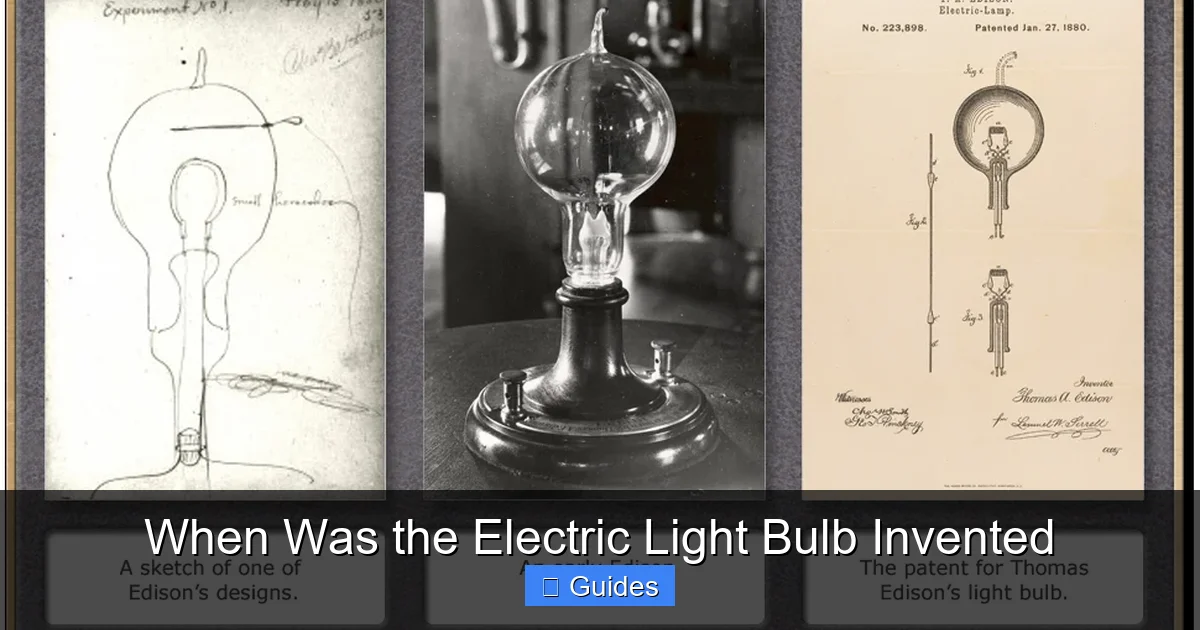
Visual guide about When Was the Electric Light Bulb Invented
Image source: vividesigns.co.uk
By the 1870s, the dream of a practical, long-lasting electric light bulb was within reach. The scientific community understood the basic principles, but significant challenges remained. Two major players emerged in this global race: Thomas Edison in the United States and Joseph Swan in the United Kingdom.
Joseph Swan’s Early Innovations
Joseph Swan, a British physicist and chemist, had been experimenting with electric light for decades. His work ran remarkably parallel to Edison’s. In 1860, he demonstrated a light bulb using carbonized paper filaments in a vacuum bulb. However, the vacuum pumps of the time weren’t good enough, and the filament consumed too much power, burning out quickly. It wasn’t until better vacuum technology became available that Swan made significant progress.
By 1878, Swan developed a longer-lasting light bulb using a thin carbon fiber filament, made by treating cotton. He publicly demonstrated his incandescent lamp in Newcastle, England, in December 1878 and patented it in Britain in 1880. Swan’s bulbs were effective and soon found use in homes and public buildings across England. His contributions are a vital part of understanding *when was the electric light bulb invented*, showing that the idea was being pursued simultaneously by multiple brilliant minds.
Thomas Edison’s Methodical Approach
Thomas Edison, a prolific American inventor, entered the electric lighting field in 1878. He famously declared that he would invent a “cheap, everlasting light” that would make gas lighting obsolete. Edison didn’t just tinker; he approached the problem with an industrial mindset, setting up a dedicated research laboratory in Menlo Park, New Jersey, with a team of skilled assistants.
Edison’s genius wasn’t always about inventing something entirely new from scratch. Instead, it was often about systematic improvement, optimization, and making existing ideas practical and commercially viable. He understood that a truly successful light bulb needed several key characteristics:
* Long-lasting: It couldn’t burn out after a few hours.
* Affordable: It had to be cheap enough for ordinary people to buy.
* Low-current: It needed to draw little power, allowing many bulbs to be used on a single circuit.
* High-resistance: This was crucial for an efficient parallel circuit, allowing individual bulbs to be turned on and off without affecting others.
Edison tested thousands of materials for filaments, from platinum and iridium to various plant fibers. He was looking for a material that would glow brightly without melting, and that could last for many hours. This relentless pursuit of the perfect filament led to his most famous breakthrough.
Edison’s Breakthrough Moment: October 1879
The moment that truly solidified Thomas Edison’s place in history for *when was the electric light bulb invented* came in the autumn of 1879. After countless experiments, his team focused on carbonized filaments.
The Carbonized Cotton Thread Filament
On October 22, 1879, Edison’s team achieved a monumental success. They used a thin strand of carbonized cotton sewing thread as the filament. This specific filament, placed inside a nearly perfect vacuum within a glass bulb, glowed continuously for over 13.5 hours. This was a massive improvement over previous attempts, which often lasted only minutes or a few hours at best.
The choice of a high-resistance filament was a stroke of genius. It allowed for the development of a practical parallel electrical distribution system. In a low-resistance system (like an arc lamp), turning one light off would affect all the others on the circuit. With high resistance, each bulb could operate independently, just like our household lights today. This was critical for making electric lighting truly useful and adaptable to homes and businesses.
From Cotton to Bamboo: Improving Longevity
Edison didn’t stop there. He continued to refine his design. After further experimentation, he discovered that a carbonized bamboo fiber filament could last for an astonishing 1,200 hours. This breakthrough, made in 1880, transformed the incandescent bulb from a scientific curiosity into a practical, marketable product.
But Edison didn’t just invent the bulb; he developed an entire system. He understood that a light bulb, no matter how good, was useless without a way to generate and deliver electricity reliably and safely to homes and businesses. This meant inventing everything from generators and meters to fuses, switches, and wiring systems. This holistic approach was what truly revolutionized the world and made electric light accessible on a large scale. The establishment of Edison Electric Light Company in 1878 and the first commercial power station in New York City in 1882 cemented his legacy, making “when was the electric light bulb invented” synonymous with his efforts to create an *entire ecosystem* for electric light.
A Tale of Parallel Innovations and Collaboration
While Edison was making headlines in America, Joseph Swan’s work in the UK was equally impressive. This parallel development often leads to debates about who “first” invented the light bulb. The reality is that both men made significant contributions, solving similar problems using slightly different approaches, and ultimately their paths converged.
Initial Patent Disputes
With both Edison and Swan developing highly similar and practical incandescent light bulbs around the same time, it was perhaps inevitable that patent disputes would arise. Edison’s U.S. patent for a carbon filament bulb (1879) and Swan’s British patent (1880) initially led to legal battles, particularly regarding the use of carbonized filaments.
The courts eventually recognized the validity of both inventors’ contributions. Swan had demonstrated a practical incandescent lamp earlier in the UK, while Edison had perfected a more durable, high-resistance, and complete system. Instead of continuing costly legal battles, a more pragmatic solution emerged.
The Edison & Swan United Electric Light Company
In a classic example of “if you can’t beat ’em, join ’em,” Edison and Swan decided to merge their interests. In 1883, they formed the “Edison & Swan United Electric Light Company” (later known simply as “Ediswan”) in Britain. This merger allowed them to combine their patents and expertise, effectively dominating the electric light market in the UK and beyond. This collaboration highlights that innovation is rarely a solo act, and the question of *when was the electric light bulb invented* is often best answered by acknowledging multiple contributors.
This collaboration also demonstrated a key aspect of innovation: sometimes the best solution isn’t about exclusive ownership but about combining strengths to achieve a broader impact. Their joint company continued to develop and improve electric lighting technology, bringing safer, brighter, and more consistent light to millions.
Beyond the Incandescent: The Light Bulb’s Evolving Legacy
The invention of the practical electric light bulb had an immediate and profound impact on society. It literally transformed the way people lived and worked, ushering in an era of unprecedented progress and change.
Transforming Daily Life and Industry
With widespread electric lighting, cities became safer and more vibrant at night. The extended hours of daylight simulation allowed factories to operate around the clock, boosting productivity and economic growth. Homes became brighter, cleaner (no more soot from oil lamps), and safer (reduced fire risk). Social activities, education, and entertainment could extend well into the evening. The ability to control light at the flick of a switch was nothing short of revolutionary. This shift was a direct result of the answer to *when was the electric light bulb invented* becoming a commercially viable reality.
Improvements to the Incandescent Bulb
Even after Edison and Swan’s breakthroughs, the incandescent bulb continued to evolve.
* Tungsten Filaments (Early 20th Century): In the early 1900s, scientists discovered that tungsten was a superior filament material. It could withstand much higher temperatures than carbon, glowing brighter and lasting longer, while using less energy. Irving Langmuir further improved the tungsten bulb in 1913 by filling the bulb with an inert gas (like argon or nitrogen), which reduced filament evaporation and increased efficiency and lifespan. These innovations kept the incandescent bulb at the forefront for decades.
* Frosted Glass and Bulb Shapes: Aesthetic and functional improvements like frosted glass (to reduce glare) and various bulb shapes (for different fixtures and light dispersion) also played a role in its widespread adoption.
The Transition to Modern Lighting
While incandescent bulbs were a marvel for over a century, their primary drawback is energy inefficiency. A large portion of the electricity they consume is converted into heat, not light. This led to the development of more efficient alternatives:
* Fluorescent Lamps (Mid-20th Century): These bulbs use gas discharge to produce ultraviolet light, which then excites a phosphor coating to create visible light. They are significantly more energy-efficient and last much longer than incandescent bulbs.
* LED Lighting (Late 20th/Early 21st Century): Light-Emitting Diodes represent the latest revolution in lighting technology. LEDs are incredibly energy-efficient, have extraordinarily long lifespans, and offer a vast range of colors and dimming capabilities. They have rapidly become the dominant lighting technology worldwide, continuing the journey of innovation started by those early pioneers.
The story of “when was the electric light bulb invented” is not just about a single device, but about the relentless human drive to innovate, improve, and illuminate. From Davy’s arc lamp to modern LEDs, the quest for better light has consistently pushed the boundaries of science and engineering, transforming our world in countless ways.
Conclusion: A Legacy of Illumination
So, *when was the electric light bulb invented*? The definitive answer is nuanced: while many contributed, Thomas Edison successfully created the first *commercially practical and long-lasting incandescent light bulb* in October 1879, with significant improvements shortly after using a bamboo filament in 1880. His work built upon the foundational efforts of numerous predecessors, including Sir Humphry Davy and Joseph Swan, who himself developed a highly practical bulb in the UK around the same time.
The invention of the electric light bulb was not a singular event but a complex tapestry woven from decades of scientific inquiry, ingenious experimentation, and a fierce drive to solve a pervasive problem. It required not just the bulb itself, but an entire infrastructure to support it, a challenge that Edison masterfully addressed. This collective effort fundamentally reshaped human civilization, allowing us to conquer the night, extend our working hours, and enhance our safety and quality of life in ways unimaginable before its advent.
Today, as we flick a switch and our rooms are bathed in light, it’s easy to take this marvel for granted. But remembering the journey of *when was the electric light bulb invented* helps us appreciate the incredible ingenuity and perseverance of those who literally brought light to the darkness, forever changing the world. It’s a testament to the power of human innovation and a reminder that even the most common technologies have extraordinary stories behind them.
Frequently Asked Questions
Who invented the very first electric light?
The very first demonstration of electric light, specifically an “electric arc” lamp, was by British chemist Sir Humphry Davy in 1802. However, this was not a practical, long-lasting light bulb for general use.
What made Edison’s light bulb different from earlier attempts?
Edison’s light bulb was distinct because it was the first to combine a long-lasting, high-resistance filament (initially carbonized cotton, then bamboo) with a high vacuum. This combination made it commercially practical, affordable, and suitable for a parallel electrical distribution system.
Did Edison work alone on the light bulb?
No, Thomas Edison worked with a dedicated team of researchers and assistants at his Menlo Park laboratory. His methodical approach involved extensive teamwork and systematic experimentation.
What challenges did early electric light bulbs face?
Early electric light bulbs faced several challenges, including short filament lifespans, low efficiency, high power consumption, the lack of a good vacuum, and the absence of a viable electrical distribution system to power them.
Why is there confusion about who invented the light bulb?
Confusion arises because the electric light bulb was a product of incremental development by many inventors over decades, not a single “eureka!” moment. Edison perfected the *practical* version, but others laid crucial groundwork and developed similar devices concurrently.
How did the invention of the light bulb change the world?
The invention of the light bulb revolutionized the world by extending productive hours into the night, making cities safer, improving living conditions in homes, and boosting industrial productivity. It led to the development of widespread electrical grids, fundamentally transforming society and daily life.
