


As an Amazon Associate, We earn from qualifying purchases.
The invention of the light bulb isn’t a simple tale of one person or one date. While Thomas Edison often gets the credit for the first practical, long-lasting light bulb in 1879, countless inventors contributed to its development over decades. From Humphry Davy’s early arc lamp in 1802 to Joseph Swan’s carbon filament bulbs, the journey to modern illumination was a collaborative effort, building on incremental innovations that made electric light viable for homes and businesses worldwide.
When Was the First Light Bulb Invented? Unraveling a Brighter History
Have you ever stopped to think about what life was like before electric light? Imagine a world reliant on candles, oil lamps, and gaslight – dim, smoky, and often dangerous. The simple flick of a switch that banishes darkness from our homes and streets is something we take for granted, a cornerstone of modern comfort and productivity. But who do we thank for this incredible convenience? And perhaps more importantly, when was the first light bulb invented?
For many of us, the name Thomas Edison immediately springs to mind when thinking about the invention of the light bulb. It’s a story often told, a pivotal moment in history that changed everything. And while Edison’s contributions were undeniably monumental, the full story of the light bulb’s invention is far richer, more complex, and involves a much larger cast of brilliant minds working across different continents and decades. It’s a tale of incremental improvements, relentless experimentation, and a shared human drive to illuminate the darkness.
So, let’s turn on the lights, figuratively speaking, and shine a brighter spotlight on the true history of this groundbreaking invention. We’ll peel back the layers of common misconception and discover that the question “When was the first light bulb invented?” doesn’t have a single, simple answer, but rather a fascinating journey through scientific discovery and engineering ingenuity.
Key Takeaways
- No Single Inventor: The light bulb’s invention was a long, collaborative process involving numerous scientists and inventors over several decades, not just one person.
- Early Discoveries Paved the Way: Humphry Davy demonstrated the first electric arc lamp in 1802, showcasing the potential of electric light, long before incandescent bulbs.
- Incandescence Experiments: Many experimented with heating various materials (like platinum) to glow, but issues with cost, longevity, and vacuum technology limited their success.
- Joseph Swan’s Contributions: British inventor Joseph Swan developed functional carbon filament bulbs in the 1860s and 1870s, even demonstrating them publicly before Edison.
- Edison’s Practical Breakthrough: Thomas Edison’s significant contribution in 1879-1880 was creating a highly durable, affordable, and commercially viable incandescent light bulb with a long-lasting bamboo filament and a robust vacuum.
- Systemic Innovation: Edison didn’t just invent the bulb; he developed an entire electrical system, including generators, wiring, and safety devices, which was crucial for widespread adoption.
- Continuous Evolution: The light bulb continued to evolve long after Edison, with tungsten filaments, gas-filled bulbs, and eventually LEDs, constantly improving efficiency and longevity.
Quick Answers to Common Questions
Who is often credited with inventing the light bulb?
Thomas Edison is widely credited with inventing the practical, commercially viable incandescent light bulb.
When did Thomas Edison invent his version of the light bulb?
Thomas Edison successfully demonstrated his long-lasting incandescent light bulb in October 1879, and patented it in January 1880.
Who invented the first electric arc lamp?
Humphry Davy invented and demonstrated the first electric arc lamp in 1802.
Did anyone create a functional light bulb before Edison?
Yes, several inventors, most notably Joseph Swan, developed functional incandescent light bulbs with carbon filaments before Edison’s breakthrough.
What made Edison’s light bulb so revolutionary?
Edison’s light bulb was revolutionary because it combined a long-lasting filament (carbonized bamboo), a high vacuum, and a low cost of manufacture, making it practical and affordable for widespread use, alongside his development of an entire electrical system.
📑 Table of Contents
Dispelling the Myth: More Than Just Edison
It’s tempting to credit one hero with a grand invention, especially when that hero is as famous as Thomas Edison. His name is almost synonymous with innovation itself. However, the electric light bulb, as we know it, wasn’t a sudden flash of genius in a single inventor’s lab. Instead, it was the culmination of over 70 years of scientific exploration and countless experiments by numerous individuals. Think of it like building a magnificent skyscraper: Edison might have been the architect who finally perfected the blueprint and oversaw its construction, but many engineers and laborers had already laid the foundation and built several floors before he arrived.
To truly understand when the first light bulb was invented, we need to broaden our perspective beyond Edison’s famous incandescent bulb of 1879. The concept of generating light from electricity had been explored for a very long time. What Edison achieved was not the *first* electric light, but the *first commercially practical and long-lasting incandescent light bulb* that could be mass-produced and integrated into an entire electrical distribution system. This distinction is crucial. Many brilliant minds before him had already made significant strides, laying the groundwork for his eventual success. They tackled the initial scientific puzzles, developed foundational technologies, and pushed the boundaries of what was thought possible with electricity and light. Without their pioneering efforts, Edison’s ultimate triumph would likely have been impossible.
The Difference Between Invention and Commercialization
It’s important to differentiate between inventing a working prototype and inventing a product that is practical, affordable, and scalable for mass adoption. Many inventors created devices that could produce light from electricity, but they were often too expensive, too short-lived, too inefficient, or too difficult to manufacture for everyday use. Edison excelled at this second stage – turning a scientific curiosity into a revolutionary commercial product that literally lit up the world. His “invention factory” approach, characterized by systematic experimentation and a focus on practical applications, was key to this transformation.
The Dawn of Electric Light: Early Discoveries
Visual guide about When Was the First Light Bulb Invented
Image source: worldatlas.com
The story of electric light truly begins at the very start of the 19th century. Far from the cozy glow of an incandescent bulb, the initial forays into electric illumination were dramatic, bright, and somewhat unwieldy. These early experiments paved the way, demonstrating that electricity held the key to a future free from the flickering flame.
Humphry Davy and the Arc Lamp (1802)
Our journey starts with the remarkable British chemist Humphry Davy. In 1802, Davy conducted a groundbreaking experiment that gave the world its first glimpse of electric light. Using a powerful electric battery, he connected two charcoal electrodes to a source of electricity. When the electrodes were brought close together, an intense, brilliant arc of light sprang forth. He called this phenomenon the “electric arc light.”
This wasn’t a “light bulb” as we’d recognize it today, but rather a powerful, open-air light source. It was incredibly bright, almost blinding, and very hot. It also consumed a lot of power and the carbon electrodes burned away quickly, requiring constant adjustment. But despite its impracticality for home use, Davy’s arc lamp was a monumental discovery. It proved conclusively that electricity could be used to generate light, igniting the imaginations of scientists and inventors for decades to come. It showed the *principle* was sound, even if the *application* was still far off. This was the fundamental spark, so to speak, that set the entire process in motion, raising the question of when the first *practical* light bulb was invented.
The Principle of Incandescence Takes Shape
After Davy’s discovery, many inventors began exploring another principle of electric light: incandescence. This is the phenomenon where a material glows when heated to a very high temperature by an electric current. Think of a blacksmith heating metal until it glows red-hot; the same idea, but with electricity as the heat source.
Early attempts at incandescent lighting involved heating thin strips of various materials, hoping they would glow brightly and last a reasonable amount of time. People tried platinum, iridium, and other metals with high melting points. For example, in 1840, British scientist Warren de la Rue enclosed a coiled platinum filament in a vacuum tube and passed an electric current through it. His design worked, but the platinum was too expensive to be practical for widespread use. Similarly, in 1841, Frederick de Moleyns was granted the first patent for an incandescent lamp, using powdered charcoal heated between two platinum coils. These early efforts, while not commercially viable, were crucial steps in understanding the materials and conditions necessary for sustained electric light. They were getting closer to the idea of a “bulb” and pushing the boundaries of when the first light bulb was invented.
Joseph Swan: Edison’s Predecessor and Competitor
While Edison often gets the limelight, it’s essential to recognize the significant contributions of Joseph Swan, a brilliant British physicist and chemist. Swan worked tirelessly on incandescent lighting for decades, long before Edison entered the race. His work in the 1860s and 1870s brought the world incredibly close to the practical light bulb.
Swan’s Carbon Filaments and Vacuum Improvements
Swan’s breakthrough came from improving both the filament material and the vacuum inside the bulb. He understood that a filament needed to be strong, conduct electricity well, and glow brightly without burning out quickly. After experimenting with various materials, he found success with carbonized paper filaments. These were thin strips of paper that had been baked at high temperatures in a non-oxygen environment, turning them into carbon. This carbon was an excellent conductor and could withstand high temperatures.
Equally important was his work on creating a strong vacuum within the glass bulb. An ordinary filament would quickly burn out in the presence of oxygen, just like a fire needs air to burn. By pumping almost all the air out of the bulb, Swan created an environment where the filament could glow for a much longer time without combusting. His improved vacuum pump technology, combined with his carbonized filaments, led to increasingly successful demonstrations.
Public Demonstrations and Early Adoption
By 1878, Swan publicly demonstrated a long-lasting light bulb in Gateshead, England. He illuminated a large room at a public meeting, dazzling attendees. The following year, he began installing his light bulbs in various places in England, including his own home and the famous Cragside House, which became the first house in the world to be lit by hydroelectric power using Swan’s lamps. So, in many ways, a functional, albeit still expensive, light bulb was “invented” and demonstrated by Swan well before Edison’s major announcement. His work undeniably moved the timeline forward for when the first light bulb was invented for practical use.
Thomas Edison’s Breakthrough: The Path to Practicality (1879)
Now, let’s turn to Thomas Edison, the American inventor whose name became synonymous with the light bulb. While others had made functioning electric lights, Edison’s genius lay in his systematic approach and his unwavering focus on creating a *commercially viable* product. He wasn’t just trying to make a light glow; he was trying to build an entire industry around electric illumination.
The “Invention Factory” Approach
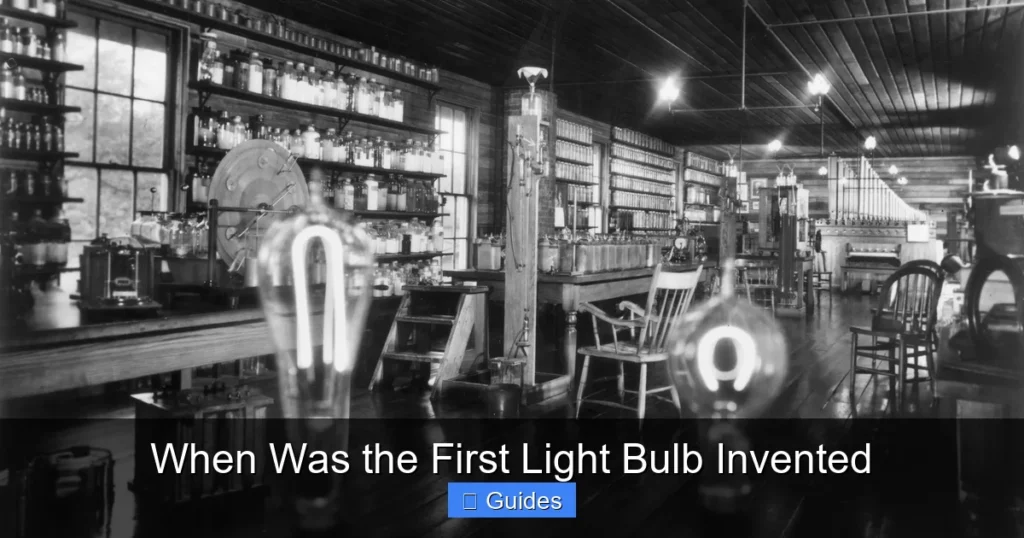
Edison’s laboratory in Menlo Park, New Jersey, was famously known as an “invention factory.” Here, he and his team conducted thousands of experiments with relentless dedication. They understood that a light bulb needed to be cheap to produce, durable enough to last for many hours, and compatible with a system that could deliver electricity safely and efficiently to homes and businesses. This meant not only perfecting the bulb itself but also developing generators, wiring, switches, sockets, and meters – an entire ecosystem of electrical infrastructure.
The Quest for the Perfect Filament
Edison and his team embarked on an exhaustive search for the ideal filament material. They tried virtually everything: platinum, other metals, and hundreds of different plant-based materials like cotton, flax, and even fishing line. Each material was tested for its resistance, brightness, and longevity under vacuum. The stories of them trying materials from all over the world are legendary.
In October 1879, after countless trials, Edison’s team achieved a breakthrough. They carbonized a cotton sewing thread and sealed it in a nearly perfect vacuum within a glass bulb. This humble thread glowed for over 13.5 hours, a remarkable improvement over previous attempts. This was a critical moment for when the first light bulb was invented in a truly practical sense.
The Bamboo Filament and Commercialization (1880)
Not content with 13.5 hours, Edison’s team continued to refine their design. Their most significant breakthrough came with the discovery of carbonized bamboo fibers. After testing thousands of different types of bamboo and plants, they found a type of Japanese bamboo that, when carbonized, could glow for an astonishing 1,200 hours! This vastly superior longevity made the bulb economically viable.
On December 31, 1879, Edison gave a public demonstration of his incandescent lighting system at Menlo Park, attracting thousands of spectators. By 1880, he had patented his long-lasting light bulb and began to establish the Edison Electric Light Company, working towards widespread electrification. This marked the moment when the first light bulb was invented that truly ushered in the age of electric lighting for the masses.
The Light Bulb’s Evolution Beyond Edison
Even after Edison’s success, the light bulb continued its rapid evolution. The initial incandescent bulb, while revolutionary, still had room for improvement in terms of efficiency and brightness. The journey didn’t end with a single invention; it was an ongoing process of refinement and innovation that continues to this day.
The “War of the Currents” and AC Power
Edison championed direct current (DC) for his electrical systems, but another brilliant mind, Nikola Tesla, alongside George Westinghouse, advocated for alternating current (AC). AC proved to be more efficient for transmitting electricity over long distances, leading to the “War of the Currents.” Ultimately, AC triumphed, shaping the electrical grids we use today and enabling even broader adoption of electric light.
Tungsten Filaments: A Major Leap Forward
Edison’s bamboo filament was good, but it wasn’t the final answer. In the early 20th century, inventors continued to seek even better materials. In 1904, Hungarian inventors Sándor Just and Franjo Hanaman patented a light bulb with a tungsten filament. Tungsten has an incredibly high melting point and can glow much brighter and more efficiently than carbon without breaking down.
In 1906, William Coolidge, working at General Electric (a company co-founded by Edison), developed a method to make ductile tungsten filaments, meaning they could be drawn into thin, flexible wires. This invention revolutionized the incandescent bulb, making it significantly brighter, more efficient, and longer-lasting. This was a major upgrade to the technology initiated when the first light bulb was invented.
Gas-Filled Bulbs and Beyond
Further improvements included filling the bulb with inert gases like argon and nitrogen (pioneered by Irving Langmuir in 1913) to slow down the evaporation of the tungsten filament, extending bulb life even further. From there, we’ve seen fluorescent lights, halogen lamps, and most recently, compact fluorescent lamps (CFLs) and light-emitting diodes (LEDs). Each new generation of lighting technology offers greater energy efficiency, longer lifespan, and often new possibilities for design and application. The modern LED, for instance, consumes a fraction of the power of Edison’s incandescent bulb and can last for tens of thousands of hours.
Conclusion: A Collaborative Legacy of Light
So, when was the first light bulb invented? As we’ve explored, there’s no single, simple answer. If you mean the very first demonstration of electric light, then Humphry Davy in 1802 takes the prize with his arc lamp. If you’re looking for the first functional incandescent bulb, Joseph Swan made significant progress in the 1860s and 1870s. But if you’re asking about the first *commercially practical, long-lasting, and widely adopted* incandescent light bulb that truly transformed society, then Thomas Edison’s work culminating in 1879-1880 is the definitive answer.
The story of the light bulb is a powerful testament to the collaborative and cumulative nature of scientific and technological progress. It teaches us that invention is rarely a solitary flash of genius but rather a long, arduous journey of small steps, shared knowledge, and relentless perseverance. Each inventor built upon the successes and failures of those who came before them, contributing a piece to the grand puzzle. From Davy’s intense arc to Edison’s steady glow, and on to today’s energy-efficient LEDs, the quest for better illumination has continuously pushed the boundaries of human ingenuity. The light bulb, in all its forms, stands as a shining example of how a persistent human desire can, quite literally, brighten the world.
Frequently Asked Questions
Was the light bulb invented by one person?
No, the light bulb was not invented by a single individual. It was the result of decades of research, experimentation, and contributions from many scientists and inventors, each building upon previous discoveries.
What was the main challenge in creating an early light bulb?
The main challenges included finding a filament material that could glow brightly for a long time without burning out, creating a sufficiently strong vacuum inside the bulb to prevent combustion, and developing an efficient and affordable electrical system to power it.
How long did Edison’s first practical light bulb last?
Edison’s first truly practical and commercially viable light bulb, using a carbonized bamboo filament, could last for an impressive 1,200 hours, which was a significant improvement over earlier designs.
What role did Joseph Swan play in the light bulb’s invention?
Joseph Swan was a crucial British inventor who developed functional carbon filament light bulbs and improved vacuum technology in the 1860s and 1870s, demonstrating them publicly and even installing them in homes before Edison’s famous breakthrough.
Why is Edison often given sole credit for the light bulb?
Edison is often given sole credit because he successfully developed a complete, practical, and economically viable lighting system, including a long-lasting bulb, generators, and wiring, which led to the widespread adoption of electric light and ushered in a new era.
What material did Edison eventually use for his famous filament?
After trying countless materials, Edison eventually found great success with a carbonized bamboo filament. This material proved to be durable and long-lasting enough to make his incandescent light bulb commercially viable.
