


As an Amazon Associate, We earn from qualifying purchases.
LED light bulbs produce light through a process called electroluminescence, utilizing semiconductor diodes. When an electric current passes through these materials, electrons inside the semiconductor recombine with “holes,” releasing energy in the form of photons, which we perceive as light. This highly efficient method directly converts electrical energy into light, making LEDs significantly more durable and energy-saving than traditional bulbs.
Have you ever paused for a moment, after screwing in a new light bulb, to wonder how that little globe of light actually works its magic? For decades, our homes were lit by glowing filaments, simple contraptions that heated up to emit light. But walk into any store today, and you’ll find a bewildering array of sleek, energy-efficient LED bulbs. They look different, feel different, and certainly perform differently. But the real question is: how does a LED light bulb work?
It’s a fantastic question, and one that gets right to the heart of modern lighting technology. It’s not just about saving energy or lasting longer; there’s some fascinating science happening inside that bulb. Think of it like this: an old incandescent bulb was like a tiny campfire in a glass sphere, inefficiently burning energy to create light and a lot of heat. An LED bulb, on the other hand, is more like a tiny, precisely engineered light factory, crafting light with minimal waste. If you’re curious about the mechanics behind this everyday marvel, you’re in the right place. We’re going to pull back the curtain and explore exactly how does a LED light bulb work, component by component, process by process.
Understanding the inner workings of an LED light bulb isn’t just for science enthusiasts; it empowers you to make smarter choices for your home, appreciate the technology we rely on daily, and even troubleshoot minor issues. So, grab a cup of coffee, and let’s embark on this illuminating journey together to discover the fascinating principles behind these ubiquitous light sources.
Key Takeaways
- LEDs are semiconductors: Light emits from electrons crossing a P-N junction.
- The driver is essential: It converts AC to DC, stabilizing power for the LED.
- Heatsinks protect lifespan: They dissipate heat efficiently, crucial for LED durability.
- LEDs offer high efficiency: They convert electricity into light, not wasteful heat.
- No fragile filament: LEDs use durable solid-state components, enhancing longevity.
Quick Answers to Common Questions
What does “LED” actually mean?
“LED” stands for Light-Emitting Diode. It’s a semiconductor device that produces light when an electric current passes through it.
How do LED light bulbs create light without a filament?
Unlike traditional bulbs, an LED light bulb uses tiny semiconductors called diodes. When electricity flows through these diodes, they release energy in the form of photons, which we perceive as light.
Why are LED light bulbs so energy-efficient?
An LED light bulb is efficient because it converts most of its electrical energy directly into light, rather than wasting a lot of it as heat. This makes them incredibly effective at illuminating your space with less power.
Do LED light bulbs get hot?
While an LED light bulb does produce some heat, it’s significantly less than incandescent bulbs. This heat is managed and dissipated by a built-in heat sink to protect the components and extend the bulb’s life.
What’s inside a typical LED light bulb?
A standard LED light bulb contains an array of LED chips, a driver (power supply) to regulate the current, and a heat sink to manage temperature, all housed within a diffusing lens for even light distribution.
📑 Table of Contents
The Core of It All: What is an LED?
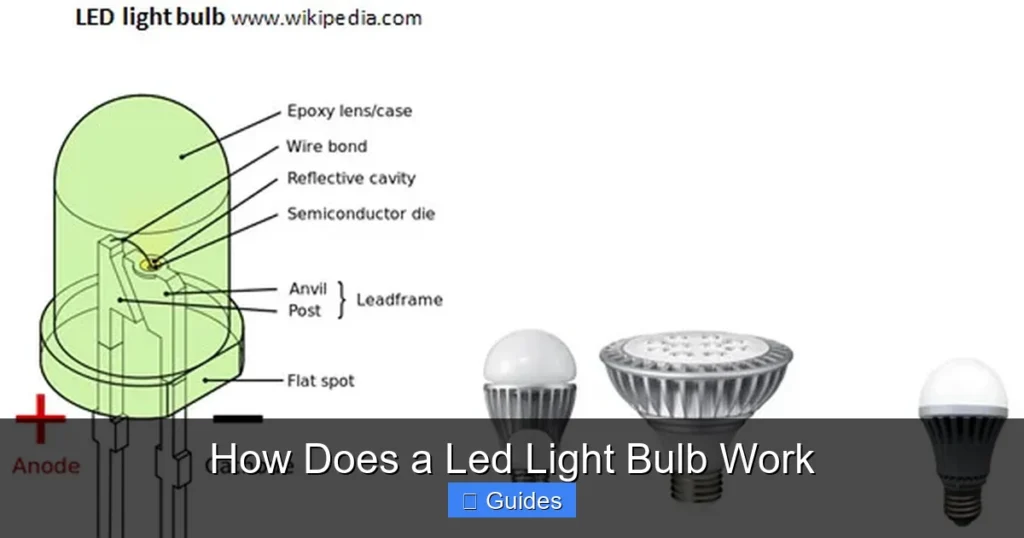
Before we dive into the entire bulb, let’s zoom in on the star of the show: the LED itself. LED stands for Light-Emitting Diode. Sounds a bit technical, right? But break it down, and it’s quite straightforward. A “diode” is a semiconductor device that allows current to flow in only one direction. The “light-emitting” part tells you exactly what it does when that current flows.
A Semiconductor Story
At its heart, an LED is made from semiconductor materials, typically combinations of elements like gallium, arsenic, and phosphorus (e.g., gallium arsenide phosphide, gallium nitride). These materials aren’t great conductors like copper, nor are they insulators like rubber; they’re somewhere in between. What makes them special is how their electrical properties can be precisely altered through a process called “doping.”
Imagine two types of semiconductor material: one “doped” with impurities that create an excess of negatively charged electrons (n-type material), and another “doped” with impurities that create “holes” – absences of electrons that act like positively charged particles (p-type material). When these two types of material are brought together, they form a “p-n junction.” This junction is where all the magic happens when you ask how does a LED light bulb work at a fundamental level.
Electroluminescence Explained
When you apply a voltage across the p-n junction in the correct direction (forward bias), the electrons from the n-type material are pushed towards the p-type material, and the holes from the p-type material are pushed towards the n-type material. They meet at the junction. When an electron encounters a hole, it “falls” into it. This isn’t a silent process; as the electron drops from a higher energy level to a lower one, it releases its excess energy in the form of a tiny packet of light called a photon. This phenomenon is known as electroluminescence.
The specific semiconductor materials used determine the energy difference between the electron levels, which in turn dictates the wavelength (color) of the emitted light. Red LEDs use one set of materials, blue LEDs another, and so on. This foundational principle is crucial to understanding how does a LED light bulb work to produce its light efficiently.
Beyond the Diode: Key Components of an LED Light Bulb
While the LED diode is the engine, a complete LED light bulb is a sophisticated assembly of several components working in harmony. It’s not just a single LED; it’s a carefully engineered system designed to deliver consistent, durable, and efficient light. Let’s look at what else is inside when we dissect how does a LED light bulb work.
Visual guide about How Does a Led Light Bulb Work
Image source: blog.constellation.com
The LED Array (SMDs)
Most modern LED light bulbs don’t use just one LED. Instead, they contain multiple small LEDs, often surface-mounted devices (SMDs), arranged on a circuit board. This array allows for greater light output and better light distribution. These tiny chips are typically blue LEDs coated with a phosphor material to create white light (more on that later). Having many small LEDs also helps with heat dissipation and allows the bulb to continue working even if one or two individual LEDs fail.
The Driver (The Brain of the Bulb)
This is arguably one of the most critical components for understanding how does a LED light bulb work. The driver is an electronic circuit responsible for regulating the electrical power supplied to the LED array. Here’s why it’s so important:
- AC to DC Conversion: Your home’s electricity is Alternating Current (AC), but LEDs require Direct Current (DC) to operate. The driver converts AC power to DC power.
- Voltage and Current Regulation: LEDs are sensitive to voltage fluctuations. The driver ensures that the LEDs receive a constant, appropriate voltage and current, protecting them from damage and ensuring consistent light output. Without a good driver, LEDs would flicker, dim prematurely, or burn out quickly.
The Heat Sink (Keeping Cool Under Pressure)
Despite their efficiency, LEDs do produce some heat. While it’s significantly less than incandescent bulbs, this heat, if not managed, can shorten the lifespan of the LED and negatively affect its performance. The heat sink, often made of aluminum or a ceramic material, is designed to absorb heat from the LED array and dissipate it into the surrounding air. This is a passive but vital cooling system that plays a huge role in the longevity and stability of the bulb’s operation.
The Diffuser (Spreading the Light)
The diffuser is the translucent cover you see on the outside of the bulb, often made of plastic or frosted glass. Its main purpose is to spread the light evenly and reduce glare from the individual LED points. LEDs emit light directionally, so the diffuser helps distribute that light more broadly, mimicking the omnidirectional light output of traditional bulbs, making it more comfortable for general illumination.
The Base (Making the Connection)
This is the familiar screw-in part of the bulb, like an E26 (standard medium base) or E12 (candelabra base). It connects the bulb to your lamp socket, providing the electrical pathway from your home’s wiring to the driver inside the bulb. It’s the physical interface that allows electricity to flow and activate the complex internal components, completing the circuit of how does a LED light bulb work.
The Magic in Motion: How an LED Light Bulb Produces Light
Now that we know the individual players, let’s put them all together and walk through the sequence of events from flipping the switch to the room being bathed in light. Understanding this process truly reveals how does a LED light bulb work from start to finish.
Powering Up: AC to DC Conversion
When you flip the light switch, Alternating Current (AC) from your home’s electrical wiring flows into the bulb’s base. This AC power then immediately reaches the LED driver. The driver’s first job is to rectify and convert this AC power into Direct Current (DC). Think of it like a translator, speaking the specific electrical language the LEDs understand.
This conversion isn’t always perfectly smooth; simpler, cheaper drivers might produce a slightly rippled DC current, which can sometimes lead to imperceptible flickering or compatibility issues with dimmer switches. High-quality drivers, however, produce a very stable DC current, ensuring consistent, flicker-free light.
The Photon Generation Process
Once the driver provides a steady stream of DC power at the correct voltage and current, this electricity flows into the LED array. Within each tiny LED chip, electrons begin to flow from the n-type semiconductor material across the p-n junction to the p-type material. As these electrons recombine with “holes” in the p-type material, they release energy in the form of photons. This is the moment light is actually created!
Initially, most high-efficiency white LEDs actually emit blue light. This might seem counterintuitive if you’re expecting white light, but it’s a clever trick of physics and material science.
Creating “White” Light (Phosphor Coating)
So, if the LED chips primarily emit blue light, how does a LED light bulb work to produce the white light we see? The answer lies in a special coating applied to the LED chips: phosphor. This yellow or orange-tinged phosphor coating absorbs some of the blue light emitted by the LED chips.
When the blue light energy strikes the phosphor, the phosphor fluoresces, emitting light across a broader spectrum, including yellow, green, and red wavelengths. The combination of the original blue light that passes through the phosphor and the yellow/red/green light emitted by the phosphor mixes together to create what our eyes perceive as “white” light. The exact composition of the phosphor coating determines the “color temperature” of the white light – whether it’s warm white (more yellow/red) or cool white (more blue). This ingenious method allows for a wide range of white light options, all starting from a blue LED.
Why LEDs Are So Different (and Better!)
Now that we’ve covered how does a LED light bulb work, it’s easier to appreciate why they have become the dominant lighting technology. Their unique operational principles translate into significant advantages over traditional incandescent or even fluorescent bulbs.
Energy Efficiency Explained
This is arguably the biggest selling point. Incandescent bulbs produce light by heating a filament until it glows. Most of the energy (around 90%) is wasted as heat, not light. LEDs, on the other hand, produce light through electroluminescence, a “cold” process that converts electricity directly into light with very little heat loss. This means a much higher percentage of the energy consumed is actually converted into usable light. For example, a 10-watt LED bulb can produce the same amount of light as a 60-watt incandescent, saving you 50 watts of electricity for every hour it’s on. This fundamental difference in how does a LED light bulb work leads to significant energy savings.
Longevity and Durability
Because LEDs don’t rely on a delicate filament, they are much more durable and shock-resistant. The lack of excessive heat also contributes to their lifespan. While an incandescent bulb might last 1,000 hours, and a compact fluorescent (CFL) around 8,000-10,000 hours, a well-designed LED bulb can easily last 25,000 to 50,000 hours or even more. This means years, even decades, without needing to replace a bulb, drastically reducing maintenance and replacement costs. The solid-state nature of how does a LED light bulb work makes it incredibly robust.
Instant On and Directional Light
Unlike some CFLs, LEDs turn on instantly to full brightness. There’s no warm-up period. Furthermore, LEDs emit light in a specific direction, rather than omnidirectionally like incandescent bulbs. While a diffuser is used for general illumination, this directional nature is a huge advantage for applications like spotlights, task lighting, or streetlights, where you want to focus light precisely where it’s needed, reducing light pollution and increasing efficiency.
Environmental Impact
The long lifespan of LEDs means fewer bulbs ending up in landfills. Their high energy efficiency reduces electricity consumption, which in turn lowers greenhouse gas emissions from power plants. Additionally, unlike CFLs, LED bulbs do not contain mercury or other hazardous materials, making them safer for disposal (though proper recycling is always recommended for electronics).
Common Types of LED Light Bulbs and Their Uses
With a better grasp of how does a LED light bulb work, let’s briefly look at the variety available and where you might use them. The versatility of LED technology means there’s a bulb for almost every need.
A-Type (Standard)
These are the most common shape, mimicking the traditional incandescent bulb. They’re perfect for general illumination in lamps, ceiling fixtures, and anywhere you need diffused, widespread light. You’ll find them in various wattages (or lumen outputs) and color temperatures to suit different moods and spaces.
BR/PAR Type (Spotlights/Floodlights)
BR (Bulged Reflector) and PAR (Parabolic Aluminized Reflector) bulbs are designed for directional lighting. They have a built-in reflector that focuses the light beam, making them ideal for recessed lighting, track lighting, or outdoor floodlights. They’re great for highlighting artwork, architectural features, or providing security lighting.
Decorative/Filament Style
These bulbs are designed to look like old-fashioned incandescent bulbs, often with visible “filaments” that are actually tiny LED arrays. They offer an aesthetic appeal, producing a warm, inviting glow, perfect for exposed bulb fixtures, chandeliers, or industrial-style lighting where the bulb itself is part of the decor.
Smart LEDs
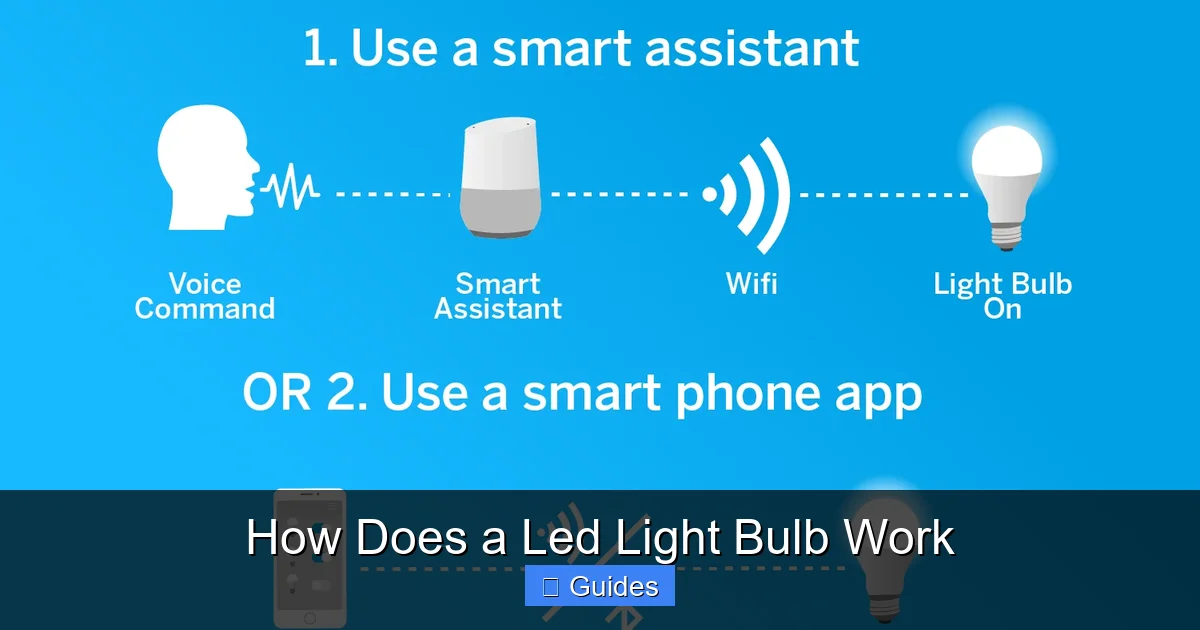
Smart LED bulbs incorporate connectivity (Wi-Fi or Bluetooth) directly into the bulb. This allows them to be controlled wirelessly via a smartphone app or voice assistant. You can change colors, dim them, set schedules, and even integrate them into a larger smart home system. These bulbs still operate on the same principles of how does a LED light bulb work, but with added layers of digital control.
Practical Tip: When choosing an LED bulb, don’t just look at “watts” (which traditionally indicated brightness). Instead, focus on lumens (the actual measure of brightness) and color temperature (measured in Kelvin, where lower numbers are warmer/more yellow, and higher numbers are cooler/more blue). Also, check the Color Rendering Index (CRI), which indicates how accurately the light reveals the true colors of objects. A higher CRI (80+ is good) means better color reproduction.
Dissecting the Tech: Key Components Overview
To summarize our deep dive into how does a LED light bulb work, let’s put it all into a handy overview of the main components and their functions. This table highlights the engineering behind the light you rely on every day.
| Component | Primary Function | Why It’s Important for How a LED Light Bulb Works |
|---|---|---|
| LED Array (SMDs) | Emits light through electroluminescence. | The core light-producing elements; multiple chips ensure brightness and redundancy. |
| LED Driver | Converts AC to DC; regulates voltage and current. | Essential for proper power supply, protecting LEDs, and ensuring stable light output. |
| Heat Sink | Dissipates heat away from the LED array. | Crucial for extending LED lifespan and maintaining performance by preventing overheating. |
| Phosphor Coating | Absorbs blue light and re-emits white light. | Transforms the intrinsic blue light of the LED into the desired white light color. |
| Diffuser | Spreads light evenly and reduces glare. | Ensures comfortable, widespread illumination and a traditional bulb appearance. |
| Base (e.g., E26) | Provides electrical and physical connection to the fixture. | The interface for power delivery and mechanical support for the bulb. |
Conclusion
So, there you have it – a comprehensive look into the intricate world of LED light bulbs. What might seem like a simple screw-in device is actually a marvel of modern engineering, combining semiconductor physics, advanced electronics, and clever material science. We’ve explored the tiny light-emitting diodes, understood the vital role of the driver in managing electricity, appreciated the necessity of heat sinks, and demystified the process of creating white light through phosphor coatings. Every component plays a critical part in answering the question: how does a LED light bulb work.
From the moment you flip a switch, a complex dance of electrons and photons begins, orchestrated by the bulb’s internal components, all culminating in the efficient, long-lasting light that brightens our lives. Understanding these principles not only deepens our appreciation for this technology but also highlights why LEDs have become the gold standard for lighting, offering unparalleled efficiency, durability, and versatility compared to their predecessors.
Next time you gaze upon the warm glow of an LED bulb, you’ll know there’s more than just electricity at play. You’ll see the culmination of decades of scientific innovation, all working together to create light in a way that’s smarter, greener, and ultimately, better for all of us. The journey into how does a LED light bulb work reveals a truly illuminating story of progress.
Frequently Asked Questions
What exactly is an LED, and how does it produce light?
An LED, or Light Emitting Diode, is a semiconductor device that produces light when an electric current passes through it. This process is called electroluminescence, where electrons combine with “holes” in the semiconductor material, releasing energy in the form of photons, which are packets of light.
How does a typical LED light bulb convert electricity into visible light?
Inside an LED light bulb, electricity flows through a semiconductor chip, causing electrons to recombine with electron holes and emit light. Unlike incandescent bulbs that create light through heating a filament, LEDs produce light directly from the electrical current, making them highly efficient.
Why are LED light bulbs so much more energy-efficient than older light sources?
LED light bulbs are incredibly efficient because they convert most of the electrical energy directly into light, with very little wasted as heat. This contrasts sharply with incandescent bulbs, which lose a significant portion of energy as heat, making LEDs a much greener and more cost-effective lighting option.
What are the main components inside an LED light bulb?
An LED light bulb typically contains several key components, including the LED chips (the actual light emitters), a heat sink to dissipate heat, a driver circuit to regulate the power, and a diffuser to spread the light evenly. These components work together to ensure efficient and stable operation.
Do LED light bulbs use a filament like traditional incandescent bulbs?
No, LED light bulbs do not use a filament. Unlike incandescent bulbs that produce light by heating a thin wire filament until it glows, LEDs generate light through the movement of electrons in a semiconductor material. This fundamental difference is why LEDs are much more durable and long-lasting.
How does the driver circuit in an LED light bulb contribute to its function?
The driver circuit is a crucial component in an LED light bulb; it converts the incoming AC power from your home into the precise DC voltage and current that the LED chips need to operate safely and efficiently. This circuit also helps protect the LEDs from power fluctuations, extending the bulb’s lifespan.
