


As an Amazon Associate, We earn from qualifying purchases.
While many associate Thomas Edison with the invention, the practical, long-lasting light bulb was primarily developed in 1879. However, the journey to create artificial electric light spanned decades, with numerous scientists and inventors contributing vital innovations long before Edison’s famous breakthrough. This article delves into the rich history of electric illumination.
Have you ever wondered, “what year was light bulb invented?” It’s a question that often brings Thomas Edison’s name to mind, and for good reason. His work undeniably revolutionized the world and cemented his place in history. However, the true story of the light bulb’s invention is far more complex and fascinating than a simple attribution to one person or one specific year. It’s a tale woven through decades of scientific inquiry, trial and error, and the brilliant minds of many forgotten pioneers.
For many of us, the image of Edison in his lab, a single brilliant bulb glowing over his head, is iconic. This popular narrative often suggests a sudden spark of genius leading to the birth of electric light. But just like any profound invention, the light bulb didn’t simply appear out of thin air. It was a culmination of numerous discoveries, improvements, and relentless dedication from a host of inventors who sought to harness electricity for illumination long before Edison’s most famous patent. So, let’s peel back the layers of history and uncover the full, illuminating truth.
The Common Misconception and the Real Answer
Let’s get straight to the heart of the matter: what year was light bulb invented in the practical, everyday sense? The most commonly cited and historically significant year for the invention of a commercially viable, long-lasting incandescent light bulb is **1879**. This is the year Thomas Edison successfully demonstrated a light bulb that could burn for hundreds of hours, making it suitable for widespread home and commercial use. This was a monumental achievement because it wasn’t just about creating light; it was about creating *practical, affordable, and sustainable* light.
However, to truly understand the light bulb’s journey, we must acknowledge that “invention” is often a continuous process, not a singular event. There were many prototypes, experiments, and patents for electric lights long before Edison’s 1879 success. These early attempts, while not fully practical, were absolutely crucial steps on the path to modern illumination. They laid the groundwork, revealing both the potential and the challenges of electric light.
Key Takeaways
- The Practical Light Bulb Arrived in 1879: Thomas Edison’s significant breakthrough in October 1879 created a commercially viable, long-lasting incandescent light bulb with a carbonized cotton thread filament.
- Edison Did Not Invent the Light Bulb From Scratch: Many inventors before Edison contributed crucial components and concepts, dating back to the early 1800s with Humphry Davy’s arc lamp.
- Key Predecessors Paved the Way: Joseph Swan, Warren de la Rue, Henry Woodward, and Mathew Evans are just a few who developed earlier versions of electric lamps, each facing challenges like short lifespan or high cost.
- Edison’s Genius Was in Practicality and Systemization: His real achievement was combining existing knowledge, perfecting the filament, improving the vacuum, and developing an entire electricity generation and distribution system to make electric light accessible and affordable for homes.
- The Invention Was a Collaborative Effort Over Time: The light bulb’s invention is better understood as a cumulative process involving many minds over several decades, rather than a single “eureka!” moment by one person.
- Continuous Evolution Beyond 1879: The light bulb continued to evolve significantly after Edison, with improvements like the tungsten filament (early 20th century) and the eventual rise of LEDs, transforming lighting technology.
Quick Answers to Common Questions
When was the first electric light demonstrated?
The very first demonstration of electric light in the form of an arc lamp was conducted by Humphry Davy in 1802.
Who is often credited with inventing the practical incandescent light bulb?
Thomas Edison is widely credited with inventing the practical, long-lasting incandescent light bulb in 1879.
What type of filament did Edison initially use for his successful light bulb?
Edison initially used a carbonized cotton thread filament for his successful incandescent light bulb in 1879.
What was a major improvement to the light bulb filament in the early 20th century?
A major improvement was the introduction of the tungsten filament in the early 20th century, which offered higher efficiency and longer lifespan.
Did Edison invent the entire electrical system for homes?
Edison didn’t just invent the bulb; he developed an entire system, including generators, wiring, and the first central power station, to make electric light practical and accessible for homes and businesses.
📑 Table of Contents
Early Pioneers and the Dawn of Illumination (Pre-Edison)
The idea of using electricity to create light wasn’t new in 1879. Scientists and inventors had been experimenting with it for nearly a century. The path to the incandescent bulb was paved by many brilliant minds who wrestled with the fundamental challenges of creating light efficiently and durably.
Humphry Davy and the Arc Lamp
The very first glimmer of electric light came in 1802, when British chemist Humphry Davy invented the electric arc lamp. He connected wires to a battery and a piece of charcoal, creating a brilliant, intense arc of light. This was truly ground-breaking, demonstrating that electricity could produce powerful illumination. However, Davy’s arc lamp was incredibly bright, consumed vast amounts of power, and was far too short-lived and impractical for widespread use. Imagine trying to light your home with a super-bright, flickering, short-lived welding torch!
The Quest for Incandescence
Following Davy’s discovery, many inventors began exploring the concept of incandescence – heating a material until it glows. The challenge was finding a material that could glow brightly without quickly burning out, and creating a vacuum to prevent the filament from oxidizing.
* Warren de la Rue (1840): British scientist Warren de la Rue enclosed a coiled platinum filament in a vacuum tube and passed an electric current through it. The platinum was an excellent choice for its high melting point, but it was prohibitively expensive, making his design commercially unviable. It showed promise, but not practicality.
* Joseph Swan (1860): British physicist Joseph Swan made significant strides. He used carbonized paper filaments in a vacuum bulb. His bulbs worked and even lasted for a reasonable amount of time compared to earlier attempts. He even patented his idea! However, the vacuum technology of the time was imperfect, meaning the filaments still didn’t last long enough to be truly practical for widespread use. He demonstrated his lamp publicly in 1860 but continued to refine his designs.
* Henry Woodward and Mathew Evans (1874): In 1874, Canadian inventors Henry Woodward and Mathew Evans patented a lamp with a nitrogen-filled glass bulb and a carbon rod. This was another step forward, but still not the final answer. Interestingly, they later sold their patent to Thomas Edison in 1879, recognizing the potential synergy with his developing work.
These early inventors faced immense technical hurdles. How do you create a perfect vacuum? What material will glow brightly, last for many hours, and be affordable to produce? How do you ensure it fits into a practical circuit? Each attempt, even if it failed commercially, taught valuable lessons and brought the world closer to the light bulb we recognize today.
Edison’s Breakthrough: The Practical Incandescent Bulb
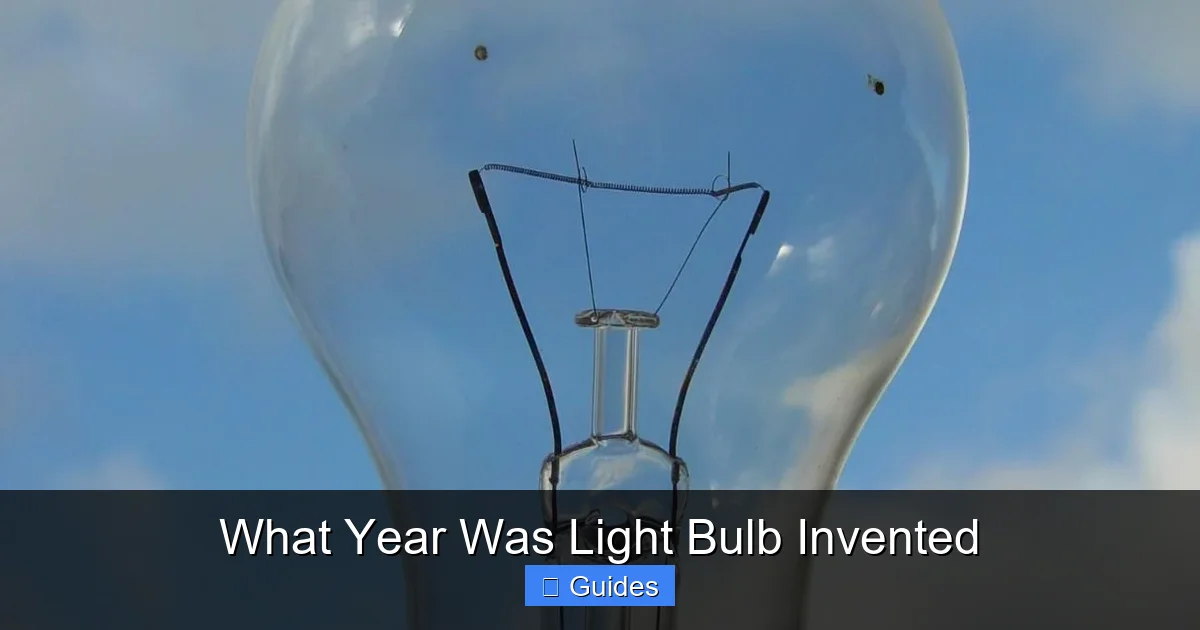
Visual guide about What Year Was Light Bulb Invented
Image source: storables.com
So, if many people were working on electric lights, why does Thomas Edison get so much credit for “what year was light bulb invented”? His genius wasn’t in inventing the concept of electric light, but in perfecting it and making it practical, affordable, and accessible. He took existing ideas, applied relentless experimentation, and, crucially, developed an entire system around the bulb.
The 1879 Milestone
After countless experiments with different materials, Edison and his team at Menlo Park, New Jersey, finally found their breakthrough in October 1879. Their success came with a carbonized cotton thread filament, enclosed in a nearly perfect vacuum within a glass bulb. This bulb famously burned for over 13 hours. Shortly after, they improved it to last for over 40 hours. This was the moment. This was the year that the light bulb, as we understand its practical application, truly arrived.
Edison’s Method: Relentless Experimentation
Edison famously said, “I have not failed 10,000 times—I’ve successfully found 10,000 ways that won’t work.” His team tried thousands of different materials for the filament: platinum, various metals, and a dizzying array of carbonized plant materials. They tested everything from fishing lines to human hair. This methodical, exhaustive approach eventually led to the carbonized cotton thread, which was relatively inexpensive and had the right electrical resistance and durability.
Beyond the Bulb: The System
Edison understood that a light bulb, no matter how good, was useless without a system to power it. His vision extended far beyond just the bulb itself. He set out to create an entire infrastructure:
* Generators: He developed more efficient dynamos (generators) to produce electricity.
* Wiring and Fuses: He designed practical wiring systems, sockets, and safety fuses for homes and businesses.
* Meters: He invented electricity meters to measure consumption and allow for billing.
* Power Plants: Most importantly, he established the world’s first central power station in Pearl Street, New York City, in 1882. This made it possible to distribute electricity to many customers from a single source.
This comprehensive approach is what truly sets Edison apart. He didn’t just invent a product; he invented an industry. When people ask “what year was light bulb invented,” the answer 1879 refers to this full-package solution that brought electric light to the masses.
The Evolution Beyond Edison: Improving the Bulb
Even after 1879, the light bulb continued its evolution. Edison’s initial design was a tremendous leap, but there was still room for improvement in terms of efficiency, brightness, and lifespan.
Lewis Latimer and the Carbon Filament
An often-overlooked but crucial contributor was Lewis Latimer, an African-American inventor and draftsman who worked for Edison. In 1881, Latimer patented an improved method for manufacturing carbon filaments, making them more durable and efficient. He also wrote the first textbook on electric lighting and designed new techniques for making carbon filaments which were adopted by the Edison Electric Light Company, significantly contributing to the practical application of electric lighting.
The Bamboo Filament (1880)
Edison’s team continued to search for the ideal filament. In 1880, they discovered that carbonized bamboo fibers could last for an astonishing 1200 hours. This was a massive improvement over the cotton thread and became the standard filament for incandescent bulbs for nearly a decade.
The Tungsten Filament (Early 20th Century)
The next major leap came in the early 20th century with the introduction of the tungsten filament. Tungsten has an incredibly high melting point, allowing bulbs to operate at higher temperatures, producing brighter light more efficiently and with a much longer lifespan.
* 1904: Austrian inventors Sándor Just and Franjo Hanaman patented a tungsten filament bulb.
* 1906: General Electric acquired the rights and began developing tungsten filament lamps.
* 1913: Irving Langmuir, an American chemist, invented the gas-filled incandescent lamp, which used inert gas (like argon or nitrogen) inside the bulb to slow down the evaporation of the tungsten filament, further increasing its lifespan and efficiency.
These innovations made incandescent bulbs even more ubiquitous, shaping homes, cities, and industries for the better part of a century.
The Impact and Legacy of the Light Bulb
The invention and subsequent refinement of the light bulb fundamentally reshaped human civilization. It’s difficult to overstate its impact, moving us from a world lit by flickering gas lamps and dangerous candles to one bathed in consistent, safe electric light.
Societal Transformation
* Extended Work Hours: Factories could operate around the clock, boosting industrial productivity.
* Enhanced Safety: Electric lights were much safer than open flames, drastically reducing fires.
* Urbanization: Cities became brighter, safer, and more vibrant at night, influencing city planning and nightlife.
* Social Changes: People could read, socialize, and engage in activities long after sunset, changing daily routines and leisure time.
* Education and Literacy: Longer hours of effective light supported learning and increased opportunities for reading.
A Catalyst for Innovation
The light bulb’s success also spurred further innovation in electrical engineering. It catalyzed the expansion of electrical grids, leading to the development of countless other electric appliances and technologies that we now take for granted, from refrigerators to computers. The question of “what year was light bulb invented” is not just about a single device, but about the genesis of the electrical age.
Modern Lighting: From Incandescent to LED
While the incandescent bulb reigned supreme for over a century, the quest for greater efficiency and sustainability continued. Today, lighting technology has moved far beyond Edison’s carbon filament.
Fluorescent Lights
Introduced in the mid-20th century, fluorescent lamps offered significantly greater energy efficiency than incandescent bulbs. They work by passing an electric current through a gas, exciting mercury vapor, which then produces ultraviolet light. A phosphor coating on the inside of the tube converts this UV light into visible light. They became common in commercial and industrial settings due to their efficiency and long lifespan.
Halogen Lamps
A variation of the incandescent bulb, halogen lamps use a halogen gas within the bulb to regenerate the tungsten filament, allowing them to burn brighter and last longer than traditional incandescents, though they are still much less efficient than newer technologies.
The LED Revolution
The latest and most transformative leap in lighting technology is the Light Emitting Diode (LED). While the first practical LED was developed in the 1960s, it wasn’t until the early 2000s that white light LEDs became affordable and powerful enough for widespread general lighting.
* Incredible Efficiency: LEDs use a fraction of the energy of incandescent bulbs.
* Remarkable Lifespan: They can last tens of thousands of hours, far outstripping any previous technology.
* Versatility: LEDs offer incredible flexibility in terms of color, brightness, and design, enabling smart lighting systems and new aesthetic possibilities.
The shift to LED lighting represents another monumental change, perhaps as significant as the original transition from gas to electric lighting. It highlights that innovation in lighting is an ongoing process, continually striving for better, more sustainable, and more versatile ways to illuminate our world.
Practical Tips for Choosing Modern Lighting
When you’re buying a light bulb today, you’re not just picking a wattage. Here are some tips:
- Look for Lumens, Not Watts: Lumens measure brightness, while watts measure energy consumption. Higher lumens mean more light.
- Consider Color Temperature: Measured in Kelvins (K), this describes the light’s warmth or coolness. Lower K (2700K-3000K) is warm white, like traditional incandescents. Higher K (4000K-5000K) is cool white or daylight.
- Check for Dimmability: Not all LED bulbs are dimmable. If you need this feature, ensure the bulb and your dimmer switch are compatible.
- Think About Energy Savings: Switching to LEDs from older incandescent or even CFL bulbs can significantly reduce your electricity bill. It’s a great way to save money and help the environment!
In conclusion, the answer to “what year was light bulb invented” is best understood as a milestone in a much longer, collaborative journey. While 1879 marks the pivotal year when Thomas Edison’s practical, long-lasting incandescent bulb was perfected and demonstrated, it stands on the shoulders of nearly a century of prior experimentation and discovery. From Humphry Davy’s arc lamp to Joseph Swan’s carbon filaments, and through to Lewis Latimer’s manufacturing improvements and the eventual development of modern LEDs, the light bulb’s story is a testament to human ingenuity and perseverance. It’s a reminder that even the most revolutionary inventions are often the result of collective effort, building step-by-step towards a brighter future.
Frequently Asked Questions
Was Thomas Edison the only person working on electric lights?
No, many inventors and scientists were researching and developing electric lights long before and during Edison’s time. Joseph Swan, Humphry Davy, and Warren de la Rue are just a few who made significant contributions to the field.
Why is Edison credited if others worked on it earlier?
Edison is credited because he perfected the design of the incandescent bulb to make it long-lasting, affordable, and commercially viable, and crucially, he developed the entire system needed to power and distribute electricity to homes and businesses.
What material was key to Edison’s 1879 breakthrough?
The key material for Edison’s 1879 breakthrough was a carbonized cotton thread filament, which allowed his bulbs to burn for an unprecedented number of hours, making them practical for everyday use.
How long did Edison’s initial successful light bulb last?
Edison’s initial successful light bulb with a carbonized cotton thread filament in October 1879 lasted for over 13 hours, which was quickly improved to over 40 hours shortly after.
What impact did the light bulb have on society?
The light bulb profoundly transformed society by extending daylight hours, increasing productivity, enhancing safety, making cities brighter, and fostering new social and economic activities, fundamentally changing daily life and industrial processes.
Are incandescent light bulbs still widely used today?
While incandescent bulbs were dominant for over a century, their use has significantly declined and is often phased out due to their inefficiency. Modern lighting, primarily LEDs, offers much greater energy efficiency and lifespan.
