


As an Amazon Associate, We earn from qualifying purchases.
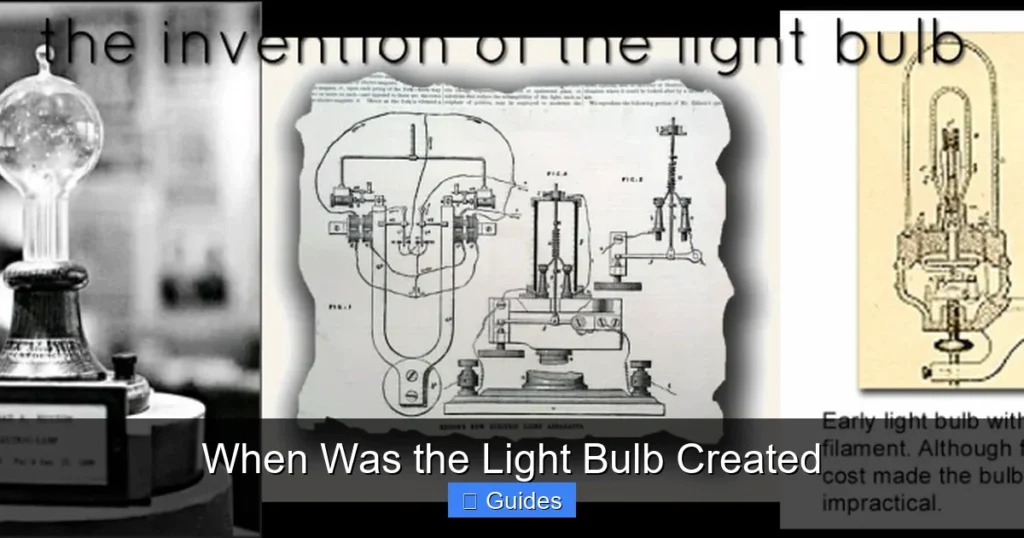
The question of when the light bulb was created doesn’t have a single, simple answer. While Thomas Edison is often credited, the electric light bulb was the culmination of over 70 years of research and contributions from numerous inventors worldwide. It was a progressive journey of innovation, with key milestones achieved by figures like Humphry Davy, Joseph Swan, and ultimately, Edison, who commercialized the first practical, long-lasting bulb around 1879.
The soft glow of a light bulb is so ubiquitous in our modern world that it’s easy to take for granted. We flip a switch, and light appears, effortlessly banishing the darkness. But have you ever stopped to truly consider *when was the light bulb created*? The answer, as fascinating as it is complex, isn’t a simple date or a single name. While Thomas Edison often gets all the credit, the true story of electric light is a rich tapestry woven with the threads of countless brilliant minds, stretching back decades before Edison’s famous patent.
It’s a common misconception that a lone genius had a sudden “aha!” moment and, poof, the light bulb was born. In reality, the journey to a practical, commercially viable light bulb was a long and arduous one, marked by incremental discoveries, relentless experimentation, and fierce competition. Understanding *when the light bulb was created* means appreciating this long evolutionary path, recognizing the foundational work laid by early pioneers, and acknowledging the continuous refinements that followed. So, let’s peel back the layers of history and illuminate the true story behind one of humanity’s most transformative inventions.
The Persistent Question: Who Really Invented It?
When we ask, “when was the light bulb created?”, we’re often implicitly asking “who invented it?”. The popular narrative overwhelmingly points to Thomas Edison and his 1879 invention. And while Edison’s contributions were undeniably pivotal, particularly in making the light bulb a practical, everyday reality, it’s crucial to understand that he didn’t start from scratch. His success was built upon a vast body of prior knowledge and experimentation. Many inventors before him had wrestled with the fundamental challenges of creating light from electricity. Their efforts, though perhaps less known, were essential stepping stones that paved the way for Edison’s breakthrough and ultimately determined *when the light bulb was created* in its most useful form.
Key Takeaways
- No Single Inventor: The light bulb was not invented by one person but was the result of decades of cumulative effort and discoveries by many scientists and inventors.
- Early Concepts: The fundamental principles of electric light, like the arc lamp by Humphry Davy, emerged in the early 19th century, long before the incandescent bulb.
- Joseph Swan’s Contributions: British physicist Joseph Swan made significant progress in the 1860s and 1870s, developing long-lasting bulbs with carbonized paper filaments and improved vacuum techniques.
- Edison’s Practical Bulb: Thomas Edison’s crucial innovation in 1879-1880 was not just creating a light bulb, but developing a highly effective, long-lasting (over 1,200 hours), and commercially viable system for electric lighting.
- The “Practical” Distinction: Edison’s bulb, with its high resistance and long-lasting carbonized bamboo filament, made electric lighting accessible for widespread home and commercial use, marking a turning point.
- Continuous Improvement: Even after Edison, inventors like Lewis Latimer (improving carbon filaments) and Willis Whitney (tungsten filament research) continued to refine the light bulb, making it more efficient and durable.
- A Collaborative Legacy: The story of when the light bulb was created highlights the collaborative and iterative nature of scientific and technological progress, building on the work of predecessors.
Quick Answers to Common Questions
When exactly was the first electric light produced?
The very first demonstration of electric light, known as the electric arc, was conducted by Humphry Davy in 1802.
Who invented the first incandescent light bulb?
Many inventors worked on incandescent light bulbs, but Joseph Swan demonstrated a long-lasting one in 1878, and Thomas Edison’s commercially viable bulb was introduced in 1879.
What made Edison’s light bulb special compared to earlier versions?
Edison’s bulb, developed around 1879-1880, was unique for its combination of a long-lasting carbonized bamboo filament (over 1,200 hours), high electrical resistance, and its integration into a complete, practical electrical distribution system.
Did Joseph Swan and Thomas Edison ever work together?
Yes, after patent disputes in the UK, Joseph Swan and Thomas Edison eventually merged their companies in England in 1883 to form the Edison & Swan United Electric Light Company, or “Ediswan.”
When did the tungsten filament become standard for light bulbs?
The tungsten filament was patented in 1904 and, with improvements like the inert gas-filled bulb by Irving Langmuir in 1913, became the industry standard for incandescent light bulbs in the early 20th century.
📑 Table of Contents
The Dawn of Electric Light: Early Discoveries and Arc Lamps
The story of electric light doesn’t begin with a bulb but with the discovery of how electricity could produce light. Long before anyone conceived of an incandescent filament sealed in a glass sphere, scientists were experimenting with electricity’s luminous properties.
Humphry Davy and the Arc Lamp (Early 1800s)
The very first glimmer of electric light came at the beginning of the 19th century. In 1800, Italian inventor Alessandro Volta developed the voltaic pile, the first true battery. This invention provided a steady source of electric current, which quickly opened new avenues for experimentation. Just a few years later, in 1802, British chemist Humphry Davy demonstrated that if two charcoal electrodes were connected to a battery and brought close together, an intense, brilliant arc of light would form between them. He called this phenomenon the “electric arc.”
Davy’s arc lamp was incredibly bright and powerful, but it had significant drawbacks. It consumed a lot of power, produced blinding light and substantial heat, and the charcoal electrodes burned away rapidly, requiring constant adjustment. It was impractical for widespread use, especially in homes, but it was a monumental scientific achievement. It definitively showed that electricity could produce light, planting the seed for future innovations and initiating the long process towards *when the light bulb was created*. For decades, scientists and inventors around the world continued to tinker with arc lamps, trying to make them more stable and useful. These early experiments were foundational, proving the concept and inspiring further research into creating artificial light.
The Incandescent Principle Takes Shape: Early Pioneers
While arc lamps were useful for large spaces like streets or lighthouses, the idea of a stable, contained, and less intense light for indoor use began to take hold. This led inventors down the path of incandescence – heating a material until it glows.
The Quest for a Filament: De la Rue, Starr, and Goebel
Many unsung heroes contributed to the understanding of incandescent light. In 1820, British scientist Warren de la Rue enclosed a coiled platinum filament in an evacuated glass tube and passed an electric current through it. Platinum was chosen for its high melting point. While his lamp worked, the cost of platinum made it commercially unviable. This experiment, however, was crucial in demonstrating the benefits of a vacuum to prevent the filament from oxidizing and burning out quickly, a key insight for *when the light bulb was created*.
Around the 1840s, American inventor James Bowman Lindsay demonstrated an incandescent light, and British physicist Frederick de Moleyns patented an incandescent lamp design in 1841. In the 1850s, American inventor Heinrich Goebel is said to have created long-lasting light bulbs using carbonized bamboo filaments in a vacuum, which he demonstrated to the public in New York City. Though his claims were later disputed in court, Goebel’s work highlighted the potential of carbonized plant fibers as a filament material and the importance of a good vacuum. These early attempts, while not leading to widespread commercial success, were vital in exploring different materials and techniques.
Joseph Swan’s Persistent Efforts (1860s-1870s)
One of the most significant figures in the lead-up to Edison’s breakthrough was British physicist and chemist Joseph Swan. Swan began experimenting with incandescent light bulbs as early as 1860. He created a light bulb using carbonized paper filaments in a vacuum. His early bulbs, unfortunately, had a short lifespan due to inefficient vacuum pumps that left too much oxygen inside the bulb, causing the filament to burn out quickly.
However, by the mid-1870s, advancements in vacuum pump technology (like Hermann Sprengel’s mercury pump) allowed Swan to create a much better vacuum. In 1878, he demonstrated a long-lasting light bulb in Newcastle, England, using a thin carbonized cotton thread filament. His bulbs were quite effective and durable, lasting for hundreds of hours. Swan patented his bulb in Britain and began installing electric lighting in homes and public buildings, making a strong case for *when the light bulb was created* in a practical form on the European side of the Atlantic. His innovations were critical, showing that a practical, if not yet perfect, incandescent light bulb was within reach.
Edison’s Breakthrough: The “Practical” Light Bulb
While others had made impressive strides, it was Thomas Edison and his team at Menlo Park who would synthesize these earlier efforts into a commercially viable and widely adoptable product. The year 1879 is often cited as *when the light bulb was created* in its truly practical form.
The Menlo Park Lab and the Search for Longevity (1878-1879)
Edison, a relentless innovator and shrewd businessman, understood that for electric light to replace gas lamps, it needed to be three things: durable, affordable, and part of a complete system. He famously declared, “We will make electricity so cheap that only the rich will burn candles.” Starting in 1878, Edison and his team focused intently on finding a long-lasting filament. They tested thousands of materials, including platinum, nickel, and various carbonized plant fibers.
Their breakthrough came in October 1879 when they used a high-resistance platinum filament, followed quickly by a carbonized cotton thread filament, in a greatly improved vacuum. This bulb glowed for 13.5 hours. Just a few months later, in late 1879 and early 1880, Edison discovered that a carbonized bamboo fiber filament could last an astonishing 1,200 hours. This was a game-changer. The long lifespan, combined with Edison’s development of a complete electrical distribution system (generators, wiring, meters, sockets), made his light bulb truly practical for homes and businesses.
The System Approach and Commercialization
Edison’s genius wasn’t just in the bulb itself, but in his holistic approach. He didn’t just invent a bulb; he invented the entire system needed to power it. This included improvements in generators, the development of parallel circuits (so if one bulb burned out, the others stayed lit), wiring, fuses, and screw-in sockets. This complete system made electric lighting reliable and safe for everyday use. On December 31, 1879, Edison gave a public demonstration of his incandescent lighting system at Menlo Park, dazzling spectators and solidifying the perception of *when the light bulb was created* for the masses. This event marked the true dawn of the electric age for many.
Competition and Consolidation: Beyond Edison
It’s important to note that Edison was not alone in the race to develop a practical light bulb. As mentioned, Joseph Swan was making similar progress in Britain. This led to patent disputes and, eventually, a merger of their companies in England to form Ediswan, a dominant light bulb manufacturer. Other inventors like Hiram Maxim and William Sawyer also developed incandescent lamps, leading to further patent battles and rival companies. These competitive forces often spurred even faster innovation and refinement, all contributing to the ultimate realization of *when the light bulb was created* for widespread adoption.
Refining the Invention: The Path to Modern Lighting
Even after Edison’s commercial success, the light bulb continued to evolve. The search for greater efficiency, longer lifespan, and lower cost was relentless.
Lewis Latimer and the Improved Filament (1880s)
One crucial figure in the improvement of the light bulb was Lewis Latimer, an African-American inventor and draftsman who worked with both Hiram Maxim and Thomas Edison. While working for Maxim, Latimer patented an improved method for making carbon filaments that were more durable and cost-effective than Edison’s original bamboo filaments. Later, at the Edison Electric Light Company, Latimer’s expertise in electric lighting and patent drawing was invaluable. He also co-authored a definitive book on electric lighting in 1890, further cementing his place in the history of *when the light bulb was created* and refined. His contributions ensured that the bulbs could be produced more efficiently and last even longer, making them more accessible.
The Tungsten Filament and General Electric (Early 20th Century)
The early carbon filaments, while revolutionary, were still relatively inefficient. Scientists continued to search for better materials. In the early 20th century, researchers at General Electric (GE), building on earlier work by others like Alexander Lodygin, made significant strides. Willis Whitney, a GE chemist, developed a heat treatment for carbon filaments that prevented the inside of the bulb from blackening. Later, in 1904, Hungarian inventors Sándor Just and Franjo Hanaman patented a tungsten filament lamp. Tungsten has an incredibly high melting point and proved to be far more efficient and durable than carbon.
Irving Langmuir, another brilliant GE scientist, further improved the tungsten filament bulb by introducing inert gases (like argon and nitrogen) into the bulb in 1913. This innovation significantly reduced filament evaporation, preventing the blackening of the glass and doubling the bulb’s lifespan and efficiency. The gas-filled tungsten incandescent bulb became the standard for nearly a century, representing the pinnacle of *when the light bulb was created* in its classic form.
Beyond Incandescent: The Evolution Continues
While our focus is primarily on the incandescent bulb, it’s important to remember that the evolution of lighting didn’t stop there. The principles of electric light continued to inspire new forms. Fluorescent lighting emerged in the 1930s, offering even greater efficiency. More recently, Light Emitting Diodes (LEDs) have revolutionized lighting once again, offering unparalleled energy efficiency and longevity. Each new technology builds on the foundational understanding of electricity and light established by those early pioneers. This continuous innovation shows that *when the light bulb was created* was not a final endpoint, but a beginning to an ongoing story of progress.
The Legacy and Impact: How Light Changed the World
The answer to *when was the light bulb created* isn’t just a historical timeline; it’s a narrative of societal transformation. The invention of practical, widespread electric lighting profoundly altered human civilization in countless ways.
Extending the Day and Boosting Productivity
Perhaps the most immediate and impactful change was the extension of the “day.” Before electric light, human activity was largely dictated by the sun. Work, study, and social gatherings were curtailed by darkness, relying on less efficient and often dangerous candles or gas lamps. Electric light allowed factories to operate around the clock, increasing productivity and driving industrial growth. Students could study later, boosting education. People had more time for leisure and social interaction in the evenings. The very rhythm of daily life shifted.
Safety, Health, and Urban Development
Electric light also brought significant improvements in safety and public health. Gas lamps posed fire hazards and released pollutants indoors. Kerosene lamps were also prone to accidents. Electric light was cleaner, safer, and emitted less heat. Well-lit streets reduced crime and made urban areas safer to navigate after dark. Cities could grow vertically, with tall buildings becoming practical thanks to internal lighting systems. The ability to illuminate large indoor spaces safely was a prerequisite for the development of modern offices, department stores, and entertainment venues.
A Foundation for Modern Innovation
The widespread adoption of electric light also spurred advancements in other fields. The demand for electricity generation and distribution networks laid the groundwork for the modern electrical grid, which powers everything from refrigerators to computers. It fostered a culture of innovation and problem-solving that continues to this day. The story of *when the light bulb was created* is, in essence, the story of how ingenuity can utterly reshape our world. It teaches us that monumental breakthroughs often emerge from a collective, iterative process, rather than a singular flash of brilliance.
A Practical Tip: Appreciating the History in Your Home
Next time you switch on a light, take a moment to appreciate the incredible journey that brought that simple glow to your room. Think about the countless hours of experimentation by Davy, the meticulous vacuum work by Swan, the systematic approach of Edison, and the filament refinements by Latimer and Langmuir. Each of these steps, each tiny improvement, contributes to the modern lighting we enjoy. It’s a powerful reminder that complex challenges are often solved not by one hero, but by a relay race of dedicated minds, each passing the baton of knowledge and innovation.
Conclusion
So, *when was the light bulb created*? The most accurate answer is not a single moment, but a continuous process of invention and refinement spanning the better part of a century. It began with Humphry Davy’s arc lamp in the early 1800s, progressed through the diligent work of inventors like Joseph Swan in the mid-1800s, and culminated in Thomas Edison’s commercially practical, long-lasting incandescent light bulb and comprehensive electrical system around 1879.
Edison’s genius lay not just in his specific bulb design, but in his vision to create an entire ecosystem that made electric light viable for the masses. His work, alongside the vital contributions of others like Lewis Latimer and the later development of tungsten filaments, transformed a scientific curiosity into a global necessity. The light bulb stands as a testament to human ingenuity, perseverance, and the collaborative spirit of innovation. It reminds us that groundbreaking inventions are often the sum of many parts, slowly built and perfected over time, illuminating our world in more ways than one.
🎥 Related Video: Ask History: Who Really Invented the Light Bulb? | History
📺 HISTORY
Thomas Edison wasn’t the only inventor to lay claim to the light bulb, so whose bright idea was it? Ask History finds out.
Frequently Asked Questions
Was the light bulb invented in a single year?
No, the light bulb was not invented in a single year. It was a gradual process spanning nearly a century, starting with early electrical discoveries in the early 1800s and culminating in a commercially viable product in the late 1870s and early 1880s.
Why is Thomas Edison so strongly associated with the light bulb if others contributed?
Thomas Edison is strongly associated because he created the first *practical*, long-lasting, and commercially distributed incandescent light bulb, along with the entire electrical system needed to power it reliably and affordably for homes and businesses. His marketing and systemic approach were key to its widespread adoption.
What role did the vacuum play in the development of the light bulb?
The vacuum was crucial because it removed oxygen from inside the bulb. Oxygen reacts with the hot filament, causing it to burn out rapidly. A good vacuum prevented this oxidation, significantly extending the filament’s lifespan, which was a major challenge for early inventors.
Were there any important African-American inventors involved in the light bulb’s creation?
Yes, Lewis Latimer, an African-American inventor and draftsman, played a significant role. He patented an improved method for manufacturing carbon filaments, making them more durable and efficient for mass production, and worked closely with both Hiram Maxim and Thomas Edison.
How did the invention of the light bulb change daily life?
The invention of the light bulb dramatically extended the workday and allowed for evening activities, boosting productivity in factories and promoting education and leisure. It also made homes and cities safer, cleaner, and more vibrant by replacing hazardous and dim gas or kerosene lamps.
What came after the incandescent light bulb in terms of lighting technology?
After the incandescent bulb, significant advancements included fluorescent lighting in the 1930s, which offered greater energy efficiency. More recently, Light Emitting Diodes (LEDs) have become the leading technology, providing even higher energy efficiency, longer lifespan, and greater versatility.
